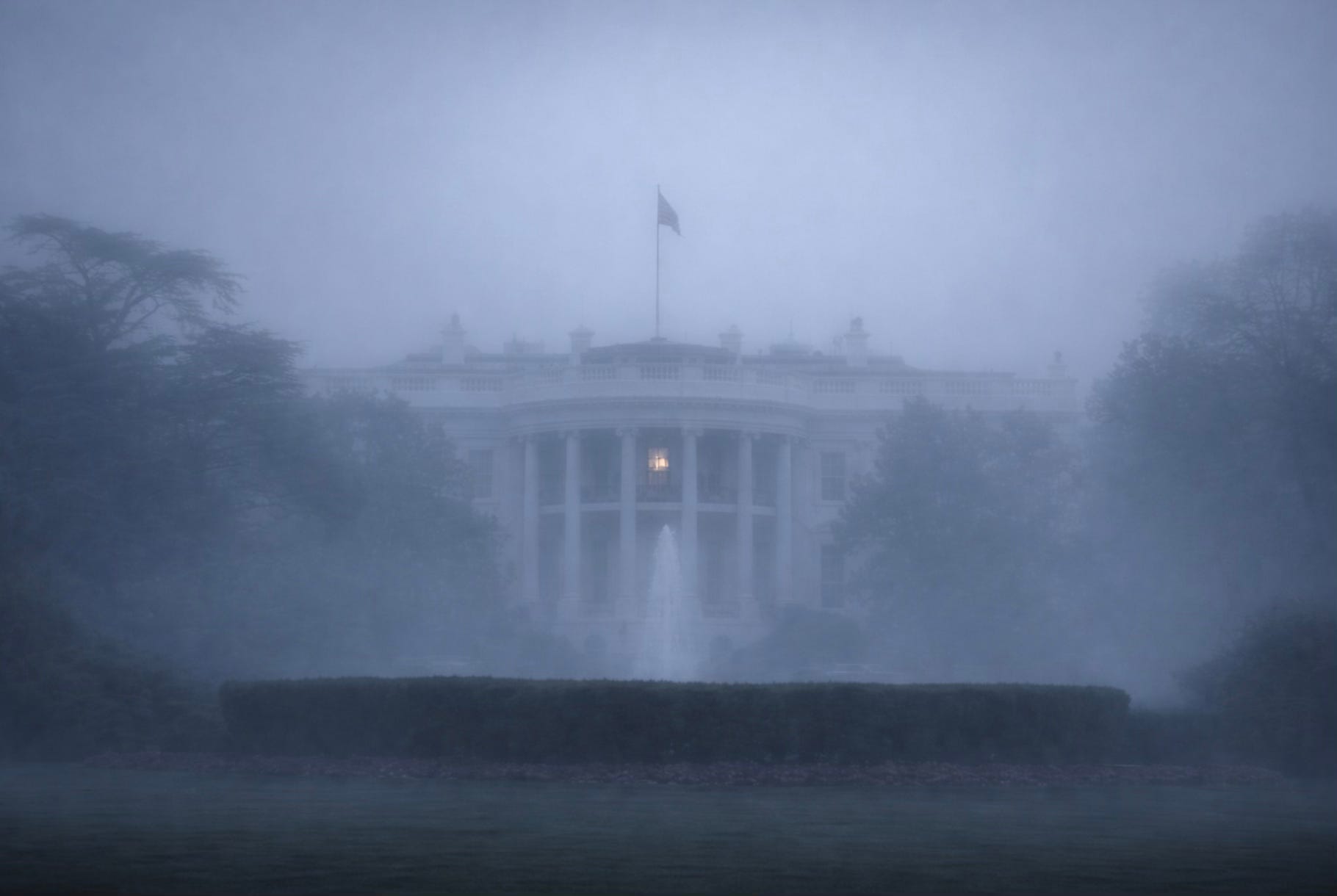
The Fog of Trump: When Nobody Knows What the President Means — Including the President
On Easter Sunday, the President of the United States threatened to bomb civilian infrastructure in Iran, signing off with a mocking invocation of the Islamic sacred. Two days later, he contemplated the extinction of a civilisation, announcing to the world that “a whole civilization will die tonight, never to be brought back again.” The following day, a two-week ceasefire was announced, brokered not by American diplomats but by Pakistan.
And then, at 4:46 a.m. on April 9, Donald Trump posted this:
All U.S. Ships, Aircraft, and Military Personnel, with additional Ammunition, Weaponry, and anything else that is appropriate and necessary for the lethal prosecution and destruction of an already substantially degraded Enemy, will remain in place in, and around, Iran, until such time as the REAL AGREEMENT reached is fully complied with. If for any reason it is not, which is highly unlikely, then the “Shootin’ Starts,” bigger, and better, and stronger than anyone has ever seen before. It was agreed, a long time ago, and despite all of the fake rhetoric to the contrary - NO NUCLEAR WEAPONS and, the Strait of Hormuz WILL BE OPEN & SAFE. In the meantime our great Military is Loading Up and Resting, looking forward, actually, to its next Conquest. AMERICA IS BACK!
Read it again, but this time as a diagnostic text. It is a paragraph that contradicts itself within its own boundaries. It speaks of the “lethal prosecution and destruction” of an enemy, while simultaneously claiming the military is “Loading Up and Resting.” It threatens that the “Shootin’ Starts” if an agreement is not complied with, while simultaneously declaring that non-compliance is “highly unlikely.” It casually anticipates a “next Conquest,” a word that, under international law, explicitly denotes the illegal acquisition of territory by military force (United Nations, 1945) as though the American military were a 19th-century imperial expeditionary force rather than a modern deterrent.
But the most devastating line in the post — the line that unravels the entire architecture of American foreign policy over the last ninety-six hours — is this one: It was agreed, a long time ago, and despite all of the fake rhetoric to the contrary.
The “fake rhetoric” does not refer to his own posts. Trump never concedes that his own words are fake. The “fake rhetoric” is everything that comes from anywhere other than him: the reporting, the analysis, that Lebanon was included in the ceasefire agreement. It is worth noting that Israel intensified its assault on Lebanon during the ceasefire, killing at least 182 people in a single day (Al Jazeera, 2026), while Trump said nothing. Iran had tabled a ten-point set of demands that included an end to Israeli attacks on Lebanon and the lifting of sanctions. The “REAL AGREEMENT,” in Trump’s telling, is whatever he says it is.
But if the agreement was reached “a long time ago,” then what was the Easter Sunday post? What was the threat to end a civilisation? If a deal was already in place, then the apocalyptic rhetoric of the preceding days was not the raving of a man who had lost control. It was a performance: staged, timed, and delivered with a purpose. The timing tells us what that purpose was.
There are only three possible explanations for this post. None of them are comforting; all are catastrophic.
The Cognitive Collapse
The first explanation is the one we have been conditioned to ignore: the president no longer possesses the cognitive architecture required to hold two thoughts in sequence without contradicting himself. We have explored this at length in our previous article (Plague Island, 2026a). Fred Trump Sr. spent his final years sitting at a desk in Brooklyn, signing blank papers while his family maintained the illusion of his authority. His phone was connected only to a secretary paid to play along. The cognitive decline of the father is now mirroring itself in the son, playing out not in a private office but on the global stage, not with blank papers but with Truth Social posts that reach every intelligence agency, every trading floor, and every military command centre on earth.
But this post offers something the previous ones did not: a window into the specific mechanics of the collapse. Consider the capitalisation. “Enemy” is capitalised, but “agreement” is not. “Conquest” is capitalised, but “military” is not, except when preceded by “great,” at which point it becomes “Military.” “Loading Up and Resting” are capitalised as though they constitute a formal military operation, which they do not. This is not the selective emphasis of a strategic communicator. It is the random firing of a mind that has lost the ability to distinguish between significance and noise.
Then there is the syntax. “It was agreed, a long time ago, and despite all of the fake rhetoric to the contrary - NO NUCLEAR WEAPONS and, the Strait of Hormuz WILL BE OPEN & SAFE.” This sentence begins as a statement about an agreement, pivots into a complaint about rhetoric, and then lurches into a pair of demands separated by a comma and an ampersand. It does not parse or resolve. It is a sentence that has lost its own thread halfway through, and the man who wrote it either did not notice or could not fix it.
And then there is the word “actually.” “Looking forward, actually, to its next Conquest.” That parenthetical betrays a flicker of self-awareness, a moment in which even the author seems to recognise the absurdity of what he is claiming, and feels compelled to insist upon it. It is the verbal tic of a man who knows, somewhere beneath the bluster, that nobody believes him, including himself.
This is the linguistic equivalent of a man wandering out of his house in his pyjamas, shouting at the traffic. The difference is that this man commands the largest nuclear arsenal on earth, and the traffic is the geopolitical stability of the Middle East, and indeed, the world.
Subscribe to Notes From Plague Island and join our growing community of readers and thinkers.
The Market Manipulation
The second explanation is darker, and it requires us to look away from the president’s mind and toward the financial markets. If the agreement was reached “a long time ago,” and the preceding days of apocalyptic rhetoric were a calculated performance, then who profited from the panic?
Consider the pattern. The Easter Sunday post — profane, threatening, designed to terrify — was published over Easter weekend. The “whole civilization will die tonight” post arrived on a Monday evening (EST). The ceasefire was announced on Tuesday. The markets, which had been closed over the weekend while the world absorbed the threat of civilisational annihilation, opened on Monday to chaos and then surged on Tuesday when the climbdown arrived. This is not a one-off. Trump’s pattern, repeated across tariffs, trade wars, and now military conflicts, is to drop the doom when markets are closed and deliver the reprieve when they open. The weekend is for fear. Monday is for profit.
Wall Street has a name for this pattern. They call it the TACO trade: Trump Always Chickens Out. The term was coined by Robert Armstrong of the Financial Times in May 2025, after Trump’s abrupt reversal on his “Liberation Day” tariffs sent the S&P 500 plunging nearly 20 percent before rebounding sharply when the tariffs were paused (Armstrong, 2025). What began as a sardonic joke has since become a recognised trading strategy. Nine of the ten largest single-day gains in the S&P 500 during Trump’s second term have come from TACO reversals (Fortune, 2026). Retail investors poured a record $3 billion into equities during the Liberation Day selloff, correctly betting that Trump would blink. “Knowing Trump will TACO is the equivalent of me knowing I need to drink water to survive,” one trader wrote on Reddit’s SmallStreetBets forum (Fortune, 2026).
The Iran ceasefire was the latest and most lucrative TACO of all. The announcement triggered a $1.5 trillion rally across all three major indices. Oil plunged 16 percent to below $100 a barrel. The Nasdaq surged 3.55 percent. The Dow climbed 1,200 points (Fortune, 2026). For anyone who had bought the dip during the days of civilisational threats, the profits were instantaneous and enormous.
But the TACO trade, for all its cynicism, at least operates in the open. The real scandal lies beneath it. In the hours before the ceasefire was publicly announced, fifty newly created accounts on the prediction market Polymarket placed highly specific, perfectly timed bets on a US-Iran ceasefire. One wallet, created just twelve minutes before Trump’s announcement, made $31,908 in “Yes” bets, earning an estimated profit of $48,500 (Associated Press, 2026). A trio of linked accounts, identified by the on-chain analytics firm Bubblemaps, collectively netted $611,000 on ceasefire bets, and the same cluster had previously made $1.2 million betting on the timing of US and Israeli strikes on Iran in late February (Yahoo Finance, 2026). “This cluster has been betting and winning on military markets since 2024 using multiple accounts,” Bubblemaps reported. “Their track record of correctly calling surprise attacks on Iran suggests they may have access to better information than most” (Yahoo Finance, 2026).
And then there are the futures markets. According to Representative Ritchie Torres, who has formally demanded an investigation by the SEC and the CFTC, traders placed over $500 million in crude oil futures bets approximately fifteen minutes before Trump’s Truth Social post announcing the pause in strikes. Trading volume at 6:49 a.m. EST was approximately nine times the average level for that time of day (Torres, 2026). Torres called it “potentially the largest instance of insider trading in history.” He noted that similar anomalies preceded Trump’s Liberation Day tariff pause and US military action in Venezuela. He also noted that the SEC’s top enforcement official had recently resigned after clashing with agency leadership over pursuing cases with ties to the president’s circle, and that the Department of Justice’s Public Integrity Section had been reduced from thirty-six lawyers to two (Torres, 2026).
Governor Gavin Newsom was blunter. “Trump’s Washington is riddled with ethical failures and insider profiteering,” he said, signing an executive order banning political appointees from profiting on prediction markets with inside information (Yahoo Finance, 2026).
If this explanation is true, then the president’s posting is not incoherent at all. The threats of civilisational death were designed to drive the markets into a panic over the weekend; the sudden announcement of a pre-existing agreement was designed to send them surging when trading resumed. The American presidency has been reduced to a pump-and-dump scheme, operated on a weekly cycle: fear on Friday, profit on Monday. The fog is very profitable.
The Performative Toughness
The third explanation is perhaps the most pathetic: the president is simply playing soldier. Look again at the language of the post. The capitalised “Enemy.” The promise of “lethal prosecution and destruction.” The boast that the military is looking forward to its “next Conquest.” This is the vocabulary of a man who has never served in uniform, who avoided the Vietnam draft through a diagnosis of bone spurs so conveniently timed that even the podiatrist’s daughters later admitted the diagnosis was a favour to his father (Plague Island, 2026c), and who now uses the American military as a prop in his own psychodrama of masculinity.
The word “Conquest” is particularly revealing. In international law, conquest — the acquisition of territory by force — was outlawed by the UN Charter in 1945 (United Nations, 1945). No American president in modern history has used the word approvingly to describe the actions of the US military. But Trump does not care about international law, and he does not care about the historical weight of the words he uses. He cares only about how the words sound. “Conquest” sounds tough. It sounds imperial. It sounds like the kind of thing a strongman would say in a film about a strongman, which is the film Trump has been making about himself for the last fifty years.
But the performance of toughness is inherently fragile, which is why it collapses within the same paragraph. He wants to be the conqueror, but he also wants to be the peacemaker who secured the “REAL AGREEMENT.” He wants the “Shootin’” to start, but he also wants the Strait of Hormuz to be “OPEN & SAFE.” He wants to be feared, but he also wants to be loved, hence “AMERICA IS BACK!” as a sign-off, as though the preceding threats of annihilation were a marketing campaign for national renewal. He is a man trying to play every role in the movie simultaneously, and failing at all of them. As one Iranian observer put it during the ceasefire negotiations: “It’s all a theatrical show that Trump is playing. We have no belief in this ceasefire” (Al Jazeera, 2026).
The tragedy, of course, is that the feeble performance has real consequences. Real ships are deployed. Real troops are stationed in harm’s way. Real people die. Real allies are trying to formulate policy based on 4:46 a.m. posts from a man who may be demented, corrupt, or simply acting out fantasies of military glory — and who may, in fact, be all three at once.
The Fog
It does not matter which of these three explanations is true. The devastating reality is that all three are likely operating simultaneously: a cognitively declining president, surrounded by financial opportunists, performing a grotesque pantomime of military strength while the world watches in horror and the markets adjust accordingly.
When the President of the United States speaks, the world no longer listens for policy. It listens for pathology. Diplomats try to decode the contradictions. Traders scan his posts for signals. Intelligence agencies attempt to distinguish between a genuine military directive, a symptom of dementia, and a signal to short the oil markets. European defence ministers convene emergency meetings to discuss a Truth Social post written at 4:46 in the morning. The leaders of allied nations — the ones who once looked to Washington for clarity, for steadiness, for the reassurance that the most powerful country on earth was governed by someone who understood the weight of his own words — now treat every presidential utterance as a puzzle to be solved rather than a statement to be trusted.
This is what it means to conduct foreign policy in a fog. Not the fog of war, but the fog of Trump. A fog in which threats and agreements coexist in the same sentence. A fog in which the annihilation of a civilisation and the announcement of a pre-existing peace deal are separated by forty-eight hours and no explanation. A fog in which nobody — not the allies, the enemies, the markets, the military, the Cabinet, and least of all the president himself — knows what is real.
“It was agreed, a long time ago, and despite all of the fake rhetoric to the contrary,” he wrote.
He is telling us, in his own words, that everything other than his version of events is fake. But the implication is the same: if the agreement was already in place, then the threats, the rage, the promises of destruction were theatre, all performed while real people died, while real markets moved, while real allies despaired and real enemies calculated. Somewhere, a cluster of anonymous accounts collects another six hundred thousand dollars. In Lebanon, at least 182 people are dead on a day that was supposed to be covered by a ceasefire that the president now says was agreed “a long time ago.”
The fog of Trump has descended over the American republic. It is not the fog of war, which lifts when the fighting stops. It is something older and more corrosive: the fog of a nation that can no longer distinguish between what its leader says, what he means, and what he has already forgotten. Nobody knows what is going to happen when it lifts. Nobody is certain, any longer, that it will.
Or support us with a one-off tip → Buy Me a Coffee
References
Al Jazeera (2026) ‘Trump says US forces to stay near Iran, ready for “next conquest”’, 9 April. Available at: https://www.aljazeera.com/news/2026/4/9/trump-says-us-forces-to-stay-near-iran-ready-for-next-conquest [Accessed: 9 April 2026].
Armstrong, R. (2025) ‘The Taco theory’, Financial Times, 2 May. Available at: https://www.ft.com/content/unhedged-taco-theory [Accessed: 9 April 2026].
Associated Press (2026) ‘Newly created Polymarket accounts bet big on US-Iran ceasefire in hours before Trump’s announcement’, 8 April. Available at: https://www.local10.com/business/2026/04/08/newly-created-polymarket-accounts-bet-big-on-us-iran-ceasefire-in-hours-before-trumps-announcement/ [Accessed: 9 April 2026].
Fortune (2026) ‘Analysts warn the TACO trade won’t last forever after an Iran ceasefire wipes out weeks of losses in markets’, 8 April. Available at: https://au.finance.yahoo.com/news/analysts-warn-taco-trade-won-183558129.html[Accessed: 9 April 2026].
Plague Island (2026c) ‘The Age of Denial: Power, Decline, and the Silence Around Trump’, 6 April. Available at: https://www.plagueisland.com/p/the-age-of-denial-power-decline-and [Accessed: 9 April 2026].
Plague Island (2026b) ‘The Death of Civility: Trump, Iran, and the Civilisation America Lost’, 8 April. Available at: https://www.plagueisland.com/p/the-death-of-civility-what-america [Accessed: 9 April 2026].
Plague Island (2026c) ‘Captain Bone Spurs and the Graves he Spits On'. 23 January. Available at: https://www.plagueisland.com/p/captain-bone-spurs-and-the-graves?utm_source=publication-search [Accessed: 9 April 2026].
Torres, R. (2026) ‘Rep. Torres Demands SEC and CFTC Investigate Suspicious Oil Futures Trade Made Ahead of Trump Iran Announcement’, Congressman Ritchie Torres, 8 April. Available at: https://ritchietorres.house.gov/posts/rep-torres-demands-sec-and-cftc-investigate-suspicious-oil-futures-trade-made-ahead-of-trump-iran-announcement [Accessed: 9 April 2026].
United Nations (1945) Charter of the United Nations. Available at: https://www.un.org/en/about-us/un-charter/full-text[Accessed: 9 April 2026].
Yahoo Finance (2026) ‘Potential Insiders Made $600K Predicting US and Iran Ceasefire on Polymarket: Bubblemaps’, 8 April. Available at: https://finance.yahoo.com/markets/crypto/articles/potential-insiders-made-600k-predicting-171731685.html [Accessed: 9 April 2026].


