The Death of Civility: What America Lost When It Let a Bully Speak for It

The words arrived on a Tuesday evening, casually dropped into the digital ether between a complaint about a judge and a boast about poll numbers. “A whole civilization will die tonight, never to be brought back again,” the President of the United States wrote. “I don’t want that to happen, but it probably will.” He then pivoted, in the very same breath, to celebrating “Complete and Total Regime Change” and offering a benediction: “God Bless the Great People of Iran!”

It was the second time in three days that Donald Trump had used his social media platform to threaten the annihilation of a sovereign state. On Easter Sunday, he had demanded that Iran “Open the Fuckin’ Strait, you crazy bastards, or you’ll be living in Hell,” signing off with a mocking “Praise be to Allah.”

We have written previously about what these posts reveal about the president’s cognitive state; the profound dissonance of a man who cannot hold two thoughts in sequence without contradicting himself, and the escalating aggression that mirrors the tragic decline of his father, Fred Trump Sr. (Plague Island, 2026). But there is another question to ask, one that moves beyond the medical and into the existential. What does it mean for the world when a sitting US president can use this kind of language, seemingly without consequence?
When a leader casually contemplates the extinction of a civilisation, he is abandoning the very concept that underpins his own authority. The words “civilisation” and “civility” share the same Latin root: civis, meaning citizen. To be civilised is, at its most basic, to behave as a citizen among citizens — the recognition that other people exist, that they have rights, and that collective life requires the restraint of our darkest impulses. When the President of the United States discards that restraint, it is not Iran that is diminished. It is America.
The sociologist Norbert Elias, writing in the shadow of the Second World War, argued that civilisation is not a permanent state of grace but a fragile, ongoing process. In The Civilizing Process (1939), Elias traced how European societies gradually learned to suppress violence, refine their manners, and develop shared norms of behaviour. This process, he warned, is never complete, and it can always be reversed (Elias, 1939). What we are witnessing now, broadcast in real-time from the Oval Office, is the decivilising of the American presidency.
“Open the Fuckin’ Strait, you crazy bastards.” “A whole civilization will die tonight.” This is not the language of statecraft, strategy, deterrence, or even of empire. It is the language of a man for whom the restraint that defines civilisation has ceased to function; the language of the schoolyard bully, elevated to the highest office in the world and armed with the deadliest weapons in human history.
The Weaponisation of the Sacred
Consider the Easter Sunday post more carefully. It was both profane and threatening, and a deliberate act of religious mockery. “Praise be to Allah” — Alhamdulillah — is one of the most sacred phrases in Islam, spoken by 1.8 billion Muslims every day in prayer, in gratitude, and in grief. Trump appended it to a threat to bomb civilian infrastructure, on the holiest day in the Christian calendar, directed at a Muslim nation. The Council on American-Islamic Relations called it a “willingness to weaponize religious language while simultaneously denigrating Islam,” part of “a long pattern of anti-Muslim rhetoric and policies that have dehumanized Muslims at home and abroad” (Anadolu Agency, 2026).
Subscribe to Notes From Plague Island and join our growing community of readers and thinkers.
The First Amendment to the United States Constitution begins with a promise: “Congress shall make no law respecting an establishment of religion, or prohibiting the free exercise thereof.” It is the foundational guarantee of a pluralist society, the recognition that in a nation of many faiths, the state must respect them all. When the president uses the sacred language of Islam as a punchline to a threat of annihilation, he is violating the letter and soul of that amendment. He is telling 3.5 million American Muslims that their faith is a joke to him, that the words they speak in prayer are available to him as instruments of humiliation.
Imagine, for a moment, what it is to be an Iranian-American Muslim in the United States today. There are approximately 750,000 Iranian-Americans in the country, many of whom fled the very regime Trump claims to oppose (Pew Research Center, 2026b). They came to America because America promised something: that you could practise your faith freely, that your children would be safe, that the state would not mock your God. Now the President of the United States uses the name of their God as a taunt, while threatening to erase the civilisation their ancestors built. He promises to bomb the bridges their cousins cross to get to work, the power plants that keep their elderly relatives alive, and he signs off with a phrase their mothers taught them to say before meals. In Dearborn, Michigan — home to one of the largest Muslim communities in the United States, a community that helped deliver the state to Trump in 2024 — the Imams Council convened a press conference to condemn what Imam Steve Elturk called “a dangerous escalation that undermines both international stability and the moral fabric of public discourse” (Word&Way, 2026). The moral fabric of public discourse: That is another way of saying: civility and civilisation.
Seven Thousand Years and Counting
The devastating irony of Trump’s threat is that the civilisation he casually proposed to erase is one of the oldest continuous civilisations on earth. Iran — Persia — gave the world the Cyrus Cylinder in 539 BC, a document often described as the first declaration of human rights, which established religious freedom and abolished slavery in the conquered territories (United Nations, 2026). It gave the world algebra, astronomy, and the postal system. It produced poets like Rumi, Hafez, and Ferdowsi, whose works have shaped human thought for centuries. The very word “paradise” comes from the Persian pairidaeza, meaning a walled garden. Iran’s civilisation spans more than 7,000 years. The United States of America is 250 years old.
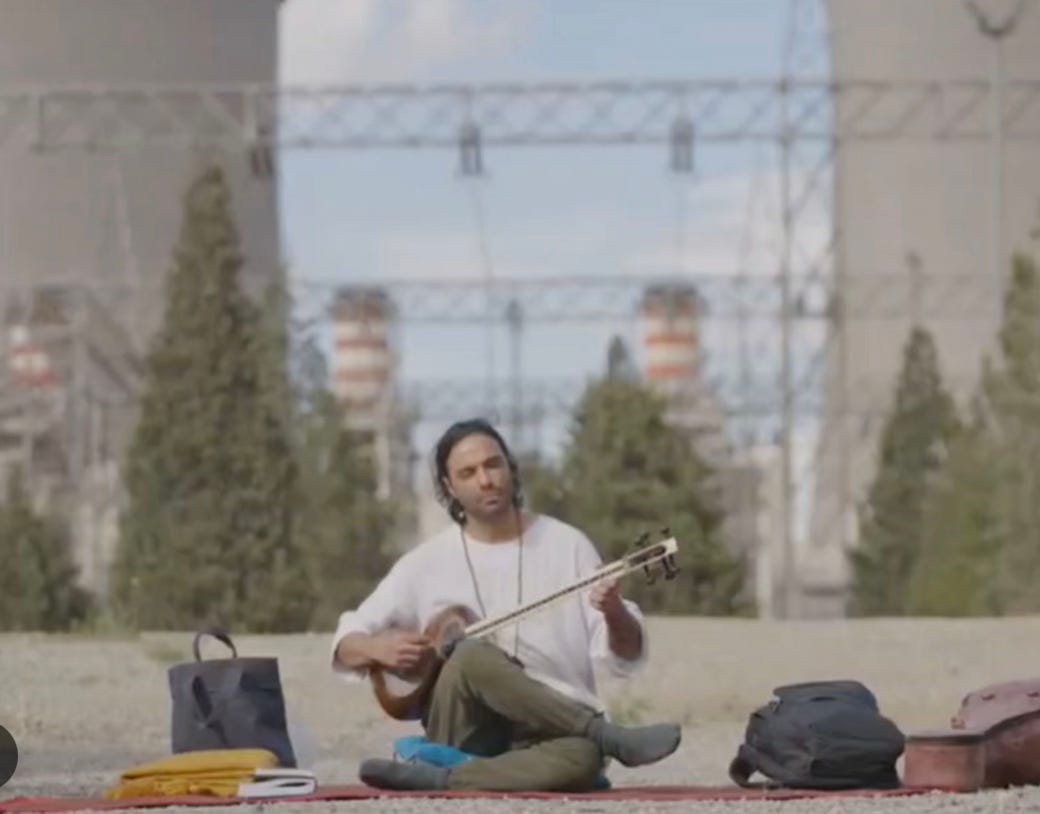
While Trump threatened that civilisation with extinction, ordinary Iranians responded with preservation. In Kermanshah and Ahvaz, citizens formed human chains around power plants. The musician Ali Ghamsari staged a sit-in at the Damavand power plant, performing on his tar — a classical Persian instrument — in an act of determined, quiet defiance. Oscar-winning filmmaker Asghar Farhadi called on artists worldwide to speak against the “destructive aggression.” As the National Iranian American Council observed: “The message emerging from within Iranian society is not one of escalation, but of preservation — an effort to maintain the basic foundations of life in the face of growing threats” (NIAC, 2026). A man with a tar, sitting beside a power plant. A president with a social media account, promising to destroy it. Which of these is the civilised act?
As Iran’s foreign ministry spokesperson Esmaeil Baqaei noted in response to a previous threat from Trump to bomb the country “back to the Stone Age”: “Civilisation cannot be destroyed by bombing” (Tribune India, 2026). He is right, but perhaps not in the way he intended. The civilisation being destroyed by this rhetoric is not Iran’s. It is America’s. Not its buildings or its infrastructure, but its claim to moral authority, its soft power, its standing as a nation that other nations might wish to emulate or trust.
The Gallup World Poll now shows that global approval of China’s leadership has surpassed that of the United States with 36% versus 31%, marking one of the widest gaps in two decades. Disapproval of US leadership has hit a record high of 48%, with approval dropping by at least 10 points in 44 countries between 2024 and 2025 (Gallup, 2026). In the Middle East, the collapse is even more profound. Polling by Arab Barometer, published in Foreign Affairs, reveals that Arab publics now regard China, Iran, and Russia more favourably than the United States. Trump’s foreign policies are viewed favourably by only 12% of people in Jordan and the Palestinian territories, 14% in Tunisia, and 24% in Iraq (Jamal and Robbins, 2026). The Pew Research Center found that favourability of the United States has fallen in 15 of the 24 countries surveyed, with majorities in key allied nations — Canada, Germany, France — now viewing America unfavourably (Pew Research Center, 2025). America has not just lost the moral high ground. It has lost the room.
The Bully’s Pulpit
Theodore Roosevelt famously coined the phrase “bully pulpit” to describe the presidency’s unique power to shape public discourse and persuade the nation. In the slang of his era, “bully” meant “excellent” or “first-rate.” Trump has returned the word to its original, uglier meaning. The presidency is now, quite literally, a bully’s pulpit. He uses it not to persuade, but to bludgeon; not to elevate, but to degrade.
We have watched this escalation for years. We watched it move from “fire and fury” directed at North Korea in 2017, to the Easter Sunday profanity of 2026, to the casual promise of civilisational death just days later. Each iteration is more unhinged, more detached from the norms of statecraft, and each time, the world is forced to adjust; the Overton window shatters.
The responses to Trump’s latest threat tell their own grim story. When figures like Marjorie Taylor Greene call the rhetoric “evil and madness,” when Alex Jones describes it as “the exact definition of genocide,” and when Tucker Carlson labels it “vile on every level” (Reuters, 2026), we must recognise that something has gone catastrophically wrong. When the most extreme voices in American politics become the voices of restraint, the centre has ceased to exist. Pope Leo XIV called the threat “truly unacceptable.” The president of the US Conference of Catholic Bishops, Archbishop Paul Coakley, said that “the threat of destroying a whole civilization and the intentional targeting of civilian infrastructure cannot be morally justified” (Word&Way, 2026). When the Pope and Alex Jones find themselves on the same side of an argument, the man they are arguing against has left the boundaries of reason entirely.
Republican Senator Lisa Murkowski called the threats “an affront to the ideals our nation has sought to uphold and promote around the world for nearly 250 years” (Reuters, 2026). But the uncomfortable truth is that this is who they are now. The Republican Party made him, protected him, and they have refused to stop him. They have chosen complicity over country, and in doing so, they have tethered America’s reputation to the whims of a man who uses the language of annihilation as a negotiating tactic.
When a White House spokeswoman can state, on the record, that “the Iranian people welcome the sound of bombs because it means their oppressors are losing” (Reuters, 2026), the insistence that the people you are bombing should be grateful for the privilege is the language of deranged empire. It is the final, grotesque abandonment of civility.
Trump said that “a whole civilization will die tonight.” He was right, but he was talking about the wrong one. The civilisation that is dying is the idea of America itself: the notion that a democratic republic, governed by laws and norms, could be a force for good in the world. That idea has been under severe strain for decades, battered by the realities of Vietnam, Iraq, Guantánamo, and Abu Ghraib. But there was always a counter-narrative, a belief that America could self-correct, that its institutions would hold, and that its foundational ideals still mattered.
Trump has broken that counter-narrative. Not because he is uniquely evil — history is replete with monsters — but because he is uniquely unchecked. The 25th Amendment exists, but it will not be invoked. Congress exists, but it will not act. The Cabinet exists, but it applauds. The party that once impeached Richard Nixon now cheers a man who threatens genocide on social media and mocks the faith of billions.
The world is not waiting for America to recover because it is already looking elsewhere. China is building infrastructure across Africa and Central Asia. The Gulf states are hedging their alliances. The European Union is accelerating its own defence capabilities. The nations that once looked to Washington for moral leadership are quietly and methodically building a world that does not require it. And in the ruins of American credibility, a man sits at a desk, typing threats into his phone, mocking the sacred, promising annihilation, and signing off with the name of someone else’s God. This is not the behaviour of a civilisation. It is the behaviour of one that has forgotten what the word means.
Or support us with a one-off tip → Buy Me a Coffee
References
Anadolu Agency (2026) ‘US Muslim group condemns Trump’s “inflammatory” post, calls on Congress to reconvene to end Iran war’, Anadolu Agency, 6 April. Available at: https://www.aa.com.tr/en/world/us-muslim-group-condemns-trumps-inflammatory-post-calls-on-congress-to-reconvene-to-end-iran-war/3894137 [Accessed: 8 April 2026].
Elias, N. (1939) The Civilizing Process. Basel: Haus zum Falken.
Gallup (2026) ‘China Edges Past U.S. in Global Approval Ratings’, Gallup, 2 April. Available at: https://news.gallup.com/poll/707945/china-edges-past-global-approval-ratings.aspx [Accessed: 8 April 2026].
Jamal, A. A. and Robbins, M. (2026) ‘America Has Lost the Arab World’, Foreign Affairs, 7 April. Available at: https://www.arabbarometer.org/media-news/america-has-lost-the-arab-world/ [Accessed: 8 April 2026].
NIAC (2026) ‘Iran’s Civil Society Stands to Preserve Its Civilization While Trump Threatens Its Destruction’, National Iranian American Council, 7 April. Available at: https://niacouncil.org/irans-civil-society-stands-to-preserve-its-civilization-while-trump-threatens-its-destruction/ [Accessed: 8 April 2026].
Pew Research Center (2025) ‘Global Attitudes Survey Spring 2025’, Pew Research Center. Available at: https://www.pewresearch.org/global/2025/06/11/us-image-declines-in-many-nations-amid-low-confidence-in-trump/ [Accessed: 8 April
2026].
Pew Research Center (2026b) ‘Iranian Americans’, Pew Research Center, 6 March. Available at: https://www.pewresearch.org/short-reads/2026/03/06/key-facts-about-iranian-americans/ [Accessed: 8 April 2026].
Plague Island (2026) ‘The Age of Denial: Power, Decline, and the Silence Around Trump’, Plague Island, 6 April. Available at:
Reuters (2026) ‘Trump’s threat to Iran shocks global leaders, unnerves some Republicans’, Reuters, 7 April. Available at: https://www.reuters.com/world/middle-east/trumps-threat-iran-shocks-global-leaders-unnerves-some-republicans-2026-04-07/ [Accessed: 8 April 2026].
Tribune India (2026 ) ‘”Civilisation cannot be destroyed by bombing”: Iran hits back at US President’s “Stone Age” threat’, The Tribune, 3 April. Available at: https://www.tribuneindia.com/news/usa-news/civilisation-cannot-be-destroyed-by-bombing-iran-hits-back-at-us-presidents-stone-age-threat/ [Accessed: 8 April 2026].
United Nations (2026) Replica of “Edict of Cyrus”. Available at: https://www.un.org/ungifts/replica-edict-cyrus[Accessed: 8 April 2026].
Word&Way (2026) ‘Faith Leaders Denounce Trump’s “Civilization Will Die” Threat’, Word&Way, 8 April. Available at: https://wordandway.org/2026/04/08/faith-leaders-denounce-trumps-civilization-will-die-threat/ [Accessed: 8 April 2026].