The Semiotics of Dismissal: When Lived Experience is Erased on Live Television

The exchange lasts barely a few seconds, but it contains within it the entire architecture of how power, identity, and credibility are negotiated in modern British media — and, more precisely, who gets to decide which identities count.
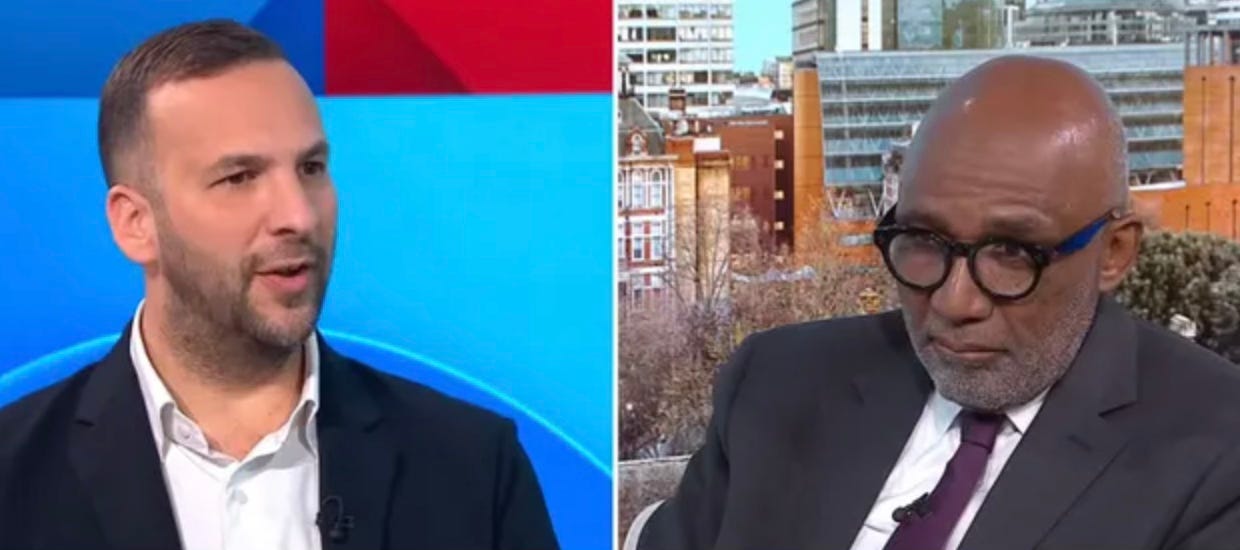
On Sky News, Trevor Phillips, the former chair of the Equality and Human Rights Commission, is interviewing Zack Polanski, the leader of the Green Party. The context is politically charged, but the mechanics of the conversation are what demand our attention. Phillips is pressing Polanski on the Macpherson inquiry’s definition of a hate crime: that an incident is a hate crime if it is perceived as such by the victim or any other person (Home Office, 1999). He is using this definition to argue that because many Jewish people perceive the pro-Palestine marches as hate marches, they must be treated as such.
Polanski counters by invoking his own identity. “But why is my Jewish identity being erased from this conversation?” he asks. He then states: “I’m a Jewish identity of so many people on those marches.”
Phillips’s response is immediate: “No, no, no. Don’t try that one on me.”
We should think about that phrase for a moment: “Don’t try that one on me.” Not, “I disagree with your characterisation” or, “that’s not the point I’m making.” But, “try that one,” as though Polanski’s invocation of his Jewishness is a trick being attempted. The phrase dismisses the argument and impugns the authenticity of the identity itself. It says: your lived experience is a rhetorical device, and we both know it.
What the Phrase Actually Does
This is where semiotics becomes indispensable. A semiotic analysis asks the meanings of words and what they do in context: what social relations they enact, what hierarchies they reinforce, what they permit and close down.
“Don’t try that one on me” performs several functions simultaneously. First, it positions Phillips as the authority who can determine whether an identity claim is legitimate or tactical. He is appointing himself the judge of Polanski’s sincerity. Second, it reframes Polanski’s testimony — the testimony of a Jewish man speaking about his own experience and his own community — as a rhetorical manoeuvre rather than a statement of fact. Third, and most consequentially, it signals to the audience that this kind of identity claim is available for dismissal. It normalises the gesture of waving away lived experience when it becomes inconvenient.
The philosopher Miranda Fricker has a precise term for what is happening here. In her landmark work on epistemic injustice, she describes “testimonial injustice” as the harm that occurs when a speaker receives an unfair deficit of credibility from a hearer due to identity prejudice (Fricker, 2007). The hearer does not engage with the content of what is being said; instead, they discount the speaker’s authority to say it at all. The testimony is not admitted as testimony.
What makes Phillips’s dismissal particularly striking is that it occurs in the very same breath as his invocation of the Macpherson principle. Macpherson’s central contribution to British race relations law was precisely the validation of subjective perception; the recognition that the experience of the victim must be taken seriously, that their account of what happened to them cannot simply be overridden by an authority figure who was not there. Phillips had just finished arguing that thousands of Jewish people who feel intimidated by the marches must be believed. He then immediately refused to believe the Jewish man sitting in front of him.
Subscribe to Notes From Plague Island and join our growing community of readers and thinkers.
The Hierarchy of Acceptable Perception
Phillips was applying the Macpherson principle selectively, to the Jewish perceptions that served his argument, and suppressing the Jewish perception that did not. The result is a hierarchy of acceptable perception, a ranking of which minority experiences are admissible as evidence, and which are to be treated as tactical noise.
This is the defining feature of how establishment discourse manages minority identity. The rule is not that lived experience always counts; the rule is that lived experience counts when it aligns with the institutional narrative. A Black person’s experience of racism counts when it is used to justify existing anti-discrimination frameworks. It becomes considerably less legible when it is used to challenge the conduct of the police, or to question the foreign policy of an allied state. A woman’s experience of harassment counts when it supports the case for specific legislation. It becomes more contested when it is used to challenge institutional structures that powerful men benefit from.
The same logic applies here. Polanski’s Jewish identity was, in Phillips’s framing, only valid as a credential if it produced the correct conclusions. When it produced the wrong ones — when it led Polanski to march alongside pro-Palestinian protesters, to question the characterisation of those marches as hate events, to resist the institutional consensus — it became something to be dismissed. “Don’t try that one on me” is not a refutation of Polanski’s Jewishness, but a revocation of its usefulness.
Consider the comparative scenarios: if a Black guest on a political programme recounted their personal experience of systemic racism, described say, what it feels like to be followed around a shop, or to be stopped and searched repeatedly in the same street and the presenter responded, “Don’t try that one on me,” the consequences would be swift and severe. The clip would be everywhere within the hour with no ambiguity about what had happened: a white authority figure had told a Black person that their experience of racism was a rhetorical trick. Careers would end. If a woman described her fear of walking home alone at night, and an interviewer dismissed it with the same phrase, the response would be identical. The lived experience of women navigating public space after dark is treated, in our current discourse, as a foundational political fact, one that cannot be simply waved away without serious consequences for the person doing the waving.
The question we are forced to ask is why the same protection does not apply to Zack Polanski. Why is his testimony, as a Jewish man, available for dismissal in a way that other minority testimonies are not? The answer, we would argue, lies not in anything particular about Jewish identity, but in the specific political function that this dismissal serves.
The Establishment Interest in Silencing This Particular Voice
Trevor Phillips is not a neutral interviewer. He is a figure of the British political establishment in the most precise sense: a man who has spent decades at the intersection of state power, media, and the management of race. He was appointed chair of the Commission for Racial Equality by Tony Blair. He was the founding chair of the EHRC. He has been friends with Peter Mandelson for fifty years; Mandelson served as the best man at Phillips’s first wedding (Sky News, 2026). These are the map of a man’s political loyalties and institutional commitments.
The establishment, in this context, has a specific and identifiable interest in the framing of the pro-Palestine movement. As we have documented elsewhere, the British state has spent years constructing an institutional apparatus designed to make criticism of Israeli policy professionally and socially costly (Notes From Plague Island, 2026). A central pillar of that apparatus is the claim that the pro-Palestine marches are antisemitic hate events, a claim that crucially depends on the erasure of the many Jewish voices that march in them, organise and defend them.
Zack Polanski is a direct threat to that claim. He is a Jewish man, a prominent political figure, who has marched on those demonstrations and who insists that his Jewish identity is not in conflict with his pro-Palestinian politics. His testimony, if admitted as legitimate, punctures the central argument that the marches are inherently antisemitic. It introduces complexity into a narrative that the establishment requires to be simple. It gives permission to other Jewish people, and to non-Jewish observers, to reach the same conclusion.
Phillips’s dismissal, then, is more than a personal rudeness or a moment of broadcast incontinence. It is a structural intervention. By refusing to admit Polanski’s Jewish identity as a legitimate epistemic credential in this context, Phillips is performing a specific political function: he is protecting the coherence of the establishment narrative against the disruption that Polanski’s testimony would introduce. The phrase “don’t try that one on me” is the sound of the gates closing.
This is what makes the moment so much more significant than a simple interruption. Through trying to silence Polanski, Phillips is demonstrating, live on television, that the rules of identity politics — the rules that say minority experience must be respected, that perception is reality, that lived testimony carries authority — apply only when they produce the right results. When they produce the wrong results, they can be dismissed by the right person with the right credentials and connections, and the dismissal will pass without consequence.
The Irony of the Islamophobia Suspension
There is a further irony that cannot be left unexamined. In March 2020, Trevor Phillips was suspended from the Labour Party following allegations of Islamophobia, based on statements he had made about British Muslims (BBC News, 2020). The suspension was eventually lifted in July 2021 (The Guardian, 2021). Phillips himself suggested that his outspokenness on Labour’s antisemitism problem had contributed to the decision to suspend him (The Jewish Chronicle, 2020).
Whatever one makes of the specifics of that case, the structural irony is acute. Here is a man who has himself been accused of dismissing the experiences and concerns of a minority community, now sitting in a television studio and dismissing the lived experience of a member of another minority community. Here is a man who argued, when it suited him, that his own perception of events should be taken seriously — who complained, with some justice, that his critics were refusing to engage with the substance of his arguments and were instead attacking his credibility — now doing precisely that to someone else.
What This Moment Tells Us About British Media
The broader significance of this exchange lies in what it reveals about the condition of British broadcast media as a space for genuine political discourse. Phillips’s “Don’t try that one on me” did not occur in a vacuum. It occurred in a media environment that has, for years, been systematically hostile to pro-Palestinian voices, that has treated the equation of Palestinian solidarity with antisemitism as a settled matter rather than a contested political claim, and that has consistently failed to apply the same standards of scrutiny to pro-Israel arguments that it applies to their critics.
In that environment, Phillips’s dismissal is representative. It is what the media ecosystem produces when a minority voice says something that disrupts the consensus: not engagement or refutation, but the revocation of the credential that gives the voice its authority. The message is clear and it is intended to be clear. You may speak as a Jewish person, but only if you say the things that Jewish people are supposed to say. The moment you deviate, your identity becomes a trick, and we will say so, on air, without apology.
This is intended as an insistence that the rules of epistemic respect must be applied consistently, or they mean nothing at all. If the lived experience of minority communities is to carry genuine weight in our public discourse, if we are serious about the principle that perception is reality, that testimony matters, that identity grants a form of authority that cannot simply be overridden by those with institutional power, then that principle must apply to Zack Polanski in the same way it applies to anyone else.
“Don’t try that one on me” is a short sentence. But it carries a very long history, and a very specific political purpose. We should not let it pass unremarked.
Or support us with a one-off tip → Buy Me a Coffee
References
Baldwin, T. (2004) ‘I want an integrated society with a difference’, The Times, 3 April. Available at: https://www.thetimes.com/sport/cricket/article/i-want-an-integrated-society-with-a-difference-zj32xdvfbpf [Accessed 4 May 2026].
BBC News (2020) ‘Trevor Phillips suspended from Labour over Islamophobia allegations’, 9 March. Available at: https://www.bbc.com/news/uk-51797316 [Accessed 4 May 2026].
Fricker, M. (2007) Epistemic Injustice: Power and the Ethics of Knowing. Oxford: Oxford University Press.
The Guardian (2021) ‘Labour lifts Trevor Phillips’ suspension for alleged Islamophobia’, 6 July. Available at: https://www.theguardian.com/uk-news/2021/jul/06/labour-lifts-trevor-phillips-suspension-for-alleged-islamophobia[Accessed 4 May 2026].
Home Office (1999) The Stephen Lawrence Inquiry: Report of an Inquiry by Sir William Macpherson of Cluny. London: The Stationery Office. Available at: https://assets.publishing.service.gov.uk/media/5a7c2af540f0b645ba3c7202/4262.pdf[Accessed 4 May 2026].
The Jewish Chronicle (2020) ‘Ex-equality chief Trevor Phillips suggests speaking out over Labour antisemitism prompted suspension by party’, 9 March. Available at: https://www.thejc.com/news/ex-equality-chief-trevor-phillips-suggests-speaking-out-over-labour-antisemitism-prompted-suspension-by-party-v0quk4ar [Accessed 4 May 2026].
Notes From Plague Island (2026) ‘The Architecture of Silence: How Britain Weaponised Antisemitism to Protect a Genocide’, 3 May. Available at: https://www.plagueisland.com/p/the-architecture-of-silence-how-britain [Accessed 4 May 2026].
Sky News (2026) ‘Trevor Phillips: “This is the end for my friend Peter Mandelson”’, 1 February. Available at: https://news.sky.com/video/trevor-phillips-this-is-the-end-for-my-friend-peter-mandelson-13501798 [Accessed 4 May 2026].