The Cosplay Catholic: J.D. Vance and the Limits of Convenience Faith
Part of an ongoing series. Read the preceding pieces: The Avignon Threat · Who Speaks for God? · The Shadow of Christian Nationalism
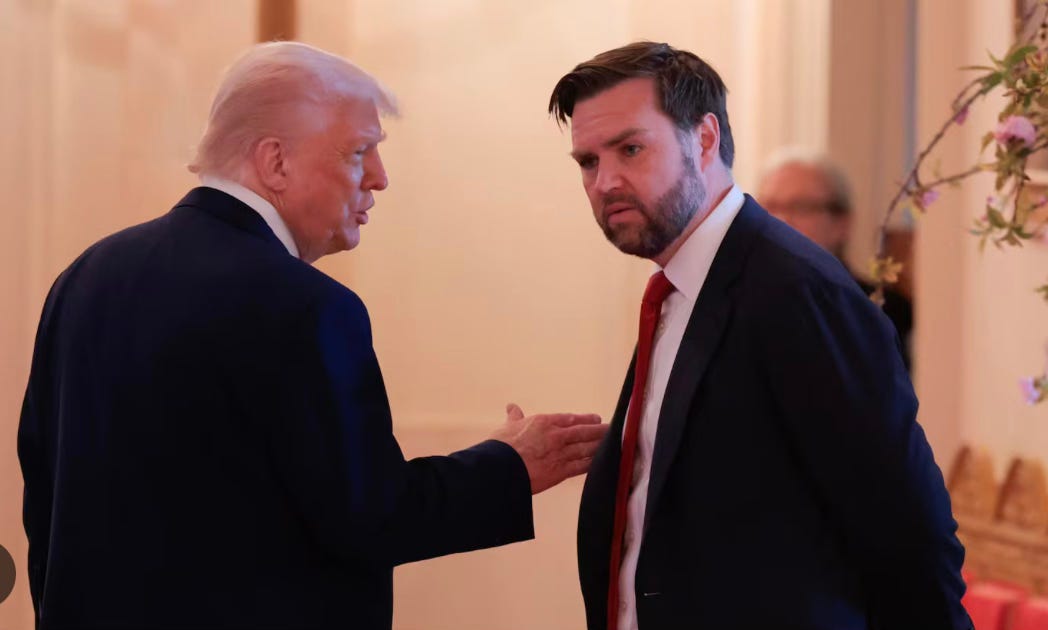
It takes a particular kind of intellectual dishonesty to build a political brand on the absolute moral authority of the Catholic Church, only to tell the Vicar of Christ to stay in his lane the moment he disagrees with your boss. Yet this is the position in which Vice President J.D. Vance now finds himself. When asked about Pope Leo XIV’s condemnation of the Trump administration’s war in Iran, Vance offered a polite but unmistakable dismissal. “It would be best for the Vatican to stick to matters of morality,” he said, “and let the President of the United States stick to dictating American public policy” (Vance, quoted in Luscombe 2026).
It is a statement that reveals everything about the nature of Vance’s faith. For years, Vance has positioned himself as the intellectual vanguard of the “post-liberal Catholic” movement: a political project that explicitly rejects the separation of church and state, arguing instead that Catholic social teaching should be the organising principle of American public life. But when the head of that Church actually attempts to apply its moral teaching to American public life, Vance suddenly discovers the virtues of secularism. His Catholicism, as it turns out, is not a submission to divine authority. It is instead a costume, worn to dignify the hangover of a decaying order and discarded the moment it becomes inconvenient.
The Post-Liberal Pretence
Vance converted to Catholicism in 2019, a decision he has frequently described as the culmination of a long intellectual journey away from the secular liberalism of his Yale Law School education. He aligned himself with a group of conservative Catholic thinkers — men like Patrick Deneen and Adrian Vermeule — who argue that the liberal democratic order has failed because it lacks a shared moral foundation. Their proposed solution, often termed “integralism” or “post-liberalism,” is a society ordered toward the highest good, as defined by the Catholic Church (Deneen 2018; Vermeule 2020).

In this worldview, the Church is the ultimate arbiter of moral truth, and its teachings should inform the laws and policies of the state. Vance has eagerly adopted this framework, using it to provide a veneer of intellectual seriousness to the Trump administration’s most brutal policies. He has presented himself as a man who has found the philosophical grounding that the modern Republican Party so desperately needs. Not just a politician, but a thinker; a man whose policy preferences are rooted in two millennia of Catholic tradition.
But this intellectual branding has always been a fragile construct, dependent on a highly selective reading of Catholic teaching. The Church’s social doctrine is vast and complex, encompassing a commitment to the poor, the marginalised, and the immigrant, as well as scepticism of unfettered capitalism and militarism. Vance, however, has consistently ignored the parts of Catholic teaching that conflict with the priorities of the Trump administration, focusing instead on those elements that can be twisted to support a nationalist, America First agenda.
Consider his defence of the administration’s mass deportation program. When challenged on the cruelty of tearing families apart and expelling millions of people, Vance did not rely on standard Republican talking points about border security. Instead, he invoked the concept of ordo amoris, the right ordering of love. Drawing on St. Thomas Aquinas, Vance argued that a Christian’s primary moral obligation is to those closest to them: their family, their community, and their fellow citizens. Only after these obligations are met, he suggested, can one extend compassion to strangers (NPR 2025).
It was an attempt to weaponise Catholic theology against the very migrants the Church commands its followers to welcome. But it was also a profound distortion of Aquinas, who never suggested that love for one’s neighbour should be conditional on their citizenship status, nor that the state is exempt from the demands of charity (Orr 2026). When Pope Francis — Leo’s predecessor — rebuked this view of theology, Vance simply ignored him, continuing to use the language of the Church to justify the policies of the empire.

This selective obedience is the hallmark of the cosplay Catholic. It allows Vance to claim the moral high ground while simultaneously supporting policies that are fundamentally incompatible with the teachings of the Church he claims to revere. It is a theology of convenience, designed not to challenge the powerful, but to comfort them.
The Church as Chaplain
This pattern of selective obedience has now reached its logical conclusion in the dispute over the Iran war. Pope Leo XIV has been unequivocal in his condemnation of the conflict, telling Chaldean Catholic bishops that “God does not bless any conflict” and warning against the “delusion of omnipotence” driving the American war machine (Winfield 2026). For a true post-liberal Catholic, one who believes that the Church’s moral authority supersedes the secular state, this should be a moment of profound crisis. The Vicar of Christ has declared the war immoral.
But Vance experiences no such crisis. Instead, he tells the Pope to “stick to matters of morality,” as if the decision to drop bombs on foreign cities and risk global conflagration is somehow a morally neutral administrative task. “Let the President of the United States stick to dictating American public policy,” he says, neatly severing the connection between faith and politics that his entire intellectual brand is built upon.
In doing so, Vance reveals himself to be the polite, articulate face of the same thuggish impulse that led a Pentagon official to threaten the Vatican ambassador with a return to the “Avignon Papacy” (Religion Dispatches 2026). The Pentagon’s threat was crude and historical; Vance’s dismissal is smooth and televised. But the underlying message is identical: the Church is permitted to exist only so long as it serves the interests of the American empire. When it refuses to bless the empire’s wars, it must be silenced, sidelined, or threatened into submission.
Vance’s demand that the Pope stay in his lane is a demand that the Church subordinate itself to the state. It is the exact opposite of the integralist vision he claims to champion. He does not want a state guided by the Church; he wants a Church that acts as a chaplain to the state, offering theological cover for whatever atrocities the administration decides to commit.
This is the fundamental contradiction of the post-liberal Catholic project as articulated by Vance and his allies. They claim to want a society ordered toward the highest good, but they are entirely unwilling to accept the authority of the institution that defines that good. They want the moral authority of the Church without the moral obligations. They want the aesthetic of faith without the substance. They want the power to dictate morality to others, without the burden of submitting to it themselves.
Subscribe to Notes From Plague Island and join our growing community of readers and thinkers.
The Choice of Submission
The ultimate absurdity of Vance’s position is illuminated by the man he has chosen to serve instead of the Pope. While Vance was telling the head of the Catholic Church to stay out of politics, his boss was busy posting AI-generated images of himself as Jesus Christ on Truth Social (CBS News 2026). Blasphemy by anyone’s standards.
Donald Trump rejects the moral authority of the Church while attempting to usurp it. He demands the kind of absolute loyalty and devotion that is traditionally reserved for the divine. When the Pope criticises him, Trump attacks the Pope’s legitimacy, claiming credit for his election and whining that the Pontiff is “weak on crime” (Trump 2026).
That is the man to whom J.D. Vance has pledged his allegiance. A man who threatens genocide before breakfast, demands that the military swear loyalty to him personally, and deletes blasphemous images of himself only when the political backlash becomes too severe.
For a genuine Catholic, the choice between the moral authority of the Pope and the demands of a man who posts himself as the Messiah should not be difficult. But Vance has made his choice. He has looked at the system that is currently dying — a system that requires constant war and the demonisation of the vulnerable to sustain itself — and decided that its hangover is worth defending, even if it means telling The Holy Father to sit down and be quiet.
At its heart, this is a question of power. Vance understands that his political future depends on his absolute loyalty to Donald Trump. If that loyalty requires him to publicly contradict the Pope, to distort Catholic theology, and to defend the indefensible, he will do so without hesitation. His faith is entirely subordinate to his ambition.
The Collapse of the Performance
Vance’s Catholicism is pure political strategy. It was adopted to provide intellectual cover for a movement that is fundamentally anti-intellectual and deeply immoral. It allowed him to present himself as a serious thinker, a man wrestling with the deep questions of political philosophy, rather than just another ambitious schmuck willing to say whatever is necessary to secure power.
But the war in Iran has forced the issue. You cannot be a post-liberal Catholic while simultaneously demanding that the Pope stay out of public policy. You cannot claim that the state must be guided by moral truth while defending a war that the Church has explicitly condemned. You cannot serve two masters.
When Vance told the Pope to “stick to matters of morality,” the performance collapsed, revealing not a devout Catholic struggling to reconcile his faith with his political duties, but a cynical operator who views the Church as just another area to be managed and manipulated.
The Trump administration’s demand for submission is absolute. It requires its servants to abandon their principles, dignity, and, ultimately, their faith. Pete Hegseth has chosen to resolve this tension by inventing a militant, crusading Christianity that blesses his desire for overwhelming violence. J.D. Vance has chosen a different path: he simply turns his faith off when the President requires it.
The tragedy of J.D. Vance is not that he is a hypocrite; politics is full of hypocrites. The tragedy is that he is a man who clearly understands the moral bankruptcy of the system he serves yet chooses to serve it anyway. He has read Aquinas. He understands the concept of the common good. He knows that the war in Iran is a moral catastrophe. But he has decided that the rewards of power are worth the price of his soul.
In the end, Vance’s cosplay Catholicism is a testament to the enduring power of the American empire to co-opt and corrupt even the most profound moral traditions. It is a reminder that when faith is reduced to a political brand, it loses its power to challenge the status quo. It becomes just another tool of the powerful, used to justify the unjustifiable and to silence those who dare to speak the truth.
Pope Leo XIV has spoken the truth. He has declared that God does not bless any conflict, and he has refused to be intimidated by the threats of the Pentagon or the insults of the President. In doing so, he has exposed the moral emptiness of the Trump administration and the intellectual bankruptcy of its defenders. J.D. Vance may tell the Pope to stay in his lane, but the Servant of the Servants of God has already spoken, and the world is listening.
The contrast between the two men could not be starker. On one side is a Pope who understands that true moral authority requires a willingness to speak truth to power, even when it is dangerous or unpopular. On the other side is a Vice President who has built his career on a carefully curated image of intellectual seriousness and religious devotion, only to abandon both the moment they become politically inconvenient.
Vance’s intellectual journey, from the secular liberalism of Yale Law School to the post-liberal Catholicism of his current political brand, has always been marked by a certain performative quality. He has adopted the language and the aesthetic of faith, but he has never truly submitted to its demands. He has used the Church as a prop, a way to signal his seriousness and his commitment to a higher moral order, while simultaneously serving an administration that is defined by its cruelty, its corruption, and its absolute disregard for the truth.
This is the essence of the cosplay Catholic. It is a faith that is entirely instrumental, a bludgeon to be used and discarded as needed. And it is a faith that is ultimately empty, devoid of the moral courage and the spiritual depth that true religion requires.
As the war in Iran continues to escalate, and the Trump administration’s rhetoric becomes increasingly unhinged, the moral ruin of Vance’s position will only become more apparent. He has tied his political fortunes to a man who demands absolute loyalty and who views any challenge to his authority as a personal insult. He has done so while claiming to represent a religious tradition that explicitly rejects the idolatry of power and the glorification of violence.
It is a contradiction that cannot be sustained. Eventually, the act will implode entirely, and Vance will be forced to confront the reality of what he has become. In the meantime, the world will continue to watch as the Vice President of the United States attempts to reconcile his carefully curated image of religious devotion with his unwavering support for an administration that is waging war in the name of God. It is a spectacle that is both tragic and absurd.
And through it all, Pope Leo XIV will continue to speak the truth. He will continue to remind the world that God does not bless any conflict, and that the true measure of a society is not its military might or its economic power, but its commitment to justice, peace, and the common good. It is a message that J.D. Vance would do well to heed, if only he were willing to listen.
But Vance has made his choice. He has chosen the empire over the Church, power over principle, and ambition over faith. He has become the very thing he once claimed to despise: a cynical operator who uses religion as a political tool; a man who invokes the name of God to justify the unjustifiable. And in doing so, he has revealed the true nature of his post-liberal Catholic project. It is not a defence of the faith; it is a betrayal of it.
Or support us with a one-off tip → Buy Me a Coffee
References
CBS News (2026) ‘Trump posts AI image depicting himself as Jesus Christ, drawing backlash’, CBS News, 13 April. Available at: https://www.cbsnews.com/amp/news/trump-posts-ai-image-jesus-christ/ [Accessed: 14 April 2026].
Deneen, P. J. (2018) Why Liberalism Failed. New Haven: Yale University Press.
Luscombe, R (2026) ‘JD Vance defends Trump amid spat with Pope Leo: ‘Stick to matters of morality.’’ The Guardian, 14 April. Available at: https://www.theguardian.com/us-news/2026/apr/14/jd-vance-defends-trump-pope-leo-spat [Accessed: 14 April 2026].
NPR (2025) ‘Pope rebukes Trump over migrant deportations and refutes VP Vance’s theology’, NPR, 11 February. Available at: https://www.npr.org/2025/02/11/g-s1-48194/pope-rebukes-trump-over-migrant-deportations-and-refutes-vp-vances-theology [Accessed: 14 April 2026].
Orr, J. (2026) ‘Neighbour-Love and Nation-State: Can Ordo Amoris Offer a Framework for Just Immigration Policy?’, William Temple Foundation, 13 January. Available at: https://williamtemplefoundation.org.uk/neighbour-love-and-nation-state-can-ordo-amoris-offer-a-framework-for-just-immigration-policy/ [Accessed: 14 April 2026].
Religion Dispatches (2026) ‘Why Would the Pentagon Allegedly Threaten the Pope’s Ambassador with an “Avignon Papacy”?’, Religion Dispatches, 10 April. Available at: https://religiondispatches.org/2026/04/10/why-would-pentagon-allegedly-threaten-popes-ambassador-avignon-papacy [Accessed: 14 April 2026].
Vermeule, A. (2020) ‘Beyond Originalism’, The Atlantic, 31 March. Available at: https://www.theatlantic.com/ideas/archive/2020/03/common-good-constitutionalism/609037/ (Accessed: 14 April 2026].
Winfield, N. (2026) ‘Pope Leo XIV amplifies criticism of US-Israeli war in Iran, says God does not bless any conflict’, AP News, 11 April. Available at: https://apnews.com/article/vatican-pope-leo-chaldean-trump-mideast-iran-720eea814712d1d859875f39661d599f [Accessed: 14 April 2026].


