The Blood Price of Silence: Trump's Incoherent War and the Complicit Opposition
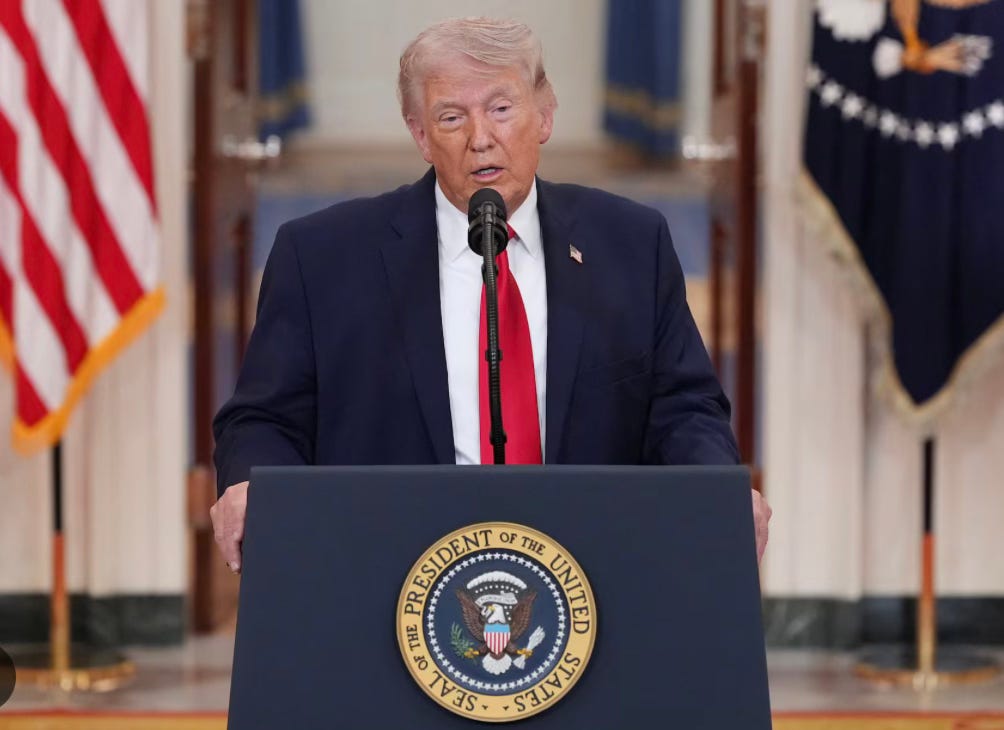
It took Donald Trump thirty-seven days to address the American people about the war in Iran. Thirty-seven days of silence while American bombs fell on Persian cities, oil prices climbed to a two-and-a-half-year high, the Strait of Hormuz remained effectively closed and the global economy absorbed the shockwaves of a conflict that nobody in the American electorate had voted for, asked for, or been consulted about. When he finally spoke, on the evening of 2 April 2026, the silence that preceded the address seemed, in retrospect, like the more honest option.
The address was a disaster. Not in the sense of a stumbling press conference or an unguarded remark because Trump has survived a thousand of those. It was a disaster in the deeper, more revealing sense: it exposed, in real time and on national television, a president who has no coherent objective in Iran, no clear account of why the war began, no credible plan for how it ends, and no answer whatsoever for the question that is now forming in the minds of millions of Americans who voted for him on the promise that the era of endless foreign wars was over. The address raised more questions than it answered. It contradicted itself within the space of single paragraphs. In doing so, it gave the watching world a portrait of a man who stumbled into a war at the behest of a foreign government and has been improvising the justification ever since.
We have already documented the architecture of how this war began — the role of Benjamin Netanyahu, the financial leverage of the Adelson dynasty, the resignation of Joe Kent, the “out of habit” confession at the Kennedy Center (Plague Island, 2026). We do not intend to repeat that ground. What we want to examine here is what happened when Trump was finally forced to stand before his people and explain himself; what his failure to do so coherently tells us about the state of American democracy, the complicity of the opposition, and the very real possibility that the midterm elections, now less than seven months away, may never take place at all.
A Man Without a Map
The central question any president must answer when committing a nation to war is: what are we trying to achieve with the sacrifice of our US soldiers? The answer does not need to be morally satisfying. It does not even need to be honest. But it must be consistent. It must hold together from one sentence to the next, or the entire premise of democratic accountability — the idea that a leader must justify the use of public power to the public — collapses.
Trump’s address failed this test comprehensively. On the question of regime change, he managed to contradict himself within the same speech. He insisted, with characteristic bluster, that regime change was never the goal, that the United States had no interest in who governed Iran, only in the elimination of its nuclear capacity. And then, in almost the same breath, he celebrated the fact that Iran’s leadership had been “obliterated,” that the regime had effectively been destroyed, and that this was a tremendous victory (Associated Press, 2026). These two positions cannot coexist. Either regime change was the goal, which has failed because the leadership has remained largely the same, or it was not the goal, in which case celebrating it as a victory is an admission that the war produced an outcome nobody planned for. Neither interpretation reflects well on the commander-in-chief.
The nuclear question was handled with equal incoherence. Trump declared, with the confidence of a man who has never been troubled by the gap between assertion and evidence, that Iran’s nuclear sites had been “totally and completely obliterated” (Associated Press, 2026). He then, within minutes, threatened to resume bombing if Iran made any further moves toward nuclear capability. This is an illogical position: if the sites are obliterated, the threat is gone, and there is nothing to bomb. If there is still something to bomb, the sites are not obliterated, and the central claim of the address — that the mission has been accomplished — is false. The audience watching at home was left with a choice between two conclusions: either the president is lying about what the strikes achieved, or he does not understand what he is saying. Neither option inspires confidence in the stewardship of the world’s largest nuclear arsenal.
Then came the ceasefire. Iran, Trump announced, had “asked for a ceasefire,” a claim that was immediately and flatly denied by Iranian officials (Forbes, 2026). He vowed that the bombing would continue until the Strait of Hormuz was reopened, a condition that has nothing to do with nuclear weapons and everything to do with the global oil supply — which is to say, everything to do with the economic interests of the energy sector that funds his political operation. In a single address, the stated objective of the war shifted from nuclear disarmament to regime change to the reopening of a shipping lane. These are three entirely different wars. The American people were being asked to support all three simultaneously, with no explanation of how they connect, no timeline for their achievement, and no acknowledgment that the goalposts had moved at all.
This is a man without a map, standing at a podium, hoping that the confidence of his delivery will substitute for the coherence of his argument. It has, after all, worked before. The question is whether it will work again.
The Bill Comes Due
While Trump was busy rewriting the objectives of the war in real time, the bill was landing on the doorsteps of the people who voted for him. The Center for American Progress estimated that by the end of March 2026, the conflict had already cost the United States $25 billion; a figure that, to put it in human terms, is enough to provide a full year of Head Start early education to every eligible child in America, with money left over (Center for American Progress, 2026). That money is gone. It has been converted into ordnance and dropped on a country that, as Joe Kent noted in his resignation letter, posed no imminent threat to the United States.
The domestic consequences are real. Gas prices have surged. The Strait of Hormuz closure has sent oil markets into chaos, and the working-class Americans who were promised relief from inflation are instead watching the cost of filling their tanks climb week by week (AP News, 2026). The K-shaped economy — where the wealthy insulate themselves while the poor absorb the shocks — is being stress-tested by a war that was launched without public consent and is being sustained without public support.
And then, on the same day as his address, Trump said the quiet part aloud. Asked about the administration’s plans for Medicaid, Medicare, and childcare support, he told reporters that it was simply “not possible” for the United States to fund these programmes while fighting wars (NBC News, 2026). This is surely the definition of insanity. The president of the United States, in the same week that he announced a $25 billion war fought at the request of Israel, told the American people that there is no money for their healthcare and no money for their children’s care. The war is funded. The people are not. This is not a budget constraint. It is a statement of political priorities, delivered with the casual indifference of a man who has never had to choose between filling a prescription and filling a tank. The message to the American working class is clear: you are on your own.
Subscribe to Notes From Plague Island and join our growing community of readers and thinkers.
The Promise That Was Always a Lie
The Telegraph, not a publication given to anti-war sentiment, published an account in March 2026 of the gap between Trump’s campaign promises and his conduct in office (The Telegraph, 2026). The headline was blunt: “Trump promised peace, then he started a war.” The article documented the specific, repeated, unambiguous pledges Trump made to the American electorate — that he would end the forever wars, that he would bring the troops home, that he would not sacrifice American blood for foreign interests. They were the central selling point of the “America First” platform. They were the reason millions of people who had voted Democrat in 2020 switched to Trump in 2024.
That mandate has been shredded. The man who mocked George W. Bush for the Iraq War, who spent a decade attacking the neoconservative foreign policy establishment, who built an entire political identity on the promise of non-intervention, has now launched a full-scale military assault on Iran using the exact language and logic of the neoconservatives he spent his career attacking. The irony would be almost literary if the consequences were not so devastating.
What the Telegraph’s analysis makes clear and what the address confirmed, is that “America First” was a marketing slogan. It was designed to capture the genuine, legitimate, long-standing frustration of the American working class with a foreign policy establishment that had spent thirty years sending their children to die in wars that served no discernible national interest. Trump understood that frustration, and he weaponised it. Then, the moment he was in power and the lobby came calling, he abandoned it without a second thought. The voters who believed in the promise are now paying increasing amounts for fuel for a war they were explicitly promised would never happen.

This is the defining political betrayal of the era. Not because it is surprising, but because of its scale its support of an Israeli-instigated war. The gap between the promise and the reality is so vast, documented, and undeniable, that it represents a fundamental rupture in the relationship between the administration and the people who put it in power. The question is what happens next.
The Democratic Silence and What It Means
Here is where this stops being just about Trump, but about the entire political system. While Trump was contradicting himself on national television, the bill for a foreign war was landing on the kitchen tables of working Americans, and the president was telling his own voters that there was no money for their healthcare — the Democratic Party was largely silent.
Not entirely silent. There were procedural complaints. There were demands for congressional oversight. There were carefully worded statements expressing “concern” about the lack of a clear strategy. But there was no sustained, moral, unambiguous opposition to the war itself. There was no Democratic leader willing to stand at a podium and say what the polling data makes abundantly clear: that this war is wrong, that it was launched at the behest of Israel, that it is being paid for by cutting the programmes that keep working Americans alive, and that it must end.
Why? The answer is not complicated, but it is uncomfortable. The Democratic Party is funded by the same donor class that funds the Republican Party. AIPAC, which spent over $100 million in the 2024 election cycle to shape congressional outcomes (Common Dreams, 2024), does not discriminate by party. It funds compliance, not ideology. The Democrats who might otherwise be expected to lead an anti-war movement are acutely aware of what happened to those who challenged the lobby in previous cycles: the primary challenges, the funding withdrawals, the coordinated media campaigns. The silence of the Democratic Party is the rational response of a party that has been financially captured by the same interests that captured the Republicans. They are not the opposition; they are the other wing of the same machine.
This matters enormously, because the absence of a credible opposition is a structural vulnerability in the democratic system itself. When both major parties are aligned with the interests of the donor class on the most consequential foreign policy question of the era, the electorate has no meaningful choice. The managed spectacle of two-party democracy — the illusion that voting changes something fundamental — is exposed. And when people lose faith in the ballot box, they look for other ways to express their discontent. Some of those ways are constructive, others are not.
The comparison to the British Labour Party is instructive and depressing in equal measure. Labour, which spent years positioning itself as the anti-war party, the party of the working class, the party that would challenge the power of capital, has, under Keir Starmer, become a reliable partner of the American foreign policy establishment. It has supported the war in Iran with the same hollow proceduralism that characterises the American Democrats. The centrist core on both sides of the Atlantic has made its choice, which is the donor class over the electorate, the lobby over the people, the comfort of power over the discomfort of principle. The working class, which has nowhere else to go within the existing system, is being abandoned by the very parties that were built to represent it.
The Midterms and the Authoritarian Temptation
Trump’s approval ratings are collapsing. The BBC’s analysis of the polling data in late March 2026 identified three specific warning signs: falling support among the working-class voters who were the bedrock of his coalition, rising disapproval of the war among independents, and a sharp deterioration in his economic approval numbers as gas prices climbed (BBC News, 2026). These are the kinds of numbers that, in a functioning democracy, translate into electoral defeat.
The midterms are scheduled for November 2026. On current trajectories, they represent a serious threat to Republican control of Congress. And here is the question that we think needs to be asked openly: will they happen?
We are looking at the pattern of behaviour of an administration that has already demonstrated its willingness to defy court orders, use the apparatus of the state against political opponents, to bypass Congress on matters of war and peace, and to treat democratic norms as obstacles rather than foundations. We are looking at an administration that has a war that it can use to justify emergency measures. We are looking at a president whose entire political identity is built on grievance, and the premise that the rules do not apply to him.
The suspension of elections under the pretext of a national security emergency is a tool that has been used by authoritarian governments throughout history, and it is a tool that becomes available the moment a government decides that its own survival is more important than the democratic process. The conditions for its use are being assembled, piece by piece, in plain sight. The question is not whether Trump would want to use it, but whether the institutions of American democracy — the courts, the Congress, the press, the military — are strong enough to stop him if he tries.
The silence of the Democratic Party on the war is a failure of democratic self-defence. Every day that the war continues without meaningful congressional challenge is a day that the precedent of executive war-making is strengthened. Every day that the opposition fails to mobilise public discontent into political pressure is a day that the administration’s grip on the narrative tightens. The Democrats are not just failing to oppose the war. They are, through their silence, helping to build the conditions under which the midterms might be rendered irrelevant.
The Awakening
The American people are not as passive as the political establishment would like them to be. The polling data tells a story that the mainstream press has been slow to amplify: the public is against this war, and the unease about it grows by the day. A poll conducted by the Institute for Middle East Understanding found that a majority of Americans believe the war in Iran is being fought primarily for Israel’s benefit rather than America’s (IMEU Policy Project, 2026). That is a remarkable finding. It means that the central argument of the “America First” promise has broken through into mainstream public consciousness.
The MAGA voter who filled up their tank and paid $5 a gallon for a war they never asked for by a leader who admitted he did it “out of habit” — that voter is doing the political arithmetic. The results are not flattering to the administration. The gap between the promise and the reality is now so wide that it cannot be papered over with a speech, however confident the delivery. Every contradiction, every shifting goalpost, every moment of incoherence was a reminder that the man at the podium does not have a plan, and that the people paying for his improvisation are the ones who can least afford it.
The question is whether this awakening can be translated into political action before the window closes. The Democratic Party, as we have argued, is not going to lead that translation. It is too captured, cautious, and financially compromised to serve as the vehicle for genuine anti-war sentiment. The energy will have to come from somewhere else: from the grassroots movements that are already organising, the independent media that is already asking the questions the mainstream press refuses to ask, and from the voters who are beginning to understand that the person they trusted has sold out in front of them.
The dying vision of a bloated American capitalism — that widening chasm between the predator class that profits from this war and the ordinary citizens who pay for it — is becoming impossible to ignore. The people who are forced to live within its contradictions are starting to look up. What they do next will determine whether the system survives the authoritarian temptation, or whether the November 2024 election was, in retrospect, the last meaningful US election.
Trump kept his people waiting thirty-seven days for an explanation. When he finally gave it, it was incoherent, contradictory, and insulting in its assumption that the audience would not notice. Perhaps he should have kept his big mouth shut after all; at least the silence left room for doubt. The address removed it.
Or support us with a one-off tip → Buy Me a Coffee
References
Associated Press (2026) ‘Read the complete transcript of Trump’s address to the nation on the Iran war’, 2 April. Available at: https://apnews.com/article/donald-trump-transcript-address-iran-war-b5970011fe934dde84d95d650bda56a9 [Accessed 3 April 2026].
AP News (2026) ‘Iran war jolts oil markets, sending US gas prices to a 2.5-year high’, 18 March. Available at: https://apnews.com/article/us-oil-trump-war-iran-gas-prices-edef1d6c5bf85ab64d959510fb50f0bd [Accessed 3 April 2026].
BBC News (2026) ‘Three charts that are warning signs flashing for Trump on Iran war’, 27 March. Available at: https://www.bbc.com/news/articles/c3w384px52no [Accessed 3 April 2026].
Center for American Progress (2026) ‘By the End of the Week, the Trump Administration’s War in Iran Will Likely Have Cost $25 Billion’, 24 March. Available at: https://www.americanprogress.org/article/by-the-end-of-the-week-the-trump-administrations-war-in-iran-will-likely-have-cost-25-billion/ [Accessed 3 April 2026].
Common Dreams (2024) ‘”Very Bad Sign for Democracy”: AIPAC Has Spent Over $100 Million’, 28 August. Available at: https://www.commondreams.org/news/aipac-100-million [Accessed 3 April 2026].
Forbes (2026) ‘Trump Says Iran Asked For A Ceasefire And Vows Bombings Will Continue Until Strait Is Reopened’, 1 April. Available at: https://www.forbes.com/sites/saradorn/2026/04/01/trump-says-iran-asked-for-a-ceasfire-and-vows-bombings-will-continue-until-strait-is-reopened/ [Accessed 3 April 2026].
IMEU Policy Project (2026) ‘New Poll: Most Americans Say Iran War Is for Israel’s Benefit, Not America’s’. Available at: https://www.imeupolicyproject.org/polls/iran-israel-2026 [Accessed 3 April 2026].
NBC News (2026) ‘Trump says it’s “not possible” for the U.S. to pay for Medicaid, Medicare and day care: “We’re fighting wars”’, 2 April. Available at: https://www.nbcnews.com/politics/donald-trump/trump-says-not-possible-us-pay-medicaid-medicare-daycare-re-fighting-w-rcna266381 [Accessed 3 April 2026].
Plague Island (2026) ‘Israel First, Paid for by American Money and Blood’, 19 March. Available at: https://www.plagueisland.com/p/israel-first-paid-for-by-american [Accessed 3 April 2026].
The Independent (2026) ‘Trump addresses nation on Iran war for first time since conflict began’, 2 April. Available at: https://www.independent.co.uk/news/world/americas/us-politics/trump-iran-war-address-completion-ceasefire-b2950498.html [Accessed 3 April 2026].
The Telegraph (2026) ‘Trump promised peace, then he started a war’, 20 March. Available at: https://www.telegraph.co.uk/world-news/2026/03/20/trump-promised-peace-then-he-started-war/ [Accessed 3 April 2026].