
The Belfast Pogrom: Meanwhile in Civilised Britain....

This essay is Part Two of The Permission Structure. Part One documented the ranking of citizens by origin entering British party politics. This is what happened three days later, when the ranking reached the street.
There are moments when the polite language of politics becomes part of the violence. It arrives after the fire, smashed glass, screaming in the street, and tries to protect the people who prepared the ground for it. It calls a pogrom “disorder”. It calls racial terror “unrest”. It calls men going door to door looking for foreigners “community anger”. It wipes the soot from the sentence and asks us to discuss “legitimate concerns”. This is the moral trick at the centre of the whole performance. Violence by the foreigner is treated as proof that outsiders do not share British values. Violence by white people is translated into anger, patriotism, grievance, or something the country is asked to understand. The violence only travels in one direction because the sympathy only travels in one direction. That language serves as a mop and bucket brought in after the arson.
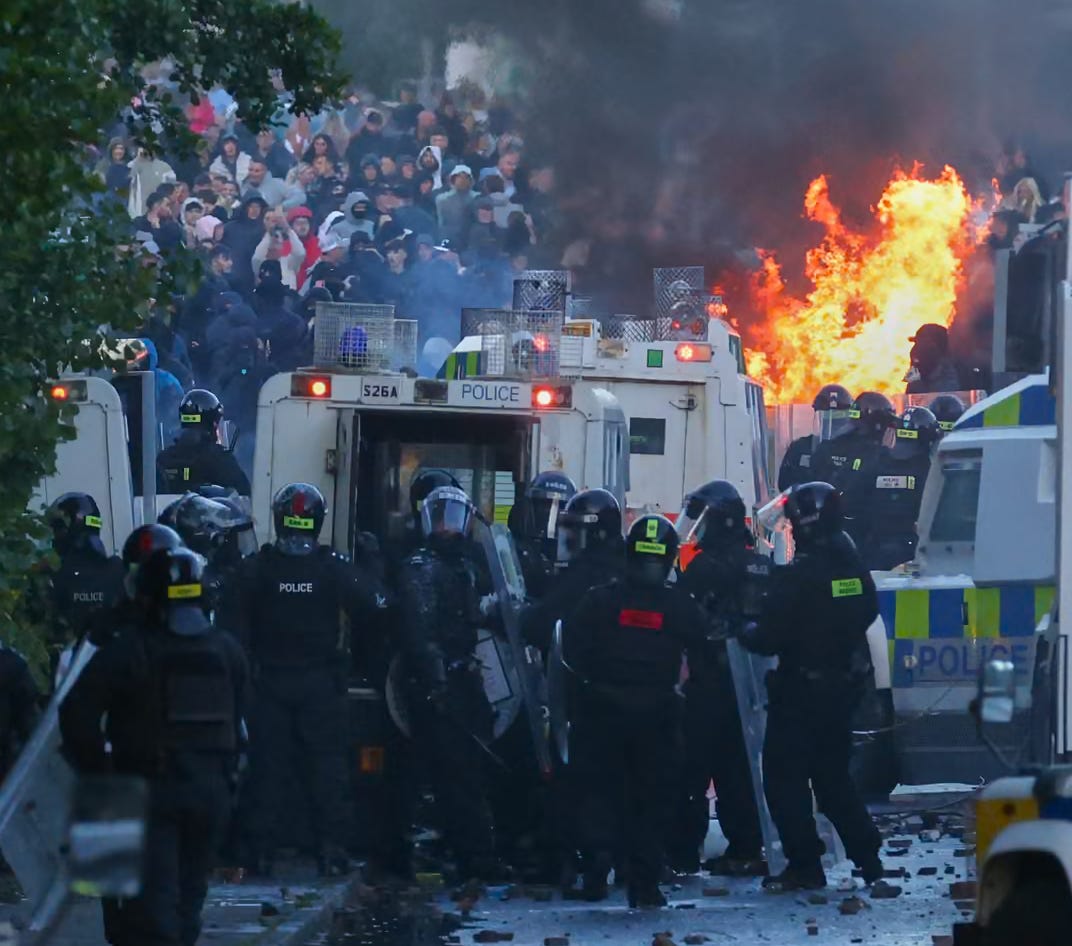
We should refuse it completely. We do not need permission from politicians to say what the facts already show. Homes and vehicles were set on fire after a knife attack in north Belfast. Residents were targeted because of skin colour and perceived foreignness. Men went door to door asking to get “foreigners out”. Families were driven from homes. At least 27 people were made homeless because mobs searched for foreign nationals (BBC News, 2026; CBS News, 2026; Al Jazeera, 2026). No policy debate explains that. No protest contains it. No phrase about concern can launder it. The name for it is pogrom.
Yesterday’s article, The Enemy Within: Dehumanisation and the Road to Authoritarianism, examined the political work done before the fire starts: ranking people, lowering whole groups in the public imagination, and the way culture becomes a polite word for suspicion (Plague Island, 2026). Belfast is the next stage. It is the moment the category becomes a target, the target becomes a door, and the door becomes a fire.
The Target
CBS reported masked men on the Lower Newtownards Road carrying bottles and bricks, shouting “foreigners out”, banging and kicking doors, and smashing windows (CBS News, 2026). The same report described men trying to burn a car until a woman told them it belonged to a “local and not a foreigner”, at which point they stopped (CBS News, 2026). That detail is the whole story in miniature. The violence was not random. It asked a single question: who counts as one of us, and who can be burned out?
SDLP MP Claire Hanna said the same thing plainly. She called the scenes a “race-based pogrom” and said men were going door to door asking to get foreigners out “based exclusively on the colour of their skin” (BBC News, 2026). This confirms the visible truth, not because the truth needed permission. A pogrom is collective violence against a marked minority, usually justified by revenge, rumour or some story of communal defence. Belfast carried those marks openly. The mob did not know who was legal, illegal, refugee, citizen, worker, student, neighbour, settled resident or recent arrival. It knew only what it could see and what it had been taught to hate.
One Man, One Crime
The original crime was real and brutal. Stephen Ogilvy was seriously injured in a knife attack in north Belfast, suffering the loss of one eye and injuries to his face and back. Hadi Alodid, a 30-year-old Sudanese man, was charged with attempted murder, possession of a knife in a public place and making threats to kill (BBC News, 2026; NPR/AP, 2026). The horror of that attack need not be minimised for the pogrom to be condemned. It was a grave crime. It was also the act for which one man was charged. A legal process exists because guilt belongs to individuals, never to races, nationalities, accents, skin tones, or families living behind doors that a mob decides to kick.
The far right exists to destroy that distinction. It takes one charged suspect and turns him into a whole people; it takes one victim and turns grief into a weapon. It waits for pain and then supplies a target. Stormont ministers said the rioters were “weaponising the genuine hurt, concern and anger” created by the stabbing (The Guardian, 2026). That is exactly what happened. The violence in Belfast did not spill naturally from sorrow. It was sorrow processed through the machinery of racial politics until it came out as arson.
The phrase “foreigners out” is a threat, not an immigration policy. It makes no request of Parliament and offers no change to visa rules. It tells a person standing in a doorway that they are prey. It has no interest in asylum decisions, housing shortages or public services. It searches by face. It judges by skin. It asks the mob to act as border guard.
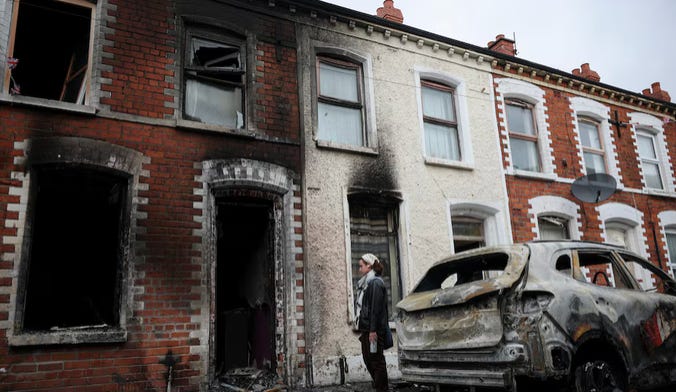
That is why the excuses offered afterwards are obscene. We will hear, as we always hear, that people are worried about housing. We will hear that communities feel ignored, that there is anger about immigration, pressure on services and a sense that the political class does not listen. These arguments are dragged out after every racist convulsion like furniture rescued from a burning house. They are meant to make the arson look sociological, but a family’s home does not become a housing policy because Black people live in it. A baby carried away from a burning street settles no argument about asylum numbers. A man kicking a door and shouting “foreigners out” is a thug carrying a political permission slip, however many commentators try to dress him up as an unheard citizen.
Subscribe to Notes From Plague Island and join our growing community of readers and thinkers.
The reports from Belfast destroy the alibi. The Northern Ireland Fire and Rescue Service handled 256 calls and attended 62 incidents between 7pm and midnight, mostly in the Greater Belfast area (BBC News, 2026). Multiple homes were set alight; a bus, cars and bins were burned; and police used water cannon during a second night of violence near Sandyknowes and Newtownabbey, where a crowd of about 300 burned a truck and threw bricks and other missiles (The Guardian, 2026; BBC News, 2026). A pastor helping people whose houses had been targeted said members of his church were being forced out “just because they’re black” (BBC News, 2026). This is the record. This is what happened. Anyone who continues to call it merely “unrest” is helping to bury the victims under vocabulary.
The Rehearsed Pretext
Belfast did not stand alone, and Southampton did not begin the pattern. Both were recent eruptions of something already rehearsed. A crime is seized as pretext. A suspect is turned into a symbol. A local tragedy is stripped of its actual facts and fed into the machinery of invasion politics. Then the same men who spend their lives telling people that the country is being stolen tell them to gather, march, protest, confront, make themselves heard. Days before Belfast, protests and clashes followed the sentencing in the Henry Nowak murder case. NPR reported that demonstrators marched in Southampton and that protesters stood outside a hotel that had housed asylum seekers holding signs saying “Illegal Migration Is Destroying Our Civilisation” (NPR/AP, 2026). CBS reported that the Nowak case had already sparked anti-immigration protests and clashes with police (CBS News, 2026). The case was immediately fed into the same machine that later turned Belfast into fire.
The facts of Southampton show how little the machine cares about truth. Henry Nowak was white and was murdered by Vickrum Digwa, a British-born Sikh. Digwa falsely claimed to police that Nowak had racially assaulted him, and he was sentenced to life in prison with a minimum term of 21 years (NPR/AP, 2026; CBS News, 2026). Both victim and killer were British, yet the far right seized the case as proof of migrant invasion (NPR/AP, 2026). The point is not to deny the possibility of police failure. If the police handled the case badly, that failure deserves scrutiny on its own terms. But the right did not pause there. It converted a possible institutional failure into the myth of “two-tier policing”, then converted that myth into racial currency. A dead young man became usable because rage could be extracted from him. The facts did not produce the story. They were bent until they served it. The pretext can change from town to town. The method does not.
JD Vance helped push that poison across the Atlantic. CBS reported that Vance claimed Nowak would still be alive if European elites had stood against what he called the “mass invasion of migrants” (CBS News, 2026). NPR likewise reported that Vance blamed immigration for the Southampton violence (NPR/AP, 2026). Let us call this out for what it is: incitement dressed as civilisational analysis. It teaches people to see neighbours as invaders. It tells them the death of one person is evidence against millions. It exports the diseased language of Trump’s America into British streets: invasion, betrayal, weakness, enemies within.
The Men Who Sell the Fire
This is the road Britain keeps pretending it is not walking. America reached Trump town by treating cruelty as common sense for long enough that violence began to look like policy. “Invasion” came before family separation. “Rapists” came before raids. “Enemies” came before the crowd. The warning for Britain is not that it will copy America exactly. It is that the same moral permission structure is already here: the same excuses, euphemisms, and the same performance of shock when language does what it was built to do.
Nigel Farage, Tommy Robinson, Elon Musk and JD Vance are the engineers of this climate, its amplifiers and beneficiaries. CBS reported that Hanna named Musk, Farage and Robinson as prominent figures who spread the Belfast stabbing video and called for mass protests (CBS News, 2026). Al Jazeera reported that Musk reposted messages blaming migration for violence in the UK and that Robinson called for more protests amid the Belfast unrest (Al Jazeera, 2026). Vance had already dragged the Southampton case into the same language of migrant invasion (CBS News, 2026; NPR/AP, 2026). These men operate at different levels of the same pipeline. Robinson supplies the street theatre. Farage supplies the television respectability. Musk supplies the platform and the billionaire megaphone. Vance supplies the American state-power accent. The sequence is always the same: find the pretext, hype the threat, summon the crowd, watch the violence, then step back and claim that no one could possibly have foreseen where the rhetoric would lead.
Their role is not mysterious. Far-right incitement rarely needs to say, burn that house. It says: your country is being invaded, elites hate you, migrants are dangerous: they despise the West. No one is protecting you — enough is enough. Protest while making the protest feel like a last stand against national extinction. Then, when men with covered faces go looking for foreign families, the same figures retreat into the cowardly distinction between words and consequences. They condemn “violence” in the abstract while preserving the lie that made the violence feel righteous.
Robinson’s own mock-apology after criticism of his role shows the mechanism in miniature. In a post headed “A PUBLIC APOLOGY - I AM SO SORRY”, he did not apologise in any meaningful sense. He sneered at politicians, mainstream media and the left, then sarcastically “apologised” for alleged crimes by what he called “imported engineers” and for “40,000 or so Muslims” supposedly being on the UK terror watch list (Robinson, 2026). The claims matter here as rhetoric rather than fact. They turn migrants into sexual threat, Muslims into security threat, and criticism of incitement into a persecution drama in which Robinson becomes the victim. It is the arsonist beside the smoking street saying, with a smirk, that the real scandal is being blamed for fire.
This is the politics of the thrown match and the clean hand. The influencer supplies the rage. The platform supplies the reach. The politician supplies the story. The mob supplies the petrol. Afterwards, everyone important claims innocence because no one can prove who lit the first flame. Belfast shows that the first flame can be verbal: a phrase repeated until a person becomes a category, a video shared until a crime becomes a race, a recent trillionaire reposting dehumanising bait while real families prepare to sleep somewhere else.
Musk’s role deserves particular contempt because it reveals trillionaire politics in its purest form: power pretending to be rebellion. He presents himself as a champion of free speech while his platform rewards fear, humiliation and racial panic. Al Jazeera reported that Labour chair Anna Turley said online platforms were playing a role in driving the unrest and suggested Musk was among the “bad faith actors” inflaming tensions (Al Jazeera, 2026). The UN human rights chief, Volker Türk, condemned “incitement” on social media and said the dehumanisation of whole groups was “totally unacceptable and frankly despicable” (Al Jazeera, 2026). That is the correct frame. The platform is an accelerant when it turns human beings into engagement material.
The old rumour had to walk through a pub, a church, a leaflet, a whisper, a newspaper column. The new rumour travels at the speed of a repost. A graphic video becomes an international weapon before the facts have settled. Men who will never live beside the burned homes or comfort the frightened children push the story into millions of feeds and watch the consequences from a safe distance. This is the modern pogrom economy: outrage extracted from suffering, monetised by attention, laundered by politics, and paid for by people whose names the mob never bothers to learn.
The Respectable Alibi
The respectable right then arrives to perform disgust while keeping the engine running. Richard Tice condemned the violence in Belfast, but when asked whether Reform UK’s call for all visas for Sudanese asylum seekers to be banned was proportionate, he said it was “absolute and proportionate” (BBC News, 2026). That is collective punishment with a press office. The mob says: punish the foreigner in the house. The politician says: punish the foreigner in the visa category. One uses bricks. The other uses policy. Both transfer the alleged guilt of one man onto people who did nothing.
This is where yesterday’s argument meets today’s fire. Before people can be removed, they have to be ranked, and Belfast shows that ranking system entering the street. The men at the doors were, crudely and violently, doing what the politics of removal asks the state to do cleanly: decide who belongs and who can be pushed out.
This is why the phrase “legitimate concerns” has become so rotten. It is used as a bridge between ordinary hardship and racial blame. Yes, there are real shortages. Yes, public services are strained and housing is broken. But migrants did not sell off social housing, starve councils, gut public services, suppress wages, deregulate landlords or build a country in which working people are forced to fight over scraps. The arsonist is being handed the wrong address. The men who profit from Britain’s decay point to the newest, poorest, most visible stranger and say: there, blame them.
Nigel Farage has made a career out of that gesture. He offers the politics of the pincer: Britain pulled away from Europe, pulled toward Trump’s America, pulled into the cold theatre of authoritarian nationalism where every problem is blamed on an outsider and every solution makes the rich safer. He does not need to throw bricks to help build the conditions in which bricks are thrown. He only needs to keep saying that the nation has been betrayed by foreigners and their elite protectors. The street will translate the rest.
The centre makes this worse by treating Farage as a weather event rather than a political arsonist. He is interviewed, platformed, normalised and then discussed as if he merely reflects public feeling. But this “public feeling” is being manufactured in real time by men who know exactly which fears to press and which wounds to reopen. Every soft-focus discussion about “anger in the community” gives the far right another inch of respectable ground. Every presenter who asks whether migrants are the “real issue” after homes have been burned helps move the conversation away from the victims and toward the mob’s preferred grievance.
Labour’s response is also too thin if it stops at condemnation. Starmer said he would not tolerate violence against people because of their background, and that statement is correct as far as it goes (BBC News, 2026). But it does not go far enough. The state cannot condemn the fire after years of accepting the terms of the argument that produced it. If mainstream politics keeps speaking of immigration chiefly as a burden, a pressure, a problem to be “controlled” for the reassurance of people already being courted by racists, then it leaves the moral terrain to the far right. It tells the public that the premise is correct and only the method is regrettable. Anti-racism requires more than regret with better manners.
Water Cannon After the Fire
The police response matters, and it came too late for the people already terrorised. Police used water cannon in Belfast during the second night of unrest, and extra officers were deployed as the violence spread (The Guardian, 2026; Al Jazeera, 2026). Public order had to be restored. Yet water cannon after the fire offers no protection before it. The harder question is why the crowd believed it had a political right to gather, identify homes, test doors and decide whose presence was intolerable. That belief was cultivated long before the first missile was thrown.
A liberal state loves the language of response because response lets it arrive late and still look responsible. It can deploy officers, issue statements, open investigations and praise calm. But the families burned out of homes do not live inside a press release. Security means little if it begins only after the first window breaks.
The deeper failure is political. A society has failed when residents can be made homeless because a mob decides they look foreign. A state has failed when belonging can be challenged by masked men at the door. A media culture has failed when it spends years turning migrants into a threat and then pretends to be surprised when someone takes that threat literally.
The most morally devastating intervention came from Stephen Ogilvy’s family. They appealed for calm, said migrants make a valuable contribution to the country, and insisted that the tragedy should not be used to divide people or fuel hostility (Al Jazeera, 2026). That statement shames the agitators. The people closest to the victim refused the politics of collective punishment. The far right ignored them because it never cared about the victim except as raw material.
This is what the far right does with victims. It consumes them instead of mourning them. It turns a wounded man into a symbol, a murdered student into a slogan, a video into a recruitment tool, a court case into proof of invasion. Justice is too specific for this politics. Justice names the accused, hears the evidence, protects the innocent, and punishes the guilty. The far right wants revenge because revenge can be made racial. Revenge never asks who did what. It asks who can be made to pay.
What the Pogrom Reveals
Belfast tells us something ugly about Britain now. The country is being trained to misrecognise pogrom politics as democratic expression. We are told that mobs outside asylum hotels are concerned citizens, that men shouting “foreigners out” are expressing anxiety, and that collective punishment is a policy option if it is spoken in a television studio rather than screamed in a street. We are gaslit to believe that the problem is always the migrant and never the men who turn fear into power.
There is a bleak irony here. The right repeatedly tells us that the people it marks as foreign do not share “our values”. Then its own crowds set towns on fire, smash windows, hunt families from door to door, and call that civilisation defending itself. If these are British values, then the phrase has been emptied of every decent meaning it ever claimed. If they are not, then the first threat to those values is coming from the men who shout loudest about protecting them.
This is how authoritarian politics grows inside ordinary life. It does not begin by announcing itself as fascism. It begins with a story about safety. It says women are unsafe, children are unsafe, streets are unsafe, the nation is unsafe, and then it identifies a visible enemy. It tells people that the law is too weak, the courts are too slow, the police are compromised, the elites are traitors, and the invader is already inside the gates. Then the mob appears. Then the house burns. Then the same men who fed the story ask why everyone is so emotional.
Not emotional, but exact: Belfast was a pogrom because people were hunted as foreigners. Southampton was a rehearsal because grief was twisted into anti-migrant mobilisation before the smoke rose in Belfast. Farage, Robinson, Musk and Vance belong to the same agitation system because they turn local crimes into racialised stories of invasion. The respectable right condemns mob violence while feeding collective punishment through policy. Platforms do host and profit from the spread of this poison.
Those burned out of their homes owe no explanation to the people who hate them. No human being should have to stand before a mob and produce paperwork for their own safety. No family should have to hope that a neighbour can convince masked men that the car they are about to burn belongs to a “local”. No child should learn that home is conditional on the mob’s ability to recognise you as belonging.
To name a pogrom is to choose moral accuracy over polite evasion. If we call Belfast “unrest”, we hide the target. If we call it “anger”, we hide the victims. If we call it “concern”, we help the arsonists write their alibi. The word matters because it forces the question that polite Britain wants to avoid: who was being hunted, and who taught the hunters to see them as prey?
Belfast showed precisely what “foreigners out” means once the slogan reaches the street. It showed what happens when billionaires, demagogues, street agitators and racists hiding behind respectable veneers spend years telling people that strangers are the enemy and then act shocked when the lesson is learned. It was a pogrom. We should treat every man who helped prepare the ground for it with the seriousness reserved for those who know exactly what they are doing.
Or support us with a one-off tip → Buy Me a Coffee
References
Al Jazeera (2026) ‘Police in Belfast use water cannon as anti-immigrant unrest continues’, 11 June. Available at: https://www.aljazeera.com/news/2026/6/11/police-in-belfast-use-water-cannon-as-anti-immigrant-unrest-continues[Accessed: 11 June 2026].
BBC News (2026) ‘What we know about Belfast attack and disorder’, 11 June. Available at: https://www.bbc.com/news/articles/cly0d13e4geo [Accessed: 11 June 2026].
CBS News (2026) ‘Violent anti-immigration protests erupt in Belfast after brutal stabbing attack’, 10 June. Available at: https://www.cbsnews.com/news/belfast-immigration-protest-stabbing-attack/ [Accessed: 11 June 2026].
NPR/AP (2026) ‘U.K. leaders call for calm as protests break out after Belfast street stabbing’, 10 June. Available at: https://www.npr.org/2026/06/10/nx-s1-5852968/uk-anti-immigration-protests-belfast [Accessed: 11 June 2026].
Plague Island (2026) ‘The Enemy Within: Dehumanisation and the Road to Authoritarianism’, Notes From Plague Island, 10 June. Available at: https://www.plagueisland.com/p/the-enemy-within-dehumanisation-and [Accessed: 11 June 2026].
Robinson, T. (2026) ‘A PUBLIC APOLOGY - I AM SO SORRY’, X post, 11 June.
The Guardian (2026) ‘Police use water cannon against rioters in Northern Ireland’, 10 June. Available at: https://www.theguardian.com/uk-news/2026/jun/10/police-use-water-cannon-against-rioters-in-northern-ireland[Accessed: 11 June 2026].
Veidlinger, J. (2021) In the Midst of Civilised Europe: The Pogroms of 1918–1921 and the Onset of the Holocaust. London: Picador.
Where were the riots when Stephen Ogilvie was drugged and set on fire by a white Ulster gang leader?
Excellent, thank you 🙏 I have taught history in the UK for 32 years and the lesson from Germany is very clear. Fascism cannot be accommodated, it must be crushed. Farage is a terrorist. He needs to be thrown in jail for at least 20 years.