
The Enemy Within: Dehumanisation and the Road to Authoritarianism

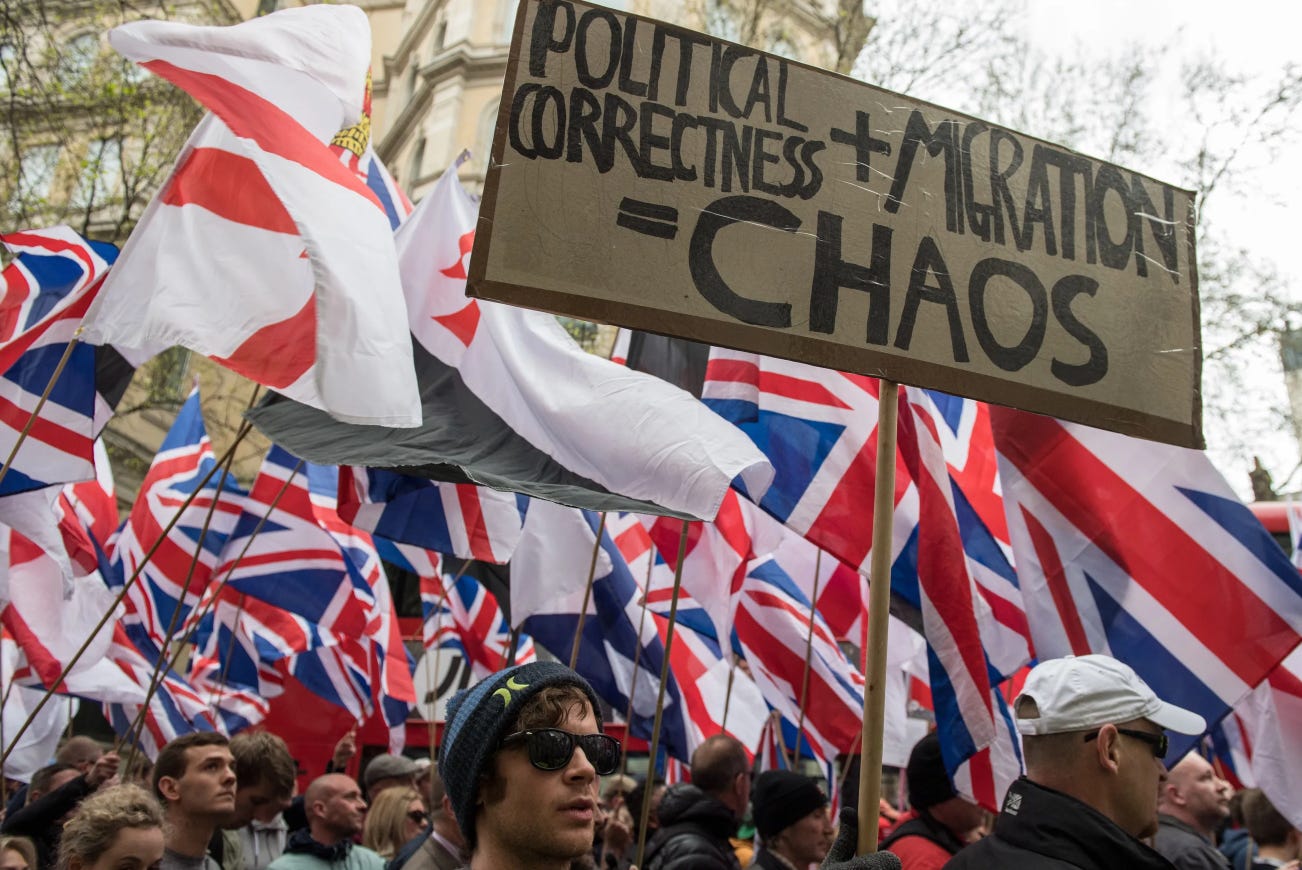
This essay opens The Permission Structure, a series on how the logic of replacement became a political vocabulary, and how the vocabulary became a mob.
“Some cultures are MUCH better than others.”
There it is. Seven words, one capitalised sneer, and a whole politics of hierarchy placed on the table as if it were merely common sense. No careful argument. No distinction between people and practices. No defence of rights. No attempt to say which culture is being judged, by whom, against which standard, or for what political purpose. Just the sentence, polished for circulation — short enough to travel, crude enough to excite, vague enough to deny.
The post appeared on the verified X account of Zia Yusuf on 9 June 2026, under the handle @ZiaYusufUK: “Some cultures are MUCH better than others” (Yusuf, 2026). Yusuf is not an anonymous crank in the digital sewer. Reform UK identifies him as its Shadow Home Secretary (Reform UK, 2026a). The BBC has described him as central to Reform’s operation, a former banker and technology entrepreneur, and a figure Nigel Farage credited with much of the party’s recent success (Mason and Rhoden-Paul, 2025). The sentence therefore matters because of where it came from: inside a political project that has already placed immigration, policing, deportation, conditional settlement, and national grievance at the centre of its offer to Britain.
This is not an article about one social media post as though a single sentence can carry all the guilt of a movement. That would be too easy, too shallow. The sentence matters because it reveals the moral weather around that movement. It shows how a politics of removal prepares its ground. Before people can be placed in camps, databases, raids, commands, flights, and legal categories of expulsion, they have to be placed somewhere else first. They have to be placed lower in the public imagination.
That is what cultural ranking does. It tells the audience that equality is sentimental nonsense. It suggests that some ways of living may be different, or even wrong in specific respects, and then slides into the darker claim that they are inferior. It gives permission to stop thinking about people, and start thinking about civilisational grades. Some people become the products of “better” cultures. Others become the products of worse ones. Once that idea settles, everything else becomes easier. Rights become conditional. Belonging becomes a probationary status. A neighbour becomes a test case. A family becomes a file. A settled life becomes something that can be reviewed, revoked, and removed.
Our previous pieces on Plague Island have already followed two parts of this road. Wake Up Call: The Echoes of Weimar examined the fragility of democratic institutions and the historical pattern through which legitimacy is eroded, crises are exploited, and democratic safeguards are hollowed out from within (Plague Island, 2025a). Britain’s Dark Turn: How Farage’s Deportation Theatre Echoes Trump’s Authoritarian Playbook examined the machinery Reform UK wants to build: detention capacity, data systems, removal flights, legal exemptions, surveillance powers, and the spectacle of state cruelty presented as administrative competence (Plague Island, 2025b). This piece starts in the gap between those two arguments. It asks what has to happen in the public mind before the machinery of removal can be sold as national rescue.
The earlier deportation article looked at the hardware: camps, databases, warrants, planes, police powers, legal carve-outs. This article looks at the software. It looks at the ranking system installed before the raid, the moral code that tells the public who belongs, who is suspect, who is merely tolerated, and who may be pushed out when the political weather changes. If the deportation plan is the hand reaching for the door, cultural superiority is the voice whispering that the person on the other side was never really one of us.
The Permission Slip
Authoritarian politics rarely begins by saying exactly what it is. It begins with permission. It asks the public to accept one smaller cruelty, then another. It asks people to stop seeing certain groups as fully human in the ordinary, daily, unremarkable sense. It asks them to imagine that rights can be earned by resemblance, that belonging can be measured by usefulness, that dignity can be withdrawn from those who fail the mood of the majority.
The line deserves attention for this reason. It is not a policy paper because it does not need to be. Its purpose is not to explain, but to authorise. It tells followers that they may say the quiet part more loudly, provided they place it under the apparently respectable word culture. They do not have to say race. They do not have to say religion. They do not have to say migrant, Muslim, foreigner, asylum seeker, traveller, neighbourhood, class, accent, dress, food, prayer, or family. They can say culture, and the audience can fill in the rest.
That is the trick. Culture sounds softer than race. It sounds learned, sociological, almost polite. It allows a speaker to insist that no one is talking about biology, skin colour, or blood. Yet in the political marketplace, culture is often a container into which all those older hatreds can be poured. Religion becomes culture. Ethnicity becomes culture. Class becomes culture. Migration status becomes culture. A person’s postcode, surname, clothing, language, diet, or mosque can be folded into the same accusation. The word becomes a mask because it lets hierarchy keep its emotional force while changing its vocabulary.
A democratic society can criticise practices. It can and must condemn misogyny, homophobia, antisemitism, racism, sectarian coercion, caste oppression, forced marriage, authoritarianism, and political violence. It can defend secular law, equal citizenship, women’s rights, gay rights, freedom of conscience, and the right of every person to leave a community that seeks to control them. There is no serious democracy without that moral clarity.
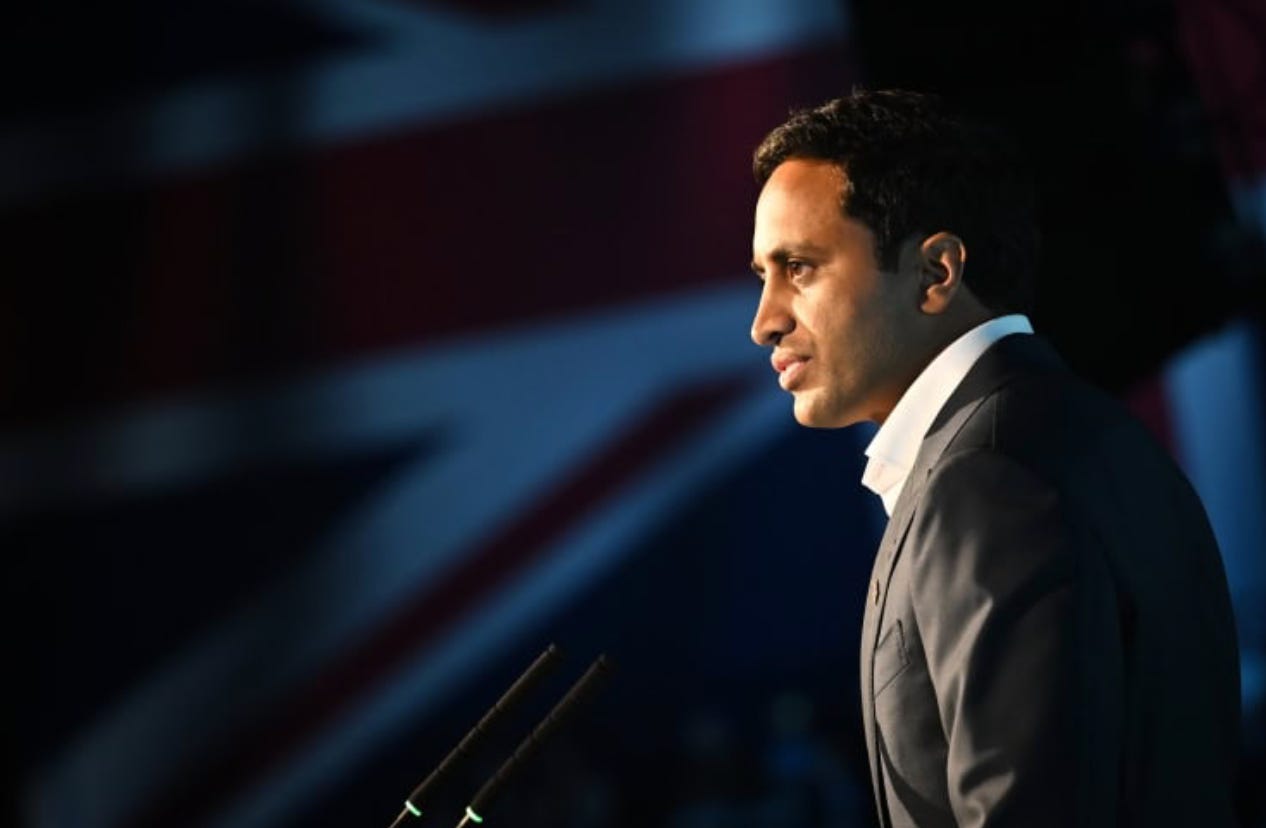
But that is not what Yusuf’s sentence does. It does not name a violation. It does not defend a right. It does not say that a practice is wrong because it crushes the freedom of an individual. It ranks cultures. It invites a scoreboard. It moves the argument away from conduct and toward origin. The authoritarian move is to take guilt, which belongs to an act, and attach it to an origin.
Once that move has been made, people associated with the “worse” culture become permanently suspect. Their innocence is provisional. Their citizenship is conditional. Their children inherit suspicion before they have done anything at all. Their success is treated as proof of exceptional escape, while their failure is treated as confirmation of collective defect. The individual disappears, and in their place stands the category.
This is how the language of civilisation becomes a permission slip for cruelty.
When Hierarchy Calls Itself Equality
Zia Yusuf’s sentence did not fall from a clear blue sky. It arrived amid Reform UK’s recent messaging around policing, race, migration, and grievance. Reform’s own article on Yusuf’s BBC appearance, published on 8 June 2026, framed him as attacking “two-tier policing” and quoted him saying there was “nothing more divisive” than such policing (Reform UK, 2026b). The party presented his remarks as a defence of equal treatment under the law, while also accusing others of politicising the death of Henry Nowak (Reform UK, 2026b).
We should be careful here — we are not making unsupported claims about the Nowak case. Rather, we are examining Reform’s public framing because that framing is the engine room of the politics. Equality is taken apart and reassembled as grievance. Any attempt to discuss racism or unequal treatment can be recast as discrimination against the majority. Anti-racism becomes racism. Concern for minorities becomes contempt for ordinary people. Recognition of social inequality becomes evidence that the system has been rigged against those who are told they are the real victims.
This is the translation machine of reactionary politics. It takes a demand for equal protection and turns it into an accusation of special treatment. It takes a request to look honestly at who is most exposed to state power and turns it into a story about the majority being humiliated in its own country. It tells people who already feel insecure that their insecurity has a culprit, and that the culprit is the person asking to be treated as fully equal.
The line works inside that mood. If the country is being betrayed by elites who allegedly favour outsiders, minorities, migrants, Muslims, or politically protected groups, then cultural superiority can present itself as restoration rather than contempt. The audience is invited to hear superiority as truth-telling.
This is where “two-tier” language does its work. It provides the bridge between grievance and hierarchy. The public is told that equality has gone too far, that law has been bent to appease minorities, that the majority has become subordinate in its own country. From there, cultural ranking begins to feel like correction. The hierarchy is advertised as common sense returning from exile.
The danger lies in that reversal. A politics that ranks cultures does not have to announce itself as hatred. It can call itself fairness, realism, law and order. It can point to crimes, costs, housing queues, police failures, and genuine public anxiety. Then it can fuse those things into a single moral story: we are weak because we have treated the wrong people as equal.
That is where the authoritarian imagination begins: the claim that equality itself has become the problem.
The Useful Mask
There is another reason Zia Yusuf matters so much to Reform UK’s politics. Yusuf is a British Muslim whose parents were first-generation immigrants from Sri Lanka, and he has presented himself as a British Muslim patriot (Akhtar, 2025). He has been described as a figure who embodies a strand of established ethnic-minority politics that takes a hard line toward newer arrivals (Akhtar, 2025). The same account noted that he faced Islamophobic abuse from parts of Reform’s online orbit, and that Farage acknowledged some of the abuse directed at him (Akhtar, 2025; Mason and Rhoden-Paul, 2025).
None of this requires us to speculate about Yusuf’s private motives; we do not need to peer into his head. We only need to look at the political function his role performs.
For a party repeatedly accused of racialised politics, a minority messenger is useful. He allows the party to point at his biography and say: how can this be racism, when he is saying it? How can this be hostility to minorities, when one of our most prominent figures is himself from a minority background? How can the politics be exclusionary when the messenger seems to contradict the accusation?
But the identity of the messenger does not settle the content of the message. A hierarchy does not become less hierarchical because it is defended by someone who can be used as evidence against the charge of prejudice. The old sales pitch becomes easier to hear. Cultural ranking can be presented as standards rather than bigotry, discernment rather than prejudice, patriotism rather than exclusion.
This is a familiar pattern. Movements of exclusion often search for legitimising figures who appear to launder the ugliness of the project. The figure does not have to be cynical. The useful function is enough. If a party can say that its harshness is endorsed by someone who appears to stand outside the old stereotype of the reactionary bigot, then the harshness gains a new costume. It can walk into respectable rooms and ask to be treated in seriousness rather than spite.
The sentence is revealing for exactly this reason. “Some cultures are MUCH better than others” is not made safer by the biography of the person who wrote it. If anything, the biography makes the sentence more politically useful. It allows Reform’s wider project to present cultural hierarchy as an insider’s verdict, a form of tough love from someone whose presence is supposed to disarm criticism before criticism has even opened its mouth.
Yusuf is not the origin of this politics. He is one of its current translators. Farage gives it the party vehicle and the deportation spectacle. Lowe and Restore show how the same appetite can be pushed even further right, with Al Jazeera reporting that Restore’s manifesto pledged the “most ambitious programme of mass deportations ever seen in Britain”(Mohamed, 2026). Tommy Robinson, whose real name is Stephen Yaxley-Lennon, gives it the street-level theatre of menace, where the language of invasion moves from the screen toward the door (Hooper, 2026). Yusuf’s role is different, but no less useful. He gives the hierarchy a cleaner accent. He helps turn an older politics of suspicion into the language of culture, standards, and seriousness.
The Machine in the Background
The Guardian reported in February 2026 that Yusuf, introduced at a Reform press conference in Dover as the party’s “shadow home secretary,” described migration as an “invasion” and set out plans for a UK Deportation Command. According to that reporting, Reform’s proposals included detaining 24,000 people at any one time, deporting up to 288,000 annually, operating five flights a day, scrapping indefinite leave to remain, replacing it with renewable visas, and pursuing expanded surveillance powers (Syal and Walker, 2026). The BBC later reported Yusuf saying that if a foreign national lives in social housing at taxpayer expense, they “automatically fail our economic test and will be deported”(Wheeler and Forsyth, 2026).
Those facts demonstrate the connection between rhetoric and administration. The sentence about culture sits beside proposals for conditional settlement and large-scale removal. It sits beside a politics that imagines the Home Office as a sorting machine, the border as a permanent internal condition, and belonging as something that can be withdrawn according to tests of worth.
The earlier article examined the hardware. Here the question is simpler and uglier: what kind of sentence makes that hardware feel acceptable?
The answer is that cultural ranking supplies a moral sorting code. If some cultures are much better, then some people are implicitly closer to the standard and others further away from it. Those further away can be subjected to more suspicion, more monitoring, more conditions, more demands to prove themselves. Their rights can be made to look like indulgences. Their permanence can be made to look like a clerical error. Their removal can be made to look like tidying.
Here, a human being becomes an administrative inconvenience. A tenant becomes an economic test. A family becomes a removal target. A child’s classroom becomes the place where politics arrives as a rumour about whose parents may have to leave. A state may one day knock on the door. The sentence has already knocked. It has already told the neighbour, the classmate, the landlord, the employer, and the passer-by to see a settled life as something provisional.
A letter published by the Guardian in response to Yusuf’s deportation plan captured the human consequence from the other end of the telescope. A secondary-school student wrote that immigrants were not what made them feel unsafe. What made them feel unsafe was the thought that politicians could break up communities and encourage harassment of people who do not look or sound “British” (Name and address supplied, 2026). That is the lived meaning of the sorting code. It does not remain in Westminster. It enters classrooms, streets, friendships, workplaces, and families. It tells some children that the country around them is debating whether their lives here count.
The cruelty of this politics lies in what it would do if given power, and what it does now, while seeking power. It teaches the public to rehearse removal, invites people to imagine their neighbours as temporary, and makes suspicion a civic habit.
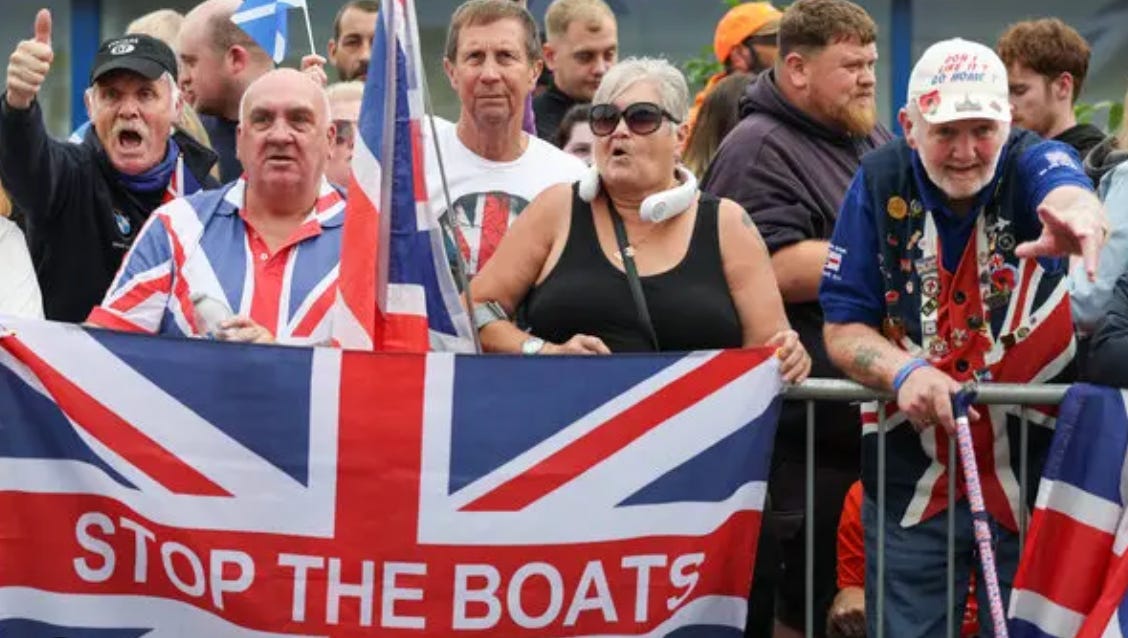
The point became brutally visible in Belfast this week. The BBC reported that residents fled their homes as houses and cars burned amid disorder after a knife attack, with the Police Service of Northern Ireland calling for calm as “sporadic pockets of disorder” broke out across Northern Ireland (BBC News, 2026). The Guardian reported that the suspect, Hadi Alodid, had been charged with attempted murder, threats to kill an NHS radiographer, and possession of a knife, and that the victim, Stephen Ogilvie, had lost his left eye, according to court proceedings (Sparrow, 2026). Those criminal allegations must be treated carefully, precisely because live proceedings are not raw material for political fantasy.
But the reaction is politically instructive. Farage posted that the authorities should reveal the attacker’s “identity and status” immediately, and Reform then republished that demand in an article asking how the suspect came to Northern Ireland and whether he had leave to remain (Farage, 2026; Reform UK, 2026c). Those are not the same words as an instruction to riot. They are, however, part of the political grammar through which an alleged individual crime is quickly pulled toward border status, migration, secrecy, and official betrayal. Keir Starmer said people had been targeted because of their background and condemned those who encouraged the disorder “online or elsewhere” (Sparrow, 2026). Naomi Long, Northern Ireland’s justice minister, said disorder had been fuelled by online commentators who would have “struggled to find Belfast on a map” (Sparrow, 2026). Claire Hanna, the SDLP leader, described what she was seeing as a “race-based pogrom”, with men going door to door demanding to “get the foreigners out” based on skin colour (Sparrow, 2026).
This is the dehumanising move. An alleged crime is recoded as the expression of an entire ethnicity and culture. The accused does not stand alone before the law. He is made to carry a whole population on his back, and that population is then told to answer for him. This is how the old language of the enemy within returns in newer clothes. It does not need to say that people are less than human. It only has to teach the public to see them first as a source of contamination, danger, burden, or invasion, and only afterwards, if at all, as neighbours, workers, parents, children, patients, citizens, or human beings.
The more explicit version of that translation appeared in the far-right ecosystem around the disorder. Metro reported that Tommy Robinson had organised protests after the attack, shared updates from Belfast, and captioned protest images by saying that “the whole of the United Kingdom” would take to the streets after “yet another invader attack on our people” (Hooper, 2026). That phrase is the whole mechanism in miniature. A suspect becomes an invader. A criminal allegation becomes an attack by a class of people. A public is invited to feel not horror at a crime, but siege by a population.
A second register of justification then appeared around the language of rage itself. In a tweet, Ben Graham wrote that Nigel Farage’s call for “cold rage” had captured how millions felt, before describing Belfast and Southampton as examples of “hot rage” after years of frustration and political failure had “boiled over into violence” (Graham, 2026). The formulation matters because it gives disorder a moral biography. Violence becomes the temperature of neglected democracy. The street becomes a thermometer. The riot becomes the proof that the people have been ignored.
That is the social life of cultural ranking. It does not stay attached to the person accused of a specific act. It migrates; attaches to the neighbour with the wrong accent, the family with the wrong skin, the child whose home is suddenly made frightening by men outside who think politics has given them permission. Language about superior and inferior cultures cannot be treated as harmless provocation. In the wrong political weather, it becomes a map for intimidation.
The Cowardice of the Unsaid Target
Part of the power of Zia Yusuf’s sentence is that it does not say which cultures he means. That omission is the design. If challenged, the defender can say the sentence only refers to liberal values, democracy, tolerance, equality before the law, or the rejection of violence. But if that was the argument, it could have been made clearly. A person can say that women’s rights are non-negotiable, or that gay people must be protected from persecution. A person can say that antisemitism, racism, religious coercion, sectarian intimidation, and political violence are wrong. And a person can say that every individual must enjoy equal protection under the law.
Yusuf did not write that. He wrote: “Some cultures are MUCH better than others.”
The vagueness does the work because it allows every supporter to supply the target privately. One hears Islam. Another hears migrants. Another hears asylum seekers. Another hears inner-city Britain. Another hears Roma communities, or Africans, or South Asians, or whoever the day’s grievance has placed under suspicion. The sentence does not need to name them. Naming them would create accountability. Leaving them unnamed creates atmosphere.
This is the cowardice of coded politics. It wants the emotional reward of bigotry without the burden of specificity. It wants to stir the people who know exactly what they think is meant, while preserving the escape route for the people who want to deny it. It is politics by smirk, by raised eyebrow, by algorithmic wink.
Social media rewards precisely this form. It rewards compression over thought, certainty over honesty, contempt over explanation. The capitalised “MUCH” is not a serious word in a serious argument. It is a shove. It is there to create the feeling of obviousness. It says: do not overthink this, do not ask hard questions, do not distinguish between practices and persons, just accept the ranking.
The post shows how digital politics turns hierarchy into a shareable object. A policy paper would have to face questions. A speech might have to sustain an argument. A seven-word boast only has to move. Outrage, applause, disgust, and denial spreads it. The sentence does not have to persuade through logic because the platform has already taught people to treat emotional force as proof.
This is the small machinery beneath the larger machine. Before the detention centre comes the post. Before the legal category comes the insult. Before the command structure comes the moral permission. The Belfast disorder shows the speed of the transfer. Online atmosphere becomes street atmosphere. A suspect’s background becomes a neighbourhood’s danger. The category begins to answer for the individual.
The British Mirror
The civilisational boast always depends on bad memory. It asks Britain to look outward, to judge other people’s cultures, and to forget what its own culture has tolerated, normalised, excused, hidden, and repeated.
If the test is how a country treats minorities, Britain has Windrush in the mirror. The scandal exposed how people who had lived legally in the UK for decades were wrongly classified, denied work and healthcare, detained or removed under the logic of the hostile environment (Williams, 2020). If the test is how a country treats the poor, Britain has food banks and child poverty in the mirror. The Trussell Trust reported distributing more than 3.1 million emergency food parcels across the UK in the year to March 2024, including more than 1.1 million for children (Trussell Trust, 2024). The Child Poverty Action Group has reported that 4.3 million children were living in poverty in the UK in 2022 to 2023 (CPAG, 2024).
If the test is how a country treats vulnerable people in state custody, Britain has its prisons in the mirror. Official inspection and monitoring reports have repeatedly warned about overcrowding, decay, violence, self-harm, and failing conditions across parts of the prison estate (HM Inspectorate of Prisons, 2024). If the test is accountability after disaster, Britain has Grenfell in the mirror. The final report of the Grenfell Tower Inquiry concluded that the deaths were the result of decades of failure by central government and other bodies, including dishonesty by companies and failures of regulation and oversight (Grenfell Tower Inquiry, 2024).
This is not an argument that Britain is uniquely wicked. That would only invert the same stupidity as the civilisational scoreboard is a lie. Every society contains cruelty and courage, domination and resistance, hypocrisy and sacrifice, as well as people who defend the vulnerable and people who profit from their abandonment. And every society tells flattering stories about itself, because every society would rather remember its rescue boats than its locked doors.
The danger of ranking cultures is that it turns moral life into national vanity. It suggests that the failures are elsewhere, that barbarism is imported, that cruelty wears foreign clothes, that oppression speaks with another accent. It lets the majority imagine itself as the judge rather than one more defendant in the dock.
A democratic society should have no patience for that smugness. The task is not to pretend every practice is acceptable, but to defend persons against domination wherever it appears. That includes domination inside minority communities. It includes domination by the state. It includes domination by employers, landlords, police, prisons, religious authorities, family structures, mobs, newspapers, algorithms, and majorities. If equality means anything, it cannot be granted only to those whose culture has passed a political loyalty test. It has to apply even when the mirror is ugly.
The Older Ladder With Newer Labels
Returning to Weimar does not mean dressing Britain in someone else’s history. Britain in 2026 is not Germany in 1933, and the argument does not require pretending otherwise. The useful lesson is sequence. Democracies are damaged when a law is passed or a court is defied. They are also damaged earlier, when enough people accept that some groups deserve less concern.
Authoritarian politics requires unequal human worth. Sometimes that inequality is described through biology. Sometimes through religion. Sometimes through nationality. Sometimes through culture. The vocabulary changes because old words become embarrassing, but the ladder remains. The phrase “Some cultures are MUCH better than others” belongs to that ladder. It is not a complete programme, a manifesto, or the whole story, but it points in a direction. It says there is an above and a below. It says there are those who may judge and those who may be judged, and that some people arrive in the political conversation already carrying an invisible charge. They have done nothing, but the culture others attach to them is treated as evidence enough.
The distinction between criticising practices and ranking cultures matters for this reason. The first is necessary to freedom. The second is useful to power. When we condemn a practice, we name the harm and defend the person harmed. When we rank a culture, we create a shadow around everyone associated with it. The state can then move through that shadow with fewer questions asked.
This is how conscience is softened. People are not always asked to approve cruelty directly. They are first asked to accept a premise: these people are different in a deeper way; their claims are weaker; their belonging is thinner; their pain counts for less; their removal is less tragic; their fear is less real. Once that premise is accepted, cruelty no longer has to announce itself. It arrives as paperwork, procedure, enforcement, policy. It arrives wearing the clothes of normal government.
They will always need someone to blame. That is the part polite commentary keeps missing. The fantasy is that once the culture has been purified, and the wrong people have been pushed out or put back in their place, peace will return. But the politics of purification does not produce peace. It produces appetite. When the migrant has been used up, the unemployed appear. When the unemployed have been punished enough, the single parent appears. Then the disabled claimant, the striking nurse, the protesting student, the tenant, the traveller, the teacher, the council estate, the city, the region, the class fraction that can be made to look lazy, decadent, disloyal, parasitic, or insufficiently grateful. The target changes because the machine requires a target. The ladder is never dismantled. It is only relabelled.
What Democracy Has to Refuse
A democratic answer to this claim cannot be cowardly. It cannot retreat into a lazy relativism that refuses to criticise anything done in the name of culture. It must say clearly that universal rights are universal or they are nothing. Women do not belong to cultures. Children do not belong to patriarchs. Gay people do not belong to clerics. Dissenters do not belong to states. Believers do not belong to mobs. Non-believers do not belong to families that demand obedience. No one’s freedom should be crushed because a custom, a priest, a minister, a father, a newspaper, or a majority says so.
But precisely because those rights are universal, they cannot be defended through cultural hierarchy. We do not protect women by declaring whole peoples inferior. We do not protect gay people by turning Muslims into suspects. We do not protect Jewish communities by tolerating racism against migrants. We do not protect secular democracy by making equality conditional on national vanity. We do not defend freedom by building a scoreboard of civilisation and placing ourselves at the top of it.
The democratic answer is simpler and harder. It says that every person is entitled to equal concern and equal protection, and that harmful practices should be named, opposed, and stopped because they harm persons — not because they prove the inferiority of a people. It says that Britain has no right to use the language of liberty while abandoning the vulnerable at its own border, in its prisons, in its tower blocks, in its schools, in its asylum system, or in the ruins left by austerity.
That answer will not trend as easily as a seven-word sneer. It is too demanding, and it does not flatter the crowd. It requires people to hold two thoughts at once: that universal rights must be defended without apology, and that the defence of those rights must never become a licence to rank human beings by culture.
Reactionary politics hates that distinction because it depends on collapsing it. It wants every criticism of cultural hierarchy to sound like a defence of every harmful practice. It wants to force the public into a false choice: either accept the civilisational ladder or surrender all moral judgment. The answer is to refuse the trap. We can judge harm without judging peoples. We can defend freedom without building a hierarchy of belonging. We can protect rights without turning culture into a caste mark.
Before Removal Comes Ranking
The danger here is not simply that the sentence is offensive. Britain is drowning in offensive sentences. The danger is that it does political work. It makes inequality sound like, and contempt sound like standards. It makes the first step down the ladder feel like no step at all.
That is how the road is prepared. First, institutions are weakened. Then the machinery is proposed. But before the machinery can run smoothly, the public must be taught who belongs inside the circle and who can be pushed outside it. That teaching does not always arrive as a manifesto. Sometimes it arrives as a sentence on a phone screen, a little blast of superiority between the day’s outrages.
We should not pretend not to understand it. The sentence is clear enough. It says that some cultures are better, and therefore some people stand closer to worth than others. It invites the public to think vertically, to look down, to imagine human beings arranged on a ladder and to mistake that ladder for moral clarity.
Democracy has to kick the ladder away. It has to do so before the database, before the detention centre, before the raid, before the flight, before the legal exemption, before the moment when cruelty has acquired enough paperwork to call itself law. It has to refuse the first ranking, because that is where the later violence begins to look reasonable.
Before people can be removed, they have to be ranked. The migrant today. The unemployed tomorrow. The single parent after that. The dissident whenever required. This is where the echo of Weimar returns, not as costume drama, not as a claim that Britain is Germany in 1932, but as a warning about political appetite. A democracy is softened when it learns to sort people before it sees them. Once that lesson has been learned, the target can change endlessly. The hierarchy survives by changing names.
Or support us with a one-off tip → Buy Me a Coffee
References
Akhtar, P. (2025) ‘Zia Yusuf turned Reform into an election winner, his angry resignation leaves Nigel Farage weakened’, The Conversation, 6 June. Available at: https://theconversation.com/zia-yusuf-turned-reform-into-an-election-winner-his-angry-resignation-leaves-nigel-farage-weakened-258382 [Accessed: 10 June 2026].
Child Poverty Action Group (2024) ‘Child poverty facts and figures’. Available at: https://cpag.org.uk/child-poverty/child-poverty-facts-and-figures [Accessed: 10 June 2026].
Grenfell Tower Inquiry (2024) Phase 2 report. Available at: https://www.grenfelltowerinquiry.org.uk/phase-2-report[Accessed: 10 June 2026].
HM Inspectorate of Prisons (2024) Annual report 2023-24. Available at: https://hmiprisons.justiceinspectorates.gov.uk/hmipris_reports/annual-report-2023-24/ [Accessed: 10 June 2026].
BBC News (2026) ‘Watch: Residents flee as cars and houses burn in Belfast’, BBC News, 10 June. Available at: https://www.bbc.co.uk/news/videos/c5yzpg514v0o [Accessed: 10 June 2026].
Farage, N. (2026) ‘What happened in Belfast last night is horrific’, X, 9 June. Available at:


[Accessed: 10 June 2026].
Graham, B. (2026) ‘Nigel Farage’s call for “cold rage” last week perfectly captured how millions of British people feel’, X, 10 June.
Hooper, S. (2026) ‘How social media encouraged destruction in the Belfast riots’, Metro, 10 June. Available at: https://metro.co.uk/2026/06/10/social-media-encouraged-destruction-belfast-riots-28717408/ [Accessed: 10 June 2026].
Mason, C. and Rhoden-Paul, A. (2025) ‘Zia Yusuf returning to Reform UK two days after quitting’, BBC News, 7 June. Available at: https://www.bbc.com/news/articles/cwyv040rnqzo [Accessed: 10 June 2026].
Mohamed, E. (2026) ‘Does UK’s new far-right party, Restore, pose a threat to Farage’s Reform?’, Al Jazeera, 3 June. Available at: https://www.aljazeera.com/news/2026/6/3/does-uks-new-far-right-party-restore-pose-a-threat-to-farages-reform [Accessed: 10 June 2026].
Name and address supplied (2026) ‘Immigrants aren’t our enemies, Zia Yusuf’, The Guardian, 2 March. Available at: https://www.theguardian.com/politics/2026/mar/02/immigrants-arent-our-enemies-zia-yusuf [Accessed: 10 June 2026].
Plague Island (2025a) ‘Wake Up Call: The Echoes of Weimar’, 8 February, Notes From Plague Island. Available at: https://www.plagueisland.com/p/wake-up-call-the-echoes-of-weimar [Accessed: 10 June 2026].
Plague Island (2025b) ‘Britain’s Dark Turn: How Farage’s Deportation Theatre Echoes Trump’s Authoritarian Playbook’, 27 August, Notes From Plague Island. Available at: https://www.plagueisland.com/p/britains-dark-turn-how-farages-deportation [Accessed: 10 June 2026].
Reform UK (2026a) ‘Zia Yusuf, Reform UK Shadow Home Secretary’, Reform Daily. Available at: https://www.reformparty.uk/news/author/zia-yusuf-reform-uk-shadow-home-secretary [Accessed: 10 June 2026].
Reform UK (2026b) ‘Zia Yusuf: “There’s nothing more divisive than two-tier policing”’, Reform Daily, 8 June. Available at: https://www.reformparty.uk/news/zia-yusuf-there-s-nothing-more-divisive-than-two-tier-policing [Accessed: 10 June 2026].
Reform UK (2026c) ‘We must know the truth about the attempted beheading in Belfast’, Reform Daily, 9 June. Available at: https://www.reformparty.uk/news/we-must-know-the-truth-about-the-attempted-beheading-in-belfast [Accessed: 10 June 2026].
Sparrow, A. (2026) ‘Belfast knife attack victim lost his left eye, court told, as suspect named as Hadi Alodid: UK politics live’, The Guardian, 10 June. Available at: https://www.theguardian.com/politics/live/2026/jun/10/belfast-riots-knife-attack-northern-ireland-sdlp-keir-starmer-kemi-badenoch-pmqs-uk-politics-latest-news-updates [Accessed: 10 June 2026].
Syal, R. and Walker, P. (2026) ‘Reform UK’s ICE-style deportation plan condemned as “sadistic”’, The Guardian, 23 February. Available at: https://www.theguardian.com/politics/2026/feb/23/reform-uk-ice-style-deportation-plan-condemned-as-sadistic [Accessed: 10 June 2026].
The Trussell Trust (2024) ‘Emergency food parcel distribution in the UK: April 2023 to March 2024’. Available at: https://www.trusselltrust.org/news-and-blog/latest-stats/end-year-stats/ [Accessed: 10 June 2026].
Wheeler, R. and Forsyth, A. (2026) ‘Yusuf in clash with Jenrick over Reform deportation policy’, BBC News, 26 May. Available at: https://www.bbc.com/news/articles/cx211m18gy7o [Accessed: 10 June 2026].
Williams, W. (2020) Windrush Lessons Learned Review. Available at: https://www.gov.uk/government/publications/windrush-lessons-learned-review [Accessed: 10 June 2026].
Yusuf, Z. (2026) ‘Some cultures are MUCH better than others’, X, 9 June. Available at:

[Accessed: 10 June 2026].
I'm in the US and I really like reading your posts for many reasons, among which is that they're so well-written and thoughtful. I wonder how much of the discontent with both the center left Labour Party and center right Tories (from a US perspective) has the at its origin the state of the UK economy. How much damage has Brexit done to the UK and has this also prompted a rise in the far right, among people whose economic outcomes and prospects are not what they expected (and not what the previous generational cohort attained)? I think that (along with the usual reactionary positions on social issues) fuels a lot of the anger and (even violence) in US politics. Is it a big factor in the UK?
You give the people a free pass in how wedded they are to white supremacy- its the only way to explain the reticence to take legal action against elected officials to enforce accountability.