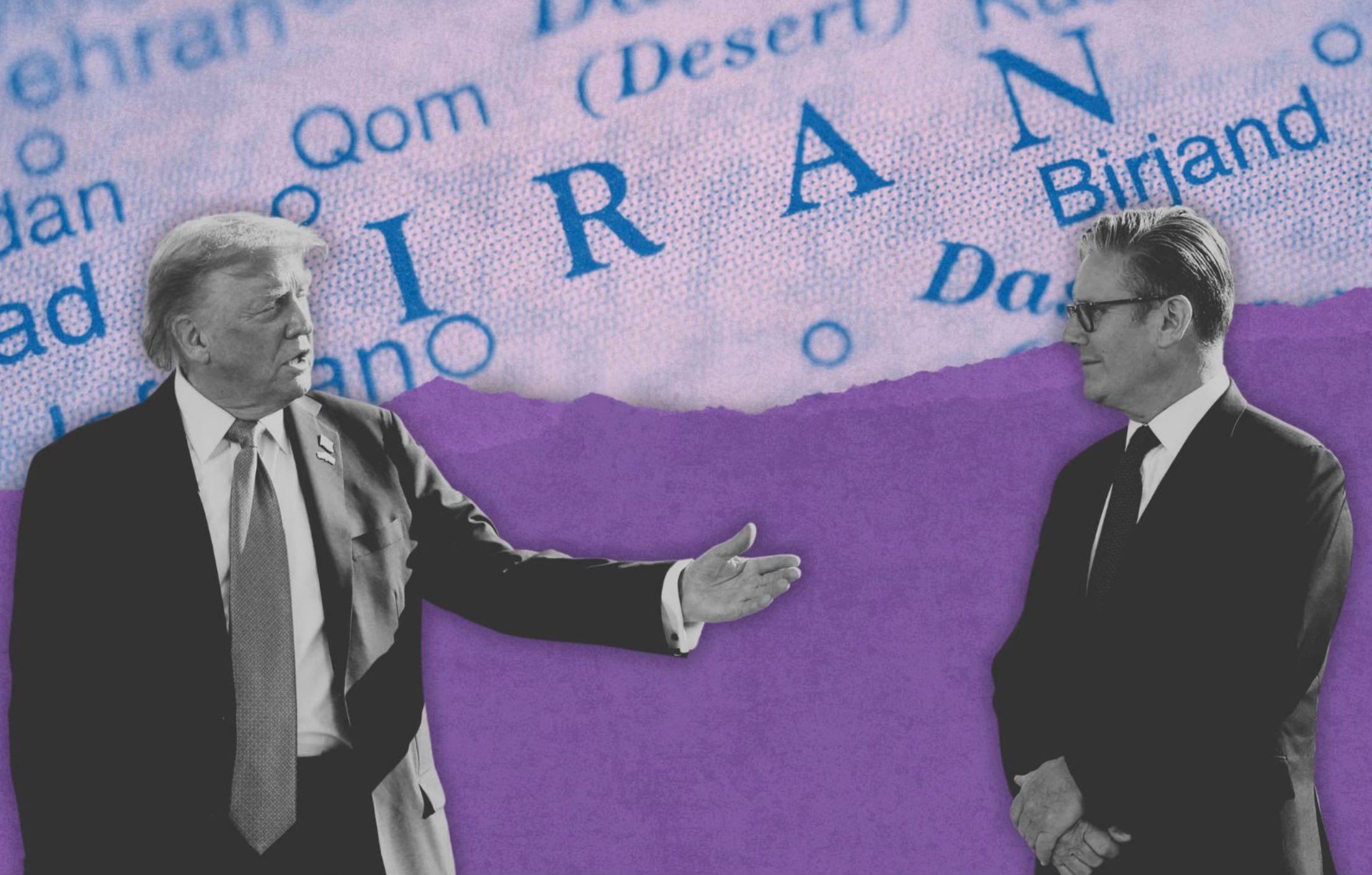
Following America Again: How Starmer is Leading Britain into Another Illegal War
The rhetoric of the British government is a masterclass in the illusion of distance. For weeks, Prime Minister Keir Starmer has stood at dispatch boxes and press podiums, assuring the public that the United Kingdom is a voice of reason, a champion of de-escalation, and crucially, not a participant in the spiralling violence consuming the Middle East. He has spoken of “lawful bases,” of “collective self-defence,” of remembering the “mistakes of Iraq.” He has wrapped the language of restraint around a set of decisions that are anything but restrained. Yet, as the smoke clears over the ruins of Iranian cities and the shattered remains of a primary school in Minab, the grim reality of British involvement can no longer be obscured by linguistic games.
The United Kingdom is not a bystander. Starmer has repeatedly insisted that Britain “will not be drawn into the wider war” and has explicitly ruled out sending British troops to join the offensive (AP News, 2026b). But this is a distinction without a difference. By providing the staging ground for American bombers at RAF Akrotiri, Diego Garcia, and RAF Fairford, the Starmer government has made Britain an active, indispensable participant in an illegal war of aggression. The distance Starmer insists upon is a carefully constructed narrative designed to shield him from accountability, while the machinery of British military infrastructure does the work his words deny. He is hiding behind the semantic technicality that British soldiers are not pulling the triggers, even as British soil provides the platform for the guns.
To understand how we arrived here, we must begin with what actually happened on February 28, 2026, and resist the urge to accept the framing offered by Washington and Whitehall. The joint US-Israeli strikes on Iran were an unprovoked, pre-emptive military campaign (CNN, 2026a). They lacked the authorisation of the United Nations Security Council. They failed to meet any credible threshold for an imminent threat that would justify self-defence under Article 51 of the UN Charter. The Israeli Defence Minister described the strikes as a “pre-emptive attack” designed to “remove threats to the State of Israel,” while President Trump stated the operation sought to destroy Iran’s missiles, raze its missile industry to the ground, and annihilate its navy (Sari, 2026). These are the words of a war of conquest, dressed in the language of security.
The scale of the assault was huge. In a single twelve-hour period, the US and Israel launched nearly 900 strikes across Iran, targeting military infrastructure and the country’s leadership, assassinating Supreme Leader Ali Khamenei and other senior officials (Institute for the Study of War, 2026; Reuters, 2026a). The Israeli Air Force reported engaging over 500 military targets using more than 200 fighter jets in the largest combat sortie in its history (Sari, 2026). This was a campaign designed to decapitate a government, destroy a nation’s defences, and force regime change from the skies — the very outcome Starmer claimed to oppose.
The context in which this war was launched matters enormously, because it is the context that Whitehall would prefer the British public not examine too closely. In the months preceding the strikes, Iran had been convulsed by a wave of mass protests following an economic collapse and the devaluation of its currency. The Iranian government’s response was brutal: security forces killed thousands of protesters, with the deadliest incidents occurring in January 2026 (NPR, 2026; Amnesty International, 2026a). The repression and suffering of the Iranian people was real, and international condemnation was justified. But the suffering of a civilian population under an authoritarian government is not, under any reading of international law, a justification for a foreign military power to launch an unprovoked war against that country. The Trump administration has pointed to Iran’s human rights record as justification for the attacks (American Friends Service Committee, 2026). By that logic, there is no shortage of governments around the world that could be bombed into liberation. That logic therefore, is an excuse.
The Legal Fiction: “Defensive” Aggression
Starmer’s initial response to the outbreak of war was, briefly, a performance of principle. He denied US President Donald Trump’s request to use British military bases, a decision reportedly taken on the basis of legal advice from the UK Attorney General, who flagged concerns that providing such support could render the UK complicit in an internationally wrongful act (Sari, 2026). This was the right call, and the legal reasoning behind it was sound. Under the UN General Assembly’s Definition of Aggression, Article 3(f) is explicit: an act of aggression includes “the action of a State in allowing its territory, which it has placed at the disposal of another State, to be used by that other State for perpetrating an act of aggression against a third State” (Sari, 2026). The Attorney General understood the risk. The Cabinet, including Ed Miliband, Rachel Reeves, and Shabana Mahmood, reportedly expressed opposition to granting base access at a National Security Council meeting on February 27 (The Telegraph, 2026a). For a brief moment, the government appeared to be holding a line.
That line collapsed within seventy-two hours, buckling under the weight of Donald Trump’s fury.
By March 1, Starmer announced that he had granted the US permission to use British bases for “specific and limited defensive purposes” (Starmer, 2026). The justification he offered was the concept of “collective self-defence” — the argument that Iran’s retaliatory strikes on Gulf states that had not attacked it created a legal basis for the UK to act in their defence. This argument deserves serious scrutiny, because it is the fig leaf behind which the entire architecture of British complicity is hidden.
The international legal consensus on the initial US-Israeli strikes is near-unanimous: they were unlawful. There was no prior armed attack by Iran against the US or Israel to justify a military response. There was no imminent threat credible enough to meet even the most expansive interpretation of anticipatory self-defence (Siddique, 2026). Professor Susan Breau, a senior associate research fellow at the Institute of Advanced Legal Studies, stated plainly: “Even the doctrine of imminent use of force is very controversial. But in this case, there doesn’t seem to be any evidence of an imminent threat by Iran” (Siddique, 2026). Professor Victor Kattan of the University of Nottingham added that “having blood-curdling rhetoric or threatening violence in and of itself does not give a state the right to use pre-emptive force” (Siddique, 2026).
The UK’s legal position attempts to sidestep this inconvenient consensus by focusing on Iran’s retaliatory response rather than the initial strikes. The argument runs as follows: Iran’s subsequent missile and drone attacks on Gulf states that had not attacked it constitute armed attacks on those states, which then have the right to request collective self-defence. The UK, acting on those requests, is therefore acting lawfully. This is the legal tightrope that Aurel Sari, writing for Just Security, described in detail, and it is a tightrope that the UK has already fallen off (Sari, 2026).
The problem is that the UK is not just shooting down Iranian drones in the airspace above Qatar. It is providing the logistical and operational infrastructure for a US military campaign whose stated objectives include destroying Iran’s military capability and toppling its government. Professor Philippe Sands of University College London identified the core problem: “The argument that the United Kingdom is entitled to provide defensive support in relation to a use of force which is manifestly unlawful — as the attack on Iran by the US and Israel was — is, on its face, far more problematic” (Siddique, 2026). Professor Adil Haque of Rutgers University was more direct, stating that allowing the US to use British bases for any attacks amounts to aiding US aggression (Middle East Eye, 2026).
The Guardian’s editorial board drew the critical distinction that the government has consistently refused to acknowledge: “Taking out Iranian missile launchers striking British targets would be legal. Embarking upon a campaign to dismantle a sovereign state’s long-term military capacity would not” (The Guardian, 2026). This distinction is precisely where the UK’s legal cover disintegrates. The expansion of base access on March 20 to include strikes on Iranian sites targeting the Strait of Hormuz — sites that are part of Iran’s broader strategic military posture — moves unmistakably in the direction of dismantling long-term capacity (Wheeler and Whannel, 2026). The UK government confirmed that the agreement “includes US defensive operations to degrade the missile sites and capabilities being used to attack ships in the Strait of Hormuz” (GOV.UK, 2026). To degrade capabilities is not to stop an ongoing attack. It is to dismantle a country’s military infrastructure. The legal line has been erased.
The Pretext and the Pattern: Drawing Europe In
The consequences of the Starmer government’s capitulation are already unfolding, and they follow a grimly familiar pattern. By allowing its territory to be used as a launching pad for American bombers, the UK has placed itself squarely in the crosshairs of Iranian retaliation. This is not a theoretical risk: on March 1, one hour after Starmer announced his decision to grant US base access, an Iranian Shahed drone struck the runway at RAF Akrotiri in Cyprus (Reuters, 2026b; AP News, 2026a).
But the escalation did not stop there. In late March, Iran fired two intercontinental ballistic missiles at the joint British-American military base on Diego Garcia (The Telegraph, 2026b). One was intercepted by a US warship; the second failed in flight. The attack marked the first confirmed use of long-range ballistic missiles by Tehran, launched from some 2,400 miles away.
The reaction to this strike reveals the true mechanics of how this war is being managed. The Israel Defense Forces (IDF) immediately seized upon the Diego Garcia attack to issue a chilling public warning: the strike proved Iran now possessed weapons capable of reaching a distance of 4,000km. “We have been saying it: The Iranian terrorist regime poses a global threat,” the IDF stated. “Now, with missiles that can reach London, Paris or Berlin” (The Telegraph, 2026b).
This is classic threat inflation, and it serves a very specific purpose. It is the exact same strategy Israel used to draw the United States into the conflict in the first place. As we have previously documented, the US did not enter this war because of an imminent threat to the American homeland; it entered because Israel launched a pre-emptive strike, forcing the US to join to protect its own assets in the region. Now, that identical playbook is being deployed against Europe. Israel identifies a target, launches a war, and when the inevitable retaliation occurs against Western assets, that retaliation is used as the pretext to demand deeper Western involvement. The IDF’s warning about London and Paris is a lobbying effort designed to drag European nations into a war they did not start and do not need.
The Starmer government is playing along perfectly. The Diego Garcia strike was splashed across every front page in Britain. It was the lead story in the Telegraph, the Times, the Guardian, the BBC. The public could see, in stark and undeniable terms, that sovereign British territory had been attacked as a direct consequence of Starmer’s decision to allow British bases to be used in the war. This should have been the moment of reckoning — the moment when the government acknowledged that its policy had made Britain a target and reversed course. Instead, it became the pretext for going further. The logic is circular and self-reinforcing: provide the bases, invite the retaliation, then use the retaliation to justify providing more bases.
Subscribe to Notes From Plague Island and join our growing community of readers and thinkers.
The trajectory is unmistakable. In the space of three weeks, Britain has moved from refusing base access, to granting “specific and limited” access, to authorising strikes on Strait of Hormuz targets, to having its own sovereign territory hit by Iranian ballistic missiles. Each step makes the next one more likely. Each escalation narrows the political space for de-escalation. This is exactly how Blair’s Britain was drawn into Iraq: not through a single dramatic decision to go to war, but through a series of incremental commitments — no-fly zones, intelligence sharing, forward deployment, logistical support — each one presented as limited, each one making the next inevitable, until British soldiers were in Basra and the country was mired in a conflict that lasted a decade and cost hundreds of thousands of lives. Starmer says he has learned the lessons of Iraq, but the evidence suggests he has learned nothing. The only difference is that this time, the Prime Minister is not even pretending to believe in the cause. Blair, for all his catastrophic failures, at least had the conviction of a true believer. Starmer has the conviction of a man who checked the weather forecast and decided to follow the wind.
Even as the front pages screamed the consequences of his decisions, Foreign Secretary Yvette Cooper continued to peddle the government’s semantic fiction. “We were not and continue not to be involved in offensive action,” she claimed, insisting the UK was only supporting “defensive action” (The Telegraph, 2026b). This statement was made while US Air Force B-1 Lancer bombers were literally taking off from RAF Fairford to bomb Iran. The government is asking the public to believe that providing the runway for the bomber is a purely defensive act, while the bomb itself is someone else’s problem.
The Democratic Deficit: War by Executive Fiat
If the legal and strategic failure of the Starmer government is serious, the democratic failure is nothing short of a constitutional scandal. The United Kingdom is being drawn into a major regional conflict, one with the potential to reshape the entire Middle East, without a single vote in the House of Commons.
Under the UK’s constitutional arrangements, the Prime Minister can authorise military action through the royal prerogative — an archaic power that allows the executive to commit the country to war without parliamentary approval. Over the past two decades, however, a political convention developed that the House of Commons should debate and vote on major military interventions before they are undertaken. This convention was established in the aftermath of the Iraq War, precisely because that conflict demonstrated the catastrophic consequences of executive overreach in matters of war and peace. The Hansard Society, which monitors parliamentary practice, has noted the significance of Starmer’s response to the Iran war in the context of this evolving convention (Hansard Society, 2026).
Starmer has chosen to govern by executive fiat. The initial denial of base access was kept quiet until it leaked to the press. The reversal on March 1 was announced as a fait accompli. The expansion of base access on March 20 was slipped out in a Friday afternoon press release (GOV.UK, 2026). At no point has Parliament been given the opportunity to vote on whether Britain should facilitate a war with Iran.
The circumvention of democratic scrutiny is made all the more egregious by the explicit will of the British people. The public is deeply opposed to this conflict. YouGov polling conducted on March 2 found that 49% of Britons opposed the US-Israeli strikes, compared to just 28% in favour (YouGov, 2026). By March 9, opposition had hardened to 59%, with support remaining flat at 25% (YouGov, 2026). A separate YouGov survey found that 70% of voters oppose the UK joining the US’s offensive, with only 17% in support (The Independent, 2026a). An Opinium poll of UK adults found 45% opposed to the US-Israeli military action and only 22% in support (Opinium, 2026). The government is not acting in the national interest, as Starmer repeatedly claims. It is acting against the explicit, documented, and consistent wishes of the electorate.
The YouGov data also reveals something important about the public’s understanding of the conflict. Just 27% of Britons think America’s reasons for attacking Iran are clear, while 61% think the reasons are unclear (YouGov, 2026). The British public, in other words, is not convinced by the justifications offered by Washington and echoed by Whitehall.
The Geopolitical Consequences: The Price of Subservience
The economic consequences of this subservience are already hitting British households. The effective closure of the Strait of Hormuz — a vital artery through which approximately one-fifth of the global oil supply passes — has triggered an energy shock of historic proportions. Brent crude oil prices surpassed $100 a barrel in the weeks following the outbreak of war (Al Jazeera, 2026; CNN, 2026b). UK gas prices surged 25% after strikes on Qatar’s South Pars gas field (BBC, 2026a).
This geopolitical instability translates directly into domestic economic pain. The Bank of England, which had been expected to cut interest rates before the war began, held them steady in March and warned that inflation could reach 3.5% in the coming months; potentially higher if the energy price spike is sustained (Islam, 2026). Bloomberg reported that the UK’s energy price cap is expected to jump 20% this summer (Bloomberg, 2026). Cornwall Insight estimated that the typical household energy bill would rise by £332 a year in July (BBC, 2026b). The National Institute of Economic and Social Research projected that higher inflation and interest rates would weigh on UK GDP, which it forecast to decrease by 0.2% in 2026 (NIESR, 2026).

These are the costs of a war that the British public did not vote for, does not support, and is now being asked to fund with their household budgets. Starmer has acknowledged the added cost of living pressures, saying that “the longer the conflict continues, the bigger the impact on the cost of living” (The Independent, 2026). What he has not acknowledged is that the UK’s own actions — the provision of military bases to the United States — have deepened Britain’s entanglement in that conflict and made the prospect of a swift resolution less, not more, likely.
The power dynamic between London and Washington that underpins all of this demands honest examination. Starmer’s capitulation on base access was not driven by a careful assessment of British national interest. It was driven by fear of Donald Trump’s anger, fear of damaging the “Special Relationship,” and fear of the public humiliation that Trump was already inflicting.
When Starmer initially hesitated, Trump launched a barrage of deeply personal and public attacks. He told the Telegraph he was “very disappointed in Keir” and complained that Starmer’s shift in stance took “far too much time” (Reuters, 2026c). The next day, speaking at the White House, Trump escalated the rhetoric, comparing Starmer unfavourably to Britain’s wartime leader: “This is not Winston Churchill that we’re dealing with” (Reuters, 2026d). He complained bitterly about the logistical inconvenience caused by British hesitation, stating, “It would have been much more convenient landing there as opposed to flying many extra hours. So we are very surprised” (Reuters, 2026d).
Trump’s demands were for active, enthusiastic participation in his war. He described the UK as the “Rolls-Royce of allies” but stated bluntly, “I was not happy with the U.K. They should be involved enthusiastically. We’ve been protecting these countries for years” (AP News, 2026b). When NATO allies, including Britain, hesitated to send warships to reopen the Strait of Hormuz, Trump branded them “cowards” (BBC, 2026c). He even threatened to abandon the UK entirely, posting on Truth Social that the US didn’t need British aircraft carriers to win the war, adding ominously, “But we will remember. We don’t need people that join Wars after we’ve already won!” (Reuters, 2026e).
Faced with this barrage of insults, threats, and demands for subservience, the Prime Minister did not stand his ground. He folded. He allowed British foreign policy to be dictated by the tantrums of an egotistical American president, proving that the UK is less a sovereign partner than a compliant vassal state. Even after Starmer granted the expanded base access on March 20, Trump was not satisfied. He called the UK’s decision “a very late response” and said he was “surprised because the relationship is so good but this has never happened before” (BBC, 2026c). The message from Washington could not be clearer: Britain’s role is to comply, promptly and without complaint. The “Special Relationship” is not a partnership between equals. It is a relationship in which one party sets the terms and the other scrambles to meet them.
The Moral Reckoning
At the heart of this analysis lies a question that the Starmer government has conspicuously refused to answer: what is the moral weight of the UK’s complicity in the atrocities being committed in Iran?
Amnesty International has conducted an in-depth investigation into a US strike on the Shajareh Tayyibah School in Minab, Hormozgan province, on February 28, 2026 — the first day of the war. The investigation found that 168 people were killed, including over 100 children (Amnesty International, 2026b). The school building was directly struck with guided weapons. Amnesty concluded that this pointed to a failure by US forces to take feasible precautions to avoid civilian harm — a serious breach of international humanitarian law. Erika Guevara-Rosas, Amnesty International’s Senior Director of Research, Advocacy, Policy and Campaigns, stated: “This harrowing attack on a school, with classrooms full of children, is a sickening illustration of the catastrophic and entirely predictable price civilians are paying during this armed conflict. Schools must be places of safety and learning for children. Instead, this school in Minab became a site of mass killing” (Amnesty International, 2026b).
The UN Human Rights Commissioner, Volker Türk, has reported that US and Israeli strikes have claimed the lives of people across Iran, with housing complexes, medical facilities, schools, shops, courthouses, and UNESCO-listed sites among the targets (OHCHR, 2026). The UN education agency, UNESCO, condemned the bombing of the primary school as a “grave violation of international humanitarian law” (UN News, 2026). The New York Times reported that a preliminary US inquiry found US forces at fault in the school strike (New York Times, 2026).
When Starmer authorises the use of RAF Fairford or Diego Garcia, he is authorising the logistical chain that ends with the slaughter of children in their classrooms. This is what British bases are facilitating. This is the reality that the language of “collective self-defence” and “specific and limited defensive purposes” is designed to obscure.
The UK rightly condemns wars of aggression and the targeting of civilian infrastructure when perpetrated by adversaries. It has supported Ukraine in the face of Russian aggression, invoking the sanctity of international law and the UN Charter. Yet it actively supports and facilitates the exact same violations of international law when carried out by its allies. The rules-based international order that Starmer claims to defend is not a set of universal principles. It is, in practice, a selective framework applied to enemies and ignored for friends.
The Green Party leader, Zack Polanski, called the initial strikes “an illegal, unprovoked and brutal attack that shows once again that the USA and Israel are rogue states” and called for the UK to “end our cosy relationship with the USA and our ongoing support for Israel” (The Jewish Chronicle, 2026). These voices have been dismissed. The war continues. The bases remain open. The bombs keep falling.
Conclusion: The Fuel in the Fire
Keir Starmer will tell you that he is protecting British lives and British interests. He will insist that he is acting in accordance with international law, and that he remembers the mistakes of Iraq. He will tell you all of this, and none of it will be true in any meaningful sense.
What he is actually doing is providing the infrastructure for an illegal war, bypassing the democratic institutions of his own country, defying the explicit wishes of the British public, and placing British service personnel and citizens in the crosshairs of a conflict they did not choose. His promise not to send British troops is a hollow comfort when British bases are already serving as the launchpad for the destruction of Iranian cities. He is doing this not because it serves British interests, but because he lacks the political courage to say no to Donald Trump, and because he has allowed Britain to be drawn into the exact same trap of threat inflation and manipulation that Israel used to ensnare the United States.
The long-term damage to Britain’s standing in the world will be severe. The credibility of the UK as a defender of international law — already badly damaged by its complicity in Gaza — is being further shredded with every sortie launched from RAF Akrotiri and RAF Fairford. The credibility of Starmer’s Labour government, which promised a different kind of foreign policy, is in ruins. The British public, who opposed this war from the beginning and who will pay for it through their energy bills, their mortgages, and their household budgets, have been betrayed.
We are not a voice of reason in this conflict. We are not a reluctant bystander. We are not watching the fire from a safe distance. We are supplying the fuel, and history will not forgive us for it.
Or support us with a one-off tip → Buy Me a Coffee
References
Al Jazeera. (2026, March 13). Oil stays above $100 a barrel amid Iran’s stranglehold on Strait of Hormuz. https://www.aljazeera.com/economy/2026/3/13/oil-stays-above-100-a-barrel-amid-irans-stranglehold-on-strait-of-hormuz[Accessed: 21 March 2026]
American Friends Service Committee. (2026). What you need to know about the U.S. war on Iran. https://afsc.org/news/what-you-need-know-about-us-war-iran [Accessed: 22 March 2026]
Amnesty International. (2026a, January 26). What happened at the protests in Iran?https://www.amnesty.org/en/latest/campaigns/2026/01/what-happened-at-the-protests-in-iran/ [Accessed: 21 March 2026]
Amnesty International. (2026b, March). USA/Iran: Those responsible for deadly and unlawful US strike on school that killed over 100 children must be held accountable. https://www.amnesty.org/en/latest/news/2026/03/usa-iran-those-responsible-for-deadly-and-unlawful-us-strike-on-school-that-killed-over-100-children-must-be-held-accountable/[Accessed: 22 March 2026]
AP News. (2026a, March 3). A drone strike jolts RAF Akrotiri, pulling Cyprus into a widening war. https://apnews.com/article/cyprus-britain-military-bases-iran-drones-d217a7fc05b85aad5fddc706c0c71d46 [Accessed: 21 March 2026]
AP News. (2026b, March 18). Trump’s failed strong-arming of allies on Iran shows that pressure is losing its effect.https://apnews.com/article/iran-us-war-trump-starmer-macron-germany-caff1073f932ddb88c3d75c7c356ebc7 [Accessed: 22 March 2026]
BBC News. (2026a). Iran war unleashes ‘world energy shock’. https://www.bbc.com/news/articles/c80me79xlvjo[Accessed: 21 March 2026]
BBC News. (2026b). Typical energy bill forecast to rise by £332 a year in July. https://www.bbc.com/news/articles/c33lnd1gxxro [Accessed: 22 March 2026]
BBC News. (2026c, March 20). UK allows US to use bases to strike Strait of Hormuz targets. https://www.bbc.com/news/articles/c36rny6xgppo [Accessed: 23 March 2026]
Bloomberg. (2026, March 20). UK energy price cap seen jumping 20% as Iran war roils market. https://www.bloomberg.com/news/articles/2026-03-20/uk-energy-price-cap-seen-jumping-20-as-iran-war-roils-market[Accessed: 23 March 2026]
CNN. (2026a, February 28). February 28, 2026 — US-Israeli strikes on Iran. https://edition.cnn.com/world/live-news/israel-iran-attack-02-28-26-hnk-intl [Accessed: 21 March 2026]
CNN. (2026b, March 12). Oil soars above $100 after Iran says Strait of Hormuz will remain shut. https://www.cnn.com/2026/03/12/energy/oil-jump-record-reserves-release-intl-hnk [Accessed: 21 March 2026]
GOV.UK. (2026, March 20). Statement on the conflict in the Middle East: 20 March 2026. https://www.gov.uk/government/news/statement-on-the-conflict-in-the-middle-east-20-march-2026 [Accessed: 23 March 2026]
The Guardian. (2026, March 2). The Guardian view on parliament’s role in war on Iran: MPs should vote before Britain gets sucked in. https://www.theguardian.com/commentisfree/2026/mar/02/the-guardian-view-on-parliaments-role-in-war-on-iran-mps-should-vote-before-britain-gets-sucked-in [Accessed: 21 March 2026]
Hansard Society. (2026, March 5). Starmer, Iran, and Parliament’s role in war powers. https://www.hansardsociety.org.uk/news/parliament-matters-podcast-e134 [Accessed: 22 March 2026]
The Independent. (2026, March 20). Starmer allows Trump to use British bases for strikes to help reopen Strait of Hormuz. https://www.the-independent.com/news/uk/politics/iran-us-war-uk-bases-aggression-b2942419.html [Accessed: 23 March 2026]
The Independent. (2026a). Voters split over Starmer’s response to Iran war, polling shows. https://www.the-independent.com/news/uk/politics/keir-starmer-iran-war-yougov-poll-b2939934.html [Accessed: 22 March 2026]
Institute for the Study of War. (2026, February 28). Iran Update Evening Special Report, February 28, 2026. https://understandingwar.org/research/middle-east/iran-update-evening-special-report-february-28-2026/ [Accessed: 21 March 2026]
Islam, F. (2026, March 19). Iran war is having a dramatic effect on the UK economy. BBC News. https://www.bbc.com/news/articles/c33lnd1gxxro [Accessed: 22 March 2026]
The Jewish Chronicle. (2026, March 3). Green Party calls for UK to cut ties with ‘rogue states’ US and Israel. https://www.thejc.com/news/politics/green-party-calls-for-uk-to-cut-ties-with-rogue-states-us-and-israel-ftiey3i9[Accessed: 21 March 2026]
Middle East Eye. (2026, March 4). Is the UK’s intervention in Iran war legal?https://www.middleeasteye.net/explainers/uk-intervention-iran-war-legal-international-law [Accessed: 22 March 2026]
National Institute of Economic and Social Research (NIESR). (2026, March 4). Middle East Conflict: Macroeconomic Impacts of Rising Oil and Gas Prices. https://niesr.ac.uk/news/middle-east-conflict-macroeconomic-impacts-rising-oil-and-gas-prices [Accessed: 22 March 2026]
New York Times. (2026, March 11). U.S. at Fault in Strike on School in Iran, Preliminary Inquiry Finds. https://www.nytimes.com/2026/03/11/us/politics/iran-school-missile-strike.html [Accessed: 22 March 2026]
NPR. (2026, January 27). At least 6126 people killed in Iran’s crackdown on protests. https://www.npr.org/2026/01/27/nx-s1-5689793/6-126-iran-crackdown-protests-death-toll [Accessed: 21 March 2026]
OHCHR. (2026, March). Civilians bear brunt of reckless war in the Middle East, says Türk. https://www.ohchr.org/en/press-releases/2026/03/civilians-bear-brunt-reckless-war-middle-east-says-turk [Accessed: 22 March 2026]
Opinium. (2026, March 9). The Iran conflict and British public opinion. https://www.opinium.com/resource-center/the-iran-conflict-and-british-public-opinion/ [Accessed: 21 March 2026]
Reuters. (2026a, February 28). US-Israeli strikes kill Khamenei and Iranian retaliation begins. https://www.reuters.com/world/iran-crisis-live-explosions-tehran-israel-announces-strike-2026-02-28/ [Accessed: 21 March 2026]
Reuters. (2026b, March 2). Iranian-made drone hits British air base in Cyprus. https://www.reuters.com/world/europe/british-air-base-cyprus-hit-by-suspected-drone-strike-sky-news-reports-2026-03-02/ [Accessed: 21 March 2026]
Reuters. (2026c, March 2). Brushing off Trump criticism, UK’s Starmer defends actions. https://www.reuters.com/world/europe/trump-very-disappointed-with-uks-starmer-initially-blocking-use-air-bases-2026-03-02/ [Accessed: 22 March 2026]
Reuters. (2026d, March 3). Trump says UK’s Starmer is no Winston Churchill after rift over Iran strikes. https://www.reuters.com/world/europe/trump-says-sad-see-us-uk-relationship-is-not-what-it-was-2026-03-03/ [Accessed: 22 March 2026]
Reuters. (2026e, March 8). Trump tells Britain he does not need its help to win Iran war. https://www.reuters.com/world/europe/trump-tells-britain-he-does-not-need-its-help-win-iran-war-2026-03-07/[Accessed: 23 March 2026]
Sari, A. (2026, March 5). The United Kingdom’s Use of Force Against Iran: Walking a Legal Tightrope? Just Security. https://www.justsecurity.org/133231/united-kingdom-iran-war-international-law/ [Accessed: 22 March 2026]
Siddique, H. (2026, March 2). What is the legality of the US and Israeli attacks on Iran? The Guardian. https://www.theguardian.com/law/2026/mar/02/what-is-the-legality-of-the-us-and-israeli-attacks-on-iran [Accessed: 21 March 2026]
Starmer, K. (2026, March 1). PM statement on Iran: 1 March 2026. GOV.UK. https://www.gov.uk/government/speeches/pm-statement-on-iran-1-march-2026 [Accessed: 21 March 2026]
The Telegraph. (2026a, March 1). Starmer’s secret meetings and the flip-flop on Iran bases. https://www.telegraph.co.uk/politics/2026/03/01/starmer-secret-meetings-flip-flop-iran-bases/ [Accessed: 22 March 2026]
The Telegraph. (2026b, March 22). Iran’s missiles can now reach London, Israel warns Starmer. [Accessed: 23 March 2026]
Time. (2026, March 3). Iran Warns UK Over US Base Access. https://time.com/7203456/iran-warns-uk-us-base-access/[Accessed: 21 March 2026]
UN News. (2026, March). UNESCO condemns strike on Iranian school. https://news.un.org/en/story/2026/03/1147892[Accessed: 22 March 2026]
Wheeler, C., & Whannel, K. (2026, March 20). UK allows US to use bases to strike Strait of Hormuz targets. BBC News. https://www.bbc.com/news/articles/c36rny6xgppo [Accessed: 23 March 2026]
YouGov. (2026, March 9). UK public opinion on the Iran war. https://yougov.com/en-gb/articles/54243-uk-public-opinion-on-the-iran-war [Accessed: 23 March 2026]