Captain Bone Spurs and the Graves He Spits On
There is a medal ribbon in my desk drawer. It is frayed, the colours faded, the stitching at the back done by the hand of a young man who had not yet learned he would survive the war. My grandfather, James, was a signaller in the British Army. He went to war because he believed, in the simple, unadorned way of a working-class boy from Birmingham, that fascism was evil and had to be stopped. He carried the physical and mental scars of that decision for the rest of his life: a leg that never fully healed, an eye that never saw clearly again, and the silent, sleepless nights of a man who had seen the machinery of death up close (L&A, 2025).
He never glorified it. He spoke of duty, not heroism. He knew that war was a failure of humanity — a last resort to be entered into with solemnity and a heavy heart. He understood that sacrifice was not a political talking point, but a currency paid in blood, bone, and the quiet, unseen grief of families. He was one of the lucky ones; he came home. Many did not.
I hold this understanding of service, sacrifice, and the quiet dignity of duty as a sacred inheritance. It is a legacy written not in grand pronouncements, but in the tremor of my late grandfather’s hand, the catch in his voice when he spoke of loss, and the profound respect he held for those who answered the call. It is from this place that I listened to the words of Donald Trump, the President of the United States, a man for whom nothing is sacred if it gets in the way of his grievance.
From the gilded halls of Davos, Trump, a man who avoided his own generation’s war with a convenient diagnosis of bone spurs, saw fit to pass judgment on the courage of allied soldiers in Afghanistan. “You know, they’ll say they sent some troops to Afghanistan, or this or that,” he sneered in an interview with Fox News, “and they did, they stayed a little back, a little off the front lines” (Pylas, 2026).
He continued his assault on reality, questioning the very foundation of the alliance forged in the aftermath of the war my grandfather fought. “I know them all very well,” he said of NATO leaders. “I’m not sure that they’d be there. I know we’d be there for them. I don’t know that they would be there for us” (Pylas, 2026).
Let us be clear: this was not a careless misstatement. It was a weapon. Trump’s words were a calculated desecration of memory, deployed to serve a grievance. At the time, he was embroiled in a dispute over his desire to annex Greenland, and his attacks on NATO were a tool of coercion (Pylas, 2026). In Trump’s world, everything is a transaction. Alliances, treaties, and even the honour of the dead are just bargaining chips. The sacrifice of allied soldiers was simply collateral damage in a shakedown. It is the bile of a coward, spitting on the graves of men and women whose courage was inconvenient to his agenda.
The Lie of the Front Lines
“A little off the front lines.” The phrase hangs in the air, thick with the stench of ignorance and contempt. It is a lie so demonstrably false, that it constitutes a form of historical vandalism, deployed to diminish an ally in a moment of pique.
When the United States was attacked on September 11, 2001, the world stood with it. For the first and only time in its history, NATO invoked Article 5, its collective defence clause. The principle is simple: an attack on one is an attack on all. It was not America answering the call of its allies; it was America’s allies answering the call of a wounded and grieving nation.
Over the next two decades, more than 150,000 British troops served in Afghanistan (House of Commons Library, 2024). They were not, as Trump’s boneheaded imagination would have it, cowering in the rear. They were in the thick of it, fighting and dying in some of the most dangerous territory on earth. They were in Helmand Province, a Taliban stronghold, a place of dust, heat, and improvised explosive devices. It was a place where the front line was everywhere and nowhere, where a routine patrol could become a fight for survival in the blink of an eye.
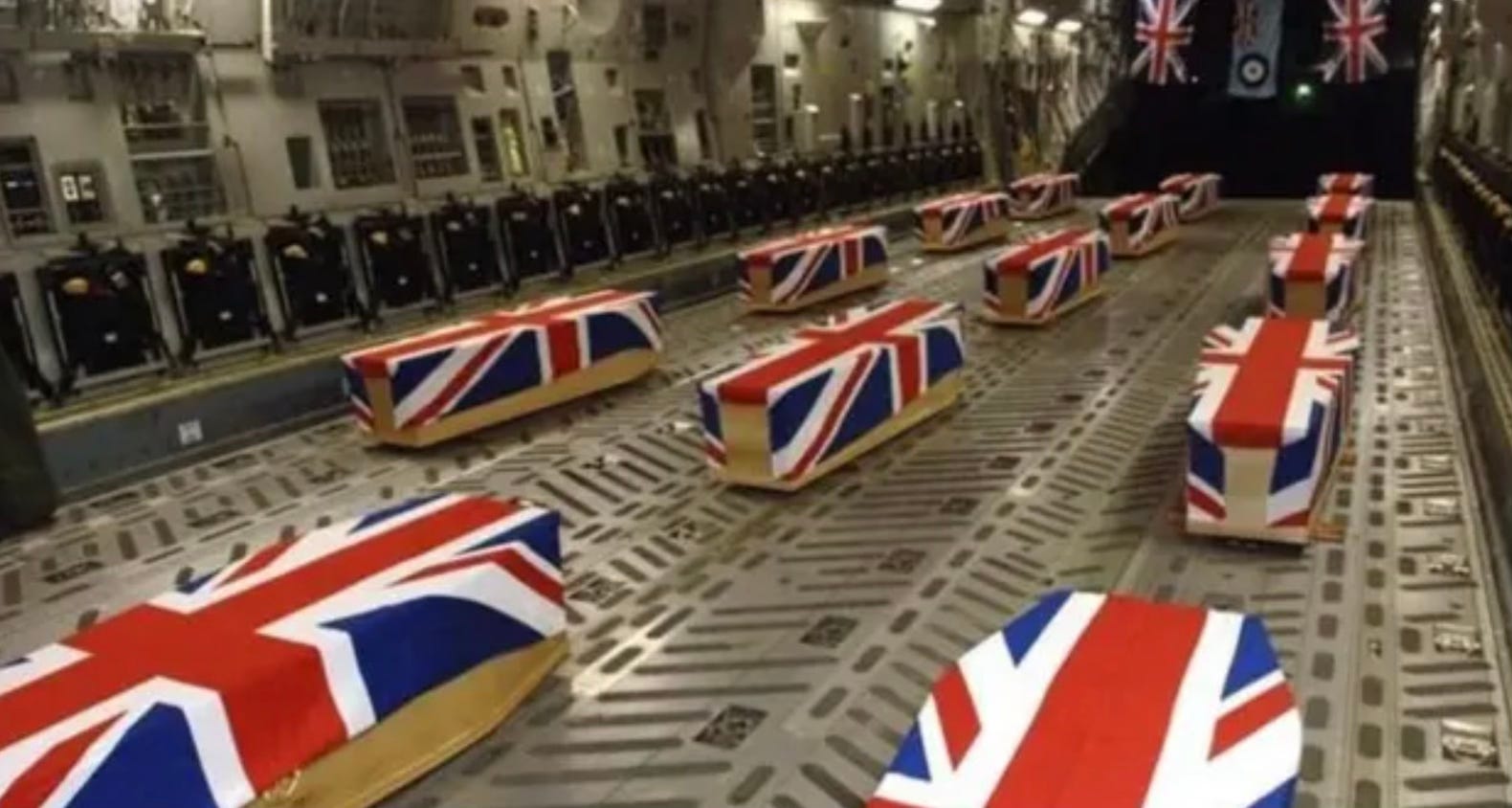
457 British service members died in Afghanistan (House of Commons Library, 2024). They were blown up by IEDs, shot by insurgents, and killed in firefights. They did not stay “a little back.” They were on the front lines of a war that America had asked them to fight. They were there, shoulder to shoulder with their American comrades, sharing the same risks, the same fears, and, for too many, the same fate.
And it was not just the British. In total, over 1,100 non-American NATO service members died in Afghanistan. Soldiers from Canada, Denmark, France, Germany, Italy, and dozens of other nations paid the ultimate price. Denmark, a country of less than six million people, lost 44 soldiers, the highest per capita death toll of any coalition nation outside the United States (Pylas, 2026). They are sons and daughters, husbands and wives, fathers and mothers. They are the honoured dead of nations who believed that their alliance with the United States meant something more than a line item on a ledger.
For Trump, their sacrifice is a currency to be devalued at will. It is an act of profound disrespect not only to the dead, but to the living: to the veterans who carry the scars of that war, to the families who live with the empty chair at the table, to the nations who honoured their commitment to a friend in need, only to have that commitment thrown back in their faces.
Subscribe to Notes From Plague Island and join our growing community of readers and thinkers.
The Voices of the Betrayed
The reaction in Britain was raw and immediate. Prime Minister Keir Starmer called Trump’s remarks “insulting and frankly appalling.” His office stated plainly that the American president was “wrong to diminish the role of NATO troops.” Defence Secretary John Healey reminded the world that the UK and NATO allies “answered the US call,” and that the more than 450 British personnel who lost their lives “should be remembered for who they were — heroes who gave their lives in service of our nation” (Topping, Mason and Grierson, 2026).
Across the political spectrum, the condemnation was unanimous. Even Kemi Badenoch, the Conservative leader, called Trump’s comments “flat-out nonsense” and accused him of “denigrating” British troops. The Liberal Democrats urged Starmer to summon the US ambassador “over this insult to our brave troops.” Armed Forces Minister Al Carns, a former Royal Marine who served four tours in Afghanistan and was awarded the Military Cross for his bravery, called the claims “utterly ridiculous.” In a video posted to social media, he invited anyone who believed Trump’s remarks to meet him and some of the bereaved families. “Alongside my American colleagues,” he said, “we shed blood, sweat and tears together, and not everybody came home” (Topping, Mason and Grierson, 2026).
The most devastating rebuke came from Diane Dernie, whose son, Ben Parkinson, suffered catastrophic injuries when his Army Land Rover hit a mine in Helmand in 2006. Ben lost both legs and suffered severe brain damage. He has spent nearly two decades fighting for his care, for a decent life, recovering from operation after operation. “To hear this man say: ‘Oh, well, you just fannied about behind the frontlines’...” she said. “It’s the ultimate insult” (Pylas, 2026). Dernie called on the Prime Minister to “call him out. Make a stand for those who fought for this country and for our flag, because it’s just beyond belief” (Pylas, 2026).
These are the voices of people who have paid the price of war, who have lived its consequences every single day. They are the voices of a nation that answered America’s call and now watches as its sacrifice is erased by a man who has never sacrificed anything.
A Coward’s Contempt
Trump’s disdain for the military is a consistent thread running through his public life, a deep-seated contempt for the very idea of service and sacrifice. This is, after all, a man who received five deferments to avoid serving in the Vietnam War, the last one for the now-infamous “bone spurs” in his heels. While his countrymen were fighting and dying in the jungles of Southeast Asia, Donald Trump was building his fortune and his brand.
He has never been able to recall which foot was afflicted by this convenient ailment, a detail that seems to have been lost to the mists of time. The daughters of the Queens podiatrist who provided the diagnosis have since come forward to say that it was done as a “favour” to his father, Fred Trump (Stracqualursi, 2018). It was a lie, a cheap trick to avoid his duty, and it is the lens through which he views all military service, whether from his own citizens or his allies.
Because he is a coward, he cannot comprehend courage. Because he is a narcissist, he cannot understand sacrifice. Because his entire life has been a series of transactions, he cannot grasp the concept of duty. And so, he projects his own failings onto others. He sees the world as a reflection of his own hollow soul.
This is the man who, according to his own former Chief of Staff, retired Marine General John Kelly, referred to the American soldiers who died at Belleau Wood as “suckers” for getting killed. This is the man who, when cancelling a visit to the Aisne-Marne American Cemetery near Paris in 2018, allegedly said, “Why should I go to that cemetery? It’s filled with losers.” He cancelled the visit, according to multiple sources with firsthand knowledge, not because of the rain as he claimed, but because he feared his hair would become dishevelled. The vanity of a man who cares more about his appearance than honouring the dead (Goldberg, 2020).
This is the man who attacked a Gold Star family, the parents of Captain Humayun Khan, a Muslim American soldier who died protecting his unit in Iraq in 2004. Khizr Khan stood at the Democratic National Convention and held up a copy of the Constitution, asking if Trump had ever read it. Trump’s response was to attack the grieving father and to suggest that his wife, Ghazala Khan, wasn’t “allowed” to speak, a vile insinuation rooted in bigotry. He then compared his own “sacrifices” — building buildings, creating jobs — to the sacrifice of a family who had lost their son in war.
This is also the man who mocked Senator John McCain, a man who endured five and a half years of torture as a prisoner of war in Vietnam, saying, “He’s not a war hero. He was a war hero because he was captured. I like people who weren’t captured” (Rucker and Leonnig, 2019).
For Trump, anyone who sacrifices for a cause greater than themselves is a “loser” or a “sucker.” It is the core of his worldview. And it applies equally to American heroes like John McCain and to the British, Danish, and Canadian soldiers who died in Afghanistan. Their sacrifice is an incomprehensible, and therefore contemptible, act.
A Debt of Honour
I think of Ben Parkinson, who lost his legs and his future to a mine in the Afghan dust, and his mother, who has spent nearly two decades fighting for his care. I think of the Danish soldiers, 44 of them, who died in a country most of their countrymen could not find on a map, because their nation believed in the promise of an alliance. I think of the Canadian soldiers, the French soldiers, the German soldiers, all of them answering the call that America made.
I am filled with anger at the injustice of it all. Anger at the man who sits in the highest office in the land and dares to diminish their sacrifice to score a point in a petty squabble. It is a lie that he is a patriot, when he is, in fact, the very antithesis of everything that word should mean.
He is a man who wraps himself in the flag while denigrating the people who fight for it. He claims to love his country while treating its most sacred alliances as disposable. He is a man who demands loyalty but offers none in return. He is one who feeds on the courage of others, drawing strength from the sacrifices of people he holds in contempt, while contributing nothing but insults and lies. He is weak. He is vain. He is a coward. And he is a liar.
Donald Trump, with his cheap insults and hollow heart, stands alone, a king of a gilded cage, forever unable to understand the quiet dignity of the world beyond his own reflection. He will never know what it means to serve, or what it means to sacrifice. He will never know what it means to honour the dead, because to him, the dead are just losers who got in the way of a deal.
We must not let his lies stand. We must not allow his desecration of memory to go unanswered. We must speak the truth, loudly and clearly, for the sake of the dead, for the sake of the living, and for the sake of the future.
My grandfather did not fight so that men like Donald Trump could spit on the graves of the fallen. He fought so that we could live in a world where courage is honoured, where alliances are kept, and where the truth still matters. That is the legacy we must refuse to forget, and it must be the thread we carry forward.
L, 23 January, 2026.
Or support us with a one-off tip → Buy Me a Coffee
References
Goldberg, J. (2020) ‘Trump: Americans Who Died in War Are ‘Losers’ and ‘Suckers’’, The Atlantic, 3 September. Available at: https://www.theatlantic.com/politics/archive/2020/09/trump-americans-who-died-at-war-are-losers-and-suckers/615997/ [Accessed: 23 January 2026].
House of Commons Library (2024) ‘Afghanistan statistics: UK deaths, casualties, mission costs and refugees’, Research Briefing CBP-9298, 9 December. Available at: https://commonslibrary.parliament.uk/research-briefings/cbp-9298/[Accessed: 23 January 2026].
L&A (2025) ‘Threads of Duty: My Grandfather, Fascism, and the Legacy I Refuse to Forget’, Notes From Plague Island,21 October. Available at: https://www.plagueisland.com/p/threads-of-duty-my-grandfather-fascism [Accessed: 23 January 2026].
Pylas, P. (2026) ‘’The ultimate insult’: Trump diminishing NATO’s Afghanistan involvement causes distress in UK’, PBS NewsHour, 23 January. Available at: https://www.pbs.org/newshour/politics/the-ultimate-insult-trump-diminishing-natos-afghanistan-involvement-causes-distress-in-uk [Accessed: 23 January 2026].
Rucker, P. and Leonnig, C. (2019) ‘“I like people who weren’t captured”: The story behind Trump’s long-running feud with John McCain’, The Washington Post, 20 March. Available at: https://www.washingtonpost.com/politics/i-like-people-who-werent-captured-the-story-behind-trumps-long-running-feud-with-john-mccain/2019/03/20/a1353a4a-4a74-11e9-93d0-64dbcf38ba41_story.html [Accessed: 23 January 2026].
Stracqualursi, V. (2018) ‘Daughters of foot doctor say he made Trump bone spurs diagnosis as ‘favor’ to Fred Trump: New York Times’, CNN, 26 December. Available at: https://www.cnn.com/2018/12/26/politics/trump-bone-spurs-vietnam-war [Accessed: 23 January 2026].
Topping, A., Mason, R. and Grierson, J. (2026) ‘Starmer accuses Trump of diminishing sacrifice of Nato troops in Afghanistan’, The Guardian, 23 January. Available at: https://www.theguardian.com/us-news/2026/jan/23/donald-trump-outrage-nato-troops-avoided-afghanistan-frontline [Accessed: 23 January 2026].


Thank you for sharing such a personal and moving account. These stories need to be told and shared, and I thank you, again, for doing just that.
Hi Teresa, thank you for reading and for taking the time to leave such a warm and appreciative comment. My grandfather left an indelible mark (in the best way) upon my worldview. Thank you again; I’m glad that this article resonated with you. 🙏 ~Laura