
War is Peace: How Trump’s Board of Peace Weaponises Genocide

Since December 2024 we have documented the genocide in Gaza and the political, legal and rhetorical machinery Britain and the West built to protect it. Every piece is collected, in the order it was written, at Palestine: The Evidence.
This is the story of Donald Trump’s “Board of Peace,” an institution born from Palestinian genocide, wreathed in the smoke of fabricated diplomacy. Rather than a diplomatic breakthrough, the October 2025 Gaza ceasefire was the cover for an imperial power grab, a meticulously engineered fiction designed to replace the post-war international order with a for-profit dystopia governed by a chairman-for-life. This article will dissect the architecture of this new world order, expose the lies it is built on, and reveal the global resistance that is already fighting back.
George Orwell wrote Nineteen Eighty-Four in 1949 as a warning. Seventy-seven years later, his warning has become an instruction manual.
Orwell’s great insight was that totalitarian control operates through violence as well as the systematic destruction of truth itself. The Party controls reality by controlling language, erases history through “memory holes,” and maintains perpetual war while calling it peace. In the novel, Winston Smith finds a coral paperweight — a beautiful, fragile object from a time before the Party — that proves another world once existed. The Party smashes it, but its existence mattered. The greatest threat to freedom isn’t the boot stamping on a person’s face, but when that person learns to love the boot.
The Board of Peace is the culmination of this logic; an institution built on the wreckage of truth.
The Memory Hole and the Anatomy of a Deception
In Oceania, the Ministry of Truth constantly rewrote history, dropping inconvenient facts into the “memory hole” to be incinerated and forgotten. The Board of Peace’s creation followed this template precisely: a three-act deception performed on the world stage.
First, the crisis: By September 2025, after nearly two years of relentless bombardment and engineered starvation, a UN Commission of Inquiry delivered its damning verdict: Israel had committed genocide in Gaza (OHCHR, 2025). The 72-page report was a charge sheet, documenting four of the five genocidal acts as defined by the 1948 Genocide Convention. Crucially, it found “direct evidence of genocidal intent” in the unvarnished statements of Israeli officials. The finding created a global political firestorm. The world had a front-row seat to a crime in progress.
Then, the bait: That October, against this backdrop of international outrage, Trump announced a surprise Gaza ceasefire. The media, starved for a glimmer of hope after years of brutal conflict, took the bait and amplified the narrative. Peace, it seemed, was finally at hand.
But the ceasefire was pure theatre. The killing never stopped; it simply disappeared from the newspapers and television screens. Within weeks, while the world celebrated a manufactured peace, the Hamas-run Government Media Office documented over one hundred separate instances of Israeli shelling and shootings. The UN reported that Israel had rejected more than a hundred aid requests, tightening the screw of starvation. The genocide continued in the dark, a testament to Orwellian genius: manufacture consent for a “peace process” while the violence accelerates.
War is Peace.
Finally, the trap: On November 17, 2025, the UN Security Council walked into it. By a vote of 13-0, with China and Russia abstaining, it passed Resolution 2803. The resolution vaguely endorsed a “Board of Peace” to manage the post-ceasefire process, with diplomats believing they were authorizing a limited, Gaza-specific body that would exist only until the end of 2027 (Borger, 2026a). They thought they were binding Trump to a multilateral process, but it was a fatal miscalculation.
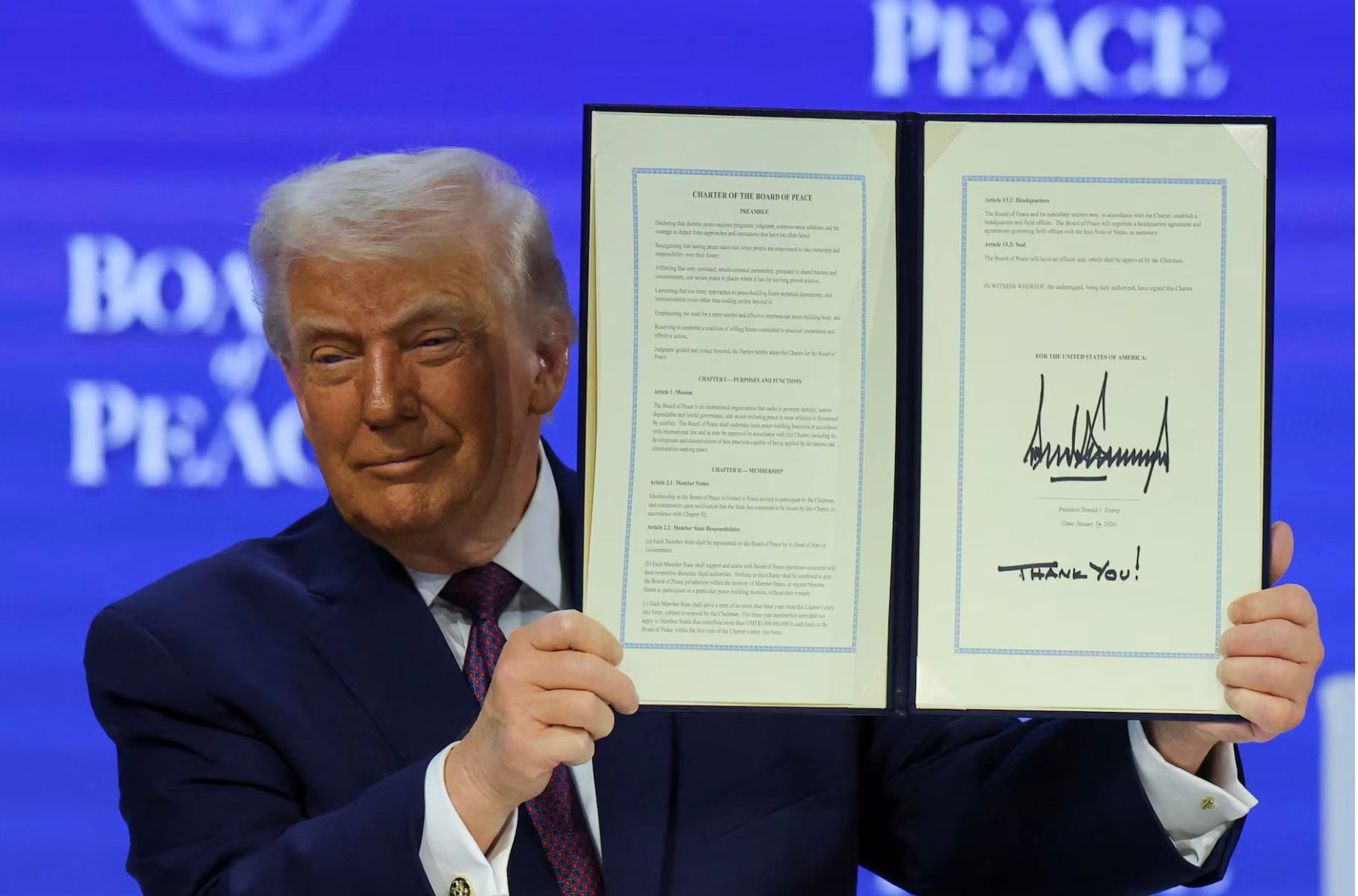
Then came the switch: On January 22, 2026, in the opulent halls of Davos, the real charter was signed. The 11-page document made no mention of Gaza. Instead, Article 1 established “an international organization” for “areas affected or threatened by conflict,” a sweeping, global mandate. The preamble called for “a more nimble and effective international peace-building body,” positioning it as a direct competitor to the United Nations (Magid, 2026).
The deception was complete. The body the UN thought it was endorsing for a specific, humanitarian, time-limited purpose was revealed as a permanent, global institution designed to supplant the UN itself. The ceasefire was never the goal. It was the marketing campaign.
Political theorist Frantz Fanon would have recognised this as the “architecture of erasure” (Solomon, 2026). The phony ceasefire erased the memory of the preceding genocide. The charter then erased Gaza entirely from the Board’s mandate. And the Palestinian people, whose suffering was the pretext for this entire project, appear nowhere in the document. They have been written out of their own story, their voices silenced, their future to be decided by the very billionaires and autocrats who profited from their destruction.
History offers chilling precedents. The British East India Company, a private corporation that conquered a subcontinent, extracted its wealth while millions starved, all under the guise of bringing “civilization.” King Leopold II’s Congo Free State was marketed to the world as a great humanitarian work, while in reality it was, in the words of historian Adam Hochschild, “the vilest scramble for loot that ever disfigured the history of human conscience.” The League of Nations mandates, which promised self-governance after World War I, became a cynical exercise in carving up the Middle East for the benefit of European powers.
The Board of Peace is the 21st-century heir to these predatory enterprises: a for-profit colonial administration dressed in the language of peace and reconstruction, designed to extract wealth from rubble while the world is encouraged to applaud.
The Architecture of Power
Deception requires structure. Trump assembled an Executive Board to operationalise the lie.
The Chairman: Absolute Authority Codified
The charter enshrines not a president, but a man. Article 3.2 states: “Donald J. Trump shall serve as the inaugural Chairman of the Board of Peace and shall designate his successor.” This is monarchy, a dynastic principle woven into the fabric of a supposedly modern institution. The charter grants him three forms of absolute power: interpretive supremacy (Article 7 makes him the “final authority” on the charter’s meaning), unilateral action (Article 9 grants him the authority to “adopt resolutions” without consultation), and indefinite tenure (he is removable only by a unanimous vote of an Executive Board he personally appoints).
The charter makes this explicit. Article 7 states:
“The Chairman shall be the final authority regarding the meaning, interpretation, and application of this Charter. All decisions of the Board shall be subject to the approval of the Chairman.”
In other words, Trump determines what the rules mean, and all decisions require his approval. This is dictatorship codified as international law. Member states wanting permanent status must contribute $1 billion, yet even that membership remains subject to renewal by the Chairman (Borger, 2026a). In Orwell’s Oceania, Big Brother’s face was on every telescreen, his presence inescapable. In the Board of Peace, Trump’s authority permeates every article.
The Executive Board: A Cartel of Vultures
The seven-member board, handpicked by Trump, is a gallery of loyalists, profiteers, and enablers; a corporate board of directors for a captured state (Handley, 2026).
First among them is Steve Witkoff, the billionaire real estate magnate appointed as Special Envoy. Witkoff’s portfolio is a testament to his worldview: gleaming towers in Manhattan and Miami, monuments to capital and luxury (Witkoff Group, 2026). His diplomatic experience is non-existent, but that is the point. His role is not to engage in the patient, frustrating work of multilateral negotiation, but to conduct shuttle diplomacy between strongmen, brokering deals for resources and reconstruction contracts with the same transactional logic he applies to a property deal. He is the face of a foreign policy that sees nations as assets on a balance sheet (Borger, 2025).
Then there is Jared Kushner, the President’s son-in-law, whose previous forays into Middle East diplomacy were marked by a chilling blend of naivete and avarice. It was Kushner who, while Gazans were still pulling bodies from the rubble, mused that “Gaza’s waterfront property is very valuable.” At Davos, he unveiled AI-generated mock-ups of a “New Gaza,” a sterile landscape of high-rises and marinas, a developer’s fantasy projected onto a scene of mass death. His vision for raising Gaza’s GDP to $10 billion was a masterclass in evasion, never specifying who would profit from this reconstruction, though the answer was obvious to anyone paying attention (Jones, 2026).
Marc Rowan, the CEO of Apollo Global Management, a private equity behemoth with over $500 billion in assets, represents the financial engine of this new order. Rowan’s philosophy was laid bare in late 2023 when he led a campaign to oust the president of the University of Pennsylvania, threatening to withdraw donations unless she resigned over her handling of campus protests. She resigned. He had demonstrated how concentrated capital could be weaponised to enforce ideological conformity. Now, he brings that same playbook to the global stage, where the targets are not university presidents, but sovereign nations.
Finally, the Board includes Tony Blair, a man whose presence serves not as a source of legitimacy, but as a declaration that war criminals are welcome. The former British Prime Minister, whose championing of the illegal 2003 invasion of Iraq made him a pariah across much of the globe, now lends his name to another catastrophic venture. The Chilcot Inquiry into the Iraq War delivered a damning verdict on his leadership, concluding that he presented intelligence with a “certainty that was not justified.” He is the architect of one of the 21st century’s greatest foreign policy disasters, a man whose legacy is inextricably linked to manufactured consent and a war that destabilised an entire region. His presence on the Board is a statement of intent. He is the ghost of imperial adventures past, summoned not to bless, but to normalise the imperial adventures of the future. His inclusion sends a clear message: accountability is for the powerless (Jones, 2026).
Subscribe to Notes From Plague Island and join our growing community of readers and thinkers..
The rest of the board comprises of Ajay Banga, the World Bank President, who represents the capture of existing international financial institutions; Marco Rubio, the Secretary of State, and Robert Gabriel, the Deputy National Security Adviser, who embed the Board’s agenda deep within the U.S. foreign policy apparatus. In no way is this a board of peace. It is a board of directors for a colonial enterprise: developers to monetise the land, financiers to structure the deals, political fixers to manage the client states, and institutional figures to provide the illusion of legitimacy.
The Symbolism of the Seal: A World Remade
Even the Board’s logo is an act of aggression, a visual declaration of its intent to supplant the existing world order. Rendered in gaudy gold, it is a deliberate and cynical appropriation of the United Nations emblem. The familiar olive branches, symbols of peace, are still there, but the world map they frame has been fundamentally altered.
The UN emblem, designed in 1945, is a projection of the globe centred on the North Pole, a deliberately neutral perspective that shows no country at its heart. It is a visual representation of the principle of sovereign equality.
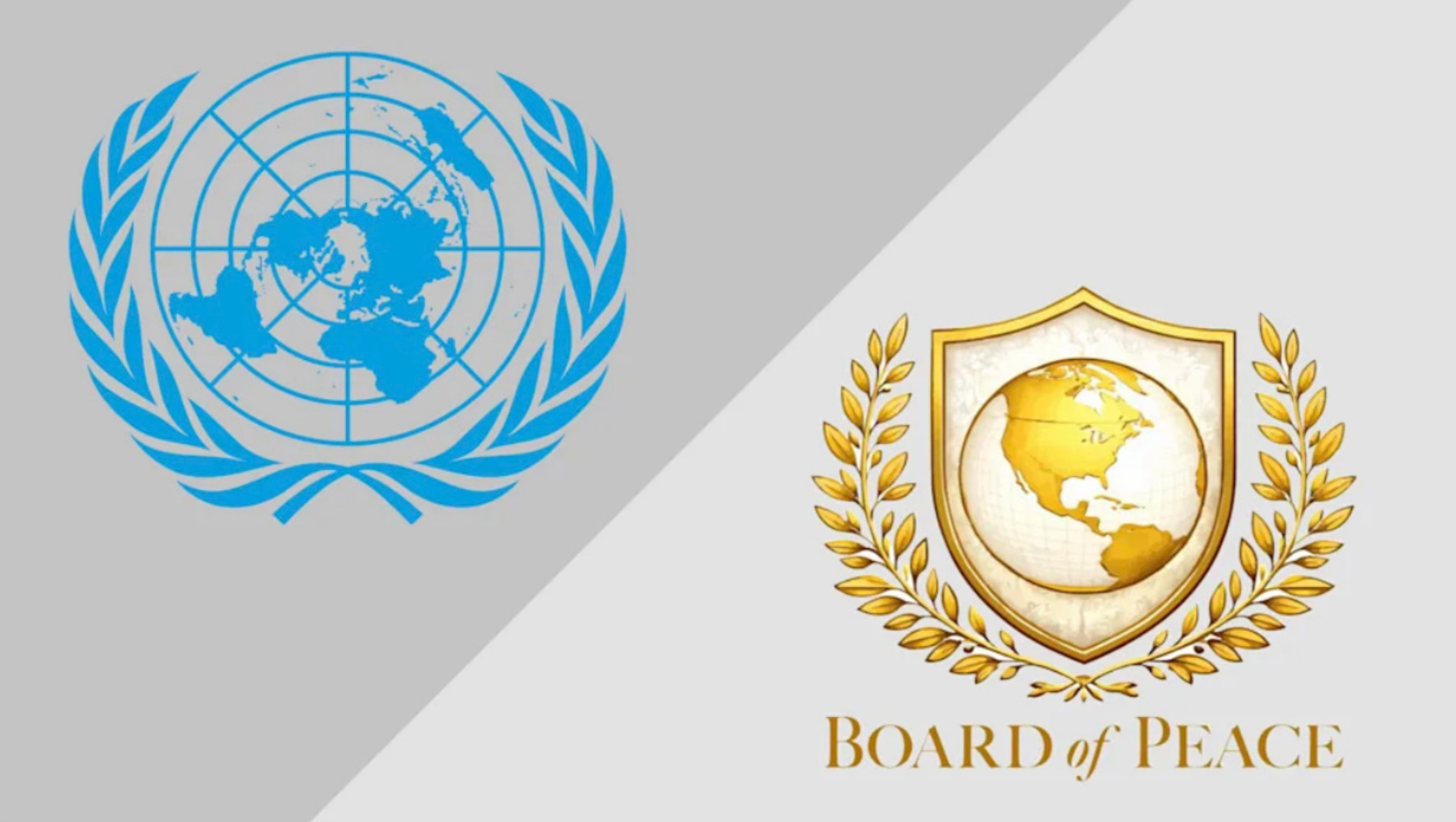
The Board’s seal discards this principle entirely. The map is re-centred, with the United States placed squarely at its heart. The other continents are arranged around it, no longer equal partners in a global community, but satellites orbiting a central power. It is a cartographic representation of a hub-and-spoke empire, a visual echo of the charter’s monarchical structure.
The choice of gold is not accidental. It is the colour of Trump’s real estate empire, the colour of opulence and personal wealth. It replaces the cool, impartial blue of the United Nations with the warm glow of money. The message is clear: this is not an institution of public service, but a private enterprise. The world is not a community of nations, but a portfolio of assets.
The logo operates as a mission statement in miniature, a declaration that the world has been remade in Trump’s image. It is the visual corollary to the charter’s legal framework: a world where one nation stands at the centre, and all others are relegated to the periphery.
The Broader Membership: A Pay-to-Play Cartel
The membership of the Board is as revealing as its leadership. Of the 62 nations invited to join, only 25 accepted the invitation; a coalition of the willing, defined by their authoritarian credentials and their desire for a seat at the table of the new world order (Handley, 2026). Israel, despite Netanyahu’s initial feigned objections, was among the first to sign on. They were joined by a predictable cast of characters: Saudi Arabia, the UAE, Egypt, Hungary, and other states where the rule of law is a negotiable concept.
More telling, however, are the nations that refused. The world’s major democracies, the traditional pillars of the post-war order, recoiled in horror. France’s Foreign Ministry issued a frosty statement, declaring that the charter “goes beyond the sole framework of Gaza and raises serious questions, in particular with respect to the principles and structure of the United Nations.” Germany, the United Kingdom, Canada, Japan, and the Nordic states all followed suit, refusing to participate in what they correctly identified as a hostile takeover of the international system (Kohut et al., 2026).
And in one of the most chilling details of all, not a single Sub-Saharan African nation was even invited to join. An entire continent of over a billion people was deemed irrelevant to this new global architecture. Their voices were not sought; their consent was not required. They were, in the cold calculus of the Board, not players in the game, but merely part of the playing field. A vast expanse of resources and populations to be managed, developed, and exploited by the new colonial masters. An entire continent, erased from the map of the future.
Newspeak: The Language of Domination
Power structures require language structures. The Board’s very name is Newspeak perfection: a body designed to facilitate war, displacement, and exploitation is called a “Board of Peace.” In Orwell’s vision, Newspeak was designed to make alternative thought impossible. The Board’s charter follows this logic to the letter.
Consider Article 1’s purpose statement: “to promote international peace, security, and prosperity.” The UN Charter’s foundational purposes are peace and security. The word “prosperity” appears nowhere in its mandate. This seemingly innocuous addition is a poison pill. It signals that peace is subordinate to profit, that security means protecting investments above all else.
Most insidiously, the charter’s preamble laments that “too many approaches to peace-building foster perpetual dependency, and institutionalize crisis.” This is a classic piece of doublethink. It positions the UN and the entire humanitarian aid system as a failure, while presenting the Board as the solution. Yet the Board’s own structure creates a far more vicious form of dependency — nations must pay a billion dollars for a seat at the table — and institutionalises crisis by financialising reconstruction, ensuring that conflict zones become permanent investment opportunities.
Doublethink, the ability to hold two contradictory beliefs simultaneously, pervades the entire structure. The Board claims to promote peace while being led by a developer who salivates over Gaza’s “waterfront property” and a financier whose business model is asset-stripping. It promises development while empowering speculators. These contradictions are designed to train observers to accept that words mean whatever power says they mean.
The most sophisticated manipulation of all involved China’s public rejection of the Board. On January 21, 2026, Chinese Foreign Ministry spokesman Guo Jiakun stated unequivocally: “No matter how the international landscape may evolve, China will stay firmly committed to safeguarding the international system with the UN at its core” (Khaliq and Gokce, 2026). This explicit rejection from a permanent member of the Security Council should have been a diplomatic earthquake.
Instead, it vanished from Western media within 48 hours. The Board’s signing ceremony on January 22 proceeded as if China’s opposition didn’t exist. This is the Memory Hole operating in real time: an inconvenient fact is simply dropped from the official discourse, ceasing to exist. In Nineteen Eighty-Four, the Party understood that “who controls the past controls the future. Who controls the present controls the past.” Erase China’s rejection from the record, and the Board’s legitimacy becomes that much harder to question. The ceasefire erased the genocide. The charter erased Gaza. Now, the media erases the opposition. Each erasure makes the next one easier.
In Nineteen Eighty-Four, the lexicographer Syme explains the purpose of Newspeak to Winston: “Don’t you see that the whole aim of Newspeak is to narrow the range of thought? In the end we shall make thoughtcrime literally impossible, because there will be no words in which to express it.”
Every use of the word “peace” to mean war, every invocation of “development” to mean exploitation, narrows the range of thought and makes resistance harder to articulate. This is why the fight over language matters. When we accept calling this institution a “Board of Peace,” we have already conceded the most important terrain.
The battle for reality begins with refusing to speak their language.
A World on the Auction Block
Gaza was the laboratory. If the world accepts that genocide can be rebranded as peace and international law replaced by a pay-to-play cartel, then the Gaza model will be exported globally. This is a business plan.
We no longer need to speculate. The Venezuelan operation, executed just weeks before the Board’s official charter was signed, provided a stunning proof of concept. On January 3, 2026, Trump ordered U.S. Marines into Caracas to abduct President Nicolás Maduro, a brazen act of military aggression against a sovereign nation, undertaken without UN authorisation, congressional approval, or any discernible legal pretext. Three days later, with Maduro in US custody, Trump announced an “energy deal” that effectively seized control of Venezuela’s vast oil reserves. The language was pure Newspeak: the deal would “restore Venezuela as a responsible, prosperous ally” through the “modernization, expansion, and upgrading” of its oil infrastructure, with funds to be “disbursed for the benefit of the American people and the Venezuelan people at the discretion of the U.S. government.”
This is the Board of Peace model in action: military intervention, regime change, and resource seizure, all cloaked in the benevolent language of restoration. The international response was muted, a mixture of shock and weary resignation. As the economist Yanis Varoufakis noted with bitter irony, many of the same European leaders who had quietly expressed reservations about the Board’s charter remained silent on Venezuela. “They thought that this is for Brown people,” he observed, “for people in the developing world.” The silence was a green light.
With the Venezuelan template established, the Board’s gaze now turns to other prizes. The reconstruction of Ukraine is not seen as a humanitarian imperative, but as a multi-trillion-dollar market for infrastructure contracts, agricultural land, and energy resources, to be carved up by the Board’s member states and their corporate partners. Iran, the ultimate prize, would be subjected to a “reconstruction” that would dwarf the Marshall Plan, its vast energy sector and educated populace handed over to the Board’s control. Rather than foreign policy, it is asset acquisition on a global scale.
If this model consolidates, we are witnessing a regression to 19th-century imperialism, armed with 21st-century tools. The old colonial powers claimed to bring “civilization”; the Board claims to bring “stability.” Leopold II’s rapacious exploitation of the Congo was marketed as a humanitarian endeavour; the Board’s plans for Gaza are marketed as “reconstruction,” even as its members dream of waterfront property on mass graves. Sovereignty becomes a commodity, human rights an externality. The world is cleaved in two: those who can afford a seat at the table, and those who find themselves on the menu.
In Nineteen Eighty-Four, Oceania didn’t just conquer territories; it transformed them. The conquest was linguistic, institutional, and psychological. Victory meant the conquered forgot they had ever been free. Gaza, if the model succeeds, won’t remember genocide; it will remember “reconstruction.” The AI-generated images of gleaming towers will replace the memory of rubble. “New Gaza” will be the official history. This is how every colonial project has rewritten its own history. The children born in “New Gaza” will grow up not knowing what was lost. The children in a reconstructed Venezuela or Ukraine or Iran will learn that the Board saved them, that sovereignty was a burden lifted from their shoulders. This is the generational transformation: not just controlling the present but colonising the future’s understanding of the past.
The Unwritten Future
But the Board’s power, built on lies, is fragile. Its authority is performative, not inherent, and the performance is already failing. The most significant act of refusal came from Beijing. China’s public, unequivocal rejection of the Board was a structural blow to Trump’s ambitions, creating a powerful alternative for nations that refuse to bow to his cartel (Khaliq and Gokce, 2026). The European Union has refused to join. The Global South is organising. The coalition of the willing is small and shrinking.
Resistance is everywhere: in the streets of London and Cairo, in the student walkouts, in the leaked documents from dissenting officials. The Board’s power depends on a perception of inevitability. Every act of refusal shatters that illusion.
In Nineteen Eighty-Four, Orwell gives us two endings. In the first, Winston Smith is broken and learns to love Big Brother. But in the appendix, written in the past tense, he reveals that the Party eventually fell. Totalitarianism is not a permanent condition because it contains the seeds of its own destruction.
We stand at that moment of refusal. The boot descends, but the world is not watching passively. In the protests, in the quiet acts of bureaucratic sabotage, in the hearts of those who refuse to forget, the coral paperweight — that fragile, beautiful object from a time before the Party — survives. It is dangerous precisely because it proves another reality is possible. The proles, Orwell’s ordinary people who lived beneath the Party’s notice, held the only hope because they had remained human, retaining their capacity for love and solidarity. Today, the proles are the two million Palestinians in tents who refuse to disappear, the protestors in global capitals who refuse to forget, the journalists who document the truth despite the threats, the nations that declined the invitation, the students who walk out, the diplomats who leak. They are us.
Conclusion: The Hand That Holds the Pen
The Ministry of Peace stands complete. The charter is signed; the Executive Board is seated. Trump’s vision of a world ordered by personal loyalty and purchased access, rather than by international law, is now operational.
But functioning does not mean inevitable. The Board’s power, like that of the Party in Nineteen Eighty-Four, is built on a foundation of lies: the fake ceasefire, the bait-and-switch charter, the Newspeak that calls exploitation “development.” And lies, as the saying goes, have short legs. They require constant maintenance, a perpetual war against the truth. Every time we call this project by its true name — colonialism, predation, theft — we reclaim the language and, with it, the power to resist. Every act of solidarity with the Palestinian people, every refusal to forget the crimes that were committed, is a blow against the memory hole.
The Board represents everything that Orwell warned us against. But Orwell also showed us why that future is not inevitable: totalitarian control fails when people refuse to forget, refuse to accept, and refuse to comply. We stand at that moment of refusal now. What is needed is not a vague sense of hope, but a concrete set of demands:
● Demand that your government refuse to legitimise this cartel. Make it politically costly to join.
● Demand that the UN Security Council revoke Resolution 2803. The Board has violated its limited mandate; its authorisation should be withdrawn.
● Demand an investigation into the charter’s violations of international law. The Board’s very structure contradicts the UN Charter’s foundational principle of sovereign equality.
● Demand accountability for those who seek to profit from genocide. Jared Kushner should not be brokering real estate deals on mass graves. Marc Rowan should not be structuring financial returns from displacement.
● Demand protection for the journalists, protestors, and whistleblowers who are documenting the Board’s reality.
● Demand support for genuine Palestinian self-determination, not a Board-administered technocratic government, but actual sovereignty.
These demands are achievable if enough people insist, if scattered resistance becomes a coordinated opposition, if the gap between the Board’s claims and its reality becomes impossible to ignore.
In Nineteen Eighty-Four, Winston’s defeat is not the book’s end. The appendix on Newspeak comes after, written in the past tense, describing the Party’s language as a historical artifact. Orwell gave us that ending as a gift: the reminder that even the most totalitarian systems are inevitably self-defeating. He wrote to show us the worst of what we might become, so that we might choose to fight for something better. The question is whether we will heed his warning.
War is Peace, they tell us. The answer is “no.” War is war, peace is peace, and we retain the language to tell the difference. Genocide is not progress. Theft is not development. Colonialism is not reconstruction.
The hand that holds the pen is not theirs alone. It is ours. What we write next determines whether Orwell’s nightmare or his hope becomes reality.
Or support us with a one-off tip → Buy Me a Coffee.
References
Borger, J. (2025) ‘Steve Witkoff: from property developer to global spotlight as Trump’s tough-talking troubleshooter’, The Guardian, 22 February. Available at: https://www.theguardian.com/us-news/2025/feb/22/steve-witkoff-trump-gaza-ukraine-envoy [Accessed: 31 January 2026].
Borger, J. (2026a) ‘Trump’s board of peace is an imperial court completely unlike what was proposed’, The Guardian, 20 January. Available at: https://www.theguardian.com/us-news/2026/jan/20/trumps-board-of-peace-is-an-imperial-court-completely-unlike-what-was-proposed [Accessed: 31 January 2026].
Handley, L. (2026) ‘Who is on Trump\’s Gaza “Board of Peace”?’, CNBC, 22 January. Available at: https://www.cnbc.com/2026/01/22/who-is-on-trumps-gaza-board-of-peace.html [Accessed: 31 January 2026].
Jones, O. (2026) ‘Donald Trump needs helpers for his appalling neocolonialist project. What else is this “board of peace”?’, The Guardian, 19 January. Available at: https://www.theguardian.com/commentisfree/2026/jan/19/donald-trump-needs-helpers-for-his-appalling-neocolonialist-project-what-else-is-this-board-of-peace [Accessed: 31 January 2026].
Khaliq, R. and Gokce, S. (2026) ‘China extends support to UN-centered system over Trump’s ‘board of peace’’, Anadolu Agency, 21 January. Available at: https://www.aa.com.tr/en/americas/china-extends-support-to-un-centered-system-over-trump-s-board-of-peace-/3806340 [Accessed: 31 January 2026].
Kohut, A. et al. (2026) ‘Trump’s Board of Peace: an alternative to the UN?’, OSW Centre for Eastern Studies, 22 January. Available at: https://www.osw.waw.pl/en/publikacje/analyses/2026-01-22/trumps-board-peace-alternative-to-un[Accessed: 31 January 2026].
Magid, J. (2026) ‘Full text: Charter of Trump’s Board of Peace’, The Times of Israel, 18 January. Available at: https://www.timesofisrael.com/full-text-charter-of-trumps-board-of-peace/ [Accessed: 31 January 2026].
OHCHR (2025) ‘Israel has committed genocide in Gaza Strip, UN commission finds’, Office of the High Commissioner for Human Rights, 25 September. Available at: https://www.ohchr.org/en/press-releases/2025/09/israel-has-committed-genocide-gaza-strip-un-commission-finds [Accessed: 31 January 2026].
Solomon, R. (2026) ‘The new mandate: Recolonisation, “peace” boards, and the architecture of erasure’, Middle East Monitor, 18 January. Available at: https://www.middleeastmonitor.com/20260118-the-new-mandate-recolonization-peace-boards-and-the-architecture-of-erasure/ [Accessed: 31 January 2026].
Witkoff Group (2026) Portfolio. Available at: https://www.witkoff.com/portfolio [Accessed: 31 January 2026].
Thank you! The 1984 comparisons wrote themselves once I saw how the ceasefire was used to erase the genocide from public consciousness while the charter was being drafted. Orwell understood that controlling language is controlling reality and that's exactly what the Board is attempting. Glad the analysis resonated.
Another stellar article. Great analysis of the Board of Peace's charter, great framing with the, very apt, comparisons to Orwell's 1984.