The Unveiling: Reform UK and the Recycling of a Failed Elite
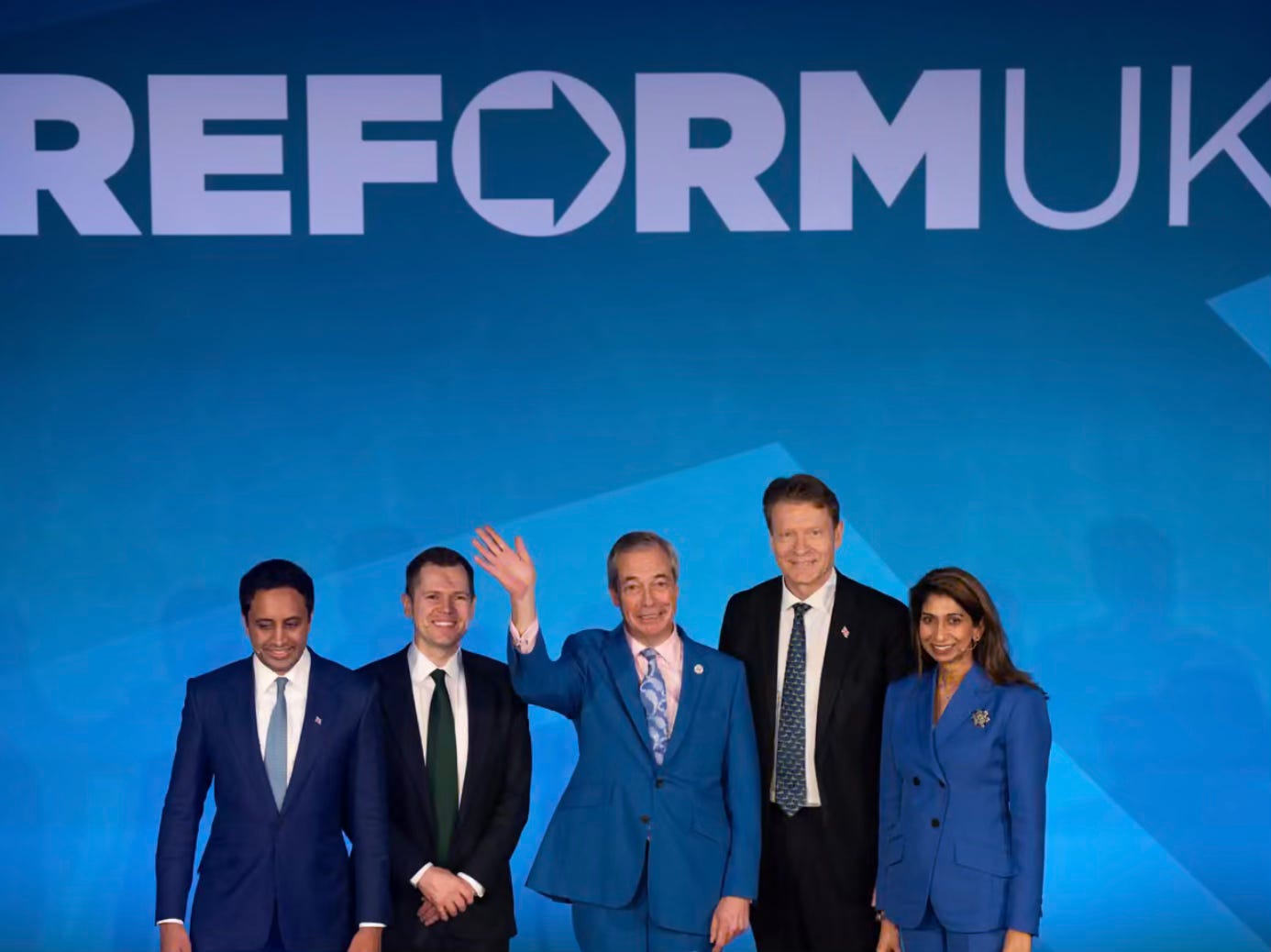
In the sterile, managed theatre of a Westminster press conference, Nigel Farage, the perpetual insurgent of British politics, presented what he termed a “machine for government” (Walker, 2026a). The unveiling of Reform UK’s first frontbench team was intended as a moment of profound declaration, a signal that the “one-man band” had matured into a credible political orchestra ready to assume power. Yet, what was unveiled was not a rupture from the political establishment, but its most cynical and dangerous recycling. The cast of characters assembled on the stage — Robert Jenrick, Suella Braverman, Richard Tice, and Zia Yusuf — did not represent a break from the past, but a harder, more ideological distillation of the very forces that have driven Britain into its current state of managed decline.
Farage’s presentation was a masterclass in his signature brand of authoritarian populism. He spoke of a party that had found its identity beyond his identity, a machine robust enough to survive even his own sudden departure from the political stage. Yet, in the same breath, he laid down the law with chilling clarity: dissent would not be tolerated, disloyalty would be met with swift removal, and he, and he alone, would have the final say on policy (Walker, 2026a). The message was unmistakable: this is a party that speaks the language of democratic renewal while operating under the iron fist of a single, unaccountable leader. The unveiling, therefore, was a moment that laid bare the profound and dangerous contradictions at the heart of the Reform project: a movement that claims to speak for the people while being led by a privately educated elite, a party that rails against the establishment while being staffed by its most recent and prominent failures, and a political force that promises a new future while being animated by the most toxic and divisive ideologies of the past.
The Myth of Rupture and the Politics of Amnesia
The central pillar of Reform UK’s political appeal is the narrative of a broken Britain, a nation in decline, betrayed by a failed political establishment. It is a powerful and resonant message, one that taps into a deep well of public discontent. Yet, the composition of Farage’s new frontbench team exposes this narrative as a calculated and cynical fiction. The presence of Robert Jenrick and Suella Braverman, two senior figures from the very Conservative governments that have presided over the last decade of national life, shatters the myth of rupture. Their inclusion is a clear indication that Reform is, in essence, a continuation of the same political project, albeit in a more radical and unapologetic form.
This is not merely a case of “failed Tories” finding a new home, as Labour’s Anna Turley suggested (quoted in Walker, 2026a). It is a far more profound and insidious political strategy, one that relies on a form of induced public amnesia. Reform’s political method depends on the electorate forgetting that the very people now promising to save the nation are the same people who held the levers of power during the period of its decline. Jenrick, as a former Treasury minister, and Braverman, as a two-time Home Secretary, were at the heart of the governments that Farage and his party now so vehemently condemn. Their presence in the Reform frontbench is a testament to the party’s belief that the public has a short memory, that the anger and frustration of the present can be harnessed to erase the inconvenient truths of the recent past.
The hypocrisy is breathtaking. Jenrick, who in October 2018 praised the “careful stewardship of the economy” under Philip Hammond’s Conservative budget, celebrating how “the hard work of the British people is paying off” (quoted in Walker, 2026b), now stands as the man to fix the economic chaos that his own party helped to create. Braverman, who as Home Secretary presided over a failing immigration system and was sacked not once but twice — a distinction that places her, as the Institute for Government noted, in the unique position of being “a senior secretary of state who has been sacked twice by two different prime ministers within 14 months” (Institute for Government, 2023) — is now presented as the solution to the very problem she failed to solve. This is the political equivalent of an arsonist returning to the scene of the crime and offering to lead the fire brigade. The claim that Reform represents a genuine break from the past is a calculated and cynical deception, one that treats the British public not as citizens to be engaged, but as a forgetful and easily manipulated mass.
The Politics of Division and the Assault on Equality
If the inclusion of Jenrick and Braverman exposes the myth of rupture, then Braverman’s specific policy pronouncements reveal the truly dangerous and divisive ideology that lies at the heart of the Reform project. Her appointment to the education, skills, and equalities brief is a clear and unambiguous signal of the party’s intention to wage a culture war on the very foundations of a fair and inclusive society. Her performance at the unveiling press conference was a chilling preview of what a Reform government would mean for the legal and social fabric of Britain.
Braverman’s declaration that she would abolish her own equalities brief and repeal the Equality Act on her first day in government is a declaration of war on the legal framework that protects ordinary people from discrimination in their daily lives (Walker, 2026a). At the press conference, she made her position explicit: “The Britain that I love is being ripped apart by diversity, equality and inclusion … on day one, we will get rid of the equalities department” (quoted in Sparrow, 2026). Her stated aim is to eliminate what she calls the “divisive notion of protected characteristics” (Sparrow, 2026). The Equality Act 2010 is not, as Braverman and her allies would have us believe, a piece of “woke” legislation; it is a cornerstone of a decent and civilized society, a legal shield that protects individuals from unfair treatment on the basis of their age, disability, gender reassignment, marriage and civil partnership status, pregnancy and maternity, race, religion or belief, sex, and sexual orientation (Equality and Human Rights Commission, 2021). To repeal it would be to turn back the clock on decades of social progress, to remove the legal protections that so many have fought so hard to win, and to unleash a new era of division and discrimination.
Braverman’s own rhetoric as Home Secretary provides a clear indication of her intentions. Her infamous description of pro-Palestinian demonstrations as “hate marches” in November 2023 was not a slip of the tongue, but a calculated and deliberate attempt to delegitimize and demonise a significant section of the British public (Al Jazeera, 2023). The Guardian’s compilation of her controversial statements noted that this was part of a consistent pattern: she had previously described immigration as an “invasion” of Britain’s southern coast, language that was widely condemned as inflammatory and dehumanising (Guardian, 2023). This is the politics of division, a strategy that seeks to consolidate power by setting one group against another, by turning neighbour against neighbour, and by creating a climate of fear and suspicion. The repeal of the Equality Act would be the legislative embodiment of this divisive and dangerous ideology, a structural change to the legal landscape that would leave the most vulnerable in our society exposed and unprotected. As the TUC warned in response to the announcement, Reform UK would effectively “make discrimination legal” (Sparrow, 2026).
Who Gets Left Behind? The False Promise of Opportunity
At the heart of Braverman’s educational agenda is a proposed shift in focus from university attendance to vocational training. She announced at the press conference that instead of a target to have fifty percent of young people attending university, this would be switched to fifty percent training in trades such as being an electrician or carpenter (Walker, 2026a). On the surface, this may seem like a reasonable ambition. The expansion of trade skills and apprenticeships is a policy that many would support, a recognition that a university degree is not the only path to a successful and fulfilling life. But, when viewed in the context of Reform’s wider ideological project, this seemingly benign proposal takes on a far more sinister and exclusionary character.
The problem is not the expansion of vocational training in itself, but the fact that it is being proposed in tandem with the dismantling of equalities protections and the politicisation of the education system. Braverman’s critique of what she calls “liberal ideology” in schools is not a call for a more balanced and intellectually rigorous curriculum; it is a thinly veiled threat to academic freedom and a clear signal of her intention to impose a narrow and politically motivated agenda on the nation’s classrooms. In her press conference remarks, she stated: “It is clear today that in too many respects, we are getting it wrong across our schools, a quiet crisis has taken hold … Discipline, once the backbone of education, has been weakened in the name of progressive ideology” (quoted in Walker, 2026b). In this context, the shift to vocational training is about creating a two-tier system of education, one that funnels a certain segment of the population into a predetermined set of trades while reserving the traditional levers of power and influence for a privileged few.
This is not a culture-war argument. It is a serious argument about power and social mobility. The fact that the entire Reform frontbench team was privately educated is by no means a trivial detail; it is a stark and revealing symbol of the profound hypocrisy that lies at the heart of their political project. As the Guardian’s live blog revealed, citing data from The British General Election of 2024 by Robert Ford, Tim Bale, Will Jennings, and Paula Surridge, seventy-five percent of Reform UK MPs are now privately educated — six out of eight — making Reform “the only party with a majority of privately educated MPs” (Sparrow, 2026). This compares to forty-six percent for Conservative MPs. One of the recent Conservative defectors to Reform, Danny Kruger, is an Old Etonian (Sparrow, 2026). These are individuals who have benefited from the very system of elite education that they now seek to dismantle for others. They are the products of a system that has historically served as a conveyor belt to the highest levels of power and influence, a system that they now wish to preserve for themselves and their children while offering a different, and implicitly inferior, path to everyone else. The promise of expanded vocational training, when stripped of its populist rhetoric, is revealed as a cynical and self-serving strategy, one that will not expand opportunity, but entrench and exacerbate the very inequalities that have left so many feeling left behind.
Subscribe to Notes From Plague Island and join our growing community of readers and thinkers.
Whose Interests Are Prioritised? The Politics of Extraction
The economic and energy policies unveiled by Richard Tice, Reform’s new business, trade, and energy spokesman, provide a further, and equally revealing, insight into the party’s true priorities. Tice’s pledge to end the “madness” of renewable energy policy and to double down on the extraction of offshore oil and gas is a clear and unambiguous statement of whose interests a Reform government would serve. At the press conference, Tice declared: “To be an enriched nation, you have to have to have cheap energy … and of course, that means using the joy of our very valuable energy treasure, oil and gas, offshore, onshore, and having the courage to get rid of the madness of what we have politely coined net stupid zero” (quoted in Walker, 2026b). This is not a policy for the people, but a policy for the powerful, a program of deregulation and extraction that would prioritise the short-term profits of the fossil fuel industry over the long-term well-being of the planet and its people.
The hypocrisy of Tice’s position is, once again, breathtaking. As the former chief executive of the property firm CLS Holdings, Tice was once a champion of environmental sustainability. The company’s 2012 annual report proudly announced: “Buspace Studios has become our first building with zero net emissions … This is the first time a building in our London portfolio has made use of renewable energy, and we intend to replicate its success elsewhere across the portfolio” (quoted in Walker, 2026b). Tice is a man who is clearly capable of understanding and even championing the principles of environmental sustainability. His current embrace of a hard-line, anti-environmental agenda is not, therefore, a matter of intellectual conviction. It is instead a matter of political expediency; a cynical and calculated appeal to a particular segment of the electorate, a populist performance that is designed to tap into a sense of grievance and resentment against what is perceived as a remote and out-of-touch environmental elite. But behind the populist rhetoric lies a clear and consistent pattern: a deep-seated hostility to any form of regulation or constraint on the activities of capital and industry.
This is the common thread that runs through all of Reform’s policy pronouncements, from the repeal of the Equality Act to the abandonment of net zero. It is a program that consistently prioritises the interests of business owners over workers, of landlords over tenants, of corporations over communities. The promise of a sovereign wealth fund to aid in the “reindustrialisation” of the UK is a classic piece of populist misdirection, a grand-sounding gesture that is designed to obscure the fact that the party’s core economic agenda is one of radical deregulation and a race to the bottom (Sparrow, 2026). Ed Miliband, Labour’s energy secretary, captured this danger succinctly when he warned that UK fuel bills would “skyrocket” if Tice ever became energy secretary due to his “dangerous” views (Sparrow, 2026). This is a plan to further strip the UK for parts, to sell off its assets to the highest bidder, and to leave the British people to deal with the social and environmental consequences.
Removing the Constraints on Power: The ECHR and the Authoritarian Turn
The final, and perhaps most revealing, piece of the Reform puzzle is the party’s stated intention to withdraw the United Kingdom from the European Convention on Human Rights (ECHR). This is a fundamental and dangerous step, one that would remove a crucial external check on the power of the British state and leave the rights and freedoms of ordinary citizens dangerously exposed. The ECHR is not, as its critics claim, an unaccountable foreign court that imposes its will on a sovereign nation; it is a treaty that the UK helped to draft in 1951, a legal framework that has protected the fundamental rights of British citizens for over seventy years, including protection from torture, killing, and slavery, as well as assuring freedom of speech and assembly (Liberty, n.d.). To leave it would be to abandon a long and proud tradition of commitment to human rights and to align Britain with Russia, which was expelled from the Council of Europe in 2022, making it the only other European nation to have left the Convention (UK and EU, 2025).
The question that must be asked is: who benefits from the weakening of legal constraints on the power of the state? The answer, as history has repeatedly shown, is not ordinary people. It is not protesters, or minorities, or trade unionists, or workers in dispute with powerful employers. The ECHR protects the right to freedom of assembly and association, including the right to form and be part of trade unions (Equality and Human Rights Commission, 2016). Its rulings have influenced UK employment law, protecting workers’ rights to fair treatment and representation. The beneficiaries of a weakened legal framework are always the powerful, those who wish to act without constraint, to silence dissent, and to impose their will on the population without fear of legal challenge. The fact that Reform’s home affairs spokesman, Zia Yusuf, has explicitly linked the party’s desire to leave the ECHR to its plan for mass deportations is a chilling admission of the party’s true intentions. At the press conference, Yusuf declared: “We will not just leave the ECHR, we will derogate from every international agreement that could be used to frustrate our plan for deportations” (quoted in Walker, 2026b). This is about removing the legal obstacles that stand in the way of a radical and authoritarian agenda.
The implications of such a move are profound and far-reaching. It would not only weaken the legal protections available to British citizens, but it would also damage Britain’s standing in the world and undermine its ability to champion the cause of human rights on the global stage. As Chatham House warned in 2023, “UK withdrawal from the ECHR affects how the UK wishes to be viewed, and how it will be perceived by others. It has far-reaching implications” (Chatham House, 2023).
This is the authoritarian turn, the moment when a political movement that claims to speak for the people reveals its true and deep-seated contempt for the very principles of liberty and justice that underpin a democratic society.
The Pincer Closes: Farage, Trump, and the Geopolitical Project
To understand Reform UK’s true significance, we must place it within a broader geopolitical context. Farage’s political project is not an isolated phenomenon; it is part of a coordinated effort to fragment and destabilise the European Union, accelerated by both American and Russian political forces. Farage’s long-standing relationship with Donald Trump is well documented. The two men share not just a personal friendship, but a common political vision: a world order based on transactional relationships between strongmen, unencumbered by the constraints of multilateral institutions or international law.

In January 2026, reports emerged that Trump had created a fund to boost the MAGA agenda in the UK and Europe, with Reform UK’s involvement (The National, 2026). Byline Times revealed that Reform UK’s cryptocurrency partner has ties to Trump-supporting tech firms and senior Conservative figures (Ahmed, 2026). Reform UK has been holding MAGA-style rallies across Britain, with the Irish Times describing the “Trumpian vibes” of a February 2026 event featuring broadcaster Jeremy Kyle (Irish Times, 2026). Yusuf himself has explicitly modelled Reform’s approach on Trump’s second administration, telling the Sunday Times in August 2025: “We are going to move at great speed. It’ll be much more like Trump mark two than Trump mark one” (quoted in Walker, 2026b).
But the connections run deeper and darker. Farage’s admiration for Vladimir Putin is a matter of public record. In 2014, he told GQ Magazine that Putin was the leader he most admired in the world, “as an operator, but not as a human being” (Bienkov, n.d.). He has consistently opposed sanctions on Russia and questioned the narrative of Russian aggression. In November 2025, the scandal deepened when Nathan Gill, Reform’s former leader in Wales, was jailed for taking payments to make statements in favour of Russia (Guardian, 2025). The Guardian urged Farage to “root out Reform links to Russia,” while Le Monde reported that he was being urged to clarify his party’s ties with Russia (Le Monde, 2025). Politico noted in February 2026 that “Reform UK is making efforts to shake off its foreign policy headaches, from Putin to Trump” (Politico, 2026).
This is the pincer closing on London. On one side, Trump’s America, a nation that has abandoned its post-war commitment to multilateralism and now seeks to reshape the world through brute economic and military power. On the other, Putin’s Russia, a revanchist authoritarian state that has weaponised energy, disinformation, and corruption to undermine democratic institutions across Europe. And in the middle, Farage, a man who has spent his entire political career working to break apart the European Union, now positioning himself to lead Britain into alignment with this emerging authoritarian axis. If Reform UK were to win power, London would not be restored to some imagined past glory; it would fall to the pincer, becoming a willing participant in the broader project of European fragmentation and the replacement of the post-war liberal order with a new architecture of authoritarian capitalism.
Conclusion: The Revolution That Never Was
The unveiling of Reform UK’s frontbench team was, in the end, a moment of profound and unintended clarity. It was the moment when the party’s revolutionary rhetoric collided with the hard and inconvenient reality of its own composition and its own ideology. What was revealed was a tired and cynical recycling of a failed and discredited elite. This is a restoration, a desperate attempt by a certain segment of the British establishment to cling to power by harnessing the anger and frustration of those they have so profoundly failed.
Reform UK is not a solution to the crisis of British politics; it is a symptom of it. It is the product of a political system that has become detached from the lives and concerns of ordinary people, a system that has allowed a narrow and self-serving elite to enrich itself at the expense of the nation as a whole. The party’s program is not a plan for national renewal, but a recipe for further division, further inequality, and a further erosion of the democratic and legal foundations of our society. It is a harder, more ideological, and more dangerous version of the very system that created the crisis in the first place.
The most revealing thing about Reform is not what it says about Britain’s future. It is what its leadership tells us about Britain’s past — and who still believes they should be allowed to run it.
Or support us with a one-off tip → Buy Me a Coffee
References
Ahmed, N. (2026) ‘Revealed: Reform UK crypto partner’s ties to pro-Trump big tech and Kemi Badenoch’, Byline Times, 26 January. Available at: https://bylinetimes.com/2026/01/26/revealed-reform-uk-crypto-partners-ties-to-pro-trump-big-tech-and-kemi-badenoch/ [Accessed: 17 February 2026].
Al Jazeera (2023) ‘Braverman slammed after calling UK pro-Palestine protesters “hate marchers”’, Al Jazeera, 9 November. Available at: https://www.aljazeera.com/news/2023/11/9/braverman-slammed-after-calling-uk-pro-palestine-protesters-hate-marchers [Accessed: 17 February 2026].
Bienkov, A. (n.d.) ‘Nigel Farage’s admiration for Putin and “concern” for Russian security’, Adam Bienkov’s Substack. Available at: [Accessed: 17 February 2026].
Chatham House (2023) ‘The UK must not sleepwalk into leaving the ECHR’, Chatham House, 17 March. Available at: https://www.chathamhouse.org/2023/03/uk-must-not-sleepwalk-leaving-echr [Accessed: 17 February 2026].
Equality and Human Rights Commission (2016) ‘Article 11: Freedom of assembly and association’, Equality and Human Rights Commission, 4 May. Available at: https://www.equalityhumanrights.com/human-rights/human-rights-act/article-11-freedom-assembly-and-association [Accessed: 17 February 2026].
Equality and Human Rights Commission (2021) ‘Protected characteristics’, Equality and Human Rights Commission, 6 July. Available at: https://www.equalityhumanrights.com/equality/equality-act-2010/protected-characteristics [Accessed: 17 February 2026].
Guardian (2023) ‘Invasions and hate marches: Suella Braverman’s controversial statements’, The Guardian, 10 November. Available at: https://www.theguardian.com/politics/2023/nov/10/invasions-and-hate-marches-suella-bravermans-controversial-statements [Accessed: 17 February 2026].
Guardian (2025 ) ‘Nigel Farage urged to root out Reform links to Russia after jailing of Nathan Gill’, The Guardian, 21 November. Available at: https://www.theguardian.com/politics/2025/nov/21/nigel-farage-urged-to-root-out-reform-links-to-russia-after-jailing-of-nathan-gill [Accessed: 17 February 2026].
Institute for Government (2023) ‘Suella Braverman’s collective responsibility problem was just one of many’, Institute for Government, 13 November. Available at: https://www.instituteforgovernment.org.uk/comment/suella-braverman-collective-responsibility-problem [Accessed: 17 February 2026].
Irish Times (2026) ‘Reform’s Maga-style rally contrasts sharply with Keir Starmer’s ongoing troubles’, Irish Times, 9 February. Available at: https://www.irishtimes.com/world/uk/2026/02/09/reforms-maga-style-rally-contrasted-sharply-with-keir-starmers-ongoing-troubles/ [Accessed: 17 February 2026].
Le Monde (2025) ‘British far right leader Nigel Farage urged to clarify party’s ties with Russia’, Le Monde, 26 November. Available at: https://www.lemonde.fr/en/international/article/2025/11/26/british-far-right-leader-nigel-farage-urged-to-clarify-party-s-ties-with-russia_6747853_4.html [Accessed: 17 February 2026].
Liberty (n.d.) ‘What is the ECHR and why does it matter?’, Liberty. Available at: https://www.libertyhumanrights.org.uk/issue/what-is-the-echr-and-why-does-it-matter/ [Accessed: 17 February 2026].
Politico (2026) ‘Nigel Farage tries to fix his Russia problem’, Politico, 9 February. Available at: https://www.politico.eu/article/nigel-farage-tries-to-fix-russia-problem/ [Accessed: 17 February 2026].
Sparrow, A. (2026) ‘UK politics: Farage insults female reporter as Braverman says Reform UK wants to scrap Equality Act – as it happened’, The Guardian, 17 February. Available at: https://www.theguardian.com/politics/live/2026/feb/17/reform-farage-shadow-cabinet-local-council-elections-labour-starmer-latest-news-updates [Accessed: 17 February 2026].
The National (2026) ‘Donald Trump creates fund to boost MAGA agenda in UK’, The National, 6 February. Available at: https://www.thenational.scot/news/25831639.us-free-speech-fund-targets-uk-europe-reform-uk-involvement/ [Accessed: 17 February 2026].
UK and EU (2025) ‘Leaving the ECHR and the Refugee Convention’, UK in a Changing Europe, 27 August. Available at: https://ukandeu.ac.uk/leaving-the-echr-and-the-refugee-convention/ [Accessed: 17 February 2026].
Walker, P. (2026a) ‘Nigel Farage unveils Reform UK frontbench team and warns over dissent’, The Guardian, 17 February. Available at: https://www.theguardian.com/politics/2026/feb/17/nigel-farage-unveils-reform-uk-frontbench-team [Accessed: 17 February 2026].
Walker, P. (2026b) ‘What do we know about Reform UK’s frontbench team of four?’, The Guardian, 17 February. Available at: https://www.theguardian.com/politics/2026/feb/17/reform-uk-frontbench-team-robert-jenrick-suella-braverman-richard-tice-zia-yusuf [Accessed: 17 February 2026].


A comprehensive and damning accounting of Reform UK.
I'm just after reading this piece about the US and I can't help but draw parallels.
“Every horror we learn about is further normalizing this, because humans usually turn away from horrors like this. It is something we do to defend our psyche, and denial is easy. But we are violating customary and US law. This is also corrosive of our collective sense of justice and morality. But in a nation turning towards white Christian nationalism, this is exactly what can be expected. One more thing, yes, many in ICE (and Core-Civic) are members of the same minority groups that are inside the walls. Since we all can only think of the Holocaust, which happened in those camps, too. We called them Kapos.”
https://nadinabbott.substack.com/p/treaty-law-homeland-security-and