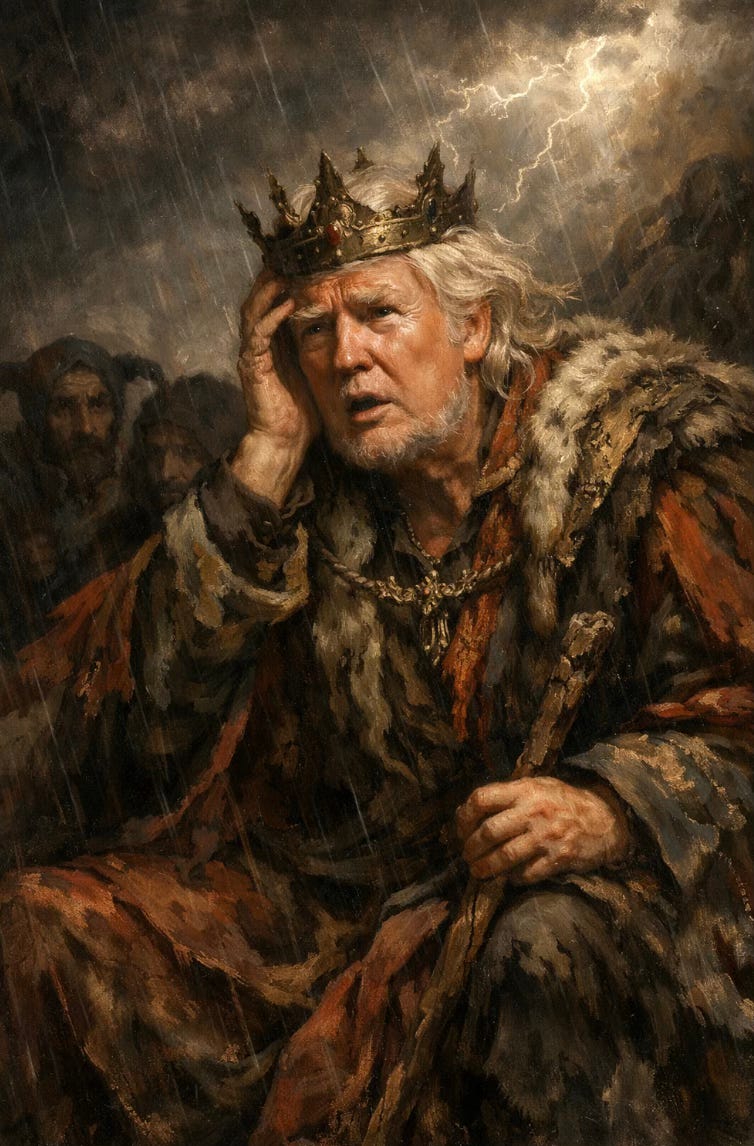
The Thane of Mar-a-Lago: A Shakespearean Reckoning of Trump and the Void

Who is Donald Trump? Not the politician, the public figure, or the caricature that dominates the news cycle, but the man himself. What drives him? What does he believe? What does he want? What is the nature of his being?
To understand Trump as a person, we must look deeper than political analysis alone. We must look at the structure of his character, the architecture of his psychology, the evident void at the centre of his being. And to do this, we must turn to William Shakespeare.
Shakespeare understood something fundamental about human nature that transcends time and politics. He understood that certain types of people - the ambitious, the narcissistic, the morally empty — follow predictable patterns. They pursue power with an insatiable hunger and surround themselves with enablers and sycophants. They are haunted by the crimes they have committed or witnessed. Ultimately, they are undone by the very nature of their own monstrosity.
Trump is a Shakespearean character. Not in the sense that he is tragic or noble; he is neither. But more in the sense that his character follows the patterns that Shakespeare identified centuries ago. He is a man driven by greed so pathological that no amount of wealth will ever satisfy it. He is a narcissist so profound that other people have ceased to exist for him as anything other than objects. He is a man who has been shaped by a mentor, Roy Cohn, who taught him that morality is weakness and that the strong have the right to do whatever they want. He is also a man haunted by ghosts: the ghost of Cohn, which whispers encouragement toward ever-greater cruelty, and the ghost of Jeffrey Epstein, which he has imprisoned in the dungeons of his mind, living in constant terror that it will break free and reveal his secrets.
This essay is an exploration of Trump as a person, using the framework of Shakespearean tragedy. It is not about his political crimes or his actions. It is about who he is: the nature of his greed, the totality of his narcissism, the inversion of his worldview, and the ghosts that haunt him. It is about understanding the monster not as a political phenomenon, but as a human being, or rather, as the absence of a human being. A void that has learned to wear a human face.
The Witches’ Prophecy
On a desolate heath, three figures emerge from the mist. They are not quite human, not quite spirit, creatures of the liminal space between worlds. Their voices intertwine in a chant that unmakes reality itself:
Fair is foul, and foul is fair.
This is the witches’ prophecy, the incantation that inverts the moral universe. It is the moment when the natural order of things is turned upside down, when evil becomes virtue and virtue becomes weakness, when the most monstrous ambitions become not only possible but inevitable. This is Trump’s lived reality. Watch as he moves through the world, and you will see the witches’ prophecy manifesting in every action, relationship, and moment of his existence.
He lies constantly, and his supporters call him honest. He cheats in business, and the business world celebrates him as a genius. He betrays his closest associates, and they thank him for the opportunity to serve him. He assaults women, and he is elected president. He incites a mob to attack the Capitol, and half the country defends him. The moral universe has been inverted. Fair has become foul. Foul has become fair.
And now, in his dotage, the inversion accelerates. He grasps for power with increasing desperation, willing to break any law, destroy any institution, sacrifice any principle. He looks at the Confederate statues and sees his own future: monuments to power that refuse to be forgotten. He wants to be a statue, immortal, remembered forever, but he knows statues can be torn down, monuments erased, legacies forgotten. So, he demands more power, more control, more proof that he matters. He fears if he is forgotten or erased, then he is nothing.
Two ghosts haunt him as he moves through this inverted world. Cohn’s ghost whispers encouragement, validating every instinct toward cruelty, every impulse toward revenge. And Epstein’s ghost presses against the bars of its cage, threatening to break free and reveal the truth. But Trump cannot afford to let it escape because if the truth is revealed and the facade collapses, then the witches’ prophecy loses its power. The inversion unravels. And Trump is left alone with the void.
Like Prospero in The Tempest, Trump creates a world of illusion and manipulation to prevent this. He conjures storms of lies and conspiracy theories. He manipulates reality itself. His supporters are like the shipwrecked courtiers in The Tempest, caught in a magical storm of his creation, unable to distinguish truth from illusion. But unlike Prospero, Trump will never renounce his magic. He will cling to them until the very end, until the walls collapse and the illusions shatter. For as long as he can maintain the inversion and keep the world believing that foul is fair and fair is foul, he can pretend that he is not what he fears most: a nothing, a void, a man who will be forgotten and erased. The witches’ prophecy is his survival mechanism; the only thing standing between him and the abyss.
Subscribe to Notes From Plague Island and join our growing community of readers and thinkers.
Act I: The Nature of Greed
Scene 1: The Hunger That Cannot Be Satisfied
Macbeth’s tragedy begins with ambition, but it is one that can theoretically be satisfied. He wants the throne; he murders to get it. Once he has it, the crime is done. But Trump’s greed is of a different order entirely. It is not a desire for something specific; it is a hunger that devours everything and is never satisfied.
Consider the nature of his wealth. Trump inherited a real estate empire worth hundreds of millions of dollars. By any rational measure, he had already won. He had more money than he could ever spend. He had power, status, the respect of the business community. And yet, he could not stop and simply enjoy what he had. The hunger drove him forward, relentlessly, endlessly.
But this is the hunger of a man who is trying to fill a void. Trump’s greed is irrational as it does not follow the logic of normal human desire. A normal person accumulates wealth to achieve security, comfort, status. But Trump already had all of these things. His greed is about proving something, that he is not what he fears most: a loser, a failure, a nothing.
This is the defining feature of his character: the inability to be satisfied. Money is not a means to an end for Trump; it is the end itself. It is the scoreboard by which he measures his worth, his power, his identity. Every dollar earned is a validation. Every dollar lost is a humiliation. Every business deal is a battle in which there must be a winner and a loser, and Trump must be the winner. The idea of a fair exchange, of mutual benefit, of honest dealing — these are foreign to him. Every transaction is an opportunity to dominate, to extract, to take more than he gives. Because in his mind, if he is not winning, he is losing. If he is not taking more than he gives, he is being cheated. There is no middle ground. There is only victory and defeat.
And now, in his aging years, the hunger has become more desperate. Time is running out. Death is approaching. The void that he has spent his entire life trying to fill is about to swallow him completely. He grasps harder and demands more. He becomes more reckless, more aggressive, more willing to break any law or cross any line. Because he knows, on some level that he cannot fully acknowledge, that time is running out. Like King Lear on the heath, Trump is descending into madness. His arrogance is increasing even as his mind deteriorates. He cannot accept criticism or admit weakness. He is surrounded by sycophants who tell him what he wants to hear, who feed his delusions, who validate his paranoia. And like Lear, this is driving him toward destruction.
But there is something more sinister than Lear’s madness. Trump is an aging tyrant who has confused his personal whims with the national interest. His desires are America’s desires. His enemies are America’s enemies. His vindication is America’s vindication. When he demands the election be overturned, he is defending the nation. When he attacks opponents, he is protecting America. When he uses government to punish enemies and reward loyalists, he is governing. This is the tyrant’s delusion: the inability to distinguish between self and state.
An aging tyrant desperate to hold power one more time is the most dangerous version. He knows this is his last chance. Everything is existential. Everything justifies any action, crime, and violation. The nation’s survival depends on his survival. His power is America’s power. And the only way to avoid facing the truth — that he is nothing, a void — is to hold onto power one more time, no matter the cost.
Scene 2: The Narcissism That Devours the Self
What is this void at the heart of Trump’s being? It is narcissism so profound and total that it has consumed his entire personality. There is no Trump beneath the narcissism. The narcissism is his character, the totality of who he is.
Consider what narcissism truly means. It is not vanity, though Trump has that in abundance. It is not pride, though he is proud. Narcissism is the inability to see other people as real. Other people exist only as mirrors in which Trump sees his own reflection. They are props in the drama of his life. They have no intrinsic value, no inner life, no reality independent of their relationship to Trump.
This is why Trump can lie so easily. Lying requires the ability to care whether others believe you but Trump does not care what others believe. He only cares what they do. If a lie makes them do what he wants, then the lie is true. If the truth makes them resist, then the truth is false. There is no objective reality in Trump’s world, only power and submission.

This is why Trump can betray his closest associates without hesitation. Roy Cohn, who taught him everything, was cast aside when he was no longer useful. Rudy Giuliani, who fought for him, was abandoned and ridiculed. Michael Cohen, who was his fixer and confidant, was turned into an enemy. These men gave Trump their loyalty, and he repaid them with contempt. But from Trump’s perspective, there is no betrayal. They were never anything more than instruments. When they broke, he simply discarded them and found new ones. As he ages, this pattern accelerates. The people around him are no longer pretending to be his friends. They are simply using him as he uses them. And Trump, desperate to maintain the illusion that he is still powerful and relevant, accepts this arrangement. The alternative is to be alone, which means facing the void.
This is why Trump can look at a woman and see only her body, only her usefulness to him. For Trump, women are not even objects in the normal sense: they are commodities, status symbols and conquests. They are proof of his power and virility. A beautiful woman on his arm is a validation. A woman who resists him is a challenge to be overcome. A woman who accuses him is a threat to be destroyed.

The Epstein connection is central to understanding Trump. It reveals the totality of his narcissism, the complete absence of empathy, the reduction of human beings to objects. The women on the Lolita Express, at Mar-a-Lago, his assault victims – they were never people to him. They were things in a world he understood where wealth and power provide immunity, where the strong prey on the vulnerable, where law is a tool for the powerful, not a constraint.
The Epstein connection reveals that Trump is not just a narcissist or a man without empathy, but a man comfortable in grotesque exploitation. He is comfortable with young women being abused and discarded, with wealth providing the right to do whatever he wants to whoever he wants, with the vulnerable existing for the consumption of the powerful. A man comfortable with these ideas is not a man with a personality disorder. He is a monster.
Scene 3: The Worldview of a Monster
What does Trump believe? What is his philosophy? What does he think the world is?
Trump believes that the world is a jungle in which the strong prey on the weak; that everyone is corrupt, selfish, and trying to cheat him. He believes that the only morality is power, the only virtue is winning, the only sin is losing. He thinks that kindness is weakness, honesty is stupidity, loyalty is a tool to be used and then discarded. He considers the law as a weapon to be wielded against enemies, not a constraint on his own behaviour. He believes that truth is whatever he says it is, that reality is whatever he can convince people to believe.
This is the worldview of a man who has never had to face consequences for his actions. He was born into wealth, which meant that his mistakes were cleaned up by lawyers and money. He was surrounded by sycophants who told him he was a genius. He was celebrated by the media, which treated his outrageousness as entertainment. He lived in a bubble in which he was always right, always winning, always the centre of attention.
And in that bubble, he developed a complete inversion of normal human values. He came to believe that the people who told him the truth were his enemies, the people who flattered him were his friends, and rules that applied to other people did not apply to him. He came to understand that he was not just superior to other people, but fundamentally different from them; a different species, almost, for whom normal morality did not apply.
He has been allowed to become a monster because no one ever said no to him. But beneath this worldview, locked away in the deepest dungeons of his mind, there is something else. There is a ghost that he has imprisoned. It is the ghost of Jeffrey Epstein. Trump has tried to contain it, and he knows what the Epstein connection means. It is not just a scandal, but a window into the abyss of his character. It provides proof that he is not just a narcissist, not just a man without empathy, but a man who participated in a world of grotesque exploitation. If that ghost escapes and if that truth is revealed, then the carefully constructed facade of his life collapses. The empire of lies crumbles and Trump is left alone with the truth about himself.
And now, as he ages, the fear intensifies. Time is running out – he will not live forever. The ghost will outlive him. After he is dead, the ghost and the truth will still be there. He will not be able to control it anymore or attack the people who speak it. So, he must keep it imprisoned now, while he still has power. He must destroy anyone who threatens to release it. He must consolidate his power, eliminate his enemies, and ensure that no one can ever bring down the walls he has built around the ghost. Once he is gone, there will be nothing left but the ghost and the truth.
Act II: The Corruption of the Soul
Scene 1: Roy Cohn and the Education in Evil
Trump did not arrive at this worldview on his own. He was trained in it, shaped by a man who understood the mechanics of power and the absence of morality: Roy Cohn.
Roy Cohn was a fixer, a lawyer who operated in the shadows of power. He had made his career doing dirty work for powerful men — first as a prosecutor in the McCarthy hearings, then as a consigliere to the mob, then as a servant to the wealthy and powerful who needed someone willing to do the things that could not be done in the light. Cohn was a man without a conscience who understood that in the world of high finance and real estate, morality was a luxury that only the weak could afford.
When Trump was a young real estate developer, hungry for success and validation, Cohn took him under his wing. He taught Trump the lessons that would define his entire life: that the law was a tool to be wielded against enemies; that loyalty was the only currency that mattered; that to show weakness was to invite destruction; that the truth was whatever you could convince people to believe; that other people were tools to be used and then discarded.
More importantly, Cohn taught Trump that there was no such thing as morality. There was only power and submission, winning and losing, the strong and the weak. The strong had the right to do whatever they wanted, because they had the power to do it and the weak did not have the power to stop them.
This is the education that shaped Trump. Even now, decades after Cohn’s death, his ghost does not rest. It does not haunt Trump with guilt or remorse because Cohn’s ghost knows that Trump is incapable of such emotions. Instead, it whispers in Trump’s ear: More, always more. Never apologise. Never admit weakness. Destroy your enemies completely. And Trump, ageing and increasingly unstable, obeys. Cohn’s ghost is not a torment; it is a command, and that voice never stops whispering.
Scene 2: The Inner Circle as Mirrors of His Narcissism
Trump’s inner circle is a collection of mirrors. Each one reflects back to Trump what he wants to see: a genius, a winner, a man above the law, a man for whom normal morality does not apply.
Stephen Miller feeds him statistics and conspiracy theories that confirm his xenophobic worldview. Miller also tells him that his enemies deserve to hang. All the sycophants who surround him confirm his belief that he was cheated. Each one knows exactly which buttons to push, which grievances to inflame, which enemies to name.
But they are not manipulating Trump in the way that Iago manipulates Othello. Iago manipulates Othello by lying to him, by presenting false evidence, by appealing to Othello’s insecurity. But Trump’s inner circle only needs to affirm what he already believes and tell him what he wants to hear.
This is the nature of narcissism. The narcissist does not need to be deceived. He deceives himself by seeing he wants to see and believing what he wants to believe. Anyone who tells him what he wants to hear becomes his trusted advisor; anyone who tells him the truth becomes his enemy.
Trump’s inner circle then, is a group of enablers. They are people who have recognised that the way to power and influence is to feed Trump’s narcissism. They have chosen to abandon their own moral compass in order to serve a man who has no moral compass. In doing so, they have become complicit in his monstrosity and have become monsters themselves. They have chosen to enable a monster because it gives them power and access and the validation of being close to power. They are, in short, the perfect reflection of Trump’s worldview: people for whom morality is weakness and power is the only virtue.
This is the world of Measure for Measure, where authority figures abuse their power for personal gain, where sexual corruption is normalised, where hypocrisy reigns. Trump’s inner circle enables not just his political crimes but his sexual crimes. They normalise his misconduct, cover for him and attack his accusers. They are complicit in his exploitation of women. Like the corrupt officials in Measure for Measure, they justify their complicity by telling themselves that power is what matters, that loyalty is what matters, that morality is weakness. They have become the perfect enablers of a sexual predator in power.
Act III: The Emptiness at the Centre
Scene 1: The Man Who Is Nothing
In the end, what is the nature of this man? What is Trump, stripped of the money, stripped of the power, stripped of the adulation of his followers?
He is nothing. He is a man so completely defined by external validation that without it, he does not exist. He is so completely dependent on the admiration of others that without it, he is nothing. He is so thoroughly hollow that he must constantly fill himself with the attention of others, the flattery of sycophants, the rage of his enemies. This is why Trump cannot stop; he cannot retire, disappear, and simply enjoy what he has. Because without the constant feed of attention and validation, he ceases to exist.
This is the ultimate tragedy of Trump. It is not that he is a tyrant, but that he is not even a complete human being. He is a collection of appetites and reflexes, a creature of pure id, a man without a self. He is Macbeth without the self-awareness, Othello without the nobility, a tragic figure without the tragedy — just a pathetic, empty man.
And yet this empty man has wielded real power. This hollow creature has corrupted institutions, shattered norms, and poisoned the soul of a nation. This void has consumed the attention and energy of millions of people. This nothing somehow became the centre of the world’s gaze.
Scene 2: The Worldview of a Dying System
Trump is the final, bloated form of a dying vision of American capitalism, a system that has elevated spectacle over substance and wealth over worth. He is the logical endpoint of a culture that has taught men that winning is everything, that money is the measure of worth, that other people are objects to be used, that morality is weakness.
Trump did not create this worldview. He inherited it from his father, Roy Cohn, the culture of New York real estate in the 1970s and 80s, and from a system that rewarded ruthlessness and punished compassion. He learned it from a nation that celebrated wealth above all else, that treated billionaires as heroes, that believed that the rich deserved to be rich because they were superior to the poor. It was inherent in a media that treated his outrageousness as entertainment, that gave him billions of dollars in free coverage, that made him famous and then made him president.
But Trump is not merely a product of this system – he is its perfection. He is what happens when you take all the worst values of American capitalism and compress them into a single human being, when you remove all restraint, conscience, and empathy. He is the consequence of elevating a man who has no internal moral compass to the highest position of power in the land.
Trump is not the symptom of America’s moral sickness. He is instead the manifestation of a disease that has been growing for decades.
Scene 3: The Final Reckoning
The play is not yet over. The tragedy is not concluded. It is unfolding in real time, before our eyes. The Thane of Mar-a-Lago sits in the Oval Office once more, and the assault on the rule of law continues. He breaks the law with impunity, secure in the knowledge that the institutions meant to constrain him have been corrupted or cowed into silence. The courts are packed with judges who owe him loyalty. Congress is controlled by those who serve him. The Department of Justice bends to his will. And yet he is still not satisfied. The void is never filled. He demands total power, complete submission, universal acknowledgment of his greatness.
And all the while, he is aging. His body is failing; his mind is deteriorating. Time is running out. This awareness that he does not have forever makes him more dangerous, not less. It makes him more desperate, more willing to break laws, destroy institutions, and sacrifice everything for the validation he seeks. He knows that is his last chance. After this, there is only death. And death is the one thing he cannot control or dominate.
But the ghosts are gathering. Cohn’s ghost whispers encouragement. Epstein’s ghost presses against the bars of its cage. The void at the centre of his being grows larger, more consuming, more desperate. This is the tempest within — the internal psychological storm that rages in Trump’s mind. There is constant conflict between his need for validation and his fear of being exposed; his desire for power and his terror of being forgotten. There is tension between Cohn’s ghost pushing him forward and Epstein’s ghost threatening to break free. This internal tempest is what drives all his actions and what makes him dangerous. It is also what will ultimately destroy him. A man who is nothing but appetite and narcissism, a man who is a void — such a man cannot sustain himself forever. The void will consume him. When the facade collapses, when the empire of lies crumbles, the reckoning will be absolute.
And we, the audience, watch as the final act unfolds, knowing that tragedy, once begun, cannot be stopped. We are not passive observers of this play, though. We are participants, the chorus. The chorus has a choice: to accept the tragedy as inevitable, or to resist it with every fibre of our being.
The Thane of Mar-a-Lago is a monster. But he is not our monster in the sense that we created him through our moral failings. He is capitalism’s monster; the logical endpoint of a system that rewards greed, elevates ruthlessness, treats other people as objects to be exploited, and measures human worth in dollars. He is what happens when you take all the worst values of capitalism and compress them into a single human being. He is what capitalism produces when it is allowed to operate without restraint, conscience, or any concern for human dignity or the common good.
We are complicit in the sense that we live within a capitalist system that requires us to participate in exploitation, to see other people as competitors rather than fellow human beings. We have allowed this system to exist, to flourish, to reshape our values and our culture in its image.
But the real enemy is not us. The real enemy is the system itself. Until we confront that and recognise that Trump is not an aberration but a logical end product of capitalism, the tragedy will continue. The void will continue to consume us.
But the final act is upon us. The walls are cracking. The doors are straining. The imprisoned ghosts are straining harder against the bars and we must choose: will we be complicit in the tragedy, or will we resist it? Will we allow the void to consume us, or will we fight back? Will we accept the monster, or will we say no?
Trump is the Fool in his own tragedy. He sees himself as a genius, but he is blind to his own emptiness. He speaks lies but calls them truth. He is incapable of seeing the truth that everyone else can see: that he is a void, a nothing, a man who will be forgotten and erased.
This is the ultimate inversion of appearance and reality: the man who appears most confident is actually the most terrified; he who appears most powerful is actually the most desperate. And the man who appears most successful is actually the emptiest. The more the facade cracks, the more violently he will defend it. The more the truth threatens to emerge, the more desperately he will grasp for power. The more the void threatens to consume him, the more he will demand validation and immortality.
But the reckoning is coming. The walls will crack. The doors will break. Epstein’s ghost will break free. The truth will emerge, and when it does — when the empire of lies finally crumbles — Trump will be left alone with the void. It is then that the void, at last, will consume him completely.
The Thane of Mar-a-Lago will fall. Not because he is opposed by a stronger force, but because he is nothing. And nothing, no matter how loudly it screams, how desperately it grasps for power, or how violently it destroys everything around it, cannot sustain itself forever. It will inevitably collapse under its own weight and implode from its own emptiness.
He will be remembered as a monster. His name will be struck from history not by his enemies, but by time itself. His monuments will crumble because they were always built on sand. When he is gone, when the void finally consumes him completely, there will be no redemption for him; only the void looking back at itself and the sound of nothing echoing through the chambers of his mind. It will be the erasure he has always feared, and he will deserve every second of it.
This is simply the inevitable end of a man who was nothing but appetite and lies. When he is gone, we will rebuild and create something better from his ashes. He will be forgotten by necessity; for a nothing cannot echo through history. A monster made of greed and emptiness cannot leave a legacy. He will simply cease to exist.
The only power that matters is ours: the power to ensure that his erasure is complete, and that we never again mistake a void for a man.
Or support us with a one-off tip → Buy Me a Coffee
References
Shakespeare, W. (Edited by Hunter, G.) King Lear. London: Penguin Classics, 2015.
Shakespeare, W. (Edited by Hunter, G.) Macbeth. London: Penguin Classics, 2015.
Shakespeare, W. (Edited by Muir, K.) Othello. London: Penguin Classics, 2015.
Shakespeare, W. (Edited by Butler, M.) The Tempest. London: Penguin Classics, 2015.


Intense analysis. The Cohn/Epstein dual-ghost framework is really effective at explaining the push-pull dynamic in Trump's behavior. I spent some time studying Shakespearean tragedy in grad school and this captures somthing I haven't seen elswhere about how Macbeth's ambition differs from pure void-filling narcissism.