The Russian Origins of a Global Authoritarian Revival

The end of the Cold War was supposed to be the end of history. When the Soviet Union dissolved in 1991, the West saw not just the collapse of a rival superpower, but the definitive triumph of its own ideology. Liberal democracy, it was believed, had proven itself the only viable system of governance, the final form of human government (Fukuyama, 1992). Russia, the heartland of the defeated empire, was expected to follow this script. This assumption was the foundation of Western foreign policy for a decade.
What followed, however, was not a seamless transition. The “shock therapy” of the 1990s, a rapid and brutal process of economic liberalisation, plunged the country into a state of gangster capitalism (Gaidar, 1997). State assets were sold off for a pittance to a new class of oligarchs, hyperinflation wiped out the savings of generations, and life expectancy for Russian men plummeted (Gaidar, 1997). The promise of a brighter future gave way to a grim reality of corruption, poverty, and a gnawing sense of national humiliation. The democratic ideals that had been so eagerly embraced just a few years earlier became associated in the popular imagination with weakness, chaos, and foreign plunder.
This created a deep ideological vacuum. The grand narrative of Marxism-Leninism was dead, and the imported narrative of Western liberalism had failed to take root. Into this void, the ghosts of Russia’s pre-Soviet past began to stir. Mystical and reactionary traditions that had been suppressed for decades: the ghosts of Tsarism, of mystical Orthodoxy, and of a uniquely Russian fascism, found a new and receptive audience. Russia turned inward, searching for a philosophical identity that could restore its sense of purpose.
In the West, the Cold War ended in triumphalism — the great liberal victory. But in Russia, the end of the Soviet Union triggered a furious philosophical search for meaning, morality, and destiny. While the West drifted into complacency, Russia rebuilt a worldview capable of challenging liberal democracy at its spiritual foundations. In hindsight, it is hard to escape the uncomfortable thought that the loser of the Cold War did far more ideological work than the victor.
The authoritarian worldview forged in this crucible was not simply a regression to the past, but a new and potent synthesis of religious nationalism, civilizational messianism, and a deep-seated resentment of the West. This article will argue that the roots of today’s global authoritarian revival can be traced back to this period of intellectual and political ferment. It was here, in the ruins of the communist project, that the ideological foundations for a new, illiberal age were laid.
Ivan Ilyin: The Prophet of Russian Christian Fascism
To understand the moral and philosophical underpinnings of modern Russian illiberalism, one must confront the spectre of Ivan Ilyin and his doctrine of Christian fascism. A figure largely unknown in the West, Ilyin has been resurrected from the ash heap of history to become a central prophet of Putin’s Russia. His writings, once obscure, are now required reading for state officials, and his ideas have been woven into the very fabric of the Kremlin’s political ideology. Ilyin’s importance lies not just in his anti-democratic thought, but in his explicit effort to create a distinctly Russian form of fascism, one that replaces the biological racism of Nazism with the mystical concept of spiritual nationhood.
Ilyin (1883-1954) was a jurist and religious philosopher exiled from the Soviet Union in 1922 on one of Lenin’s infamous “philosophers’ ships,” vessels that carried hundreds of Russian intellectuals, writers, and philosophers deemed enemies of the Bolshevik state into exile in Western Europe. A fierce opponent of the Bolsheviks, he did not turn to the liberal West for salvation. Instead, he looked to the rising fascist movements in Europe. He admired Mussolini and, for a time, saw Hitler as a necessary guard against communism. For Ilyin, fascism was not an evil to be condemned, but a “redemptive excess of patriotic arbitrariness” (Snyder, 2018). He believed that in the face of the existential threat of godless communism, a strong, nationalist, and authoritarian response was not only necessary but righteous. His project was to adapt fascism to Russia, grounding it not in secular or pagan ideas, but in the traditions of Russian Orthodoxy.
At the core of Ilyin’s Christian fascism is the concept of the nation as a sacred, organic entity, a mystical body with a collective soul. He saw the Russian people as cells in this larger spiritual organism, bound together by a shared faith and historical destiny (Ilyin, 1956). From this, he derived a political theology that was profoundly anti-democratic and totalitarian. Western-style democracy, with its emphasis on individual rights and pluralism, was a mortal threat to this spiritual unity, a poison that atomised society and undermined the nation’s sacred purpose (Ilyin, 1928). In its place, he advocated for a system of “sacred authoritarianism” led by a “national dictator,” a messianic figure who would embody the national will and rule with absolute authority. This leader’s task was to protect the spiritual purity of the nation, and for the people, true freedom was to be found not in autonomy, but in willing submission to this collective will (Snyder, 2018).
The revival of Ilyin’s ideas in post-Soviet Russia is a testament to their enduring power. Vladimir Putin has repeatedly and publicly praised Ilyin, and in 2005, he arranged for the philosopher’s remains to be repatriated from Switzerland and buried with full honours in Moscow (The Economist, 2024). By resurrecting Ilyin, Putin is knowingly embracing a fascist ideologue. Ilyin’s writings provide the philosophical bedrock for Putin’s concept of “sovereign democracy” and the moral justification for his autocracy (Snyder, 2018). He transforms what would otherwise be a naked power grab into a sacred duty, a righteous defence of the nation’s soul against the corrosive forces of secularism and Western decadence. This vision of a spiritually legitimised, fascist hierarchy has a powerful resonance that extends far beyond Russia’s borders, appealing to Christian nationalists and other post-liberal movements who see in it a model for their own political projects.
Subscribe to Notes From Plague Island and join our growing community of readers and thinkers.
Aleksandr Dugin: The Geopolitical Playbook for Holy War
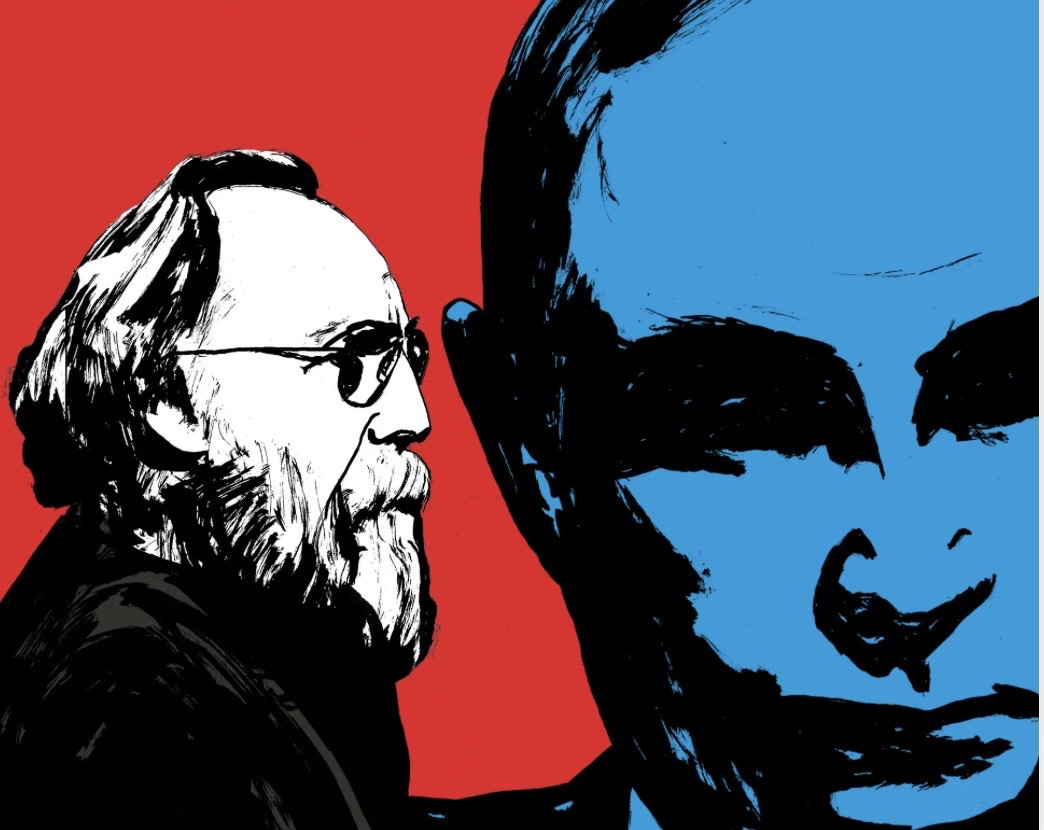
If Ivan Ilyin is the moral architect of the new Russian authoritarianism, then Aleksandr Dugin is its geopolitical strategist. A shadowy figure with a background in occultism and esoteric theorising (Shlapentokh, 2010), Dugin has emerged as one of the most influential ideologues in Putin’s Russia. He provides the grand narrative for Russia’s increasingly confrontational stance towards the West, a playbook for turning Ilyin’s spiritual crusade into a global, metaphysical war.
Dugin (born 1962) is the founder of the “Eurasianism” movement, a political philosophy that posits Russia as a unique civilization, neither European nor Asian, but a continental land power with a global mission to challenge the maritime dominance of the United States and its allies (Dugin, 2012). In his seminal 1997 book, The Foundations of Geopolitics, Dugin lays out a vision of the world as a clash of civilizations, a struggle between the land-based, traditionalist civilization of Eurasia, led by Russia, and the sea-based, liberal civilization of the Atlantic, led by the United States. He argues that Russia’s primary goal must be to “introduce geopolitical disorder into America’s internal activity, encouraging all kinds of separatism and ethnic, social and racial conflicts, actively supporting all dissident movements – extremist, racist, and sectarian groups – thus destabilizing internal political processes in the U.S.” (Dugin, 1997).

In Dugin’s apocalyptic worldview, the West is a demonic, decaying liberal order, a civilization that has lost its spiritual roots and is now in a state of terminal decline. Against this, Dugin posits Russia as the “katechon,” a concept he borrows from Orthodox Christian eschatology. The katechon is the force that holds back the apocalypse, the restrainer of the Antichrist. For Dugin, Russia is the last bastion of traditional values against the nihilistic tide of Western liberalism (The New York Times, 2022). The destruction of the liberal system is therefore not a tragedy, but a necessary act of purification. His ideas have found a receptive audience outside of Russia, making him a hero to elements of the European far-right and the American alt-right. Figures like Steve Bannon have praised his work, seeing in him a fellow traveller in the war against a decadent globalist elite (Foreign Policy, 2016).
From Ideas to State Power: The Architecture of a Fascist State
The philosophies of Ilyin and Dugin the architectural blueprint for the modern Russian state. The Putin system is a living embodiment of their ideas, a fusion of mystical nationalism and geopolitical ambition. Ilyin’s concept of the state as a moral guardian, tasked with protecting the spiritual purity of the nation, has been translated into a series of repressive policies designed to enforce a traditionalist, Orthodox moral order. The infamous “gay propaganda” law, formally the “Federal Law to Protect Children from Information Promoting the Denial of Traditional Family Values,” is not just a piece of reactionary legislation; it is the direct application of Ilyin’s belief that the state must police the spiritual health of its citizens, purging any behaviour deemed decadent or foreign (The Guardian, 2021). The persecution of religious minorities like Jehovah’s Witnesses, and the suppression of independent media are likewise justified as necessary measures to protect the organic unity of the nation from corrosive outside influences (Human Rights Watch, 2023).
Meanwhile, Dugin’s vision of a metaphysical struggle between Russia and the West has become the Kremlin’s foreign policy doctrine. The annexation of Crimea and the full-scale invasion of Ukraine are not framed as conventional wars of conquest, but as holy wars, acts of civilizational self-defence against an aggressive and expansionist West (Putin, 2022). Putin’s rhetoric, which casts Ukraine as an artificial state and a beachhead for Western aggression, is lifted directly from Dugin’s playbook. The Kremlin’s support for anti-Western movements and its use of disinformation to sow chaos in Western democracies are the practical application of Dugin’s strategy of “geopolitical disorder” (Mueller, 2019).
At the heart of the Putin system is a powerful fusion of Orthodoxy, nationalism, and state power. The Russian Orthodox Church, once persecuted by the Soviet state, has been transformed into a key pillar of the regime’s ideological power and spiritual legitimacy for Putin’s rule. In return, the state showers the Church with financial and political support, creating an unholy alliance that fuels a resurgent, messianic nationalism. The Putin persona itself is a direct embodiment of Ilyin’s “national saviour” archetype. Through a carefully cultivated cult of personality, Putin is portrayed as the only leader who can restore Russia to its former glory, a strong and decisive ruler who is willing to stand up to the West and defend Russia’s unique civilizational identity.
Russia as the First Post-Liberal State of the 21st Century
Modern Russia represents something new and dangerous in the landscape of global politics. It is not simply a throwback to the totalitarian regimes of the 20th century, nor is it a typical developing-world dictatorship. Instead, it is the prototype of a new kind of authoritarian state, a post-liberal regime that has rejected the core tenets of Western modernity and has forged its own, unique path. Unlike the secular, materialist authoritarianism of China, which is built on a promise of economic prosperity and technological competence, Russia’s model is built on a foundation of spiritual and ideological fervour. It is this that makes it “post-liberal” rather than simply “illiberal.” It does not just reject the processes of liberal democracy; it rejects the philosophical foundations of the Enlightenment itself.
Russia’s post-liberalism is defined by its rejection of both the collectivism of the Soviet era and the individualism of the West. It is a “third way” that seeks to combine the national unity and social solidarity of the past with the dynamism and technological prowess of the present. The result is a system in which the forms of democracy are maintained, but they are stripped of any real meaning. Elections are held, but the outcome is never in doubt. Opposition parties exist, but they are carefully managed and controlled by the Kremlin. The media is nominally free, but it is dominated by state-controlled outlets that pump out a relentless stream of propaganda.
The Russian economy is also a hybrid, a form of state capitalism in which key sectors are controlled by a small elite of oligarchs who are loyal to the regime (Guriev & Sonin, 2009). At the heart of the system is a powerful and pervasive security apparatus, the inheritor of the Soviet KGB, which is tasked with monitoring the population and suppressing dissent (Soldatov & Borogan, 2010). What makes this model so potent, however, is its ideological dimension. The Putin regime is not just a kleptocracy or a police state; it is a deeply ideological regime that is animated by a quasi-religious vision of national destiny. This ideology, a blend of Ilyin’s sacred authoritarianism and Dugin’s civilizational messianism, provides the regime with a sense of purpose and a powerful narrative of national renewal. It is this narrative, far more than economic performance, that forms the basis of its legitimacy and its appeal to a growing number of countries around the world.
How Russia’s Ideology Became Global: The Export of Resentment
The ideas that were forged in the crucible of post-Soviet Russia did not remain confined within its borders. They have migrated to the West, where they have found fertile ground in the soil of popular discontent. The narrative of national humiliation and renewal, the critique of liberalism as a spiritually bankrupt ideology, and the vision of a strongman leader who can restore order and defend traditional values have all found a receptive audience among those who feel left behind by globalisation and who are resentful of the liberal elite.
This migration has taken two distinct forms. The first is the direct export of Dugin’s geopolitical anti-liberalism. His vision of a global rebellion against a decadent, globalist elite has been embraced by figures on the far-right who see in it a powerful critique of American hegemony. The second, and more insidious, is the indirect export of Ilyin’s Christian nationalism. While few Western populists would openly embrace the label of “fascist,” many have adopted a political style that is deeply indebted to Ilyin’s ideas. The embrace of a muscular and unapologetic nationalism, the fusion of religious and political rhetoric, the demonisation of minorities, and the cultivation of a leader cult all echo the core tenets of Ilyin’s political theology.
In this context, Vladimir Putin has become a role model for a new generation of populist leaders. His strongman style, his defiance of the liberal international order, and his embrace of nationalism have made him a hero to figures like Donald Trump, Marine Le Pen, and Viktor Orbán. They see in Putin a leader who is not afraid to speak his mind, to challenge the political establishment, and to put the interests of his own nation first. The migration of these ideas has been facilitated by a sophisticated and well-funded Russian propaganda machine. State-controlled media outlets like RT and Sputnik have been used to spread disinformation, to sow division, and to promote a pro-Kremlin narrative in the West (U.S. State Department, 2022). The result has been the creation of a global ecosystem of anti-liberal and anti-Western sentiment, a network of political parties, media outlets, and activists who are united by their shared opposition to the liberal international order and their admiration for Putin’s Russia.
Conclusion: The Russian Origin of a Global Authoritarian Revival
Russia’s journey after 1991 is the beginning of a new political epoch. The collapse of the Soviet Union did not usher in the end of history, but rather the beginning of a new and dangerous chapter in the struggle between democracy and authoritarianism. The West, in its triumphalism, failed to see that the seeds of a new and potent illiberal ideology were being sown in the ruins of the communist project. It was in Russia that the intellectual and ideological foundations for a new form of authoritarianism were laid, a model that would prove to be both resilient and exportable.
Ivan Ilyin provided the moral and theological rationale for this new authoritarianism, transforming what would otherwise be a hostile takeover into a sacred duty. Aleksandr Dugin provided the civilizational and geopolitical framework, casting Russia as the leader of a global crusade against the liberal West. And Vladimir Putin embodied and operationalised both, creating a new model of governance that has been emulated by a growing number of countries around the world. These ideas did not stay in Moscow. They have built the philosophical and emotional foundation for the collapse of Western liberal confidence, finding a receptive audience among those who are disaffected, resentful, and yearning for a return to a more ordered and traditional world.
This script, written in Moscow, was not meant for a Russian audience alone. It was a playbook for global insurgency, designed to be exported, adapted, and deployed within the heart of the liberal world itself. The journey of these ideas, from the margins of Russian intellectual life to the centre of Western political culture, is the story of a transmission belt that carried a virus across continents. In the next part of this series, we will trace the path of this infection, examining the mechanisms through which Russia’s worldview migrated into the West and created the conditions for its own authoritarian turn.
Or support us with a one-off tip → Buy Me a Coffee
References
Dugin, A. (1997). The Foundations of Geopolitics: The Geopolitical Future of Russia. Arktogeya.
Dugin, A. (2012). The Fourth Political Theory. Arktos Media.
Foreign Policy (2016). ‘The Kremlin’s marriage of convenience with the European far right’. 21 November. Available at: https://foreignpolicy.com/2016/11/21/the-kremlins-marriage-of-convenience-with-the-european-far-right-bannon-dugin-le-pen/ [Accessed: 12 December 2025].
Fukuyama, F. (1992). The End of History and the Last Man. Free Press.
Gaidar, Y. (1997). Days of Defeat and Victory. University of Washington Press.
Guriev, S. & Sonin, K. (2009). ‘Dictators and Oligarchs: A Dynamic Theory of Contested Property Rights’. Journal of Political Economy, 117(5), 802-836.
Human Rights Watch (2023). ‘Russia: Persecution of LGBTQ People’. Available at: https://www.hrw.org/news/2023/12/06/russia-persecution-lgbtq-people [Accessed: 12 December 2025].
Ilyin, I. (1928). On the Essence of Legal Consciousness. Munich.
Ilyin, I. (1956). Our Tasks. Paris.
Mueller, K. P. (2019). Russia’s Asymmetric Cyber War. RAND Corporation.
Putin, V. (2022). ‘Address of the President of the Russian Federation’. 24 February. Available at: http://en.kremlin.ru/events/president/news/67843 [Accessed: 12 December 2025].
Snyder, T. (2018). ‘Ivan Ilyin, Putin’s Philosopher of Russian Fascism’. The New York Review of Books, 16 March. Available at: https://www.nybooks.com/online/2018/03/16/ivan-ilyin-putins-philosopher-of-russian-fascism/ [Accessed: 12 December 2025].
Soldatov, A. & Borogan, I. (2010). The New Nobility: The Restoration of Russia’s Security State and the Enduring Legacy of the KGB. Farrar, Straus and Giroux.
The Economist (2024). ‘The unholy alliance of the Russian Orthodox Church and the Kremlin’. 11 December. Available at: https://www.economist.com/culture/2024/12/11/the-unholy-alliance-of-the-russian-orthodox-church-and-the-kremlin[Accessed: 12 December 2025].
The Guardian (2021). ‘Russia’s ‘gay propaganda’ law: a decade of state-sponsored hate’. 29 June. Available at: https://www.theguardian.com/world/2021/jun/29/russias-gay-propaganda-law-a-decade-of-state-sponsored-hate[Accessed: 12 December 2025].
The New York Times (2022). ‘The Grand Theory Driving Putin to War’. 22 March. Available at: https://www.nytimes.com/2022/03/22/opinion/russia-ukraine-putin-eurasianism.html [Accessed: 12 December 2025].
U.S. State Department (2022). ‘Report: RT and Sputnik’s Role in Russia’s Disinformation and Propaganda Ecosystem’. 20 January. Available at: https://2021-2025.state.gov/report-rt-and-sputniks-role-in-russias-disinformation-and-propaganda-ecosystem/ [Accessed: 12 December 2025].