The President's Enforcer: Pam Bondi and the Rot at the Heart of Trump's America
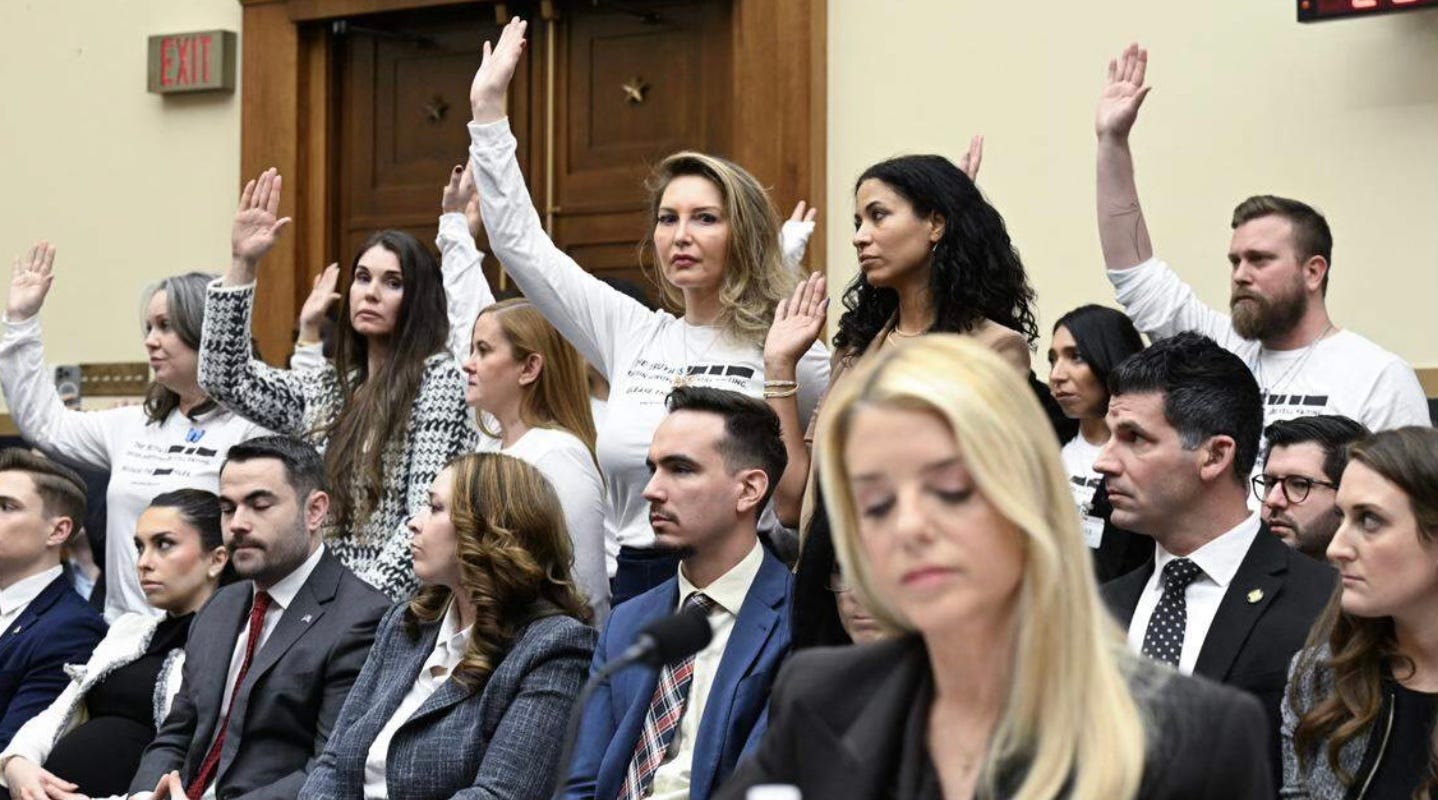
There are moments that crystallise an entire political era. They are rarely grand or cinematic. More often, they are small, quiet gestures of contempt that reveal more than a thousand speeches ever could. Such a moment arrived on February 11, 2026, in the sterile confines of a House Judiciary Committee hearing room. On one side sat Pam Bondi, the 87th Attorney General of the United States, the nation’s chief law enforcement officer. Behind her, a silent chorus of women stood, their hands raised in a desperate, dignified plea for acknowledgment. They were the survivors of Jeffrey Epstein’s global sex trafficking ring, women who had endured the unimaginable and had come seeking a measure of truth from the very department meant to deliver them justice (Miami Herald, 2026).
As lawmakers questioned Bondi about her department’s catastrophic mishandling of the Epstein files, the women remained standing. One looked directly at the Attorney General, a silent appeal to a shared humanity. Bondi, just a few feet away, did not meet her gaze, or even acknowledge their presence. Instead, she stared down at the table before her, her back turned to the very people she was sworn to protect. A photographer captured the image, and in that single frame, the moral bankruptcy of an entire regime was laid bare. The photo is a heartbreaking tableau of calculated indifference, a perfect encapsulation of the Trump administration’s posture toward the powerless (Miami Herald, 2026).
The turning of Pam Bondi’s back was the physical manifestation of a career built on turning a blind eye. It was the defining gesture of a political operative who has spent two decades trading justice for power, accountability for access, and integrity for personal enrichment. Pam Bondi is the quintessential Trump loyalist, a figure whose long, sordid history with the President is a masterclass in sycophancy and corruption. She is the enforcer, the fixer, the loyal soldier who has weaponised every office she has ever held in service to her one true client: Donald J. Trump. This is the story of how she rose to power, the trail of compromised ethics she left in her wake, and how her handling of the Epstein saga became the ultimate case study of the rot at the heart of Trump’s America.
The Long Con: Forging a 20-Year Alliance
The symbiotic relationship between Donald Trump and Pam Bondi is a nearly two-decade-long saga of mutual advancement, a transactional alliance forged in the crucible of cable news and solidified in the corridors of power. It began with a typically Trumpian grievance: in 2006, Trump was embroiled in a legal battle with the town of Palm Beach over the size of an American flag flying at his Mar-a-Lago club. Bondi, then a local prosecutor and a rising legal commentator, went on television and defended him. The performance caught the eye of the man himself. As Bondi later recounted to Trump’s daughter-in-law, Lara Trump, her assistant announced, “’Donald Trump’s on the phone for you,’ and I said, ‘Donald Trump the billionaire?’” Trump had seen her, gotten her number, and called to thank her personally. The seeds of a long and profitable friendship were sown (The New Yorker, 2025).
For the next decade, Bondi continued her ascent, becoming Florida’s Attorney General in 2011. But her defining political move came in 2016. As the Republican presidential primary raged, Bondi made a calculated gamble. With her home-state favourite, Jeb Bush, faltering, she threw her weight behind the man once considered a sideshow. She became the first major elected official in Florida to endorse Donald Trump, a decision that flew in the face of the party establishment and her state’s other contender, Marco Rubio, who was at the time deriding Trump as a “con artist.” A political consultant who had recruited Bondi to run for attorney general, Adam Goodman, had urged her to take the risk. If Trump won the nomination, Goodman argued, “wow, you’ll be the first major elected G.O.P.er from Florida at the table” (The New Yorker, 2025). The bet paid off spectacularly. Trump vanquished his rivals, and Bondi was rewarded with a prime-time speaking slot at the Republican National Convention, where she gleefully joined the chorus of “Lock her up” aimed at Hillary Clinton (The New Yorker, 2025).
Her loyalty, then and now, has been richly rewarded. Bondi’s career is a case study in the personal enrichment that comes from orbiting Planet Trump. After leaving her post as Attorney General, she cashed in on her connections. She joined Ballard Partners, a lobbying firm with deep ties to the Trump administration, earning a reported $1 million. Her clients included the government of Qatar, a relationship that would later create a massive conflict of interest when, as U.S. Attorney General, she approved Trump’s acceptance of a $400 million luxury plane gifted by the same nation (Common Cause, 2025). She pulled in over half a million dollars from the America First Policy Institute, a pro-Trump think tank and received nearly $3 million in shares of Trump’s social media company for consulting work. Even after the 2020 election, the money kept flowing, with Trump-affiliated committees paying her over $240,000 in 2021 alone (The New Yorker, 2025). For Pam Bondi, loyalty to Trump has always been a bull market.
Pay-to-Play: The Trump University Precedent
Long before she was weaponising the Department of Justice on a national scale, Pam Bondi was honing her skills in the art of the political fix in Florida. The 2013 Trump University scandal provided the perfect training ground, a sordid episode that served as the blueprint for the transactional corruption that would come to define her relationship with Donald Trump. It was a simple, brazen case of pay-to-play, and it demonstrated early on that Bondi’s principles were for sale.
By 2013, Trump University, the President’s eponymous get-rich-quick scheme, was imploding. Complaints were piling up across the United States from students who alleged they had been duped into paying tens of thousands of dollars for worthless real estate seminars (CREW, 2016). In New York, Attorney General Eric Schneiderman had already filed a massive fraud lawsuit. Florida, a key market for the sham university, was also seeing a surge in complaints. At least 22 grievances had been filed with Bondi’s office, which acknowledged it was “reviewing the allegations” in the New York lawsuit (CREW, 2016).
An investigation seemed imminent. The facts were damning, the victims were numerous, and the political pressure was mounting. Then, a funny thing happened on the way to justice. On September 17, 2013, a political action committee supporting Bondi’s re-election, And Justice for All, received a $25,000 contribution. The donor was the Donald J. Trump Foundation. The donation itself was illegal — charitable foundations are prohibited from engaging in political activity — but that was merely a technicality in a far more profound corruption. The money, it was later revealed, had been personally solicited by Bondi from Trump himself (CREW, 2016).
Shortly after the check cleared, Bondi’s office had a sudden change of heart. The review of Trump University was unceremoniously dropped. A spokesperson for Bondi announced that her office had decided not to join the New York lawsuit or launch its own investigation (CREW, 2016). The timing was, to put it mildly, suspicious. For a mere $25,000, Donald Trump had seemingly made his legal troubles in a major state disappear. When questioned about the decision, Bondi’s defence was a masterclass in disingenuousness. “I was never, nor was my office, investigating him. Never,” she claimed, a statement directly contradicted by her own office’s prior statements to the press (CREW, 2016). It was a foundational moment, a clear demonstration that for the right price, Pam Bondi’s official duties were negotiable. She had learned a valuable lesson that would serve her well in the years to come: in Trump’s world, loyalty isn’t just rewarded, it’s prepaid.
Subscribe to Notes From Plague Island and join our growing community of readers and thinkers.
The Epstein Debacle: A Masterclass in Malice and Incompetence
If the Trump University scandal was a dress rehearsal, then Pam Bondi’s handling of the Jeffrey Epstein case as U.S. Attorney General was the disastrous opening night. It was a performance so catastrophically inept, so riddled with contradictions and bad faith, that it managed to infuriate everyone from Epstein’s victims to the most ardent MAGA conspiracy theorists. It revealed Bondi not just as a corrupt political operative, but as a dangerously incompetent one, a woman whose primary instinct is always to protect her patron, even at the cost of her own credibility and the public’s trust. The Epstein saga is the dark heart of the Bondi story, a through-line of complicity and contempt that stretches across her entire career.
It is crucial to be precise about Bondi’s role in the long, sordid history of the Epstein case in Florida. She was not the state’s Attorney General when the monstrous financier was handed his infamous “deal of the century” in 2008. That disgrace belongs to her predecessor, Bill McCollum, and the federal prosecutor Alexander Acosta, who granted Epstein a non-prosecution agreement that was a travesty of justice. But Bondi took office in 2011 and held it for eight long years, a period during which Epstein, having served a laughably short 13-month sentence, was largely free to continue his predatory activities. Legal experts have confirmed that Bondi had the authority to launch her own investigation into Epstein’s crimes during her tenure, but she did not (Palm Beach Post, 2025). The mountain of evidence, the chorus of victims, the national outrage — none of it was enough to compel Florida’s top law enforcement officer to act. Epstein was arrested again in July 2019, this time on federal charges in New York, and was found dead in his cell a month later. This all occurred just as Bondi was ending her final term as Attorney General, a decade marked by conspicuous inaction and a stunning lack of curiosity about one of the most prolific sex offenders in the state’s history.
Her inaction in Florida makes her subsequent actions as U.S. Attorney General all the more grotesque. Confirmed in February 2025, Bondi immediately recognised the political currency of the Epstein case within the MAGA ecosystem. She went on Fox News and, with the conspiratorial fervour of a late-night radio host, teased a bombshell. She had “a lot of flight logs” and “a lot of names,” she promised. Then came the money shot, the phrase that would ignite a firestorm of expectation: the famed “client list,” she claimed, was “sitting on my desk right now” (The New Yorker, 2025). She and her allies distributed white binders labelled “Epstein Files: Phase 1” at a White House event for conservative influencers, a cheap political stunt that contained little more than previously released information (The New Yorker, 2025).
For months, the MAGA base waited with bated breath for the promised unveiling. Then, in July 2025, the rug was pulled. The Justice Department issued a terse memo stating that there was no client list and that it would be releasing nothing more about Epstein (The New Yorker, 2025). The reversal was as stunning as it was absolute. The reason for the abrupt about-face remains a matter of speculation, but one report offers a chillingly plausible explanation: Bondi had reportedly informed President Trump that his own name appeared in the files (Common Cause, 2025). Whether to protect her boss or due to sheer incompetence, Bondi had made a promise she couldn’t, or wouldn’t, keep. The backlash from the right was swift and brutal. At a Turning Point USA conference in Bondi’s own home state, speaker after speaker called for her to be ousted. “Her days are numbered,” the conservative podcaster Megyn Kelly predicted (The New Yorker, 2025). Pam Bondi, the ultimate Trump loyalist, had managed to become a target of the very movement she had spent her career appeasing. It was a masterclass in political self-immolation, a debacle born from the toxic intersection of malice and incompetence.
The People’s Lawyer vs. The President’s Enforcer
The office of the Attorney General is meant to serve as the people’s lawyer, an impartial defender of the Constitution and the rule of law. But in Pam Bondi, Donald Trump has finally found what he has always craved: a personal attorney with the seal of the United States Department of Justice. Her tenure has been a relentless assault on the independence and integrity of the institution, a systematic campaign to transform the DOJ into a political weapon, a shield for allies, and a sword against enemies. As one veteran of past Republican Justice Departments told The New Yorker, “in Pam Bondi, Donald Trump has the Attorney General he always wanted” (The New Yorker, 2025). He wanted a fixer, a sycophant, and an enforcer, and in Bondi, he got all three.
Her first acts as Attorney General were to enforce loyalty. In a move dripping with petty vindictiveness, she personally stormed into the offices of the National Security Division, furious that framed portraits of the previous administration’s leaders were still hanging on the wall. She tore them down herself, demanding of the staff, “Don’t you people realize who won the election?” (The New Yorker, 2025). The acting chief of the division was demoted within hours. The message was clear: there is no room for dissent, no space for anything less than total fealty to the new regime. Her chief of staff, Chad Mizelle, put it even more bluntly, rejecting the very notion that the DOJ’s client is the United States rather than the President. “I don’t see a difference between those,” he said. “The President is the executive branch” (The New Yorker, 2025). This is the philosophy of authoritarians, the logic of the unitary executive theory taken to its terrifying conclusion, and it is the guiding principle of Pam Bondi’s Justice Department.
Under her command, the department has been systematically gutted and repurposed. The Public Integrity Section, the very unit tasked with prosecuting corruption by government officials, was effectively disbanded. Enforcement of the Foreign Corrupt Practices Act, a crucial tool for fighting bribery, was suspended (Common Cause, 2025). The Civil Rights Division, once a beacon of hope for the vulnerable, was twisted into a culture-war cudgel, redirected to attack transgender youth and punish schools for teaching honest history (Common Cause, 2025). In their place, new priorities emerged. Bondi’s DOJ launched a flurry of politically motivated investigations into Trump’s perceived enemies, including former intelligence officials John Brennan and James Comey, and the New York Attorney General Letitia James, who had dared to prosecute Trump (Common Cause, 2025). Rather than the work of a department committed to justice, it is the work of a protection racket.
Her most audacious move, however, has been the unprecedented federal takeover of the Washington, D.C. police force. Citing a non-existent crime wave — the city had, in fact, recorded its lowest violent crime rates in 30 years in 2024 — Bondi placed the head of the Drug Enforcement Administration in charge of the local police (Common Cause, 2025). It was a shocking power grab, a test run for the kind of federal crackdowns Trump has long threatened to unleash on cities he deems disloyal. It was a move with no legal or factual justification, an act of pure political intimidation designed to see how far they could push, how much they could get away with. With Pam Bondi as his enforcer, the answer, it seems, is quite a lot.
Conclusion: The Face of the Rot
We return, in the end, to that single, damning image: the back of an Attorney General turned against the victims she is sworn to protect. It is more than a photograph; it is a portrait of an entire political ethos. Pam Bondi’s career is a monument to the corrosive power of unchecked loyalty, a testament to the moral vacuity required to survive and thrive in Donald Trump’s orbit. She is the archetype; the perfect embodiment of a regime that has replaced justice with loyalty, truth with power, and compassion with contempt.
Her story is a sickeningly familiar one in the landscape of America’s debased political culture. It is the story of a public servant who ceased to serve the public, choosing instead to pledge her allegiance to a single man, a predator king who rewards fealty and punishes dissent. From the grubby pay-to-play scheme of the Trump University case to the breathtaking horror of the Epstein crimes, her trajectory has been a relentless downward spiral into ethical decay. She has shown us, time and again, that there is no line she will not cross, no principle she will not sacrifice, and no victim she will not ignore to protect her patron.
Pam Bondi is the face of the rot. She is the enforcer for a president who views the law as a personal weapon. Her actions as Attorney General are an assault on the very idea of justice itself. The image of her turning her back on the survivors of Jeffrey Epstein’s abuse will be her legacy, a permanent stain on the history of the Department of Justice. It is a quiet, devastating portrait of a woman who, when faced with a choice between power and humanity, chose power. And in doing so, she revealed the true nature of the regime she so loyally serves: one built on impunity for the powerful and utter, unforgiving contempt for the powerless.
Or support us with a one-off tip → Buy Me a Coffee
References
CREW (2016). The Trump Foundation-Pam Bondi scandal. Citizens for Responsibility and Ethics in Washington. Available at: https://www.citizensforethics.org/reports-investigations/crew-investigations/the-trump-foundation-pam-bondi-scandal/ [Accessed: 19 Feb 2026].
Common Cause (2025). Pam Bondi Has Weaponized the DOJ for Trump. Common Cause. Available at: https://www.commoncause.org/articles/pam-bondi-has-weaponized-the-justice-department-to-settle-trumps-political-scores/ [Accessed: 19 Feb 2026].
Marcus, R. (2025). Pam Bondi’s Power Play. The New Yorker. Available at: https://www.newyorker.com/magazine/2025/08/25/pam-bondi-profile [Accessed: 19 Feb 2026].
Miami Herald Editorial Board (2026). Pam Bondi and the Epstein victims photo controversy. Miami Herald, 12 February. Available at: https://www.miamiherald.com/opinion/editorials/article314674558.html [Accessed: 19 Feb 2026].
Baltz, H. (2025). Could Pam Bondi have prosecuted Jeffrey Epstein as Florida AG? The Palm Beach Post. Available at: https://www.palmbeachpost.com/story/news/trump/2025/07/18/could-pam-bondi-have-prosecuted-jeffrey-epstein-as-florida-ag/85239431007/ [Accessed: 19 Feb 2026].