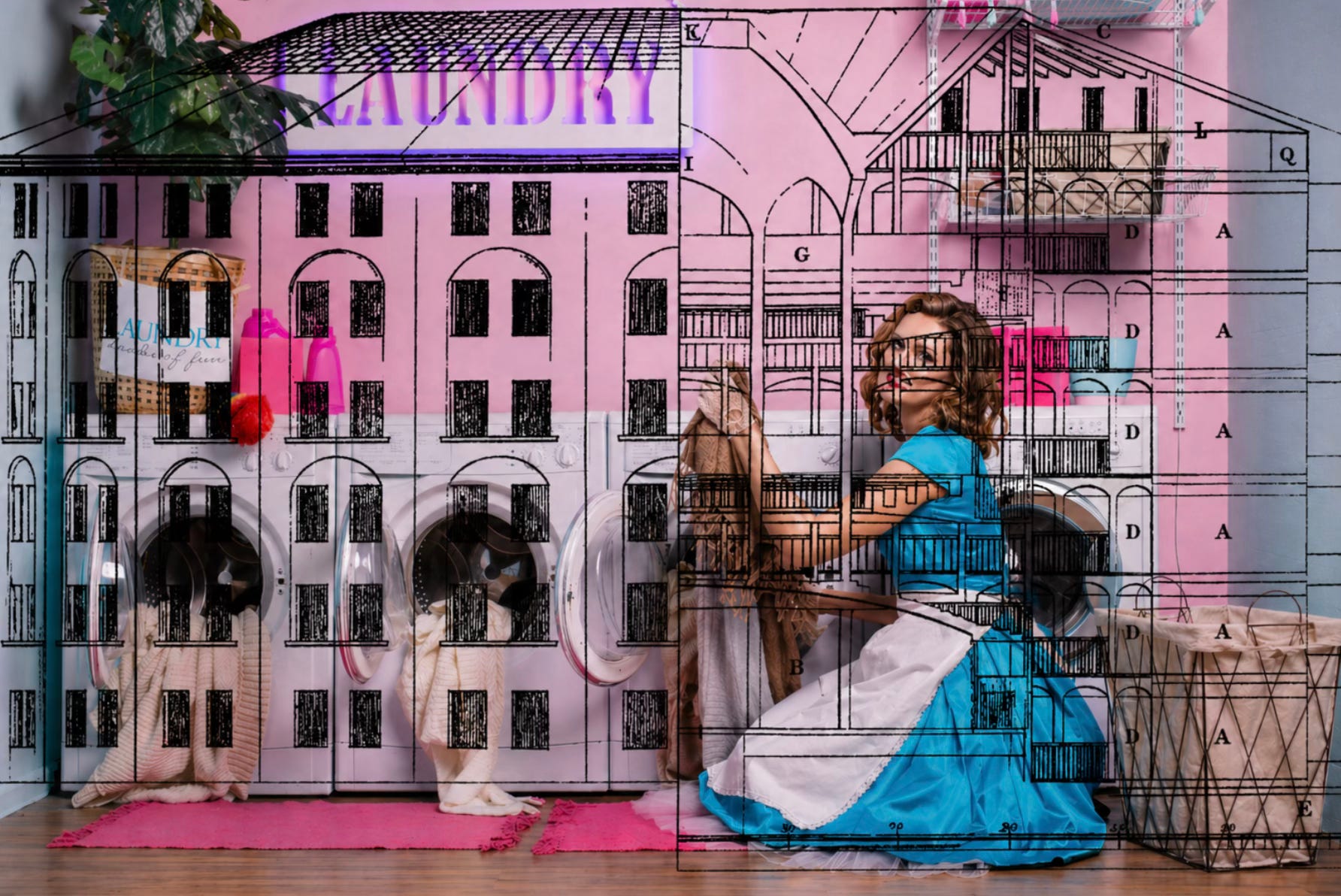
The Panopticon in the Kitchen: Wife School and the Repackaging of Patriarchy

There is a woman sitting in an earth-tone living room, bathed in natural light, offering advice to a friend whose husband refuses to wash his hands. The friend is frustrated, tired of reminding a grown man about basic hygiene. The woman on the couch, however, has a different perspective. She tells her friend that it would be better for her entire family to contract the bubonic plague and die than for her to continue treating her husband like a toddler by reminding him to wash his hands (Demopoulos, 2026).
This is not a sketch from a dystopian comedy. It is a genuine piece of instruction from “Wife School,” a video masterclass led by Tilly Dillehay, a Baptist writer and pastor’s wife. For $17, Dillehay teaches women how to become the kind of wives who inspire “godly leaders.” This means smiling, remaining attentive, and above all, submitting. It means learning the “skill of zip it” when disagreements arise, asking permission to spend $300 on a chair or to join a committee. It literally means, quite literally, choosing the risk of pestilence over the risk of nagging (Demopoulos, 2026).

Wife School is part of a growing cottage industry of online courses sold by affable Christian women to other women, promising domestic bliss through total submission. It sits alongside the broader “tradwife” movement, where influencers churn butter in milkmaid dresses and declare that feminism is the root of all female discontent. But to dismiss this as mere nostalgia or internet cosplay is to miss the machinery whirring beneath the pastel surface.
This is a counter-revolution. When women gain autonomy, patriarchy rarely returns in the form of a blunt instrument. Instead, it returns wearing softer clothes: wellness, femininity, faith, and order. It repackages hierarchy as virtue. To understand how this mechanism works, we must look beyond the aesthetics of the kitchen into the architecture of the prison.
The Aesthetics of Submission
The French philosopher Jean Baudrillard argued that we no longer live in reality, but in a “hyperreality” composed of simulacra: copies of things that either had no original or no longer have one. We consume the simulation of a thing rather than the thing itself (Baudrillard, 1981).
The tradwife movement and courses like Wife School are perfect examples of this phenomenon. These women are not actually living in the mid-twentieth century. They are modern influencers, building lucrative businesses on platforms like Instagram and TikTok, monetising the image of a past that never truly existed in the frictionless, perfectly curated way they present it. They are selling a simulacrum of tradition.

As Mariah Wellman, an assistant professor at Michigan State University who studies influencers, notes, these women are exploiting the feelings of inadequacy and instability felt by their followers. “They’re selling wife skills, sure, but what they’re really selling is stability” (Demopoulos, 2026). In an era defined by economic precarity, the burnout of the “girlboss” era, and the overwhelming complexity of modern life, the promise of a simple, ordered existence is deeply seductive.
But the simulation serves a darker purpose. By wrapping subjugation in the aesthetics of Pottery Barn catalogues and fresh blowouts, the Christian Right has managed to market misogyny as a lifestyle brand. They have realised that you cannot force women back into the kitchen with laws alone (at least, not yet) but you can sell them the kitchen as a wellness product. Submission is no longer framed as a legal or economic necessity; it is framed as the cure for the anxieties of modernity. Patriarchy has entered its influencer era.
This commodification of submission is a highly effective strategy for neutralising resistance. When oppression is packaged as a consumer choice, it becomes much harder to critique. The tradwife influencer is not a victim of patriarchy; she is its most successful salesperson. She has taken the very structures that limit women’s freedom and turned them into a lucrative personal brand. In doing so, she provides a template for other women to follow, suggesting that the path to happiness lies not in challenging the system, but in perfectly adapting to it.
This hyperreal version of the 1950s erases the actual history of that era. It ignores the widespread dissatisfaction, the reliance on tranquillisers, and the systemic exclusion of women from public life that characterised the period. Instead, it presents a sanitised, Instagram-filtered version of the past, where the only challenge is perfecting a sourdough recipe. This historical amnesia is crucial to the movement’s success. By erasing the reality of women’s past struggles, it makes the return to those conditions seem desirable.
The danger of this simulacrum is that it replaces political action with aesthetic consumption. Instead of fighting for structural changes, such as affordable childcare, equal pay, or reproductive rights, women are encouraged to retreat into a highly curated domestic sphere. The political is reduced to the personal, and the systemic failures of society are reframed as individual failings that can be cured by a $17 online course.
The Internal Guard
If Baudrillard explains the packaging, Michel Foucault explains the mechanism. In his seminal work Discipline and Punish, Foucault traces the evolution of power from the spectacular, public violence of the sovereign to the subtle, pervasive control of modern institutions. At the centre of this shift is the concept of the Panopticon: a prison design where inmates can be observed at any moment by a central guard tower, but cannot see into the tower themselves (Foucault, 1975).

Because the prisoner never knows exactly when they are being watched, they must assume they are always being watched. The genius of the Panopticon is that it renders the external guard obsolete. The prisoner internalises the surveillance and begins to police their own behaviour. As Foucault writes, “He who is subjected to a field of visibility, and who knows it, assumes responsibility for the constraints of power; he makes them play spontaneously upon himself; he inscribes in himself the power relation in which he simultaneously plays both roles; he becomes the principle of his own subjection” (Foucault, 1975).
Subscribe to Notes From Plague Island and join our growing community of readers and thinkers.
Wife School is the domestic Panopticon. The teachings demand the meticulous policing of the internal self. Dillehay instructs women to track their hormonal cycles — not for family planning, but so they can monitor the “insanity” of their emotions and ensure they remain kind to their husbands. She tells them to “rewrite the headlines” in their own minds, reframing their husbands’ failures as virtues. If a husband neglects a duty, the wife must tell herself that it simply means he has time for something else (Demopoulos, 2026).
This is the creation of what Foucault called “docile bodies:” bodies that can be subjected, used, transformed, and improved through disciplinary practices. The woman is taught to monitor her tone, her facial expressions, her hormones, and her private thoughts. The husband does not need to be a tyrant, because the wife has been trained to be both the prisoner and the guard.
The ultimate victory of this system is that the subjugation is framed as a choice. Dillehay calls it “proactive submission.” By convincing women that they are choosing to shrink themselves, the system masks its own coercive nature. The soul, as Foucault observed, becomes the prison of the body.
This internalised surveillance extends beyond the immediate relationship with the husband. It encompasses the woman’s entire relationship with herself. She is taught to view her own desires, ambitions, and even her basic emotional responses with suspicion. Any feeling of frustration or resentment is not a valid response to an unequal situation, but a sign of her own spiritual failing. She must constantly monitor herself for signs of rebellion, actively suppressing any impulse that might disrupt the patriarchal order.
In this way, Wife School achieves a level of control that external force could never manage. A woman who is forced to submit may still harbour rebellious thoughts; a woman who has been trained to police her own mind will actively suppress those thoughts before they can even form. She becomes the architect of her own subjugation, constantly working to ensure that she remains a docile and compliant subject.
The brilliance of this mechanism lies in its invisibility. Because the control is internalised, it does not feel like oppression. It feels like self-improvement. The woman is not being forced to submit; she is choosing to become a “better” wife. This framing makes the system incredibly resilient, as any critique of the power structure can be easily dismissed as an attack on the woman’s personal choices and religious beliefs.
The Weaponisation of Consent
The most chilling application of this internalised surveillance occurs in the realm of bodily autonomy. The Guardian report highlights the teachings of Wife School regarding sexual obligation. Dillehay instructs her students that “a husband expects a yes” when he asks for sex, quoting Corinthians to argue that spouses should not deprive one another.
She compares sex to pizza: when it is good, it is great, and when it is bad, it is still pretty good. Therefore, wives must sometimes settle for “frozen pizza,” which is an extended metaphor that attempts to make the consumption of unwanted sex sound mundane and acceptable (Demopoulos, 2026).
When “a husband expects a yes” becomes theology, consent is no longer about mutuality. It becomes a weapon. This is where the Panopticon reaches a dark, terrifying conclusion. The woman must not only submit her body to her husband, but she must police her own mind to ensure she does so willingly, or at least without complaint. She must manufacture her own consent to avoid the sin of deprivation.
This ideology operates in a culture where, as the CDC reports, one in four women will experience physical violence by an intimate partner (Demopoulos, 2026). Yet Wife School does not address abuse. Instead, as writer Elena Trueba discovered when she took the course, women are directed to resources that argue against always believing victims and suggest that abuse sometimes stems from a victim’s “sinfulness” (Trueba, 2026; Demopoulos, 2026). The internal guard is thus reinforced: if you are suffering, it is because you have not policed yourself rigorously enough. As Dillehay herself puts it: “If you’re going to suffer, suffer as a righteous woman” (Demopoulos, 2026).
The weaponisation of consent is perhaps the most insidious aspect of this entire ideology. By framing submission as a religious duty, it removes the possibility of refusal. A woman who says no is defying God. This places an immense psychological burden on the woman, forcing her to constantly override her own instincts and desires in order to maintain her spiritual standing.
Furthermore, the trivialisation of unwanted sex — comparing it to “frozen pizza” — serves to normalise coercion. It suggests that a woman’s physical boundaries are of little consequence, and that her primary role is to serve the needs of her husband. This is a profound violation of the core principles of bodily autonomy, repackaged as a quirky, relatable metaphor. It is a bleak reminder that beneath the pastel aesthetics of the tradwife movement lies a deeply disturbing reality of control and subjugation.
This dynamic is not limited to sex. It permeates every aspect of the marital relationship. The woman is expected to constantly anticipate her husband’s needs and desires, adjusting her own behaviour to ensure his comfort and satisfaction. She must become an expert in reading his moods, managing his emotions, and smoothing over any potential conflicts. This emotional labour is entirely unacknowledged and uncompensated, yet it is essential to the functioning of the patriarchal household.
The psychological toll of this constant self-monitoring and emotional management is immense. It requires a level of hyper-vigilance that is exhausting and ultimately destructive to the woman’s sense of self. She is no longer an independent agent, but a mere extension of her husband’s will. This is the true cost of the tradwife fantasy: the systematic dismantling of the female self.
The Laboratory of Tyranny
Why does this matter beyond the walls of individual homes? Because the domestic sphere is the foundation of the political sphere. Hannah Arendt, in her analysis of totalitarianism, warned of the dangers of atomising individuals and destroying the public sphere. When the public realm is eroded, citizens retreat into the private realm, where unquestioning obedience can be normalised (Arendt, 1951). The home becomes the laboratory where authoritarian subjects are manufactured.
The creators of these courses are not operating in a political vacuum. Dillehay’s books are published by Canon Press, an imprint owned by Douglas Wilson, an extremist pastor based in Moscow, Idaho. Wilson is a self-described Christian nationalist who has openly opposed a woman’s right to vote and envisions a patriarchal theocracy (Demopoulos, 2026; Simmons, 2026). In Wilson’s ideal America, voting rights would belong solely to the male head of the household. Women in households led by a husband would have no individual political voice (Simmons, 2026).
This is the political endgame of Wife School. If you can train half the population to treat obedience as holiness — to ask permission to buy a chair, to view their own desires as sinful, to police their own thoughts for signs of rebellion — you are manufacturing the ideal authoritarian citizen. A woman who has been trained to say “yes” to every demand of her husband is a citizen who has been trained to say “yes” to the demands of the state.
The recent UNLV study on the tradwife movement confirms the hostility beneath the aesthetic. Researchers found that men who view the movement favourably do not hold “benevolent” sexist views rooted in chivalry; rather, they exhibit “overt, explicit and hostile” sexism. They resent women while simultaneously expecting them to bend to every whim (Robnett, 2026; Demopoulos, 2026).
The connection between domestic subjugation and political authoritarianism is a stated goal of the Christian nationalist movement. By establishing strict hierarchies within the home, they are laying the groundwork for a society based on similar principles. The husband is the sovereign of the household, and his authority is absolute. This model of governance is then projected outwards, creating a vision of a state where power is concentrated in the hands of a few, and unquestioning obedience is demanded of the many.
In this context, Wife School is a training ground for a new political order. It is teaching women to accept their own disenfranchisement, to view their lack of political power as a natural and necessary consequence of their gender. By normalising submission in the private sphere, it prepares the ground for the acceptance of authoritarianism in the public sphere.
This is why the tradwife movement must be understood as a deeply political phenomenon. It is not a retreat from politics; it is a different kind of politics — one exclusion, of hierarchy, and control. It seeks to dismantle the democratic institutions that have allowed women to participate in public life, and to replace them with a system based on patriarchal authority.
The danger of this movement is amplified by its alignment with broader authoritarian trends. As democratic norms erode and right-wing populism gains ground, the tradwife ideology provides a ready-made model for social organisation. It offers a vision of a society where order is maintained through strict gender roles and unquestioning obedience to authority. This is a vision that is deeply appealing to those who feel threatened by social change and long for a return to a mythical past.
The Machinery of Choice
The Christian Right understands that democracy depends on equality, and therefore, to dismantle democracy, one must first dismantle equality. They have built a sophisticated machinery to achieve this. The simulation of tradition (Baudrillard) masks the internalised surveillance (Foucault), which in turn manufactures the compliant citizens required by authoritarianism (Arendt). It is a system that commercialises female insecurity, turning misogyny into a $17 online course.
Authoritarianism does not always arrive in jackboots. Sometimes it arrives in pastel kitchens, accompanied by Bible verses and smiling women who have been taught to call their own erasure “freedom.” The question is not whether individual women “choose” submission. The question is what social, political, and theological machinery is shaping that choice, and who profits when women are taught to shrink.
This machinery is constantly evolving, adapting to new platforms and new anxieties. It uses the language of empowerment to sell subjugation, and the aesthetics of wellness to mask control. It is a highly effective system, precisely because it is so difficult to identify. It does not look like oppression; it looks like a lifestyle choice.
But we must not be fooled by the packaging. The core message of Wife School and the broader tradwife movement is one of profound inequality. It is a rejection of the fundamental principles of feminism, and a deliberate attempt to roll back the gains that women have made over the past century. It is a reminder that the fight for equality is never truly won, and that we must remain vigilant against the ever-changing forms of patriarchal control.
The ultimate goal of this movement is to change the very nature of Western society. By establishing the home as a laboratory of tyranny, they are preparing the ground for a broader political transformation. They are building a world where hierarchy is naturalised, where submission is virtue, and where the Panopticon is not a prison, but a kitchen.
The success of this movement depends on our willingness to accept its premises. It relies on our collective amnesia, and our willingness to trade freedom for the illusion of stability. But we must resist this temptation and recognise the tradwife movement for what it is: a sophisticated attempt to repackage patriarchy for a new generation. We must reject the simulacrum of tradition, dismantle the internal guard, and refuse to participate in the laboratory of tyranny. Only then can we hope to build a society based on true equality and genuine freedom.
Or support us with a one-off tip → Buy Me a Coffee
References
Arendt, H. (1951). The Origins of Totalitarianism. New York: Harcourt, Brace & Co.
Baudrillard, J. (1981). Simulacra and Simulation. Translated by S. Faria Glaser. Ann Arbor: University of Michigan Press.
Demopoulos, A. (2026). ‘‘A husband expects a yes’: how wife schools are shaping submissive Christian women.’ The Guardian, 28 April. Available at: https://www.theguardian.com/us-news/ng-interactive/2026/apr/28/wife-school-christian-women-submissive [Accessed: 28 April 2026].
Foucault, M. (1975). Discipline and Punish: The Birth of the Prison. Translated by A. Sheridan. New York: Pantheon Books.
Robnett, R. D. and Hammond, M. (2026). ‘Ambivalent Sexism Theory as a Framework for Understanding Men’s Attitudes About the #Tradwife Movement.’ Psychology of Women Quarterly. Available at: https://journals.sagepub.com/doi/10.1177/03616843261433199 [Accessed: 28 April 2026].
Simmons, T. (2026). ‘Hegseth mentor Doug Wilson’s vision for a Christian nation means married women can’t vote.’ Religion News Service, 10 April. Available at: https://religionnews.com/2026/04/10/hegseth-mentor-doug-wilsons-vision-for-a-christian-nation-means-married-women-cant-vote/ [Accessed: 28 April 2026].
The Wife School (no date). The Wife School: Biblical Wife Coaching for Women Who Want to Fix What's Out of Order in Their Marriage. Available at: https://thewifeschool.com [Accessed: 28 April 2026].
Trueba, E. (2026). I went to Wife School so you don’t have to.’ Substack, 13 February. Available at:
[Accessed: 28 April 2026].