The Madness of King Donald: A Kingdom for a Middle Finger
There is a moment in Shakespeare’s definitive tragedy when King Lear, divested of his power, betrayed by his own blood, and cast out into the wilderness, stands upon a desolate heath and roars at the storm. It is the iconic, searing image of a man entirely undone by his own ego, a monarch whose catastrophic vanity has unspooled the very fabric of his kingdom and his mind. He is a king of nothing, shouting at everything. Four centuries later, we find ourselves unwilling spectators on a similar heath, watching the tragicomedy of another mad king: Donald Trump.
This is not a performance confined to a distant stage, for we are all courtiers in this crumbling kingdom, trapped in the tempest of his unravelling. In a dizzying, terrifying trifecta of public displays, Trump has offered a raw, unfiltered glimpse into the abyss of his own psyche. His recent assertion that the United States “shouldn’t even have an election” in 2026, his pathetic and desperate embrace of a second-hand Nobel Prize, and his vulgar, snarling response to a heckler are not isolated gaffes to be interpreted by the media. They are a clear, three-act drama of autocratic madness, a portrait of a man who, like Lear, has become so consumed by his own reflection that he is willing to burn the entire kingdom down simply to preserve the sanctity of his own image. We are watching the visible, festering symptom of a deep-seated democratic decay.
Act I: The Abdication of the Vote
Lear’s tragedy begins not with a bang, but with a game. It is a catastrophic error born of pure vanity: he decides to abdicate his responsibilities while retaining the title and all the hollow privileges of a king. He divides his kingdom based on which of his daughters can offer the most performative declaration of love. It is a loyalty test, a demand for flattery, and it is the kingdom’s undoing. The honest daughter is banished; the liars are rewarded with a nation.
Trump, in his own uniquely clumsy and brutal fashion, has staged a similar abdication. His recent pronouncement to Reuters that, because of his litany of imaginary accomplishments, “we shouldn’t even have an election” is the logical, inevitable conclusion of a long-held authoritarian fantasy (Hawkinson, 2026). And this was the explicit echo of the promise he made to his “beautiful Christians” in 2024, a promise whispered at a rally like a dark prophecy: if they voted for him “just this time,” they wouldn’t have to bother with the tedious ritual of democracy ever again. “It’ll be fixed,” he assured them, as if the entire constitutional framework of the republic were a leaky tap in one of his gaudy, gold-plated bathrooms (Vargas, 2024).
The White House, of course, performed its now-rote duty of gaslighting the public. Press Secretary Karoline Leavitt insisted he was merely “joking” and “speaking facetiously” (Hawkinson, 2026). But no one who has been paying attention for the last decade is laughing. This is the open, undisguised expression of a desire to rule by decree, to enjoy the pomp and power of the presidency without the messy, inconvenient, and increasingly challenging necessity of securing the public’s consent. It is the same impulse that led him to admire the world’s most brutal dictators, from Putin to Kim Jong-un, men who have truly “fixed” their nations so that no one ever has to vote again (Vargas, 2024).
Like Lear, Trump wishes to “unburdened crawl toward death,” retaining the name and all the additions of a king while casting off the fundamental duty of democratic leadership: accountability to the people. He is attempting to trade the vote, the most vital organ of the republic, for a lifetime subscription to his own ego. He is attacking the very idea that power in America flows from the people, and not from the whims of a single, deeply unwell man.
Consider the brazen audacity of the claim. He lists his “accomplishments” — a litany of executive orders, many of which are being challenged in courts across the nation, and a series of chaotic, destabilising policy shifts — and concludes that these achievements are so magnificent that the American people should simply forfeit their right to have a say in their own governance. It is the logic of a tyrant, dressed in the ill-fitting clothes of a populist. It is the argument of a man who believes the state exists to serve him, rather than the other way around. And it is a warning, delivered in plain sight, of what is to come if he is not stopped.
Subscribe to Notes From Plague Island and join our growing community of readers and thinkers.
Act II: A Beggar’s Prize, A Fool’s Gold
Lear’s hunger for adulation is a bottomless pit. He doesn’t want genuine love from his daughters; he wants a public spectacle of it. He craves the performance of devotion. He rewards the empty, extravagant flattery of his treacherous daughters, Goneril and Regan, and banishes Cordelia, the one child who loves him honestly and without artifice. Her refusal to “heave her heart into her mouth” is a crime against his narcissism, an unforgivable injury to his pride.
And so, in a spectacle of such profound cringe that it would be comical if it weren’t so deeply pathetic, we were treated to the recent, “unbelievably embarrassing” scene of Trump accepting a hand-me-down Nobel Peace Prize medal from the Venezuelan opposition leader, María Corina Machado (Bryant, 2026). The act was so desperate, so reeking of fraudulent validation, that it drew immediate and scathing condemnation from Norwegian politicians, the actual custodians of the prize. Trygve Slagsvold Vedum, a Norwegian party leader, perfectly captured the essence of the man: “a classic showoff who wants to adorn himself with other people’s honours and work” (Bryant, 2026).
Trump, naturally, paraded the little trinket on his failing social media platform as if it were a genuine honour, a testament to “the work I have done” in securing a “free Venezuela,” a country he has, in reality, plunged into further chaos (Bryant, 2026). It is the political equivalent of a toddler wearing a plastic sheriff’s badge and believing he is the law. The Nobel Committee itself was forced to issue a statement clarifying that its prize “cannot be revoked, shared or transferred,” a polite, Scandinavian way of saying, “You cannot have this. It is not for you” (Bryant, 2026).
But the truth, as always, is irrelevant. For Trump, as for Lear, the performance of honour is infinitely more valuable than honour itself. He is so starved for the symbols of legitimacy, so desperate for the world to see him as something other than the corrupt, failed businessman and reality TV star he is, that he will eagerly accept any fraudulent, hollow gesture and present it to the world as proof of his greatness. It is a golden calf for his followers to worship, a glittering bauble to distract from the rot at the core of his presidency.
The parallel to Lear is almost too perfect. Lear demands that his daughters quantify their love, turning a private emotion into a public transaction. Trump, similarly, is obsessed with the quantifiable symbols of success: ratings, crowd sizes, and now, Nobel Prizes. He doesn’t care if the prize is earned; he cares only that he can hold it up and say, Look, I have this. The medal is a prop, a piece of theatre, and the performance is all that matters.
Act III: The Rage of the Unkinged
When the consequences of his folly finally corner Lear, when he is stripped of his knights, his authority, and his illusions, he does not find wisdom or humility. He instead finds rage. On the heath, his madness is not one of quiet contemplation, but of impotent, screaming fury. He lashes out at the storm, at his daughters, at the world that has refused to bend to his will. It is the incoherent roar of a man who has lost everything and learned nothing.
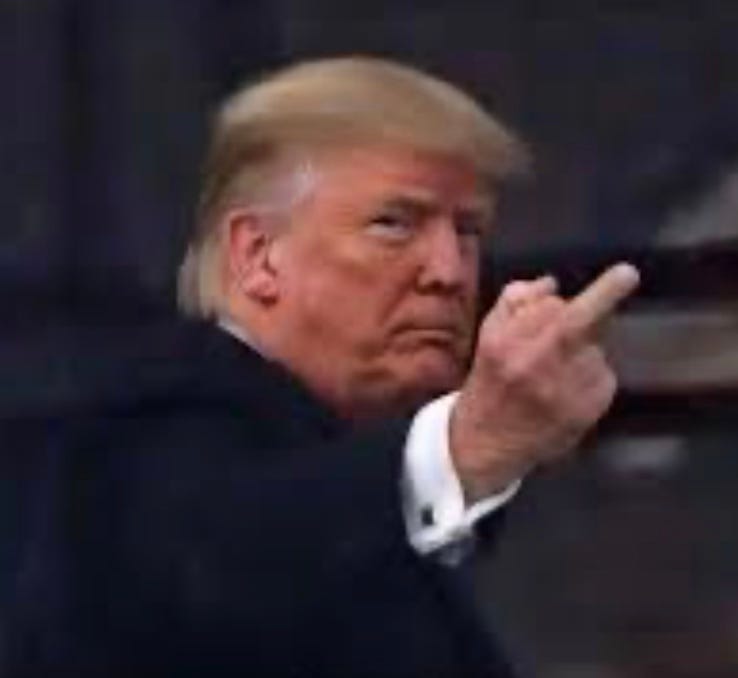
This brings us to the Ford factory in Dearborn, Michigan. This is Trump’s heath. When a heckler, a UAW worker named TJ Sabula, shouted that Trump was a “pedophile protector” -- a pointed and deeply resonant accusation, given the president’s well-documented and never-explained association with the infamous sex trafficker Jeffrey Epstein — the response was not a denial, a defence, or even a political attack (Solis, 2026). It was a primal scream of pure, unadulterated rage. Trump turned, his face a mask of fury, and mouthed “fuck you” before raising his middle finger in a gesture of obscene contempt (Canon, 2026; Solis, 2026).
The heckler, in this moment, becomes the Fool. In Shakespeare’s play, the Fool is the one character who speaks uncomfortable, often brutal, truths to power. He uses riddles and sharp-witted insults to expose the king’s folly, holding up a mirror to his madness. He is the only one who can tell Lear the truth without being banished, and even he is eventually silenced. TJ Sabula, in shouting that specific accusation, held up such a mirror. He spoke the unspeakable, the thing that festers in the dark corners of the public consciousness, and the king could not bear to see his own reflection.
And what of the consequences for the Fool? In Shakespeare’s play, the Fool disappears, his fate unknown. In Trump’s America, the consequences are more immediate and more brutal. Sabula, the worker who dared to speak, was suspended from his job (Solis, 2026). The message is clear: speak truth to power, and you will be punished. The king may rage, but the machinery of his court will ensure that those who challenge him are silenced.
And what of the king’s court? The White House, in a chilling display of the new, debased normal, defended the gesture. Communications director Steven Cheung dismissed the worker as a “lunatic” and declared that “the president gave an appropriate and unambiguous response” (Solis, 2026). So, the official position of the White House is that an obscene gesture and a mouthed expletive are an “appropriate” response for the President of the United States. The normalisation of this vulgarity is a political choice. It is a signal to his followers that all norms are dead, all decorum is for the weak, and the only language that matters is the language of brute force and contempt.
This is the modern-day Lear on the heath. Confronted with a direct challenge to his authority and a raw reminder of his own sordid history, his only recourse is a vulgar gesture, a middle finger against the storm of truth. It is the impotent rage of a man who has nothing left but his own fury, a man who would rather curse the world than face himself.
The Kingdom in the Storm
These three events, occurring in a rapid, dizzying succession, are the connected, cascading symptoms of a single disease: a bottomless narcissism that has curdled into a full-blown, dangerous detachment from reality. The desire to cancel elections, the craving for fake accolades, and the explosive rage at any slight are the actions of a Shakespearean tragic figure, a man who has become so convinced of his own centrality to the universe that he believes he is the state.
The tragedy, however, is not just his; it is the nation’s. As Trump’s personal decay accelerates, so does the political decay of the country he leads. A new, devastating analysis from The Century Foundation, the “Democracy Meter,” provides the grim, empirical data to accompany our allegorical narrative. In the first year of Trump’s second term, the United States’ democracy score plummeted from a mediocre 79 out of 100 to a shocking 57: a 28 percent drop that lands the country squarely in the territory of “authoritarianism” (Schenkkan and Cambanis, 2026).
The report is a damning indictment. It identifies the core problem as the “aggrandizement of the executive branch’s powers at the expense of and with the acquiescence of Republican-controlled Congress, supported by a compliant and highly partisan Supreme Court” (Schenkkan and Cambanis, 2026). In other words, the system of checks and balances, the very architecture designed to prevent a mad king from seizing absolute power, has collapsed. The report characterises the government’s behaviour in stark, terrifying terms: “breaking the law, ignoring court rulings, engaging in grand corruption, [and] targeting critics for persecution” (Schenkkan and Cambanis, 2026). This is the quantifiable consequence of the Mad King’s reign. The storm Lear raged against was in his own mind; the storm Trump has unleashed is real, and it is tearing down the institutions of the republic.
There is, perhaps, one small glimmer of hope buried within the report. The “Elections” category, the report notes, held steady at 12 out of 15 points. “Elections can still be a means of contesting and changing power,” the authors conclude (Schenkkan and Cambanis, 2026). This is the thin reed upon which the future of the republic rests. The Mad King wants to abolish elections; he has said so, plainly and repeatedly. The question is whether the kingdom will let him.
We are all on the heath now, caught in the tempest of one man’s ego. The wind howls, the rain lashes down, and the king rages. The question is no longer whether the king is mad because he has shown us, with terrifying clarity, that he is. The question is whether the kingdom can survive his madness and whether Americans, the subjects of his chaotic reign, will find the courage to speak the truth, like Cordelia and the Fool, or whether they will be swept away by the storm. The answer, as it was for Lear, will determine whether this tragedy ends in ruin or in some form of redemption. The clock is ticking dear Americans, and the storm shows no sign of abating.
Or support us with a one-off tip → Buy Me a Coffee
References
Bryant, M. (2026) ‘Giving Trump the Nobel peace prize medal is ‘absurd’, say Norwegian politicians’, The Guardian, 16 January. Available at: https://www.theguardian.com/world/2026/jan/16/maria-corina-machado-giving-trump-nobel-peace-prize-medal-absurd-say-norwegian-politicians [Accessed: 16 January 2026].
Canon, G. (2026) ‘Trump gives heckler the middle finger during Michigan Ford plant visit’, The Guardian, 13 January. Available at: https://www.theguardian.com/us-news/2026/jan/13/trump-middle-finger-michigan [Accessed: 15 January 2026].
Hawkinson, K. (2026) ‘Trump says the US ‘shouldn’t even have an election’ in 2026 because of all his accomplishments’, The Independent, 15 January. Available at: https://www.independent.co.uk/news/world/americas/us-politics/trump-2026-election-interview-b2901450.html [Accessed: 16 January 2026].
Schenkkan, N. and Cambanis, T. (2026) ‘Century’s New Democracy Meter Shows America Took an Authoritarian Turn in 2025’, The Century Foundation, 15 January. Available at: https://tcf.org/content/report/centurys-new-democracy-meter-shows-america-took-an-authoritarian-turn-in-2025/ [Accessed: 16 January 2026].
Shakespeare, W. (edited by Wells, S.) King Lear. London: Penguin Books, 2015.
Solis, B. (2026) ‘A Ford worker called out Trump. The president flipped him off. Now, he’s been suspended.’, Michigan Advance, 13 January. Available at: https://michiganadvance.com/2026/01/13/a-ford-worker-called-out-trump-the-president-flipped-him-off-now-hes-been-suspended/ [Accessed: 16 January 2026].
Vargas, R.A. (2024) ‘Trump tells supporters they won’t have to vote in the future: ‘It’ll be fixed!’‘, The Guardian, 27 July. Available at: https://www.theguardian.com/us-news/article/2024/jul/27/trump-speech-no-need-to-vote-future [Accessed: 16 January 2026].