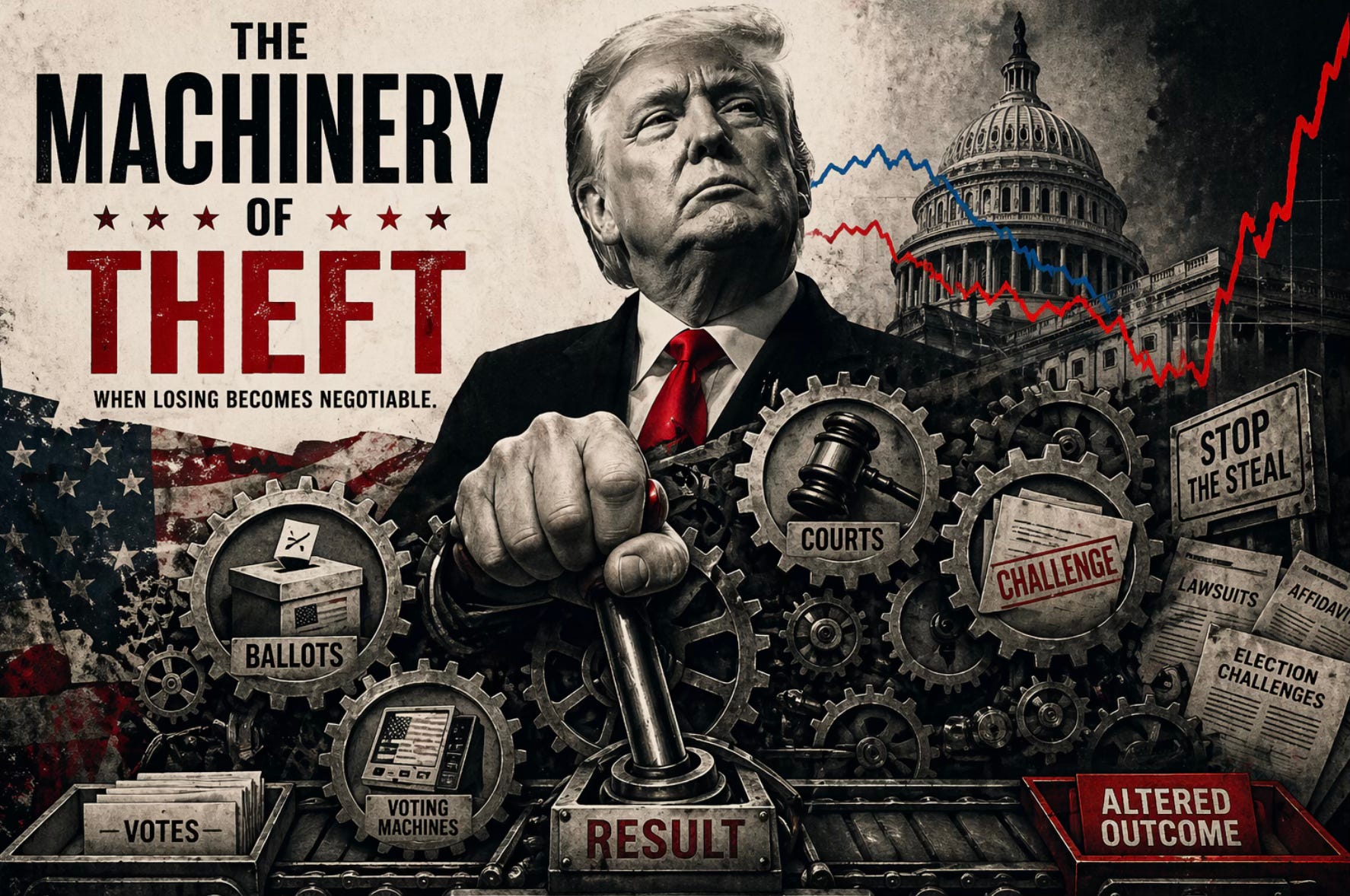
The Machinery of Theft: Trump, The Midterms, and the Road to 2028
On April 22, 2026, Donald Trump posted a message on Truth Social responding to a state-level redistricting referendum in Virginia. The vote had narrowly passed by 51.4 percent to 48.5 percent. The President declared the entire process illegitimate. “A RIGGED ELECTION TOOK PLACE LAST NIGHT IN THE GREAT COMMONWEALTH OF VIRGINIA!” he wrote. “All day long Republicans were winning, the Spirit was unbelievable, until the very end when, of course, there was a massive ‘Mail In Ballot Drop!’” (Al Jazeera, 2026). He called it “another Crooked Victory” and demanded the courts reverse the result.
The sitting President of the United States declared a democratic vote rigged because his side lost, and because people voted by mail. Not a presidential election; not even a congressional race. A state redistricting referendum. A procedural vote about where to draw lines on a map, and he called it a stolen election.
By pre-emptively declaring a state-level referendum fraudulent because of mail-in ballots, Trump is testing the exact language, logic, and narrative architecture he intends to deploy against the 2026 midterms. The Virginia post is the warning shot. The administration is actively constructing the machinery to steal them.
Our previous analysis published here — Wake Up Call: The Echoes of Weimar — established the historical framework: the Weimar Republic was not destroyed by a putsch but by a pseudo-legal process of coordination, Gleichschaltung, in which democratic mechanisms were turned against democracy itself. That argument was made as a warning. The evidence now suggests it was not a warning about a distant possibility, but a description of what was already beginning. This article is about what is happening.
There is one detail from history that is worth holding in mind as you read what follows. In April 1932, Hitler lost the German presidential election to Paul von Hindenburg by millions of votes. He immediately declared the result fraudulent. A German court examined the claim and ruled against him. He vowed to “attack, attack, and attack again.” The filmmaker Leni Riefenstahl, watching him that night, observed that he “spoke as if he had won the election” (Ryback, 2024). Bear that in mind, and then read Trump’s Virginia post again.
Since the Weimar analysis was published, the administration has moved with deliberate speed to remove every institutional safeguard that protected the integrity of the 2020 election. The officials who held the line have been fired. The agencies that debunked fraud claims have been gutted. The legal mechanisms that blocked politically motivated prosecutions have been dismantled. And a draft executive order — seventeen pages long, circulated among Trump allies since spring 2025 — sits ready to be signed, granting the President emergency powers over the conduct of federal elections. The question this article addresses is not whether Trump will attempt to interfere with the 2026 midterms, because the evidence that he is already doing so is overwhelming and documented. The question is what that interference will look like, why he cannot afford a clean election, and what the consequences will be; not just for November 2026, but for November 2028, and for the republic itself.
As the 2026 midterms approach, the landscape has fundamentally and irreversibly changed. The current administration has spent the last year quietly and systematically executing its own Gleichschaltung. What Trump is building is not a system without elections; it is rather a system of “managed democracy,” the model perfected by Vladimir Putin and his chief ideologue, Vladislav Surkov. In a managed democracy, the regime gouges the ballot box. Elections are retained as political theatre to provide a veneer of democratic legitimacy while the outcome is predetermined long before the first vote is cast (Atlantic Council, 2024). The visual markers of democracy remain — campaign commercials, polling stations, volunteers — but the competitive nature of the system is entirely eradicated.
The Existential Risks
For Trump, the 2026 midterms are about personal, existential survival. His approval ratings have collapsed into the mid-30s, driven down by the economy, mass deportations, and the war in Iran (The Guardian, 2026). The Senate map, once thought to be a Republican lock, is now a genuine toss-up, with prediction markets placing control at a 50-51 coin flip (270toWin, 2026).
If the Democrats win the House, they gain subpoena power. That means the immediate launch of sweeping investigations into the Department of Government Efficiency (DOGE), the conduct of the Iran war, and, most dangerously for Trump, the Epstein files.
The Epstein exposure is a uniquely personal threat. In November 2025, Congress passed the Epstein Files Transparency Act, requiring the Department of Justice to release all files related to Jeffrey Epstein and Ghislaine Maxwell within 30 days. The DOJ blew past the deadline. When they finally released approximately 3 million files in January 2026, the rollout was chaotic: nearly 100 victims’ names and nude photos were mistakenly left visible, while crucial information was redacted (Yahoo News, 2026). More importantly, 2.5 million files are still being withheld from the public.
What is being hidden? An NPR investigation found that the DOJ appears to have withheld notes from an FBI interview with a woman who accused Donald Trump of sexually abusing her when she was 13 years old (CNBC, 2026; Daily Beast, 2026). The released files are missing dozens of pages related to sexual abuse accusations involving Trump (Houston Public Media, 2026). Despite evidence detailing the abuse of more than 1,000 women and children, the DOJ has made zero arrests beyond Epstein and Maxwell themselves (NPR, 2026).
Trump’s handling of the fallout reveals his panic. On April 2, 2026, he fired Attorney General Pam Bondi, ostensibly because he was unhappy with her handling of the Epstein files and her failure to prosecute his political enemies (CNBC, 2026). He replaced her with Deputy Attorney General Todd Blanche, who promptly declared that the Epstein files “should not be a part of anything going forward” (Krishnamoorthi, 2026). Meanwhile, Trump’s allies are floating a presidential pardon for Ghislaine Maxwell.
House Oversight Republicans have spent the last year acting as Trump’s firewall, blocking Democrats from issuing subpoenas related to Epstein by holding “roundtables” instead of hearings to prevent votes on the matter (Politico, 2026). A Democratic House strips away that shield. The Department of Justice’s internal watchdog has already opened an audit into the agency’s compliance with the Transparency Act (New York Times, 2026). The pressure is mounting.
If the Democrats win the Senate as well, the threat escalates from exposure to removal. More than 85 Democrats have already called for Trump’s impeachment or removal via the 25th Amendment over his actions in Iran (NBC News, 2026). Former Speaker Nancy Pelosi has explicitly refused to rule out a third impeachment if Democrats regain control (The Grio, 2026).
Trump knows this. He has publicly warned his supporters that a strong Democratic showing will lead to his impeachment (Newsweek, 2026). He cannot afford a clean election, because a clean election, given his current standing, likely means losing the House. Losing the House means losing the shield. It is these reasons alone that make a clean election unviable for him.
Gutting the Electoral Immune System
To ensure the election is not clean, the administration had to first remove the people who kept it clean in 2020. To comprehend the scale of what has been done, one must look back to a windowless room in Washington in December 2020. Attorney General William Barr had summoned federal officials responsible for protecting American elections — experts from the Cybersecurity and Infrastructure Security Agency (CISA) and top FBI officials — to a fortified room at the Justice Department’s headquarters. Trump was obsessed with a conspiracy theory that voting machines in Antrim County, Michigan, had switched votes from him to Biden. The CISA specialists explained patiently that a clerk had made a mistake when updating ballot styles on machines, leading to a software problem. There was no fraud. Just human error, subsequently confirmed through a hand count of the ballots (Clark and Fifield, 2026).
Those CISA specialists, and the dozens of career officials like them who stood between Trump and the theft of the 2020 election, are now gone. Every single one of them. A ProPublica investigation published in April 2026 found that at least 75 career officials who played important roles in election security at the Department of Homeland Security, the Department of Justice, and other departments have left, been fired, or been reassigned since Trump returned to power (Clark and Fifield, 2026). They have been replaced by roughly two dozen political appointees. Ten of those appointees actively worked to reverse the 2020 vote. The rest are associates of such people. The election denial movement has merged with the federal government.
The destruction of CISA is the most visible part of this purge. CISA was created by Trump in his first term to counter cyber threats in the aftermath of Russia’s efforts to influence the 2016 vote. After the 2020 election, it played a crucial part in puncturing the fallacies spread by Trump supporters, producing a “Rumor Control” website to rebut them. Trump swiftly fired Chris Krebs, whom he had appointed to lead CISA, after Krebs and his colleagues released a statement calling the 2020 election “the most secure in American history” (Clark and Fifield, 2026).
Upon returning to the Oval Office, Trump finished the job. Starting in February 2025, DHS leadership put employees focused on countering disinformation and helping safeguard elections on leave. The agency’s election security work was frozen entirely. Eventually, all three dozen or so CISA employees specialising in elections were fired or transferred to work in other areas (Clark and Fifield, 2026).
The destruction did not stop at CISA. The National Security Council’s election security group, which coordinated departmental responses to electoral threats, was disbanded. The Foreign Malign Influence Center — a branch of the Office of the Director of National Intelligence that had stymied efforts by Russia, China, and Iran to interfere in the 2024 election — was dismantled in August 2025. Former national security officials told ProPublica that its functions had largely ceased (Clark and Fifield, 2026).
The FBI has been similarly gutted. Kash Patel, the bureau’s new director, dismantled the public corruption team, which had been deployed in previous administrations to help monitor possible criminal activity on Election Day. The Foreign Influence Task Force, which aimed to combat foreign influence in American politics, was also disbanded.
The Justice Department’s Public Integrity Section, which had been responsible for ensuring the department’s inquiries were not improperly influenced by politics, was effectively destroyed. After Trump returned to power, the unit’s top staff resigned when agency leaders directed them to dismiss corruption charges against then-New York City Mayor Eric Adams. More resigned or were transferred thereafter. The 36-person section was reduced to two (Clark and Fifield, 2026). It no longer reviews politically sensitive cases.
The Civil Rights Division’s voting section, which had enforced federal laws protecting voting rights and combating racial discrimination, has been similarly undermined. Nearly all of the section’s roughly 30 career lawyers have resigned or been moved. Harmeet Dhillon, Trump’s assistant attorney general for civil rights, issued a memo declaring that the division’s mission would shift from ensuring voting rights to enforcing Trump’s executive order on elections. The administration then filled the section with conservative lawyers who are now litigating against the very lawyers they replaced. At least four of those newly appointed lawyers participated in challenging the 2020 vote or have worked with people who helped Trump try to overturn the 2020 election (Clark and Fifield, 2026).
Subscribe to Notes From Plague Island and join our growing community of readers and thinkers.
This is the deliberate, coordinated removal of every person and institution that said “no” in 2020. The mechanism is the goal. The institutional immune system has been systematically dismantled to ensure that when the order comes to intervene in the 2026 midterms, there will be no one left to refuse.
The Fulton County Raid: The Weimar Parallel Made Flesh
What happened in Georgia is the single most important event of the last year, because it demonstrates exactly how the machinery of theft operates when the guardrails are gone.
In late January 2026, the FBI carried out an unprecedented seizure of 2020 election materials from Fulton County, Georgia — a Democratic stronghold. The operation was orchestrated by Kurt Olsen, whom Trump had hired as his director of election security and integrity. Olsen had worked to overturn Trump’s 2020 loss in court and was later sanctioned by judges for making baseless allegations about Arizona elections (Clark and Fifield, 2026).
When the FBI’s Atlanta field office chief, Paul Brown, examined the report Olsen presented to justify the raid, his team found that Georgia’s election board had already looked into its allegations, dismissing many altogether. Brown’s team submitted an affidavit to their superiors that did not make a strong enough case to move forward. Brown was then offered a choice: retire or be moved to a new office. He retired. With Brown gone, the case moved ahead under his replacement (Clark and Fifield, 2026).
This is the Weimar parallel made flesh. The career official who says no is removed. He is replaced by someone who says yes. The raid proceeds. “They’re just moving through people until they find someone who’s willing to do exactly what they want,” said Ryan Crosswell, a former Justice Department lawyer who handled election cases for nearly five years (Clark and Fifield, 2026).
The Fulton County demonstrates the FBI can now be weaponised against local election officials who refuse to comply with the administration’s demands. It is a message to every county clerk, secretary of state, and election official in America: comply, or face the consequences. Imagine being a local election worker in Detroit or Philadelphia, knowing that the federal government is now willing to deploy the FBI to seize your equipment if the President dislikes the vote count. The machinery of theft is abstract until it touches a person. The Fulton County raid proves it will touch anyone who stands in the way.
Manufacturing the Illusion of Fraud
With the guardrails removed and the loyalists installed, the administration has spent the last year manufacturing the pretexts necessary to justify intervention. The most aggressive tool in this arsenal has been the DOJ’s unprecedented campaign to seize state voter rolls. The Justice Department has filed federal lawsuits against 29 states and the District of Columbia seeking access to sensitive voter registration data (Holtzman Vogel, 2026). The administration’s stated rationale is the detection of non-citizen voters. But the tool being used to identify them — the Systematic Alien Verification for Entitlements system — has been found to be riddled with inaccuracies. DHS claimed the system had identified more than 21,000 potential non-citizens on voter rolls in the past year. But officials who checked those results in detail found vast inaccuracies. Most states eventually marked only a few to a few hundred potential non-citizens as registered to vote, and far fewer had ever actually voted (Clark and Fifield, 2026).
The tool is not fit for purpose, but that is not the point. The point is to generate numbers, doubt, and a pretext. It creates the illusion of a tainted voter pool, which can later be cited as justification for throwing out results.
Running in parallel is the SAVE America Act, which passed the House at Trump’s urging and would require voters to provide documentary proof of citizenship — such as a passport or birth certificate — when registering to vote (Votebeat, 2026). Trump himself stated that if the SAVE Act were enacted, Republicans would “never lose a race. For 50 years, we won’t lose a race” (Center for American Progress, 2026). It is an explicit admission that the policy is about partisan advantage, not election integrity.
To understand what this means in practice, consider Courtney Patterson. He is 80 years old. He was born on his family’s farm in Lenoir County, North Carolina, and was fortunate that a country doctor recorded his birth. “But many other people who grew up with me didn’t even have that,” Patterson told Capital B. Babies were delivered at home by midwives who were illiterate. On the rare occasions a doctor visited, he might leave with a ham or produce — payment from families with little cash. Documentation of births, if it existed at all, was written down in a family Bible (Tensley, 2026).
Patterson has served on the Lenoir County Board of Elections for close to 15 years. In all that time, he said, “we have never had to investigate” a single case of someone falsely claiming citizenship to vote. What he sees in the SAVE Act is something older and uglier: “It’s the same pattern,” he said, comparing it to the literacy tests and poll taxes of the Jim Crow era (Tensley, 2026).
The numbers confirm his instinct. The Brennan Center for Justice found that 21.3 million voting-age Americans do not have proof of citizenship readily available. One-fifth of Black Americans born in 1939 and 1940 were never issued birth certificates. Only one-third of Black Americans hold passports, compared to half of all American adults. The racial disparity is not incidental (Morris and Henry, 2024). As Demetria McCain of the NAACP Legal Defense Fund put it: “This isn’t an ID law. Your driver’s license isn’t going to help you. You’ve got to have something like a passport or a birth certificate.” And then she drew the direct historical line: “And guess what the poll tax was about? It was about money” (Tensley, 2026).
The SAVE Act would also destroy the infrastructure of Black civic participation. For decades, voter registration has orbited around community life: churches, fraternities, sororities, grocery stores. But proving citizenship requires formal documentation verified at a government office. “You can’t do that at a church registration drive,” McCain said. “You can’t do that in front of a grocery store” (Tensley, 2026). The legislation dismantles the communal architecture through which Black Americans have exercised their democratic rights for generations.
The Uniform at the Door
Beyond the legal machinery of disenfranchisement, the administration is also preparing a more visceral form of voter suppression: the physical deployment of federal immigration agents to American polling locations.
In March 2026, Trump abruptly ordered ICE agents to major US airports to assist the Transportation Security Administration during a DHS funding lapse. The decision surprised even senior officials within his own administration. But Steve Bannon, Trump’s former chief strategist and a figure who remains deeply embedded in the administration’s ideological orbit, was not surprised at all. On his War Room podcast, Bannon explained the real purpose: “We can use this as a test run, as a test case, to really perfect ICE’s involvement in the 2026 midterms.” He was unambiguous about the intended outcome: “ICE is going to be there in the fall of ‘26, just like they’re in airports today. So, from the War Room, suck on that!” (Knutson, 2026).
Mike Davis, a far-right lawyer assisting the administration with its effort to pack the judiciary with loyalists, endorsed the idea on the same broadcast. His justification was the same baseless claim that animates the entire voter suppression apparatus: that non-citizen voting is a widespread problem. It is not. Numerous studies and voter roll audits have found that non-citizens fraudulently voting is vanishingly rare. The claim is a pretext (Brennan Center, 2026b).
The Brennan Center for Justice has been explicit: sending ICE or any other armed federal agents to polling places is illegal. Federal law expressly bans federal officers from interfering in elections, and a separate statute — on the books since 1865 — prohibits troops and armed federal agents from being deployed anywhere an election is held. Any form of voter intimidation by federal agents is illegal under both federal and state law (Brennan Center, 2026b). The Department of Homeland Security has no role in enforcing election laws. ICE has no business being anywhere near a polling place.
But legality is not the point; the uniform at the door is, as is the patrol car parked outside a polling station in a predominantly Latino neighbourhood in Phoenix or Miami, or the ICE van idling at the end of the street where a Black church in Detroit has been running its voter registration drive for forty years. Nobody needs to be arrested. Nobody needs to be turned away. The mere presence of immigration enforcement agents at or near a polling place is enough. The chilling effect — the decision made at home, before leaving the house, that today is not worth the risk — is the intended outcome. The architecture of theft does not always require a lock. Sometimes a shadow is enough.
Markwayne Mullin, confirmed by the Senate as Trump’s Secretary of Homeland Security, refused during his confirmation hearing to definitively rule out deploying ICE to polling places, saying only that it could happen in the event of a “specific threat” (Brennan Center, 2026b). The White House has similarly declined to issue a categorical assurance that it will not happen. In the absence of a clear prohibition, Bannon’s promise stands.
The Iran War as Pretext
The most dangerous pretext being manufactured, however, is an international one. Just hours after launching the war in Iran, Trump reposted a headline on Truth Social claiming: “Iran tried to interfere in 2020, 2024 elections to stop Trump, and now faces renewed war with United States” (Waldman, 2026).
This was a deliberate signal. By explicitly linking the Iran war to election interference on the very day the bombs began falling, Trump was constructing a narrative bridge between the foreign conflict and the domestic vote. If Iran is an enemy of America, and Iran tried to interfere in elections, then any election result that weakens Trump — the man Iran supposedly fears — can be reframed as an Iranian victory. The logic is circular, but it does not need to be sound, it just needs to be loud.
Timothy Snyder, writing in Project Syndicate just days ago, laid out the threat of using crisis to manipulate elections with characteristic bluntness: “The United States is seven months away from the most consequential midterm elections in its history. Meanwhile, U.S. President Donald Trump, together with Israel, has started a war against Iran. These are the ideal conditions for a head of state to seize power in a coup” (Snyder, 2026). Snyder identifies five scenarios through which Trump could exploit the war but singles out one as the most dangerous: the exploitation of terror. A foreign enemy carrying out an attack against American civilians during wartime would provide an aspiring dictator with a pretext to declare a state of emergency and suspend elections. Snyder does not stop there. He raises the spectre of a false-flag operation, noting that “in 1999, the Russian secret services bombed apartment buildings in Moscow, triggering a chain of events that set in motion Putin’s march toward dictatorship. Chances are high that Trump, Putin’s client in the White House, has considered this approach” (Snyder, 2026).
Whether or not one considers a false-flag operation plausible, the broader point is undeniable: the Iran war is a domestic political tool (as well as a foreign policy disaster). It provides the ultimate national security rationale for executive overreach. And it creates the conditions under which an attack — real or manufactured — could be used to justify the suspension of democratic norms. As Snyder concludes: “if a terrorist attack does occur in the next seven months, Americans should be skeptical of Trump, who will undoubtedly attempt to blame his domestic opponents and discredit the midterms” (Snyder, 2026).
The Shadow of Emergency Powers
The final, most severe escalation in this architecture of theft is the preparation to use emergency powers to seize control of the electoral process itself. A 17-page draft executive order titled “Establishing Security, Integrity, and Transparency for United States Elections with Protections Against Foreign Interference” has been circulating among anti-voting groups and administration allies since spring 2025 (Democracy Docket, 2026a). The draft order would declare a national emergency to allow the President to take unprecedented control over voting. Its sweeping scope would prohibit most Americans from casting a mail ballot and would require all 211 million registered Americans to re-register in person at an election office by proving their citizenship (Center for American Progress, 2026).
The draft cites the National Emergencies Act, the Federal Information Security Modernization Act, and the Defense Production Act as its legal basis. Legal scholars note that none of these authorities delegates the president any power to change voting laws, let alone enact a wholesale takeover of federal and local elections (Center for American Progress, 2026). The US Constitution expressly gives states the power to administer federal elections.
Yet the administration’s allies are openly preparing the ground. Late last week, election deniers who tried to overturn the 2020 election met with top administration election security officials in a “summit” aimed at pushing Trump to declare a national emergency and take over the midterms (Waldman, 2026). Among the attendees were Kurt Olsen, the architect of the Fulton County raid, and Heather Honey, an election denier now in charge of election security at DHS.
Jerome Corsi, an election denier who is reportedly coordinating with the White House on the draft order, stated on a right-wing podcast in March 2026: “I think Plan A has always been an executive order from President Trump... He’s not going to allow the 2026 midterm elections to be stolen without taking some strong executive action and executive order” (Democracy Docket, 2026b).
The legal reality — that the President does not possess the constitutional authority to suspend or rewrite election laws — is almost beside the point. If the administration issues an emergency declaration aimed at seizing control of the electoral apparatus, it will force the courts, state governors, and the military to choose sides in real-time. In a system where the institutional guardrails have already been systematically dismantled, relying on the courts to swiftly and decisively halt an executive power grab is a terrifying gamble. When leaders are allowed to deny reality on this scale, atrocity often follows.
Election Night: The Machinery in Motion
So, what does this actually look like in practice? Imagine November 3, 2026.
The polls close. The early returns, heavily skewed by in-person voting, show Republicans performing well. But as the night wears on, the mail-in ballots — the very ballots Trump has spent years demonising — begin to be counted in key swing states like Pennsylvania, Michigan, and Arizona. The margins tighten. The Senate hangs in the balance. The House majority begins to slip away.
Before the count is even close to finished, Trump takes to Truth Social, echoing his Virginia post: “A RIGGED ELECTION IS TAKING PLACE! MASSIVE MAIL-IN BALLOT DROPS!”
But this time, the machinery activates. The DOJ, now purged of its independent career lawyers, immediately files emergency injunctions in federal courts to halt the counting of mail-in ballots, citing the “tainted” voter rolls they spent the last year manufacturing doubt about. The FBI, weaponised as seen in Fulton County, dispatches agents to election offices in Democratic strongholds, demanding to seize voting machines and ballots under the guise of investigating “foreign interference” from Iran.
And then, the executive order drops. Citing the ongoing war and the “national emergency” of foreign meddling, Trump signs the 17-page document, attempting to federalise the election process and invalidate millions of votes.
The chaos is intentional; the goal is to stop the count, create an impenetrable fog of doubt, and force the issue into a Supreme Court that he has packed, or into state legislatures where his loyalists hold power.
The Final Test
Senator Alex Padilla, a California Democrat who has led the pushback to the administration’s actions on elections, put it plainly: “Our election system withstood Trump’s attacks following the 2020 election, but this will be an even tougher test, with more election deniers in positions of power and fewer guardrails in place” (Clark and Fifield, 2026).
In 2020, there were 75 career officials across DHS, DOJ, and other departments who formed the backbone of the institutional immune system. There was a CISA that could debunk fraud claims in real time. There was a Public Integrity Section that could block politically motivated prosecutions. There was an FBI field office chief in Atlanta who could look at a politically motivated request and say no.
Every single one of those defenses has been removed. With the federal oversight mechanisms gone, the defense of the election now relies entirely on the resilience of state officials, the integrity of the remaining independent courts, and the public’s unwavering refusal to accept a pre-rigged outcome.
That is a very thin line to hold. But it is not nothing, and there is something else that the architecture of theft cannot suppress, something that the draft executive orders and the purged officials and the ICE deployments cannot reach: the fact that more and more Americans are seeing through Donald Trump.
Consider what the machinery itself reveals. Trump’s approval ratings are in freefall. The Virginia redistricting vote went against him. The Senate is a genuine toss-up. If he were truly popular — if the MAGA movement were the unstoppable force it presents itself as — none of this would be necessary. The SAVE Act would not be needed. The DOJ voter roll lawsuits would not be needed. The draft emergency executive order would not be needed. The promise of ICE agents at polling places would not be needed. The architecture of theft is the confession of a man who knows he cannot win a clean fight.
The resistance is already underway. It is being led not by institutions in Washington but by state-level officials who were elected by the same people Trump is trying to disenfranchise. It is being built in courtrooms where attorneys general are fighting the DOJ’s voter roll lawsuits. It is being sustained by the ordinary donations filling the legal defence funds preparing injunctions against the emergency orders. The institutional immune system may have been hollowed out at the federal level, but it is being rebuilt from below: in state houses, county election offices, and in the decisions of local election workers who look at a federal agent at their door and refuse to be intimidated. The people united is a formidable thing. History has shown that repeatedly.
This is not a moment for passive observation. The time to act is now. Support the state-level officials fighting the voter roll lawsuits. Fund the legal groups preparing the injunctions. Demand that local representatives publicly commit to certifying the vote, regardless of federal pressure. The architecture of theft is being built in plain sight — so is the resistance to it.
There is one final, devastating reality to confront. The 2026 midterms are not a rehearsal for something else. They are the foundation upon which everything that follows will be built. If the Republicans hold the House through suppression and manufactured doubt, they retain the committee chairs, the subpoena power, and the firewall around the Epstein files. If they hold the Senate, they retain the ability to confirm loyalists to every remaining institution — including any Supreme Court vacancy that opens before 2028. And if the emergency executive order is successfully deployed in 2026 and survives legal challenge, it does not remain a draft document circulating among election deniers. It becomes established practice. By November 2028, the courts will have ruled on it. The precedent will have been set.
And in January 2029, the man sitting in the Vice President’s chair, presiding over the certification of the Electoral College, will not be Mike Pence. Pence was a constitutionalist who believed, however reluctantly, that his role was ceremonial and legally constrained. He did the right thing in 2020, and he paid for it politically — hounded out of the movement he had served, booed at his own party’s rallies. JD Vance has given every indication that he holds no such conviction. He has been explicit that he believes Pence made the wrong call. Every piece of the architecture being built now — the purged officials, the gutted agencies, the weaponised DOJ, the ICE deployments, the emergency powers — serves two purposes simultaneously: to win in 2026, and to make 2028 irreversible. With Vance in the chair, the final act only requires a signature.
The Weimar Republic fell because its citizens believed the institutions would save them, even as those institutions were being gutted from within. Americans do not have the luxury of that illusion. The federal institutions have been inverted, their authority turned against the democratic processes they were built to protect. The defence of the republic now rests not in Washington, but in the hands of the people who are already fighting back, and in the hands of every American who understands what is at stake before the polls open in November 2026.
Or support us with a one-off tip → Buy Me a Coffee
References
270toWin (2026) ‘RacetotheWH 2026 Senate Forecast’, 270toWin, 14 April. Available at: https://www.270towin.com/2026-senate-election/racetothewh-2026-senate-forecast [Accessed: 24 April 2026].
Al Jazeera (2026) ‘Trump calls Virginia election “rigged” after redistricting referendum’, Al Jazeera, 22 April. Available at: https://www.aljazeera.com/news/2026/4/22/trump-calls-virginia-election-rigged-after-redistricting-referendum[Accessed: 24 April 2026].
Atlantic Council (2024) ‘What to watch in Russia’s stage-managed presidential “election”’, Atlantic Council, 13 March. Available at: https://www.atlanticcouncil.org/blogs/new-atlanticist/what-to-watch-in-russias-stage-managed-presidential-election/ [Accessed: 24 April 2026].
Center for American Progress (2026) ‘The Trump Administration Has No Legal Authority To Invoke National Security and Take Over Elections’, Center for American Progress, 3 March. Available at: https://www.americanprogress.org/article/the-trump-administration-has-no-legal-authority-to-invoke-national-security-and-take-over-elections/ [Accessed: 24 April 2026].
Clark, D.B. and Fifield, J. (2026) ‘Inside Trump’s effort to “take over” the midterm elections’, ProPublica, 13 April. Available at: https://www.propublica.org/article/trump-midterm-elections-takeover [Accessed: 24 April 2026].
CNBC (2026) ‘Trump fires Attorney General Pam Bondi’, CNBC, 2 April. Available at: https://www.cnbc.com/2026/04/02/trump-pam-bondi-attorney-general-lee-zeldin.html [Accessed: 24 April 2026].
Daily Beast (2026) ‘Epstein Files About 13-Year-Old Trump Accuser Kept Secret’, The Daily Beast, 31 March. Available at: https://www.thedailybeast.com/epstein-files-about-13-year-old-donald-trump-accuser-kept-secret/ [Accessed: 24 April 2026].
Democracy Docket (2026a) ‘Read a draft of the emergency executive order for Trump to take control of elections’, Democracy Docket, 27 February. Available at: https://www.democracydocket.com/news-alerts/exclusive-read-the-draft-executive-emergency-order-for-trump-to-take-control-of-elections/ [Accessed: 24 April 2026].
Democracy Docket (2026b) ‘Trump’s emergency elections order is “being prepared,” key ally believes’, Democracy Docket, 18 March. Available at: https://www.democracydocket.com/news-alerts/trumps-emergency-elections-order-is-being-prepared-key-ally-believes/ [Accessed: 24 April 2026].
Evans, R.J. (2014) ‘The Conspiracists: The Reichstag Fire’, London Review of Books, 36(9), 8 May. Available at: https://www.lrb.co.uk/the-paper/v36/n09/richard-j.-evans/the-conspiracists [Accessed: 24 April 2026].
Brennan Center (2026b) ‘Sending ICE to Polling Places Is Illegal’, Brennan Center for Justice, 31 March. Available at: https://www.brennancenter.org/our-work/research-reports/sending-ice-polling-places-illegal [Accessed: 24 April 2026].
Brennan Center (2026) ‘Foreign Influence vs. Foreign Interference in Elections’, Brennan Center for Justice, 27 March. Available at: https://www.brennancenter.org/our-work/research-reports/foreign-influence-vs-foreign-interference-elections[Accessed: 24 April 2026].
Knutson, J. (2026) ‘Bannon: Trump’s ICE airport deployment is ‘test run’ for ICE at polls’, Democracy Docket, 23 March. Available at: https://www.democracydocket.com/news-alerts/bannon-trump-ice-airport-deployment-test-run-2026-midterm-elections/ [Accessed: 24 April 2026].
Holtzman Vogel (2026) ‘DOJ’s voter roll lawsuits: A primer’, Holtzman Vogel, 4 March. Available at: https://www.holtzmanvogel.com/news-insights/doj-voter-roll-lawsuits-a-primer [Accessed: 24 April 2026].
Houston Public Media (2026) ‘Melania Trump denies close ties to Jeffrey Epstein in rare public statement’, Houston Public Media, 9 April. Available at: https://www.houstonpublicmedia.org/npr/2026/04/09/nx-s1-5779783/melania-trump-denies-close-ties-to-jeffrey-epstein-in-rare-public-statement/ [Accessed: 24 April 2026].
Krishnamoorthi, R. (2026) ‘Krishnamoorthi Blasts Potential Maxwell Pardon in Letter to Acting Attorney General Blanche’, Representative Raja Krishnamoorthi, 22 April. Available at: https://krishnamoorthi.house.gov/media/press-releases/krishnamoorthi-blasts-potential-maxwell-pardon-letter-acting-attorney-general [Accessed: 24 April 2026].
NBC News (2026) ‘Dozens of Democrats call for Trump’s removal after his Iran threats’, NBC News, 7 April. Available at: https://www.nbcnews.com/politics/congress/democrats-trump-removal-iran-threats-impeachment-25th-amendment-rcna267194 [Accessed: 24 April 2026].
New York Times (2026) ‘DOJ Watchdog Begins Review of Epstein Files Release’, New York Times, 23 April. Available at: https://www.nytimes.com/2026/04/23/us/politics/epstein-files-release-doj-watchdog.html [Accessed: 24 April 2026].
Newsweek (2026) ‘Will Donald Trump Be Impeached a Third Time? Exploring the Likelihood’, Newsweek, 30 March. Available at: https://www.newsweek.com/will-donald-trump-be-impeached-a-third-time-exploring-the-likelihood-11747452 [Accessed: 24 April 2026].
Morris, K. and Henry, C. (2024) ‘Millions of Americans Don’t Have Documents Proving Their Citizenship Readily Available’, Brennan Center for Justice, 11 June. Available at: https://www.brennancenter.org/our-work/analysis-opinion/millions-americans-dont-have-documents-proving-their-citizenship-readily [Accessed: 24 April 2026].
NPR (2026) ‘Why have there been no arrests from the Epstein files?’, NPR, 3 April. Available at: https://www.npr.org/2026/04/03/nx-s1-5766260/epstein-files-arrests-doj-prosecutors [Accessed: 24 April 2026].
Politico (2026) ‘This is how Democrats say Oversight Republicans are blocking Epstein subpoenas’, Politico, 21 April. Available at: https://www.politico.com/news/2026/04/21/congress-epstein-oversight-subpoenas-00882501 [Accessed: 24 April 2026].
Ryback, T.W. (2024) Takeover: Hitler’s Final Rise to Power. New York: Alfred A. Knopf.
Ryback, T.W. (2025) ‘How Hitler Dismantled a Democracy in 53 Days’, The Atlantic, 8 January. Available at: https://www.theatlantic.com/ideas/archive/2025/01/hitler-germany-constitution-authoritarianism/681233/ [Accessed: 24 April 2026].
Snyder, T. (2026) ‘Trump’s next coup attempt’, Project Syndicate, 19 April. Available at: https://www.project-syndicate.org/commentary/how-trump-could-attempt-coup-before-midterm-elections-by-timothy-snyder-2026-04[Accessed: 24 April 2026].
The Grio (2026) ‘Former House Speaker Nancy Pelosi has not ruled out the idea of impeaching President Trump again’, The Grio, 4 April. Available at: https://www.facebook.com/theGrio/posts/former-house-speaker-nancy-pelosi-has-not-ruled-out-the-idea-of-impeaching-presi/1306786567986244/ [Accessed: 24 April 2026].
The Guardian (2026) ‘Trump approval slips as polls show warning signs for midterms’, The Guardian, 22 April. Available at: https://www.theguardian.com/us-news/2026/apr/22/trump-approval-slips-polls-midterms [Accessed: 24 April 2026].
USHMM (2020) ‘Gleichschaltung: Coordinating the Nazi State’, Holocaust Encyclopedia, United States Holocaust Memorial Museum, 23 January. Available at: https://encyclopedia.ushmm.org/content/en/article/gleichschaltung-coordinating-the-nazi-state [Accessed: 24 April 2026].
Tensley, B. (2026) ‘Black Seniors Without Birth Records Could Be Disenfranchised by SAVE America Act’, Capital B, 24 March. Available at: https://capitalbnews.org/black-elders-save-america-act-voting/ [Accessed: 24 April 2026].
Votebeat (2026) ‘How the SAVE America Act would affect the 2026 elections’, Votebeat, 16 February. Available at: https://www.votebeat.org/2026/02/16/save-america-act-passes-house-proof-of-citizenship-register-vote-photo-id/[Accessed: 24 April 2026].
Waldman, M. (2026) ‘What Does War with Iran Have to Do with Elections?’, Brennan Center for Justice, 26 March. Available at: https://www.brennancenter.org/our-work/analysis-opinion/what-does-war-iran-have-do-elections [Accessed: 24 April 2026].
Yahoo News (2026) ‘Trump DOJ Under Investigation for How It Handled Epstein Files’, Yahoo News, 23 April. Available at: https://www.yahoo.com/news/articles/trump-doj-under-investigation-handled-200713615.html [Accessed: 24 April 2026].