
The Line That Stalks the Land: The Ceasefire as Land Grab and the New Architecture of Dispossession

Since December 2024 we have documented the genocide in Gaza and the political, legal and rhetorical machinery Britain and the West built to protect it. Every piece is collected, in the order it was written, at Palestine: The Evidence.
The ceasefire was announced. Gaza disappeared from the front pages overnight. When the October 2025 ceasefire deal was signed, the international community breathed a collective, performative sigh of relief. The television screens could finally look away without embarrassment; the protests could be politely ignored; the word “ceasefire” could be deployed as a shield against any further moral inquiry. The deal was presented by Trump as a triumph of American diplomacy, a moment of statesmanship, in the language of those who had enabled the slaughter. And so the governments moved on. The editors moved on. The cameras moved on.
The relentless bombardment that has, by July 2026, killed more than 73,200 Palestinians has not stopped (Gaza Government Media Office, 2026). The killings have not stopped. Since the ceasefire was declared in October 2025, more than 1,000 Palestinians have been killed by Israeli forces: shot at the kill zone’s edge, struck by airstrikes, targeted by drones (Associated Press, 2026). Israel committed at least 3,201 documented ceasefire violations between October 2025 and June 2026 alone (Al Jazeera, 2026). What the ceasefire did was add a new layer on top of the ongoing violence: bulldozers and surveyors, the quiet machinery of territorial annexation (Abu Alkas et al., 2026). The current situation in Gaza is the simultaneous prosecution of two strategies, continued killing and the permanent seizure of land, running in parallel, each one providing cover for the other. What is happening in Gaza is not a peace process. It is a land grab conducted in plain sight, with the full backing of the man in the White House.
The Geography of Erasure: The Creeping Border
The geography of this erasure is not subtle. It is written in concrete and enforced by sniper fire. It is also not new. Gaza has been under continuous Israeli military occupation since 1967. The blockade that turned it into what the UN called “the world’s largest open-air prison” has been in place since 2007. What is happening now is that history, accelerated. The so-called “Yellow Line,” established by the October 2025 agreement, was sold to the world as a temporary demarcation of Israeli withdrawal. Under the terms of the deal, Israeli forces were meant to pull back to this line, ceding control of the western portion of the strip to Palestinian governance, while further withdrawals were to be negotiated in subsequent phases. It was, in the language of diplomacy, a starting point. It was also a line drawn without Palestinian consent, negotiated between Israel and the United States, with Hamas pressured into signing under conditions of siege and annihilation (Council on Foreign Relations, 2026). The civilian population of Gaza, the people whose land the line divides, had no say in where it was drawn.
It was never meant to hold. Not a broken promise, but a deliberate lie: a line drawn to be moved, a deal signed to give the theft of Palestinian land the veneer of international legitimacy.
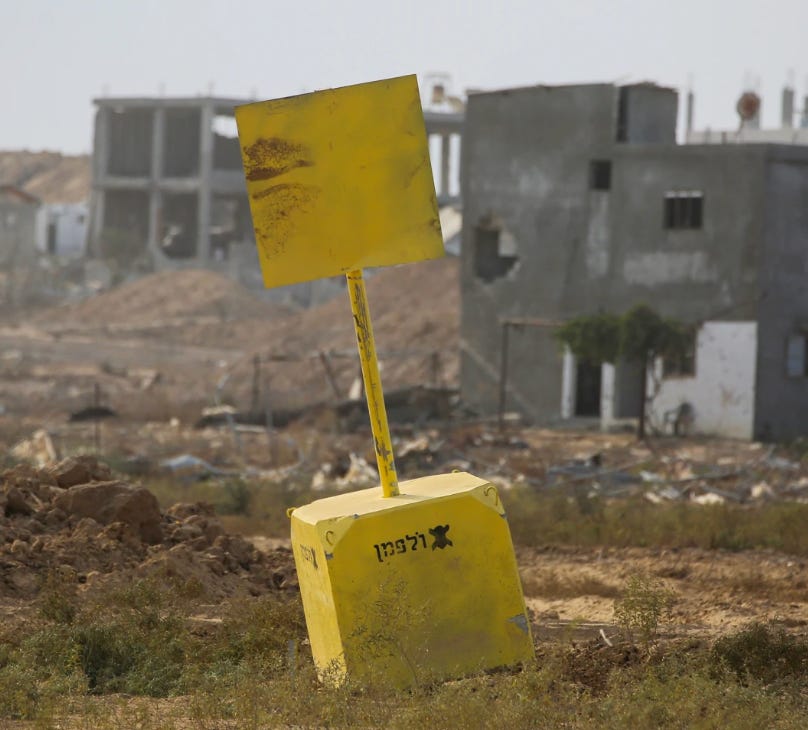
From the moment the line was drawn, the Israeli military began moving it. The army uses yellow-painted concrete blocks and massive earthen berms to physically demarcate the boundary, and satellite imagery analysed by BBC Verify revealed that these markers were surreptitiously moved hundreds of metres deeper into the strip, a process described by Andreas Krieg, a professor and Middle East expert from King’s College London, as a “tool for territorial engineering” (Garman, Pengelly, and Murphy, 2026). In the Al-Tuffah neighbourhood of Gaza City, Reuters documented how Israeli forces moved blocks roughly 200 metres beyond the declared line in December 2025, then razed at least 40 buildings in the newly seized area, displacing the families who lived in them (Abu Alkas et al., 2026). In Khan Younis, blocks were placed as much as 390 metres deeper into Palestinian territory.
The Israeli military denied shifting the line, offering no evidence for its denial. A military source described the maps published by the Trump administration as mere “illustrations” (Abu Alkas et al., 2026). This is the language of impunity. The maps, the agreements, the lines: set in stone one day, mere illustrations the next.
The human cost of this territorial engineering is immediate and lethal. Israel has declared all areas outside of the Yellow Line to be a free-fire zone. Palestinians attempting to return to their homes or access their agricultural land are routinely shot. Between the ceasefire’s onset on 10 October 2025 and 27 February 2026, the UN Human Rights Office recorded the killing of at least 224 Palestinians east of or near the Yellow Line, and another 347 in attacks far from it (OCHA, 2026). An Israeli soldier, speaking anonymously to the Associated Press, confirmed that orders were given to open fire on anyone approaching the boundary, adding, “To call it a ceasefire is a joke” (Abushawish, 2026). In Gaza City’s Zeitoun neighbourhood, eleven members of the Abu Shaaban family were killed after the Israeli military claimed their vehicle had crossed the Yellow Line (Wilkins, 2025).
Eleven people. Seven of them children. For crossing a line they could not see.
This is one incident, in one neighbourhood, in one moment of an occupation that has been running for 59 years.
Bombing is the violence the camera recognises. Zoning is the violence that arrives with cleaner language.
Manal Abu Al-Kas, one of the Palestinians forced to flee eastern Al-Tuffah after Israel moved the blocks beyond where she was living, put it plainly. Two of her sons had been killed and buried in the neighbourhood. She had lived there, she said, “until they put up these yellow stones and we were forced to leave.” Her husband and another son had both had legs amputated. “If there weren’t shells falling on us in our homes,” she said, “we wouldn’t have left our house” (Abu Alkas et al., 2026).
The encroachment did not stop at the Yellow Line. In April 2025, Netanyahu announced the “Morag Corridor,” a new military axis that physically dissects Gaza, running from east to west to cut off Rafah and the south from the rest of the territory (PBS News, 2025). It joins the Netzarim Corridor further north (in place since early in the war), which already severs Gaza City and the entire north from the central and southern zones. Together, these two corridors carve the strip into three isolated fragments: a besieged north, a shrinking centre, and a sealed south. This is a classic medieval siege tactic updated for the 21st century: divide the population, control the movement of people and goods, and make the territory ungovernable except on your own terms. By deploying the 36th Division to secure the Morag Corridor (PBS News, 2025), the Israeli military compounded the existing severance of humanitarian access already imposed by the Netzarim line, strangling the movement of aid and people in both directions (Refugees International, 2024). It is a deliberate strategy of fragmentation, ensuring that the Palestinian population cannot function as a unified whole.
Then, in March 2026, the Israeli military quietly distributed new maps to aid organisations showing an “Orange Line” pushed even further into Palestinian territory, creating an expanded restricted zone that effectively places nearly two-thirds of Gaza under Israeli control (Magid, Al-Mughrabi, and Cornwell, 2026). These maps were not released publicly. They were sent only to aid groups, as if the military understood that what it was doing was indefensible and needed to be kept from the eyes of the world.
Rani Ashour, living in a displaced persons camp near Gaza City that sits between the two lines, described the experience to Reuters: “People don’t know what is what. The orange line is here today, you sleep, and you wake up, and you find it has passed you” (Magid, Al-Mughrabi, and Cornwell, 2026). Hundreds of families in eastern Gaza City are living it literally. On the night of 16 June 2026, Israeli tanks moved concrete barriers 300 metres westward in the Sanfoura area without warning. Mohammed Ayad, 48, fled with his wife and six children: “Around midnight, we started hearing tanks and heavy gunfire. At first, we thought it was a limited military operation, but by dawn we realised the concrete blocks had moved much closer to our neighbourhood. We received no warnings” (Ibrahim, 2026). Abu Hamed Hamada, 55, now sheltering in a school, said: “Since the war began, we’ve moved many times. Each time, we think we’ve found safety, but occupation advances, and we’re forced to leave again... Now, there’s almost nowhere left to go” (Ibrahim, 2026). This is the reality of life under a stalking occupation: the boundary is wherever the army decides it is, and you learn of its new location when the bullets start.
The 70 Percent Directive: How to Steal a Country in Plain Sight
The endgame of this creeping annexation was made explicitly clear by Benjamin Netanyahu in May 2026. Speaking at a conference in an occupied West Bank settlement, he declared to his audience, “We are currently squeezing Hamas. We now control 60% of the territory in the strip. You know, we were at 50, we moved to 60. My directive is to move to… 70%.” When someone in the crowd shouted “100!”, Netanyahu replied, “Let’s go step by step. First of all, 70. Let’s start with that. We’re pressing them from all sides, we’ll deal with the remnants” (Tantesh and Borger, 2026). By 18 July 2026, Israel’s deputy chief of staff, Maj Gen Tamir Yadai, confirmed in an on-camera briefing to Defence Minister Katz that Israel now directly controls 65% of the strip, already 12 percentage points beyond what the ceasefire permitted (Graham-Harrison, 2026). “I don’t know how to describe this,” Yadai told Katz, “other than victory, when you control 65% of the territory, when you have killed over 70,000 terrorists here.” By his own arithmetic, 21,000 of those terrorists were Palestinian children. More than 1,000 of them never reached their first birthday. More than 73,000 people are listed by name in the Gaza Health Ministry’s database of the dead, each with their Israeli-issued ID number. That figure is a floor. When Palestinians and aid agencies can finally dig in the rubble, the number will be higher. It will be so much higher. Katz, standing in the ruins of Palestinian homes and communities, said he “felt good.”
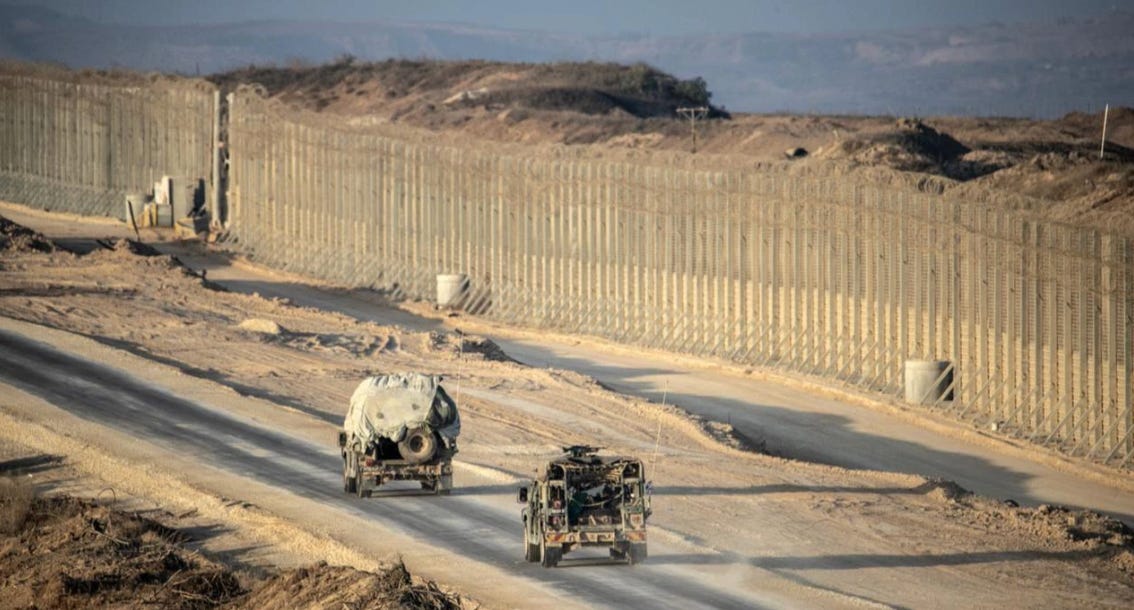
The horrifying maths of this dispossession is difficult to fathom. It means cramming more than 2 million traumatised, starving people into less than a third of an already tiny, devastated territory. Gaza was already one of the most densely populated places on earth. Now, with 92 percent of its housing units destroyed or damaged (Turak, 2025), the people who are still alive, still there, are packed into an even smaller share of what remains, living in tents on top of rubble, on top of sewage, on top of the graves of their neighbours.
An Al Jazeera investigation, using satellite imagery from Planet Labs, identified 40 distinct Israeli military outposts built inside Gaza after the October 2025 ceasefire, eight of which were constructed beyond the declared Yellow Line (Al Jazeera, 2026). These are permanent fortifications, built from concrete and earth, designed to hold territory indefinitely. In December 2025, the Israeli military’s chief of staff, Eyal Zamir, was recorded in a briefing to soldiers explicitly stating, “The Yellow Line is the new border” (Abushawish, 2026). This statement did not violate the ceasefire’s intent. It revealed it. The line was always designed to become permanent. The language of “temporary” and “phased withdrawal” existed only to make the deal palatable to the international community. By saying the quiet part aloud, Israeli military leadership confirmed what the physical evidence already showed: the Yellow Line was never a withdrawal boundary. It was the first draft of a new border, drawn in Palestinian blood.
We must reject the soft, sanitising language of “buffer zones” and “security perimeters.” This is straightforward land theft. It is unlawful annexation and a war crime. As Michael Becker, a professor of international human rights law at Trinity College Dublin, stated, “If Israel’s ultimate plan is to exercise permanent effective control over the entirety of the Gaza Strip, we are talking about unlawful annexation... [which] constitutes a violation of the bedrock prohibition of the acquisition of territory by force” (Cordall, 2026). The International Court of Justice reaffirmed this principle in its 2024 advisory opinion. The law is not ambiguous. The violation is not disputed. What is absent is any consequence whatsoever.
Subscribe to Notes From Plague Island and join our growing community of readers and thinkers.
To enforce this expansion, the state is increasingly deploying Israeli-backed armed militias to carry out the forced displacement it cannot formally acknowledge. The Guardian reported on the activities of a militia run by Gaza warlord Ashraf al-Mansi, which has been advancing westward from the Yellow Line around Jabalia, attacking Hamas but also telling Palestinian residents near the line to leave their homes. Wael Nayef Abu al-Ajeen, a 26-year-old living east of Deir al-Balah, described what happened when the militiamen came: “They went to the homes of the Abu al-Ajeen family there and informed them that they had until 10pm to evacuate all the houses in the area. They instructed them to take whatever furniture and belongings they could carry and to empty the houses as much as possible” (Tantesh and Borger, 2026). This is ethnic cleansing conducted by proxy, with the state maintaining a thin veneer of deniability while the result is identical.
On 18 July 2026, Defence Minister Katz announced plans for three formal “Nahal” outposts in northern Gaza (Nahal being the Israeli military’s agricultural-settlement unit, the same military-first mechanism that has paved the way for every major Israeli settlement in the West Bank since 1967). Dror Etkes, founder of the land-monitoring group Kerem Navot, was explicit about what Nahal outposts mean: “The military is only the first phase, which aims to prepare it for future settlement. All together, dozens of Israeli settlements in the West Bank were established in this way” (Graham-Harrison, 2026). The announcement was not a threat. It was a schedule.
Behind the military and the militias stands the settler movement, which has been openly preparing to colonise the ruins since October 2023. The Nachala movement, led by 79-year-old Daniella Weiss, a veteran of the original Gush Emunim settlement project, has organised six settlement groups comprising 700 families “who are ready right now” to establish new communities in Gaza (Times of Israel, 2024a). In November 2024, Weiss was physically smuggled into Gaza by IDF soldiers. According to Kan public broadcaster, she was driven in a military jeep deep into the strip via the Netzarim Corridor to survey the former site of Netzarim settlement for future colonisation, then exited through an unofficial portal to avoid detection by senior officers (Times of Israel, 2024b). The army initially denied it happened. Weiss was unrepentant, telling Kan: “How will we enter a military base? There are all sorts of creative ideas: So here you have a tent, and next to the tent there is a structure, and next to that there is a kitchen, and next to that there are kids, and so it goes on.” In December 2024, Nachala held a “procession to Gaza” at the border, with shipping containers emblazoned with “Gaza Is Ours Forever!” loaded onto flatbed trucks (Leifer, 2025). Then, in December 2025, two months after the ceasefire was signed, dozens of Nachala settlers crossed into Gaza with men, women, young children, and babies, planting Israeli flags at the former sites of Morag and Kfar Darom. “Gaza belongs to the people of Israel,” Weiss declared. “We must begin to settle in Gaza now” (Sharon, 2025). The IDF said it removed them. But the fact that settlers carrying infants could walk into an active military zone tells you everything about the army’s actual relationship with the movement it claims to oppose. In February 2026, hundreds more Nachala activists staged a provocative march toward the besieged strip, with some breaching the boundary itself (Middle East Eye, 2026). Finance Minister Smotrich declared on Israeli public radio: “We must occupy Gaza, maintain a military presence there, and establish settlements” (Leifer, 2025). The 70 percent directive, the Yellow Line, the Morag Corridor: these are not military strategies. They are the groundwork for a settler-colonial project that the governing coalition’s own members have stated openly. The military clears the land; the settlers fill it. This is the pattern of the West Bank, now being replicated at industrial speed in Gaza.
The “Voluntary Migration” Lie: Ethnic Cleansing with a Brochure
This physical constriction is designed to achieve a specific demographic goal: ethnic cleansing, masked by the grotesque euphemism of “voluntary migration.” Israeli ministers have repeatedly invoked this term. Following the assassination of a Hamas leader in May 2026, Defence Minister Israel Katz stated, “The plan for voluntary emigration from Gaza will also be implemented, all at the proper time and in the proper manner” (Cordall, 2026). Finance Minister Bezalel Smotrich and National Security Minister Itamar Ben-Gvir have made similar statements with similar regularity. Jad Isaac, director general of the Applied Research Institute-Jerusalem, described the strategy with clinical precision: “They want to put as many Palestinians as possible in the smallest area in order to drive them out because of the absence of any viability or any sustainability in what’s left of Gaza” (Magid, Al-Mughrabi, and Cornwell, 2026).
Let us be clear about what “voluntary migration” means. The phrase has the ring of the early days of the worst regimes in history: the offer to leave, to go anywhere but where you are, extended to a people already being killed. It is the language of a state that wants to be able to say, later, that it gave them a choice. In Gaza, the killing has already started. It started before the ceasefire. It continued through it. The offer to “voluntarily migrate” is not an alternative to the violence. It is the violence, dressed in the language of humanitarianism. When the state has destroyed your home, killed your family members, demolished your hospital, contaminated your water supply, and banned the only agency providing services to Palestinian refugees from operating in the territory, your departure is not voluntary. It is the forced removal of a people from their own land. The question is not where Palestinians are supposed to go. They are supposed to be in Palestine. Free. Not in tents in concentration camps. Khadija Saleh, living with her family in a classroom shelter at the Abu Hussein School directly on the edge of the military’s advancing line in northern Gaza, explained the reality: “People often ask why we stay so close to such a dangerous area. The answer is simple: We have nowhere else to go... If we leave this area, we will literally be left to sleep in the street” (Abushawish, 2026). When the alternative to leaving is sleeping in the street while quadcopters drop grenades on your roof, leaving is not a choice. It is the predictable outcome of making life impossible. It is forced displacement. It is ethnic cleansing. The word “voluntary” is doing the same work here that “special military operation” does in Russian state media: it is a euphemism designed to launder a crime.
Far from standing by, the United States is the active enabler of this erasure. The Trump administration has watched without objection as Israel expanded and entrenched its grip on Gaza, choking off access to about two-thirds of the enclave for its inhabitants (Cordall, 2026). But the complicity goes deeper than silence. The Board of Peace, the monitoring body launched by Donald Trump in January 2026, has actively shielded Israel from accountability. In May 2026, the board’s top diplomat, Nickolay Mladenov, told the UN Security Council that Hamas was the “principal obstacle” to the ceasefire, putting sole blame on the militant group while failing to directly criticise Israel for moving the Yellow Line, killing hundreds of Palestinians, or blocking humanitarian aid (Borger, 2026).
As Muhammad Shehada of the European Council on Foreign Relations pointed out, “Israel never fulfilled any of its obligations under phase one of the deal, so why would anyone trust they’d live up to phase two?” By placing the blame solely on Hamas, the US-backed Board of Peace provides the necessary diplomatic cover for Netanyahu to eventually declare the ceasefire dead and return to full-scale war, absolved of any obligations under the agreement (Borger, 2026). This is diplomacy succeeding at what it was designed to do: provide endless runway for annexation.
Now the Board of Peace has gone further still. A draft resolution obtained by the Guardian on 27 June 2026, labelled “sensitive but unclassified,” reveals that the body is moving to immunise itself from all legal accountability, shielding every board member, Palestinian technocrat, international military force, and contractor from “any arrest, detention or legal proceedings in the courts or other entities in Gaza” (Brown and Roston, 2026). The resolution would also allow the Board of Peace to obtain public property in Gaza “free of charge.” Legal experts told the Guardian this singular phrase could open the door to the illegal confiscation of Palestinian land and buildings. The right to waive immunity would rest with Donald Trump himself, pending majority approval from his own board. The draft resolution has not been shared with the Palestinian cohort being assembled to govern Gaza.
Noura Erakat, an international law professor at Rutgers University, was precise in her assessment: “They are basically saying there’s no external oversight, including applicable international law regarding occupation. It’s creating a legal system unto itself.” Omar Shakir of Dawn was blunter: “By unilaterally declaring the power to seize Palestinian land, property and buildings for their own use without consent, compensation or readdress, the Board of Peace is taking a page out of Israel’s repressive playbook… This risks not only complicity, but direct perpetration of grave abuses” (Brown and Roston, 2026).
This is the architecture of the occupation made legal. The Yellow Line moves the boundary. The 70 percent directive annexes the land. The GREAT Trust (the US-backed redevelopment plan) monetises the ruins. And the Board of Peace immunises everyone responsible from prosecution. Each layer of the structure is designed to make the next one possible. The impunity is not incidental. It is the point.
This is being done in your name, with your government’s money, and with your silence as permission. And it is being done with the active concealment of your allies: Smotrich’s 1.3 billion shekel settlement expansion in the West Bank was kept secret for a month specifically because of “expected US opposition.” Israel knew it was violating American expectations, hid it, and proceeded anyway (Graham-Harrison, 2026).
The logic of the Yellow Line is transactional. Israel takes the land. The United States gets the development rights. The ceasefire was not a peace deal. It was a real estate deal, with Gaza’s coast as the payment to Trump for his unconditional support. The 70 percent directive is not just annexation. It is the clearing of a site for a client.
The “Riviera”: Genocide as a Real Estate Opportunity
And then there is the plan. The vision. The glossy brochure for the future.
The “Gaza Reconstitution, Economic Acceleration and Transformation (GREAT) Trust,” a 38-page document developed by some of the same Israelis who founded the Gaza Humanitarian Foundation, was presented at the World Economic Forum in Davos in January 2026 by Jared Kushner (Gritten, 2026). It proposes a “New Gaza” of skyscrapers, luxury apartments, AI-powered smart cities, a manufacturing hub named after Elon Musk, and coastal tourism built quite literally on the mass graves of Palestinians (Turak, 2025). The document claims that reconstruction “will also increase value of Gaza by ~$324B and dramatically improve quality of life” (Turak, 2025). It envisions a decade of US trusteeship, financed not by public funds but by private investment, with Gaza’s public land leased to the Trust for up to 99 years.
To understand what “voluntary migration” actually means, it is necessary to understand who is being asked to leave. Approximately 70 percent of Gaza’s population are refugees or the descendants of refugees: people expelled from their homes in what is now Israel during the Nakba of 1948, when Zionist militias and the nascent Israeli state destroyed more than 500 Palestinian villages and drove approximately 750,000 Palestinians from their land. They fled to Gaza. Their children were born in Gaza. Their grandchildren and great-grandchildren are the people now living in the camps at Jabalia, Shati, Nuseirat, Khan Younis, and Rafah. The “voluntary migration” plan is not asking them to relocate. It is asking them to complete their own expulsion, to finish the journey that began when their grandparents were driven from Majdal, Isdud, Beit Daras, and Barbara at gunpoint in 1948. The right of return is not an abstract political demand. It is the specific, legally recognised right of specific people to return to specific places. The GREAT Trust does not address it. It does not mention it. It assumes it does not exist.
When asked whether relocated Palestinians would have the right to return to Gaza, Trump replied: “Why would they want to return?” The question pretends to be practical. Why return to rubble? Why return to trauma? Why return to a place made unliveable by the same powers now offering to redevelop it? This is how dispossession justifies itself. First make home unbearable. Then treat the desire to return as irrational.
Donald Trump, viewing the devastated enclave through the lens of a real estate developer, described Gaza as a “big real estate site,” stating aboard Air Force One, “the United States is going to own it and we’ll slowly — very slowly, we’re in no rush — develop it” (Klein and Nasser, 2025). “I’m a real estate person at heart,” he declared at Davos, “and it’s all about location. And I said: ‘Look at this location on the sea. Look at this beautiful piece of property. What it could be for so many people’” (Gritten, 2026). Jared Kushner, the man who brokered the ceasefire while simultaneously running a private equity fund, Affinity Partners, seeded with $2 billion from the Saudi sovereign wealth fund, had already made his view clear in a Harvard interview in 2024: “Gaza’s waterfront property could be very valuable… if people would focus on building up livelihoods.” He suggested Israel should “move the people out and then clean it up” (Wintour, 2024). The conflict of interest is structural. The man negotiating the future of Gaza had a financial interest in the outcome. The man deciding what would be built on the rubble had already secured the investment capital from the very Gulf states being courted to fund the project.
The GREAT Trust plan completely excludes Palestinians from their own future. It envisions a decade of US and Israeli trusteeship, handing over aid and reconstruction to the same cynical entities that ran the Gaza Humanitarian Foundation, whose distribution centres became, in the words of Arab Center Washington DC analysts, “bait-and-kill sites that have become epicenters of massacres of aid seekers” (Jahshan et al., 2025). Gazans who choose to relocate to another country would be given a $5,000 relocation package and digital tokens in exchange for the right to develop their property (Turak, 2025). The plan assumes that 25 percent of Gazans would choose to leave the country permanently. It does not address international law. It does not address Palestinian self-determination. It does not address the right of return. It does not mention a Palestinian state.
The plan makes cynical attempts to lure Gulf state investment by naming proposed highways after Mohammed bin Salman and Mohammed bin Zayed (Jahshan et al., 2025). The erasure of Palestine is being packaged as a regional investment opportunity, a chance for Gulf autocrats to launder their own reputations by funding luxury apartments on the ruins of a people they abandoned. Staff at the Tony Blair Institute participated in developing an earlier version of this plan alongside Boston Consulting Group, in a project that envisaged a “Trump Riviera” and an “Elon Musk Smart Manufacturing Zone” (Al Jazeera, 2025). The same man who took Britain to war in Iraq on the basis of a lie is now helping design the architecture of Gaza’s dispossession. The moral rot runs deep and connects across decades.
This is the plan as it was sold. The reality, by July 2026, is rather different. The “wildly optimistic slideshow” Kushner presented at Davos, promising that water, sewage, electricity, hospitals and bakeries would be restored across the strip within 100 days, has been discarded. In its place: a pilot camp of portable cabins near Rafah, intended for “tens of thousands” of displaced people, out of 2 million (Borger, 2026b). Former Israeli Prime Minister Ehud Olmert called it a “concentration camp” in the making. Muhammad Shehada, visiting fellow at the European Council on Foreign Relations, was more precise: Israel is trying to build “a caged and controlled Potemkin village with a tiny symbolic population who would be afforded slightly better conditions than their peers in West Gaza in order to use that facade of ‘progress’ to lend credence to its escalating campaign against the rest of Gaza” (Borger, 2026b). The Palestinian technocrat body appointed to oversee reconstruction, the NCAG, has been barred from entering Gaza by Israel since the start of the year. It has been sitting in Cairo. To fund even this diminished pilot scheme, the Trump administration is now negotiating to divert Palestinian tax revenue and frozen Palestinian bank assets (money belonging to the Palestinian Authority) to pay for a project Palestinians have unanimously rejected (Borger, 2026b). The plan to rebuild Gaza may be funded by money stolen from Palestinians themselves. The skyscrapers and smart cities were never real. What remains is a cage, a propaganda exercise, and a bill sent to the people being caged.
The condemnation of this plan is universal among Palestinians. The Palestinian Authority, Palestinian civil society organisations, trade unions, and virtually every Palestinian political faction, along with the vast majority of the Palestinian diaspora, have denounced it as colonialism dressed in the language of development. Hamas officials called it “absurd” and insisted that “Gaza is not for sale” (Klein and Nasser, 2025; Turak, 2025). But the real horror of the GREAT Trust is not just that it exists; it is how seamlessly it fits into the broader machinery of the American political and economic order. It is the expression of a people being told that their homeland is a development opportunity, that their dead are an inconvenience to be cleared away before the luxury apartments go up, and that the same men who funded their destruction will now profit from their displacement.
Refuse
We must refuse the narrative that this is a complex geopolitical problem requiring careful, calibrated diplomacy. It is a straightforward land grab and a genocide, now transitioning into a real estate venture. The complexity is manufactured to provide cover for inaction.
The question is what those of us watching from a distance are prepared to do. Support the Boycott, Divestment and Sanctions movement: it is not a gesture, it is economic pressure applied to a system that responds to economic pressure. Refuse to buy from companies that profit from the occupation: the arms manufacturers, the surveillance technology firms, the construction companies building on stolen land. Demand that your government recognise Palestine, recall its ambassador, and make clear that silence is not neutrality, it is complicity. And never, under any circumstances, vote for a politician who supports this genocide, provides it with diplomatic cover, or uses the word “ceasefire” while voting to keep the weapons flowing. That choice belongs to all of us.
Right now, the land seizure is advancing. People are being displaced, compressed into an ever-smaller strip, forced from their homes by tanks that move in the night. But the Palestinians are still there. They have not left Gaza. The “voluntary migration” plan has no takers. More of the world is speaking out: the ICJ, the ICC, the growing list of states recognising Palestine. But mostly, governments have offered words. Statements. Expressions of concern. None of it has stopped the Yellow Line from moving. What is needed is not more language without consequence. It is language with teeth: sanctions. An arms embargo. The withdrawal of the diplomatic cover that allows this to continue. Trump will not be in the White House forever. Whoever comes next needs to understand, before they get there, that supporting genocide is not a viable political position. The US midterms are coming. Those asking for votes need to know that Americans who are paying attention will not be giving them to genocide apologists. And here in the UK, the message to our politicians must be equally clear: no votes for genocide. Not now. Not ever.
The “Riviera” is already collapsing under its own weight: the skyscrapers abandoned before the first brick was laid, the grand plan reduced to a cage of portable cabins, the reconstruction body sitting in Cairo while the territory it was meant to rebuild is seized kilometre by kilometre. But the collapse of the pitch deck does not mean the end of the project. What is left when the brochure is discarded is the same thing that was always underneath it: a military occupation, a land seizure, and a population being squeezed into an ever-smaller strip of rubble. You cannot build luxury apartments on mass graves and expect the foundations to hold. The rubble is real. The people dying in it are real. The debate about what to build on top of them is an obscenity.
The Yellow Line is not a border. It is a moving kill zone with no legal standing, no fixed coordinates, and no purpose except to take land. The GREAT Trust is not a reconstruction plan. It is a prospectus for the colonisation of a graveyard. And what is happening in Gaza is not a ceasefire. It never was.
It is up to us, in solidarity with Palestine, in the memory of those murdered, to resist. To refuse the narrative. To build the political will that our governments have refused to find. And to make clear, with our votes and our money and our voices, that this is not done in our name.
Or support us with a one-off tip → Buy Me a Coffee
References
Abushawish, A. (2026) ‘Israel’s “Orange Line” threatens to squeeze Palestinians into 30% of Gaza’, Prism, 8 June. Available at: https://prismreports.org/2026/06/08/israel-orange-line-palestinians/ (Accessed: 21 June 2026).
Abu Alkas, D., Cartier, C., Carron, E. and Ayyub, R. (2026) ‘How Israel moved its “Yellow Line” deeper into a shattered Gaza City neighbourhood’, Reuters, 22 January. Available at: https://www.reuters.com/world/middle-east/how-israel-moved-its-yellow-line-deeper-into-shattered-gaza-city-neighbourhood-2026-01-22/ (Accessed: 21 June 2026).
Al Jazeera (2026) ‘Israel is building more military posts in Gaza, satellite imagery shows’, Al Jazeera, 3 June. Available at: https://www.aljazeera.com/news/2026/6/3/israel-is-building-more-military-posts-in-gaza-satellite-imagery-shows (Accessed: 21 June 2026).
Council on Foreign Relations (2026) ‘A Guide to the Gaza Peace Deal’, updated 24 February. Available at: https://www.cfr.org/articles/guide-trumps-twenty-point-gaza-peace-deal (Accessed: 27 June 2026).
Al Jazeera (2025) ‘Tony Blair Institute staff took part in “Gaza Riviera” project with BCG’, Al Jazeera, July. Available at: https://www.facebook.com/aljazeera/posts/staff-at-the-tony-blair-institute-participated-in-a-project-to-redevelop-gaza-in/1177263784447974/ (Accessed: 21 June 2026).
Brown, C. and Roston, A. (2026) ‘Trump’s Board of Peace plans to grant itself sweeping immunity, documents show’, The Guardian, 27 June. Available at: https://www.theguardian.com/law/2026/jun/27/board-of-peace-legal-immunity-un (Accessed: 27 June 2026).
Cordall, S. S. (2026) ‘Just what are Israel’s long-term plans for Gaza?’, Al Jazeera, 29 May. Available at: https://www.aljazeera.com/news/2026/5/29/just-what-are-israels-long-term-plans-for (Accessed: 21 June 2026).
France 24 (2025) ‘Israel’s Netanyahu announces new “Morag” security corridor across Gaza’, 2 April. Available at: https://www.france24.com/en/middle-east/20250402-live-israel-seize-large-areas-gaza-strip-palestine-hamas-netanyahu-war (Accessed: 21 June 2026).
Garman, B., Pengelly, E. and Murphy, M. (2026) ‘Israel moves Yellow Line deeper into Gaza, satellite images show’, BBC News, 16 January. Available at: https://www.bbc.com/news/articles/ckgxl6zkenqo (Accessed: 21 June 2026).
Gritten, D. (2026) ‘US unveils plans for “New Gaza” with skyscrapers’, BBC News, 22 January. Available at: https://www.bbc.com/news/articles/cy7mmpljze7o (Accessed: 21 June 2026).
Leifer, J. (2025) ‘Inside the Israeli movement to recolonize Gaza’, +972 Magazine, 11 February. Available at: https://www.972mag.com/gaza-israeli-settlements-nachala-ceasefire/ (Accessed: 22 June 2026).
Sharon, J. (2025) ‘Dozens of settler activists enter Gaza, plant Israeli flags in bid to resettle enclave’, The Times of Israel, 18 December. Available at: https://www.timesofisrael.com/settler-activists-again-enter-gaza-plant-israeli-flags-in-bid-to-resettle-enclave/ (Accessed: 27 June 2026).
Times of Israel (2024a) ‘Senior ministers call for new settlements in Gaza at ultranationalist conference’, 21 October. Available at: https://www.timesofisrael.com/government-ministers-call-for-new-settlements-in-gaza-at-ultranationalist-conference/ (Accessed: 22 June 2026).
Times of Israel (2024b) ‘Troops smuggled settler leader into Gaza to survey settlement options: report’, 22 November. Available at: https://www.timesofisrael.com/troops-smuggled-settler-leader-into-gaza-to-survey-settlement-options-report/ (Accessed: 27 June 2026).
Jahshan, K. E., Harb, I. K., Munayyer, Y., Rad, A. and Sheline, A. (2025) ‘The GREAT Trust for Gaza: A Blueprint for Dispossession, Not Reconstruction’, Arab Center Washington DC, 4 September. Available at: https://arabcenterdc.org/resource/the-great-trust-for-gaza-a-blueprint-for-dispossession-not-reconstruction/ (Accessed: 21 June 2026).
Klein, B. and Nasser, I. (2025) ‘Trump describes Gaza as a “big real estate site” as he doubles down on plans to redevelop the enclave’, CNN, 9 February. Available at: https://www.cnn.com/2025/02/09/politics/trump-gaza-real-estate (Accessed: 21 June 2026).
Magid, P., Al-Mughrabi, N. and Cornwell, A. (2026) ‘Israeli maps outline expanded zone of military control in Gaza’, Reuters, 29 April. Available at: https://www.reuters.com/world/israeli-maps-outline-expanded-zone-military-control-gaza-2026-04-29/ (Accessed: 21 June 2026).
Michel, C. (2026) ‘They Went to Jared’, Mother Jones, June/July. Available at: https://www.motherjones.com/politics/2026/06/jared-kushner-affinity-partners-fund-saudi-arabia-qatar-uae-israel-middle-east-deals-nepotism-iran-war-gaza-peace-deal-diplomat-steve-witkoff-donald-ivanka-trump/ (Accessed: 21 June 2026).
Tantesh, S. and Borger, J. (2026) ‘Netanyahu orders Israeli army to seize “70% of Gaza Strip”, violating ceasefire deal’, The Guardian, 28 May. Available at: https://www.theguardian.com/world/2026/may/28/netanyahu-orders-israeli-army-seize-70-gaza-strip-violating-ceasefire-deal (Accessed: 21 June 2026).
Turak, N. (2025) ‘U.S.-run “Gaza Riviera”: Post-war redevelopment plan sees “voluntary relocation” of millions’, CNBC, 1 September. Available at: https://www.cnbc.com/2025/09/01/gaza-riviera-trump-administration-weighs-post-war-redevelopment-plan.html (Accessed: 21 June 2026).
Wintour, P. (2024) ‘Jared Kushner says Gaza’s “waterfront property could be very valuable”’, The Guardian, 19 March. Available at: https://www.theguardian.com/us-news/2024/mar/19/jared-kushner-gaza-waterfront-property-israel-negev (Accessed: 21 June 2026).
Associated Press (2026) ‘Over 1,000 people killed during Gaza ceasefire, Palestinian authorities say’, NPR, 18 June. Available at: https://www.npr.org/2026/06/18/g-s1-128734/over-1-000-people-killed-during-gaza-ceasefire-palestinian-authorities-say (Accessed: 21 June 2026).
Borger, J. (2026) ‘Board of Peace focus on Hamas risks return to war in Gaza, critics say’, The Guardian, 23 May. Available at: https://www.theguardian.com/world/2026/may/23/board-of-peace-focus-on-hamas-risks-return-to-war-in-gaza-critics-say (Accessed: 21 June 2026).
Ibrahim, S. (2026) ‘Israel’s “yellow line” in Gaza creeps westward, causing families to flee again’, The New Arab, 17 June. Available at: https://www.newarab.com/news/israels-yellow-line-gaza-creeps-westward (Accessed: 21 June 2026).
PBS News (2025) ‘”We are cutting up the strip”: Israel deploys troops to new corridor across southern Gaza’, 5 April. Available at: https://www.pbs.org/newshour/world/we-are-cutting-up-the-strip-israel-deploys-troops-to-new-corridor-across-southern-gaza (Accessed: 21 June 2026).
Refugees International (2024) ‘Scorecard: Israel Fails to Comply with U.S. Humanitarian Access Demands in Gaza’, 12 November. Available at: https://www.refugeesinternational.org/reports-briefs/scorecard-israel-fails-to-comply-with-u-s-humanitarian-access-demands-in-gaza/ (Accessed: 21 June 2026).
Borger, J. (2026b) ‘Trump’s Board of Peace drops full Gaza recovery plan in favour of tiny pilot scheme’, The Guardian, 16 July. Available at: https://www.theguardian.com/world/2026/jul/16/trumps-board-of-peace-drops-full-gaza-recovery-plan-for-tiny-pilot-scheme (Accessed: 18 July 2026).
Gaza Government Media Office (2026) ‘1,000 Days of Genocide: Updated Casualty Figures’, 16 July. Reported by Palestine Chronicle. Available at: https://www.palestinechronicle.com/1000-days-of-genocide-new-gaza-death-toll-as-resistance-rejects-defeat/ (Accessed: 18 July 2026).
Graham-Harrison, E. (2026) ‘Israeli ministers announce plans for new illegal settlements in Gaza and West Bank’, The Guardian, 18 July. Available at: https://www.theguardian.com/world/2026/jul/18/israel-plan-new-illegal-settlements-gaza-west-bank-occupied-palestine(Accessed: 18 July 2026).
Middle East Eye (2026) ‘Israelis breach Gaza boundary in march calling for settlements’, 6 February. Available at: https://www.middleeasteye.net/news/over-thousand-israeli-settlers-march-gaza-call-resettlement (Accessed: 20 July 2026).
OCHA (2026) ‘Humanitarian Situation Report’, United Nations Office for the Coordination of Humanitarian Affairs, occupied Palestinian territory, 6 March. Available at: https://www.ochaopt.org/content/humanitarian-situation-report-6-march-2026 (Accessed: 20 July 2026).
Wilkins, B. (2025) ‘Israel Massacres 11 Members of Palestinian Family in Deadliest Gaza Ceasefire Violation’, Common Dreams, 19 October. Available at: https://www.commondreams.org/news/israel-gaza-ceasefire-massacre (Accessed: 20 July 2026).