The King's Gambit: How the Arrest of Andrew Mountbatten-Windsor Protects the Crown

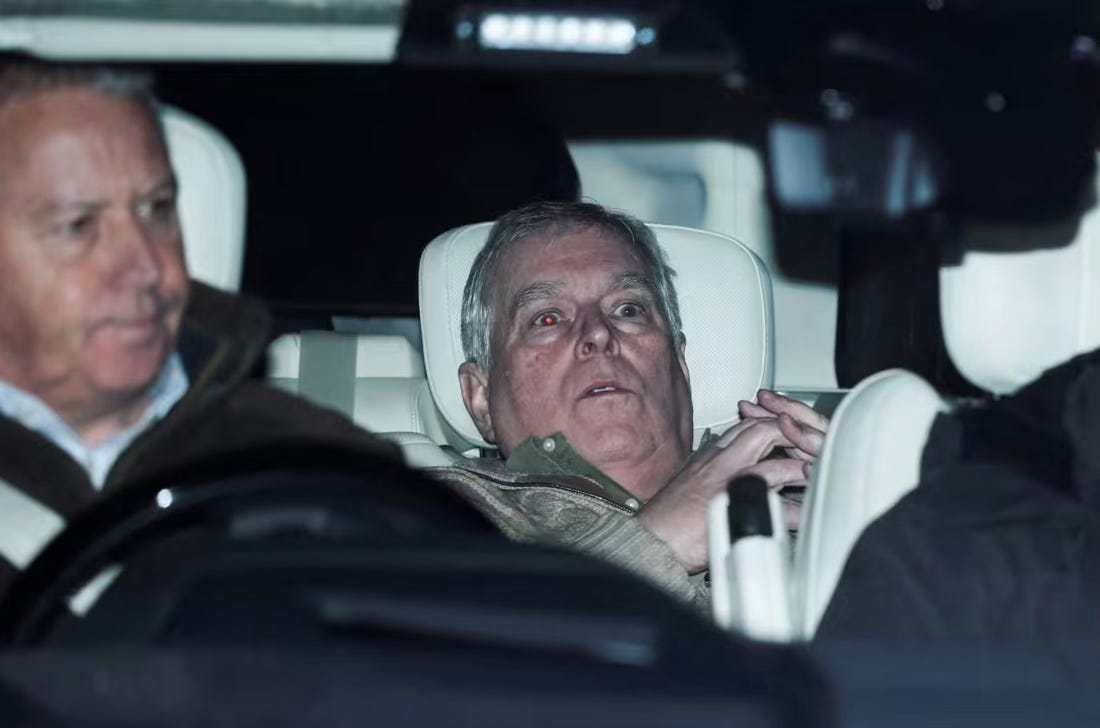
It began, as it so often does in Plague Island, with carefully choreographed performance of justice. On the morning of his 66th birthday, plain-clothed officers from Thames Valley Police arrived at Wood Farm, the downsized but still comfortable royal cottage on the Sandringham Estate, and arrested Andrew Mountbatten-Windsor, the man formerly known as Prince Andrew, Duke of York (The Independent, 2026). The charge was not — as a generation of scandal-weary observers might expect after years of sordid headlines and stomach-churning allegations — related to the sexual abuse of a trafficked teenage girl. The charge was misconduct in public office.
This is the endgame, the institutional checkmate. The arrest, presented to a baying public as a moment of long-overdue accountability, is nothing of the sort. It is a cynical and calculated gambit, a move designed to manage a public relations catastrophe that has festered for over a decade. The establishment, in its infinite and self-preserving wisdom, has chosen to prosecute the lesser crime, the one that threatens the integrity of the state, to draw a line under the whole ugly affair. The girls, the women, the victims, were never the priority. The Crown was. The system was. And the system, as always, is protecting itself.
Within hours, the palace, that ancient and opaque institution, issued a statement from King Charles III, notable for its icy and deliberate distance. “Let me state clearly: the law must take its course,” it read, a masterpiece of empty neutrality from a man who reportedly helped fund the very settlement that bought a victim’s silence (The Sun, 2026). It is a statement that rings with the tinny echo of hypocrisy, a declaration of principle from an institution that has demonstrated time and again that it operates far beyond the reach of any law that might inconvenience it.
The Prime Minister, Keir Starmer, dutifully echoed the sentiment, declaring that “nobody is above the law,” a phrase that sounds increasingly absurd with each repetition in a nation where a man can be housed and financed by the monarch while being under investigation for crimes that would see any ordinary citizen cast into the wilderness (BBC, 2026).
This is a story about the enduring, suffocating power of a system that insulates its own. It is about the selective application of justice, the cynical manipulation of public anger, and the quiet, brutal truth that for the powerful, some victims are simply more disposable than others. The arrest of Andrew Mountbatten-Windsor is the final act in a long and sordid cover-up, the closing of a ledger on a debt that will never truly be paid.
The Queen’s Favourite Son – A Legacy of Impunity

To understand the farce of Andrew’s arrest, one must first understand the man at its centre. Andrew Mountbatten-Windsor was not just any royal; he was, by all accounts, the Queen’s favourite son (CNN, 2019). This status conferred upon him a unique and toxic form of privilege, a lifelong insulation from consequence that bred a profound and dangerous arrogance. He was the Falklands hero, the handsome prince, the “Randy Andy” of the tabloid press — a persona actively cultivated by the palace and its media allies to project an image of a modern, virile monarchy. He was also a man who believed the rules that govern lesser mortals simply did not apply to him. This belief was not a delusion; for most of his life, it was a statement of fact, repeatedly affirmed by the institution that created him.
Nowhere was this impunity more evident than in his long and sordid friendship with the convicted sex offender Jeffrey Epstein. Andrew met the shadowy financier in 1999, introduced by the now-convicted sex trafficker Ghislaine Maxwell (The Independent, 2026). It was a deep and enduring association that continued long after Epstein’s monstrous crimes were a matter of public record. In 2008, Epstein was convicted of procuring a child for prostitution and soliciting a prostitute. For any public figure, let alone a senior member of the British royal family, this should have been a moment of immediate and unequivocal severance. For Andrew, it was not. The friendship, it seems, was too valuable, too convenient, to be discarded over such trivialities as the sexual exploitation of children.
In 2010, he was photographed strolling through Central Park with Epstein and staying at his palatial New York townhouse, a full two years after Epstein’s conviction (The Independent, 2026). The message was clear: Andrew’s loyalty was not to decency or public duty, but to his own circle of depraved and powerful friends. He was untouchable, and he knew it. Emails later released would prove the lie to his claims of ending the friendship, with Andrew writing to Epstein in February 2011, months after he claimed to have cut ties, “Keep in close touch, and we’ll play some more soon” (The Independent, 2026).
Subscribe to Notes From Plague Island and join our growing community of readers and thinkers.
This spectacular arrogance was laid bare for the world to see in November 2019, in what can only be described as one of the most catastrophic television interviews in modern history. Speaking to Emily Maitlis on BBC’s Newsnight, Andrew attempted to clear his name. Instead, he immolated what was left of his reputation in a blaze of delusion and absurdity. He offered a series of increasingly bizarre and insulting excuses for his alleged conduct with Virginia Giuffre, a then-17-year-old girl he claimed to have no recollection of meeting. He couldn’t have been dancing with her in a London nightclub, he claimed, because he was at a Pizza Express in Woking with his daughter. He couldn’t have been sweating, as she described, because a medical condition brought on by an “overdose of adrenaline in the Falklands war” had left him unable to perspire (The Independent, 2026). It was a performance of such incredible ineptitude and lack of empathy that equality campaigners rightly described him as “too stupid to even pretend concern for Epstein’s victims” (The Independent, 2026).
The interview was a disaster, but the institutional response was, as ever, one of damage control, not genuine accountability. Four days later, Andrew announced that the Queen had given him permission to “step back from public duties,” framing it as his own noble decision to prevent his associations from becoming a “major distraction” to the family’s work (The Independent, 2026). It was the classic move of the powerful: a strategic retreat masquerading as a sacrifice. The problem was, in fact, the public’s reaction to his conduct, and not his actual conduct.
The ultimate proof of this institutional protection racket came in March 2022. Faced with a civil lawsuit from Virginia Giuffre in the United States, a lawsuit that threatened to drag the sordid details of his private life into a public courtroom, the institution closed ranks. Andrew paid a multi-million-pound settlement, reported to be as much as £12 million, to make the case disappear (New York Times, 2022). He admitted no liability. He expressed no remorse. He simply paid. And who provided the funds for this legal get-out-of-jail-free card? According to reports, the money came from the very top: a loan from his mother, the late Queen Elizabeth II, and his brother, the future King Charles III (The Sun, 2026). It was the monarchy using its vast, opaque wealth to buy the silence of a trafficking victim. It was the cost of doing business for a family that has always understood that power, in its rawest form, is the ability to make problems — and people — disappear.
The Two Crimes of Andrew Mountbatten-Windsor
To truly grasp the nature of the institutional gambit at play, we must dissect the two distinct crimes of Andrew Mountbatten-Windsor. They are not equal in the eyes of the law, not because of their inherent gravity, but because of who they victimised. One was a crime against a person, a disposable girl from the wrong side of the tracks. The other was a crime against the state, a betrayal of the elite club to which he belonged. Only one of these was deemed worthy of prosecution.
Crime One: The Unprosecuted
The first crime is the one that has haunted the public imagination for years, the one that speaks of grotesque entitlement and the darkest corners of human exploitation. This is the crime against Virginia Giuffre. Recruited from the manicured lawns of Mar-a-Lago at just 16 years-old, she was drawn into the predatory orbit of Epstein and Maxwell and passed around like a party favour to their powerful friends (The Guardian, 2025). For years, her story was dismissed, her credibility questioned, her trauma ignored. She was a voice crying in a wilderness of immense wealth and impenetrable power.
In her posthumous memoir, Nobody’s Girl, published after her tragically early death in April 2025 at the age of 41, Giuffre gave her testimony its most powerful and enduring form. She wrote of being trafficked to Andrew on three separate occasions. In one devastating line, she captured the very essence of his alleged mindset, the disturbing worldview of a man for whom consent was an irrelevance. Andrew, she wrote, “believed having sex with me was his birthright” (The Guardian, 2025).
Birthright. The language of feudalism, of ownership, of a divine right to rule not just over nations, but over the bodies of the powerless. This was an accusation of a fundamental belief system, a worldview in which a teenage girl was not a human being with agency and rights, but a perquisite of his royal status. It is a crime of profound moral and human degradation. And for this crime, the response from the institutions of justice was silence, followed by a financial transaction. No charges were ever brought. No criminal investigation was ever seriously pursued in the United Kingdom. The system did not fail; it simply chose not to act. Virginia Giuffre’s life and testimony were weighed against the stability and reputation of the monarchy, and they were found wanting.
Crime Two: The Prosecuted
The second crime is the one that finally, after all these years, brought the police to Andrew’s door. It is not about sex, girls, or trafficking. It is about information. As the UK’s Special Representative for International Trade and Investment from 2001 to 2011, Andrew was privy to sensitive government and commercial information. The allegation that led to his arrest on his 66th birthday is that he shared this information with Jeffrey Epstein and other associates, committing the offence of misconduct in public office (USA Today, 2026). This charge also encompasses his association with other questionable figures, including an alleged Chinese spy who was banned from the UK after visiting Andrew at his royal residence (The Independent, 2026).
Suddenly, the system roared to life. The crime, now, was not against a vulnerable individual, but against the state itself. It was a betrayal of the trust placed in him by the establishment, a breach of the rules of the club. This, the system could not tolerate. The potential compromise of national security and economic interests, the embarrassment of a senior royal using his position to curry favour with a depraved financier — this was a threat that had to be neutralised. The police are also, belatedly, “reviewing” allegations that a woman was trafficked to the UK for Andrew by Epstein, but it is the misconduct charge that triggered the arrest (The Independent, 2026). The priorities are crystal clear.
The contrast is stark and damning. When the victim was a teenage girl, the response was a wall of silence and a private payoff. When the victim was the British state, the response was a police raid and a criminal prosecution. This is the brutal calculus of power. The message it sends is unambiguous: the abuse of a child can be settled out of court, but the betrayal of the establishment is a matter for the law. The arrest of Andrew Mountbatten-Windsor is a demonstration of what the system truly values, and who it is truly designed to protect.
The Hollow Reign of King Charles III
The final act of this institutional theatre is being directed by the new monarch himself, King Charles III. His reign, we are told, is to be a modern one, a slimmed-down, more accountable version of the ancient institution he inherited. The arrest of his own brother is presented as the ultimate proof of this new chapter, a demonstration that no one, not even family, is above the law. It is a compelling narrative. It is also complete fiction.
The hypocrisy of Charles’s position is bold. His statement that “the law must take its course” is a line delivered with the straightest of faces, while every action he takes is designed to cushion his brother’s fall and protect the monarchy from the shrapnel. Let us deconstruct the performance. While the world was being told that Andrew was being cast out, he was, in fact, being relocated. Evicted from the grand, 30-room Royal Lodge in Windsor, he was not cast into the wilderness but moved into Wood Farm, a comfortable property on the Sandringham Estate, with his relocation reportedly financed by the King (CNN, 2025). This is a managed relocation rather than punishment, a shuffling of assets to maintain the appearance of consequence while ensuring the disgraced royal remains comfortably within the institutional fold.
This is the same King Charles who, as Prince of Wales, reportedly contributed £1.5 million to the £12 million settlement that silenced Virginia Giuffre (The Sun, 2026). He was a party to the very transaction that subverted the course of justice in the first place. His current posturing as a champion of the rule of law is an insult to the memory of the woman whose testimony his family paid to suppress. The palace, of course, has denied his involvement, but the stench of a coordinated cover-up lingers, a reminder that the first instinct of the monarchy is not truth, but self-preservation.
The stripping of Andrew’s titles, another key moment in this drama of accountability, was similarly driven by PR. The first wave of removals, in January 2022, came only after a US judge ruled that Giuffre’s civil case could proceed to trial (The Independent, 2026). The threat was the impending legal and reputational cataclysm of a public trial. The final stripping of his remaining titles in October 2025 followed the publication of Giuffre’s posthumous memoir, a moment of renewed and intense public fury (The Independent, 2026). Each step was a reaction, a concession forced by external pressure, not a proactive move driven by a moral compass. The monarchy acted not because it was the right thing to do, but because it had run out of other options.
King Charles is playing a long game. He understands that the survival of the monarchy in the 21st century depends on its ability to project an image of relevance and accountability. By sacrificing his brother — or rather, by appearing to sacrifice him while quietly managing his exile — he hopes to cauterise a wound that threatens to poison the entire institution. The icy statement that pointedly did not refer to Andrew as his “brother” was a masterstroke of public relations, a signal to the world that the King was putting duty before family. But the reality is that the duty he is performing is not to the law, or to the victims of his brother’s alleged crimes. It is to the Crown. The reign of King Charles III is not a new chapter of accountability. It is a continuation of the old one, a masterclass in the art of institutional survival, where justice is a performance and the truth is whatever the powerful decide it should be.
Conclusion: A Line Drawn in Sand
And so, the circle closes. The arrest of Andrew Mountbatten-Windsor is the final, cynical move in a long and sordid game of institutional self-preservation. It is a line being drawn in the sand, not to mark a boundary that the powerful cannot cross, but to bury the inconvenient truths that lie beneath. The establishment, having weathered the storm of public revulsion, has offered up a sacrifice. But it is a carefully chosen one. They are prosecuting the crime against the state, not the crime against the child. They are punishing the betrayal of the club, not the violation of a human soul.
This is what privilege looks like in its most unvarnished form. It is not just the ability to commit crimes without consequence, but the power to define which crimes matter. For years, the story of Virginia Giuffre was a ghost at the royal banquet, a story that could be ignored, dismissed, and ultimately, paid off. Her life, her trauma, her truth, were all negotiable. The real scandal is not just what Andrew did, but what the institutions of power did to protect him. A mother who funded her son’s legal escape. A brother who provided a safe harbour while posturing about the rule of law. A justice system that remained dormant until its own interests were threatened.
The family of Virginia Giuffre released a statement after the arrest, saying, “Today, our broken hearts have been lifted at the news that no one is above the law, not even royalty” (CNN, 2026). One can only hope they find some solace in this moment. But we must not share in the illusion. The law did not triumph. The system did. It has successfully transmuted a story of sexual abuse and exploitation into a more manageable one of misconduct and betrayal. It has offered up a head on a platter, but it is the wrong head, for the wrong crime. The King’s gambit has been played, and the Crown, once again, has been protected. The girls were collateral damage in a game they were never meant to survive, and the system that allowed it remains entirely intact
Or support us with a one-off tip → Buy Me a Coffee
References
BBC (2026) ‘Read King and police statements in full after Andrew arrest’, BBC News, 20 February. Available at: https://www.bbc.com/news/articles/cd6zjl58734o [Accessed: 20 February 2026].
CNN (2019) ‘Prince Andrew: The Queen’s ‘favorite’ child embroiled in the Epstein scandal’, CNN, 16 November. Available at: https://www.cnn.com/2019/11/16/uk/prince-andrew-queen-jeffrey-epstein-scli-intl-gbr [Accessed: 18 February 2026].
CNN (2025) ‘What we know about Sandringham, Andrew’s new home’, CNN, 1 November. Available at: https://www.cnn.com/2025/11/01/uk/andrew-sandringham-estate-explained-intl [Accessed: 19 February 2026].
CNN (2026) ‘Analysis: As former Prince Andrew is arrested in the UK, accountability is in question in the US’, CNN Politics, 20 February. Available at: https://www.cnn.com/2026/02/20/politics/epstein-prince-andrew-arrest-wexner-trump-justice-analysis [Accessed: 20 February 2026].
Roberts Guiffre, V. (2025) Nobody’s Girl: A Memoir of Surviving Abuse and Fighting for Justice. New York: Simon & Schuster.
The Guardian (2025) ‘‘Prince Andrew believed having sex with me was his birthright’: Virginia Giuffre on her abuse at the hands of Epstein, Maxwell and the king’s brother’, The Guardian, 15 October. Available at: https://www.theguardian.com/us-news/2025/oct/15/prince-andrew-virginia-giuffre-abuse-epstein-maxwell [Accessed: 18 February 2026].
The Independent (2026) ‘Timeline of Andrew Mountbatten-Windsor’s scandals as royal arrested on his birthday amid Epstein allegations’, The Independent, 20 February. Available at: https://www.the-independent.com/news/uk/home-news/andrew-mountbatten-windsor-arrested-epstein-scandal-timeline-b2923484.html [Accessed: 20 February 2026].
New York Times (2022) ‘Prince Andrew Settles Sexual Abuse Lawsuit With Virginia Giuffre’, The New York Times, 15 February. Available at: https://www.nytimes.com/2022/02/15/nyregion/prince-andrew-virginia-giuffre-settlement.html[Accessed: 19 February 2026].
The Sun (2026) ‘Queen and Charles ‘funded Andrew’s £12m payout to sex accuser’’, The Sun, 11 February. Available at: https://www.the-sun.com/royals/15929512/andrew-pay-off-loan-virginia-giuffre-royals/ [Accessed: 19 February 2026].
USA Today (2026) ‘Andrew Mountbatten-Windsor arrested over Epstein links’, USA Today, 19 February. Available at: https://www.usatoday.com/story/entertainment/celebrities/2026/02/19/andrew-mountbatten-windsor-arrested-epstein/88753446007/ [Accessed: 20 February 2026].


This is spot on!