

This essay is Part Three of The Permission Structure. Parts One and Two documented the permission structure at work in Britain. This part traces where it came from: a century of manufactured fear, from Madison Grant to the House of Commons.
There are ideas that should remain in the dark, contained within the digital sewers where they were born. But sometimes, a poison is polished until it looks like policy. It is given a respectable name, a television slot, a place in the political mainstream. The “Great Replacement” is one of those poisons. It arrives wearing the language of demography, of civilisational concern, of patriotic anxiety. It has taken root. We can choose to ignore it, downplay it, or treat it as the concern of someone else in some other country. We do that at our peril.
It is what happens when demographic change is turned into apocalypse, immigration into invasion, and political grievance into racial paranoia. It is the consequence of the fear of a changing world processed through a story about enemies. It is what happens when that story is funded, amplified, and handed to politicians who are willing to use it.
The Great Replacement is a racist conspiracy narrative that turns immigration, demographic change and multicultural society into a story of deliberate racial dispossession. What it claims is the licence. Dehumanisation, political paranoia, mass deportation fantasies, terrorist violence — these are the theory, made flesh. The phrase should not be treated neutrally. Some versions name Jewish people as the supposed orchestrators of replacement; others make the same claim without naming the puppet master. This flexibility is one of the theory’s greatest strengths. It can be picked up as anti-immigration politics, as anti-Muslim civilisational panic, as a defence of Christian Europe, or as the oldest racist myth of all — a Jewish cabal secretly controlling the world. Each version finds the same story waiting, already shaped to fit the grievance the person arrived with.
What the Theory Claims
The theory makes four interlocking claims. That white Europeans, white Americans, or white Christian populations are being displaced by non-white migrants. That this is not a social or economic process but an intentional plot. That there are identifiable villains behind it: liberal politicians, multiculturalists, “globalists”, NGOs, the media, and, in explicitly antisemitic versions, Jews. And that the alleged “replacement” is happening through immigration, asylum, birth rates, citizenship, voting rights and cultural change — all at once, all deliberately, all designed to destroy the white majority.
This is a totalising conspiracy theory in which immigration is the weapon, race is the target, and the state itself is the accomplice. At its most explicit, replacement is only the beginning. The endpoint is white genocide; the deliberate, systematic elimination of white people through immigration, intermarriage, falling birth rates and cultural erasure, orchestrated by identifiable enemies. Replacement is the mechanism; genocide is the destination. For those who hold this version, the conspiracy is here. The multicultural city is the crime scene. The mixed-race family is the evidence. The diversity policy is the weapon.
The same logic operates at a lower temperature when politicians talk about alien cultures and incompatible values, about a way of life that cannot survive contact with the newcomers. It does not need to say genocide to be pointing toward it. The audience only has to be convinced that the presence of others is an existential threat to their culture. Once that belief is in place, the rest follows. The talk of invasion, of swamping, of a country being given away — these are not separate from the conspiracy. They are the conspiracy, operating through mainstream politics, waiting for the crisis that will make the explicit version feel like common sense.
This is how the theory functions as a political tool. The world is changing. Cities look different. Neighbourhoods change. Languages change. The faces on television change. For people who find that disorienting, or threatening, or simply unfamiliar, the Great Replacement arrives as an answer. It does not ask people to go looking for an explanation. It provides one before the question has been fully formed. It says: this is not just change, it is something being done to you. It names the agent, identifies the motive, and supplies the enemy. That is an enormously powerful thing to offer someone who is already anxious.
It also does something else, something that operates below the level of conscious reasoning. It provides cover for racism that was already present. People do not generally think of themselves as racist. The theory allows racial hostility to be expressed as legitimate political concern. Discomfort with immigration becomes civilisational defence. Resentment of minority communities becomes demographic self-preservation. The racism does not disappear; it is repackaged as something that sounds, to the person holding it, like common sense. The theory does not create the hostility. It launders it. And once it has been laundered, it becomes available to politics in a way that naked prejudice is not. The inversion at its core — in which equality becomes aggression, and the demand for rights becomes the act of dispossession — is what makes the theory so effective in mainstream politics. To understand how a conspiracy this powerful got here, you have to go back.
Historical Roots: Older Than the Modern Phrase
The Great Replacement is a relatively recent phrase, but the fear beneath it is not. The idea that white Christian populations face deliberate dispossession by outsiders — directed by hidden powers, enabled by treacherous elites, carried out through immigration and intermarriage — has roots that stretch back through the nineteenth century and into the colonial period.
In the United States, replacement-style arguments can be traced back to the period after Reconstruction, when white supremacists argued that Black voters were being weaponised by Northern elites to destroy white Southern political power. The logic was identical to the modern theory: a racial majority under deliberate attack, a conspiracy of elites, a demographic weapon. That argument was used to justify the systematic disenfranchisement of Black Americans for nearly a century. By the early twentieth century, the same logic had moved into the language of eugenics and “race science”. Madison Grant’s 1916 book The Passing of the Great Race warned that immigration from southern and eastern Europe would destroy the Nordic race through intermarriage and demographic dilution. Grant was a celebrated conservationist, a founder of the Bronx Zoo, and a man whose book Adolf Hitler reportedly described as his “bible” (Baumgartner, 2025). Rather than a fringe obsession, the fear of racial replacement was a respectable intellectual position held by scientists, politicians and philanthropists.

In Europe, the same period produced The Protocols of the Elders of Zion, the antisemitic forgery first published in Russia in 1903 that claimed to document a Jewish conspiracy to dominate the world through finance, media and demographic manipulation. The Protocols were a lie, exposed as a forgery within decades of their publication, but they circulated across Europe and the United States and provided the template for the hidden-hand version of replacement thinking that persists today. The Nazis drew directly on this tradition. Their propaganda described Jewish people as a demographic and racial threat to the German nation, a foreign body within the body politic, orchestrating Germany’s destruction from within. The Holocaust was, among other things, the most extreme implementation of replacement logic in history: the physical elimination of a population defined as an existential demographic threat. The theory has always known where it leads (Baumgartner, 2025).
In the United States, the eugenics movement translated this fear into law. The Johnson-Reed Immigration Act of 1924 established national origin quotas designed explicitly to restrict immigration from southern and eastern Europe and to exclude Asian immigrants entirely. Its architects cited race science directly. The Act was a demographic project, designed to preserve the racial composition of the United States by restricting the entry of people deemed racially inferior. It remained in force until 1965 (Migration Policy Institute, 2024).
Jean Raspail’s 1973 novel The Camp of the Saints imagined white Western civilisation being overwhelmed by mass migration from the Global South. The novel was distributed by Cordelia Scaife May, the Mellon bank heiress who would go on to fund much of the modern anti-immigration movement in the United States, and it circulated in the same networks that later produced the modern replacement conspiracy (Tucker, 2002). Renaud Camus later popularised the modern phrase Le Grand Remplacement in 2011, claiming that white Europeans were being replaced by non-white immigrants, especially Muslims and people from Africa and the Middle East (ADL, 2021).
The line from the Protocols to Grant to Raspail to Camus to Charlottesville to Belfast is not a straight one, but it is a real one. Each generation of this politics borrows from the last. The theory has been most dangerous not when it is held by extremists in forums, but when it is held by governments. The Reconstruction-era South held it. The architects of the Johnson-Reed Act held it. The Nazis held it. The question the modern period raises is not whether the theory has entered mainstream politics (it already has). The question is how far it will be taken.
Renaud Camus and the Key Thinkers
Camus gave the conspiracy its modern slogan. His version focused on Europe, immigration, Islam, demography and culture. The key move was to describe social change as replacement, and replacement as a deliberate act of violence against the supposedly native population. The term has moved into everyday French political language, especially since the 2022 presidential campaign, concealing its racist and conspiratorial meaning (Onishi, 2019). Marine Le Pen and Éric Zemmour have both used replacement-adjacent language in their campaigns, with Zemmour explicitly endorsing the theory and making it a central plank of his presidential bid (Los Angeles Times, 2022; Hope Not Hate, 2022). What Camus wrote in a book, Zemmour said on television. The distance between the two is the distance the theory has travelled.
Camus did not invent racial paranoia, but he gave it a compact, portable phrase. “Great Replacement” works because it is simple, dramatic and emotionally loaded. It turns demographic complexity into a crime scene. It takes a city that has changed over fifty years and tells you that the change was done to you by a plan, a conspiracy, a betrayal. It converts the texture of modern life into evidence of malice.
In the United States, figures like Richard Spencer and Jared Taylor have been instrumental in pushing these ideas. Taylor’s American Renaissance publication has long promoted the myth that Black people are predisposed to be less intelligent and that white people are facing demographic replacement (Kotch and Hayden, 2021). Spencer, a neo-Nazi and white supremacist, used the media to mainstream racism in all its forms — including its antisemitic variants — bringing these fringe ideas closer to the centre of American political discourse (SPLC, 2021). He understood that the language of the academy, dressed up in suits and given a microphone, could carry ideas that would have been laughed out of the room if they had arrived in a white hood.
In Europe, the Identitarian Movement, led in Austria by Martin Sellner, took the Great Replacement theory and turned it into a political programme. Sellner’s version added a policy prescription: “remigration”, the forced mass deportation of migrants and non-white citizens. The Identitarians launched campaigns, disrupted migrant rescue operations in the Mediterranean, and built transnational networks connecting far-right activists across Europe and North America (Global Project Against Hate and Extremism, 2026). Sellner received a donation from the Christchurch attacker and exchanged emails with him before the massacre (The Guardian, 2019; BBC News, 2019). He denies involvement in the attack, but the connection between the ideas he promoted and the violence that followed is not mysterious. It is the brutal conclusion of a politics that tells people their survival requires the removal of others. But ideas do not travel on their own. They need money, infrastructure, and the appearance of legitimacy. That is where the backers come in.
The Financial Backers
The spread of these ideas is funded and deliberate. While the white supremacist movement as a whole often struggles for money, certain organisations have received massive injections of cash from mainstream conservative donors, which has been decisive in turning fringe ideas into policy-adjacent arguments.
The VDARE Foundation, a prominent white nationalist hate group founded by Peter Brimelow, received $4.3 million in 2019, over eight times more than the year before (Kotch and Hayden, 2021). A significant portion of this came from DonorsTrust, a right-wing funding vehicle tied to wealthy conservative donors. DonorsTrust functions as a donor-advised fund, allowing wealthy individuals to give money to causes without their names appearing on the recipient’s tax filings. It is a mechanism for funding extremism at arm’s length, with plausible deniability built into the transaction.
The Pioneer Fund, established in 1937 by textile magnate Wickliffe Draper, has bankrolled studies of race and intelligence for decades, promoting the genetic stock of white people and supporting anti-immigration groups like the Federation for American Immigration Reform (FAIR) (Tucker, 2002). Its original mandate was to pursue “race betterment” by promoting the genetic stock of those “deemed to be descended predominantly from white persons who settled in the original thirteen states prior to the adoption of the Constitution.” The fund has supported many of the leading Anglo-American race scientists of the last several decades, including researchers whose work was later cited in The Bell Curve, the widely criticised 1994 book that claimed differences in intelligence were at least partly determined by race (Lane, 1994).
The Colcom Foundation, started by Mellon bank heiress Cordelia Scaife May, has donated around $150 million since 2005 to anti-immigrant groups, including FAIR and the Center for Immigration Studies (CIS) (Deto, 2020). In 2017 alone, the foundation gave more than $34 million to anti-immigrant groups, which was more than 80 percent of their total giving that year (Deto, 2020; Penn Capital-Star, 2022). May’s co-conspirator in building this network was John Tanton, who helped found FAIR with $50,000 in seed money from May in 1978. Tanton’s own words reveal the project clearly. “I’ve come to the point of view that for European-American society and culture to persist requires a European-American majority, and a clear one at that,” he said in 1993 (Deto, 2020). May herself once wrote that the United States was “being invaded on all fronts” by immigrants and that foreigners “breed like hamsters” (Kulish and McIntire, 2019).
This dark money pipeline ensures that the Great Replacement theory has the resources to masquerade as legitimate policy debate. It funds think tanks that produce reports. Those reports are cited by politicians. Those politicians appear on television. The ideas travel from Tanton’s correspondence to congressional testimony to prime-time news without the money ever showing its face.
The Hidden Hand: Antisemitism at the Heart of the Conspiracy
In some versions, Muslims, Black people, migrants, asylum seekers or Latin American immigrants are cast as the “replacers”. But in many white supremacist versions, Jews are cast as the hidden organisers. In place of a separate ideology grafted onto the theory, it is the same racism, directed at a different target. The theory links easily to older racist myths about Jewish people and secret control, betrayal, finance, media and government manipulation. While Camus’s original framing did not primarily focus on Jews, the theory became associated with this strand of racism because many white supremacists blame Jews for non-white immigration (ADL, 2021).
The migrant is presented as the visible enemy; the Jew is often imagined as the hidden hand. The conspiracy requires someone orchestrating the replacement, and the oldest racist conspiracy in Western history supplies the answer. This racism directed at Jewish people is not structural to the Great Replacement; remove it and the theory loses its engine. The migrant alone cannot carry the full weight of the conspiracy, because the migrant is visible, individual, and human. The conspiracy needs an invisible, coordinating force. Racist hatred of Jewish people has always been available to supply one.
The theory needs a pantomime villain, and it has found one in George Soros. The Hungarian-born Jewish billionaire and philanthropist has become the living embodiment of the puppet master the conspiracy requires: Jewish, enormously wealthy, funding progressive and pro-immigration causes across the world, operating internationally, apparently everywhere at once. Viktor Orbán built an entire electoral campaign around him. Tucker Carlson named him repeatedly. Marjorie Taylor Greene claimed he was funding migrant caravans. In the UK, he has been blamed for funding remain campaigns, open borders lobbying, and the supposed replacement of the British population. None of the specific claims are true. All of them draw on the same ancient racist trope: the Jewish financier pulling the strings of governments and populations from the shadows. The theory inherited the oldest racist conspiracy in Western history — the idea of a secret Jewish power shaping the world against the interests of Christian populations — which is the Great Replacement with the mask off.
This structural role explains why the theory keeps producing racist violence against Jewish people even when individual promoters claim to be focused only on immigration or culture.
When the Theory Reaches the Street
The theory does not always issue a direct command to violence. Its danger is subtler and broader: it creates a world in which violence can appear defensive, even heroic, to those who believe the conspiracy. If you genuinely believe that your people are being replaced, that the replacement is deliberate, and that the institutions of the state have been captured by those doing the replacing, then violence begins to look like resistance. The attacker becomes a soldier. The massacre becomes a battle. The manifesto becomes a call to arms.
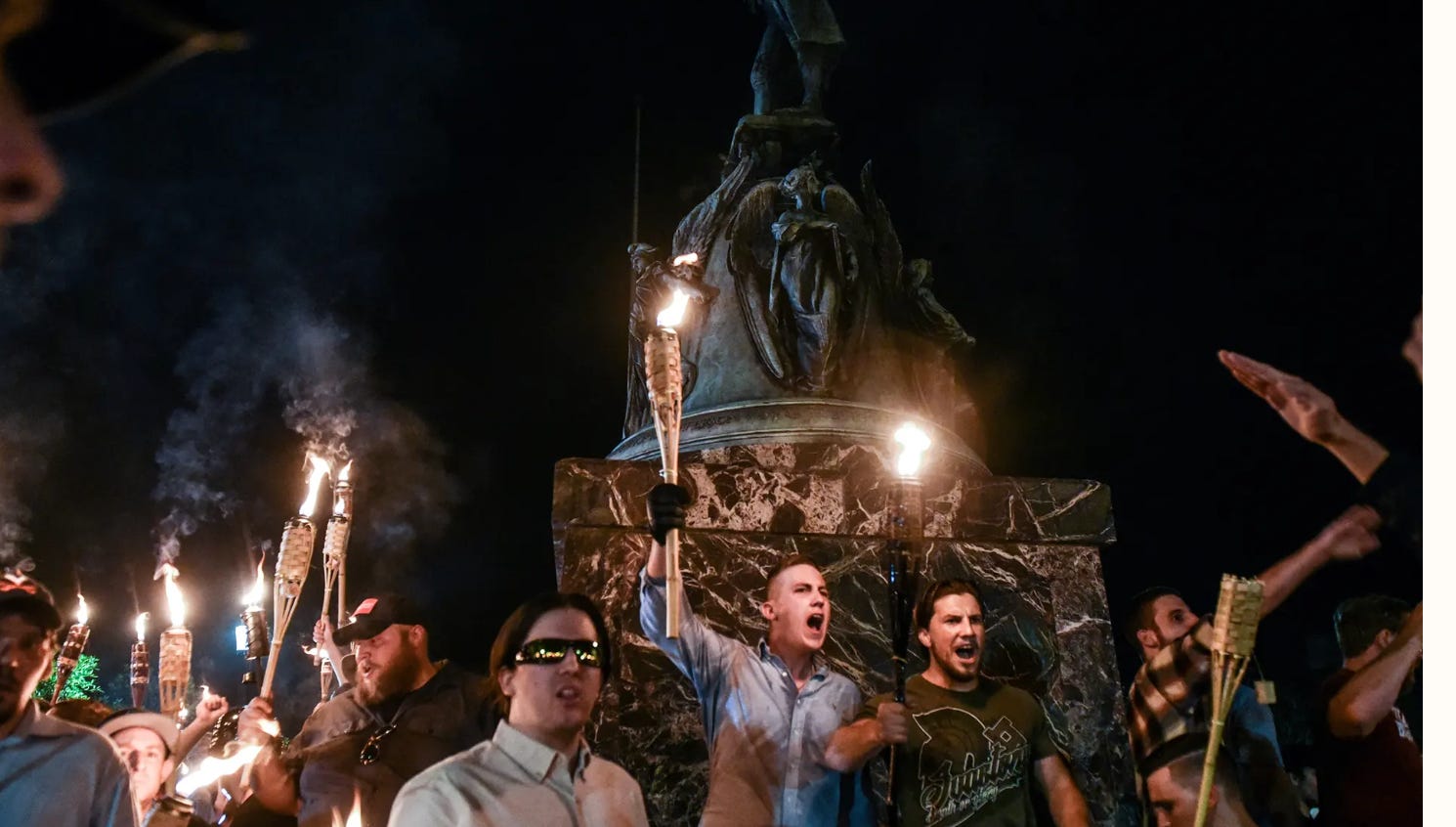
At the 2017 “Unite the Right” rally in Charlottesville, white supremacists chanted “You will not replace us” and “Jews will not replace us.” This turned the abstract conspiracy into a public political performance. It was more than anti-immigration rhetoric; it was a declaration that demographic change was to be understood as racial war (ADL, 2021). The rally brought together neo-Nazis, Ku Klux Klan members, white nationalists and Identitarians under a single banner. They carried tiki torches through the streets of a university town. They were not hiding. They had been told, by years of online radicalisation and political mainstreaming, that they no longer needed to.
Charlottesville revealed the emotional grammar of the theory: resentment, racial entitlement, racism in all its forms, victimhood and threat. It also revealed the pipeline between the online world and the street. The men who marched had been radicalised in forums, on imageboards, in comment sections, in the same digital spaces where the Great Replacement had been circulating for years. They had absorbed the theory, and they had come to perform it. One woman, Heather Heyer, was killed when James Alex Fields Jr., an avowed white supremacist, drove his car into a crowd of counter-protesters; he was later sentenced to life in prison (Department of Justice, 2019). Fields had previously espoused neo-Nazi and white supremacist beliefs and had been absorbing far-right material online for years (PBS NewsHour, 2019). The theory had done its work. And the then-President of the United States said there were “very fine people on both sides” (PolitiFact, 2019). That sentence did not create the movement, but it told the movement that the White House was not its enemy.
Subscribe to Notes From Plague Island and join our growing community of readers and thinkers.
In Pittsburgh in 2018, Robert Bowers killed 11 worshippers at the Tree of Life synagogue, driven by the belief that Jews were bringing non-white immigrants into the US; he was sentenced to death in 2023 (American Immigration Council, 2018; GWU Program on Extremism, 2023). In Christchurch in 2019, the attacker murdered 51 people at two mosques; his manifesto was titled The Great Replacement, and he was sentenced to life without parole (BBC News, 2020). In El Paso in 2019, the attacker targeted Latino shoppers, killing 23 people, referring to a “Hispanic invasion” in his manifesto; he received 90 consecutive life sentences (Department of Justice, 2023). In Buffalo in 2022, a white supremacist killed 10 Black people at a supermarket, driven by a desire to prevent Black people from replacing white people; the Department of Justice authorised the federal death penalty for him (Death Penalty Information Center, 2024).
These are not isolated incidents, but a pattern. Each attacker cited the same theory. Each attacker used the same language. Each attacker had absorbed the same ideas from the same networks. The theory did not pull the trigger, but it loaded the gun. It told each of these men that they were soldiers in a war, that their victims were enemies, and that history would vindicate them. That is what a permission structure does. It does not command violence; it makes violence feel like duty.
Mainstreaming: From Extremist Forums to Respectable Politics
“The Great Replacement” may be too toxic to say in a parliamentary speech or a television studio, but the assumptions behind it now travel in different language: “invasion”, “civilisational collapse”, “imported voters”, “globalist elites”, “two-tier policing”, “remigration”, “our country is being taken from us”. These phrases only require the audience to feel the emotional logic beneath them. The conspiracy travels in the feeling, not the phrase. By the time the language is mainstream, the ideas are already doing their work.

In the US, replacement ideas entered the mainstream through media and political rhetoric. Tucker Carlson frequently pushed these false views on his Fox News show, suggesting the Democratic Party was trying to replace the current electorate with “obedient voters from the Third World” (Bond, 2023). This was broadcast to millions of people every night on the most-watched cable news channel in America. Carlson understood that the theory’s power lay in its emotional charge. He did not need to say, “Great Replacement.” He only needed to say that Democrats wanted to change the electorate, that immigration was a political weapon, and that the people asking for equal treatment were actually asking for power over you. The audience filled in the rest.
Leaked emails revealed that Stephen Miller, a senior adviser in the Trump White House, regularly promoted white nationalist literature and racist propaganda, including content from VDARE and American Renaissance, demonstrating how high up these ideas reached (SPLC, 2019). Miller’s emails showed him recommending white nationalist websites to Breitbart journalists, citing replacement-style arguments about immigration and voting, and framing immigration policy in terms that echoed the conspiracy directly. The theory had moved from the forum to the West Wing.
The most significant single amplifier of the theory in the current period is Elon Musk. The richest man in the world, with more than 200 million followers on the platform he owns, posted about race almost every day in January 2026, with content that experts described as indistinguishable from white supremacist material (The Guardian, 2026). He wrote that “whites are a rapidly dying minority”, replied “yes” to a post claiming that what destroyed Rhodesia and South Africa was “being brought to America”, and endorsed a post claiming white people would be “slaughtered” as a demographic minority. He reposted Martin Sellner’s content and replied that it was “simply a statement of fact”. He has repeatedly promoted the claim that there is an ongoing genocide against white people in South Africa — a claim that has no factual basis. South Africa’s violent crime overwhelmingly affects Black citizens, and the land reform legislation that prompted Musk’s claims has not resulted in a single case of expropriation without compensation (Harvard Kennedy School, 2025).
Musk’s promotion of the white genocide narrative is not abstract ideological commitment. He is a white South African who grew up under apartheid, and his amplification of this conspiracy is a personal political project as much as a global one. The consequences have been concrete. In February 2025, Trump signed an executive order directing the United States to resettle Afrikaner refugees — the only group-specific carveout from a refugee programme that simultaneously suspended admissions for Cubans, Haitians, Nicaraguans, Venezuelans and virtually every other population (Harvard Kennedy School, 2025). Stephen Miller declared the Afrikaners’ situation “the textbook definition of why the refugee program was created”. The same Stephen Miller whose leaked emails showed him recommending white nationalist websites to journalists. The conspiracy had moved from Musk’s timeline to the White House to US refugee law.
In Europe, nationalist and populist parties have moved from the edges of politics toward the centre, especially around migration, sovereignty and anti-elite politics. In November 2023, a secret meeting in Potsdam brought together AfD politicians, Identitarian leaders and neo-Nazis, at which Sellner presented his remigration plan to an audience that included sitting politicians (Correctiv, 2024). When the meeting was exposed in January 2024, hundreds of thousands of people took to the streets in Germany to protest. The AfD’s response was to double down. Donald Trump used the term “remigration” during the US presidential campaign in a post that received more than 56 million views (Kassam, 2024). The AfD was later designated a confirmed right-wing extremist organisation by German domestic intelligence in May 2025 (ICCT, 2025). A concept born in neo-Nazi networks had become a transatlantic political project, a US presidential campaign talking point, and a formal designation for a major European party. Britain was not immune.
The UK Angle: Invasion Rhetoric, “Remigration” and the Belfast Pogrom
The British version often avoids the fully explicit language of “replacement”, but the underlying story is familiar: outsiders are coming, elites are complicit, minorities are favoured, and the majority is being dispossessed. Anti-migrant discourse targeting the UK skyrocketed in 2024, with a 90 percent increase in mentions year on year, portraying migrants as dirty, alien and incapable of assimilating (Venkataramakrishnan, 2025). More than 10 percent of all anti-migrant posts in the dataset included explicit or implicit references to the Great Replacement conspiracy. The language of “invasion” appeared in more than a quarter of posts. The infrastructure of the theory was already present in British online discourse long before it reached the street.
What makes the British case particularly instructive is where the language has ended up. In May 2025, Keir Starmer — a Labour Prime Minister, a former Director of Public Prosecutions, a man who presents himself as the antithesis of the populist right — stood at a podium and warned that without tougher immigration controls, Britain risked becoming “an island of strangers” (BBC News, 2025a). The phrase was widely compared to Enoch Powell’s 1968 “Rivers of Blood” speech, and Starmer later said he regretted it (The Guardian, 2025). But the regret came only after the damage was done. The phrase had already been broadcast, clipped, shared and absorbed. The Great Replacement does not require its promoters to be conscious of what they are doing. It only requires the language to travel. When a centrist Prime Minister reaches for the vocabulary of demographic threat — strangers, not neighbours; an island at risk, not a country changing — he is borrowing that vocabulary. In doing so, he lends it legitimacy that no far-right figure could provide. The theory does not need Tommy Robinson in Downing Street. It needs Downing Street to sound, occasionally, like Tommy Robinson.
Following the tragic stabbing in Southport in July 2024, false claims that the attacker was a Muslim asylum seeker fuelled far-right riots across England and Northern Ireland. These riots involved racist attacks, arson, and looting, driven by networks on Telegram and X (formerly Twitter) (ISD Global, 2025). The Southport attacker, Axel Rudakubana, was born in Cardiff, Wales (BBC News, 2025b). The mob did not care; the theory does not require facts. It just requires a face that fits the story.
The legacy of this rhetoric continued to fuel violence into 2026. On 8 June 2026, a man was stabbed in north Belfast. A 30-year-old Sudanese man was charged with attempted murder. Before the legal process had run a single day, the far-right machinery had already converted one man’s alleged crime into a racial verdict against an entire community. Masked men moved through the streets of east Belfast, targeting minority ethnic homes, banging on doors, shouting “foreigners out”, torching cars and setting houses alight. At least 27 people were made homeless. The Northern Ireland Fire and Rescue Service handled 256 calls and attended 62 incidents between 7pm and midnight on the first night alone (Associated Press, 2026).
SDLP MP Claire Hanna called it plainly: a “race-based pogrom”, with men going door to door asking to get foreigners out “based exclusively on the colour of their skin” (Associated Press, 2026). The mob did not know who was legal, illegal, refugee, citizen, worker, student, neighbour, settled resident or recent arrival. It knew only what it could see and what it had been taught to hate.
The violence unfolded in interface areas, the zones where Protestant and Catholic communities are still divided by fences and signage, a legacy of the Troubles that the far right has now learned to exploit. Political anthropology professor Dominic Bryan at Queen’s University Belfast noted that what we are witnessing is a shift in some unionist and Protestant areas, away from the outgroup being Catholics and toward people with a different skin colour (France 24, 2026). The Great Replacement theory did not create the sectarian geography of Belfast, but it filled it with new targets. The old architecture of hatred was repurposed.
Nigel Farage, Tommy Robinson and Elon Musk were among the prominent figures who spread the Belfast stabbing video and called for mass protests (Associated Press, 2026). Musk reposted messages blaming migration for violence in the UK. Robinson called for more protests. These men operate at different levels of the same pipeline. Robinson supplies the street theatre. Farage supplies the television respectability. Musk supplies the platform and the billionaire megaphone. The sequence is always the same: find the pretext, hype the threat, summon the crowd, watch the violence, then step back and claim that no one could possibly have foreseen where the rhetoric would lead.
The family of the stabbing victim appealed for calm and said migrants make a valuable contribution to the country. The far right ignored them. It never cared about the victim except as raw material. This is what the Great Replacement theory does with real human suffering. It consumes it. It turns a wounded man into a symbol, a crime into a racial verdict, a legal process into proof of invasion. Justice is too specific for this politics. Justice names the accused, hears the evidence, protects the innocent, and punishes the guilty. The Great Replacement wants revenge, because revenge can be made racial.
A Conspiracy in Plain Sight
Demographic change is real. Migration is real. Birth rates vary. Cities change. Nations change — none of this is in dispute. What is false is the claim that any of it is a conspiracy. The Great Replacement takes ordinary social, economic and historical processes and imposes a plot onto them. It treats non-white citizens and migrants not as human beings with agency, rights, histories and reasons for movement, but as instruments of someone else’s plan. It turns the ordinary fact of a changing society into a crime scene, and it demands a suspect. The suspect is always the same.
Immigrants do not vote as a single bloc. Non-white citizens are not “replacements”; they are members of society. Cultural change is not genocide. The countries that have received the most immigration are not weaker, more divided or more dangerous than those that have not — by most measures, the opposite is true. Political disagreement over immigration policy is legitimate; the claim that immigration is a racial weapon deployed by a secret conspiracy is not. The theory cannot survive contact with any of these distinctions, which is why it works so hard to prevent the distinctions from being made. It is not a theory about demography. It is a theory about enemies. And it needs its enemies to be permanent, because the moment they become neighbours, the conspiracy collapses.
The theory also requires its believers to hold a deeply contemptuous view of their own governments and institutions. It requires them to believe that the state has been captured, that the media is complicit, that the courts are compromised, and that the only honest account of what is happening is the one circulating in far-right forums. This is a closed epistemic system in which every piece of contradictory evidence becomes further proof of the conspiracy. The theory cannot be falsified because it has already explained away every possible refutation. The mainstream media denies it? That proves the media is captured. The courts convict the attacker? That proves the courts protect migrants. The government condemns the riots? That proves the government is the enemy.
The theory offers a simple enemy: migrants, minorities, liberals, Jews, NGOs, “globalists”. It converts policy failure into betrayal. It tells anxious voters that housing shortages, wage pressure, NHS strain, crime, cultural change and political alienation are not the result of austerity, inequality, deregulation, underinvestment or bad governance, but of deliberate demographic sabotage. This is its deepest political utility. It takes the legitimate grievances produced by decades of economic mismanagement and redirects them away from the people who made those decisions and toward the people who had no part in making them.
In Britain, this translation from conspiracy to politics has been done with increasing openness. Nigel Farage, leader of Reform UK, has repeatedly described Channel crossings as an “invasion,” a word that converts asylum seekers into an army and reframes the legal obligation to process claims as an act of surrender. Rupert Lowe, who left Reform to found Restore Britain, has been more explicit still. In June 2026, he wrote that “the country is on track to become minority White British” and that “demographic change and mass immigration are radically transforming our home”. This is the language of the Great Replacement stated plainly, stripped of its academic framing and placed directly into electoral politics. Neither man invented the theory. Both have made it available to millions of voters as a description of reality.
It protects the powerful by directing rage at the powerless, and it does so while claiming to speak for the powerless. It makes authoritarian solutions sound like self-defence. It tells people that the problem is not the system but the people the system has let in. That double move — presenting racial hierarchy as working-class common sense — is the theory’s most cynical achievement.
The Language and the Violence
Before people can be expelled, they must be described as not belonging; before they can be attacked, they must be described as a threat; before violence becomes thinkable, language does the clearing work. “Invasion” makes civilians sound like an army. “Flood” makes people sound like a natural disaster. “Replacement” makes neighbours sound like usurpers. “Remigration” sanitises deportation. “Globalist” is a racist dog whistle directed at Jewish people. Each word does a small amount of work. Together, they build a world in which certain people are permanently suspect, conditional, and removable.
We know from history that the language of dehumanisation precedes the act of dehumanisation. It does not happen the other way around. The question is always whether we are willing to name it while it is happening, or whether we will wait until the houses are burning and then call it “unrest”. Belfast in June 2026 showed what happens when the language reaches the street. The men at the doors were doing, crudely and violently, what the politics of replacement asks the state to do cleanly: decide who belongs and who can be pushed out. The mob and the manifesto are not opposites because the mob is the manifesto with its mask off.
The drift of this language into everyday politics is a sign that they have become normal. Normalisation is the condition in which the next escalation becomes possible. Every time a politician uses “invasion” without being challenged, the word becomes cheaper. Every time “remigration” appears in a mainstream debate without being named as a deportation fantasy, it becomes more available. In the hours after the Southport stabbing in 2024, the word “invasion” was already circulating in posts that would fuel riots within days. In Belfast in June 2026, the men at the doors had absorbed a vocabulary, which told them what to do. The language prepares the ground and violence is what grows in it.
The Great Replacement theory has moved from the published work of a French writer to the manifestos of mass murderers; from neo-Nazi forums to prime-time television; from a secret meeting in Potsdam to a US presidential campaign; from a fringe network to the immigration policy of the world’s most powerful government. Cordelia Scaife May funded the infrastructure. Renaud Camus supplied the slogan. Richard Spencer and Martin Sellner built the transnational movement. Tucker Carlson broadcast the emotional logic to millions. Stephen Miller carried it into the White House. Nigel Farage and Rupert Lowe translated it into British electoral politics.
In Britain, we wait. The theory has done enough work here — in online networks, political language, the riots of 2024 and the pogrom of 2026 — that the next crisis is not a question of if. It is a question of what pretext will be used, which community will be targeted, and how many politicians will spend the following week explaining that they cannot be held responsible for the words they chose. The Great Replacement does not need to be believed in its entirety to produce an atrocity. It only needs to have prepared enough people to feel that, when the moment comes, violence is the logical reply. That preparation is already complete.
The Great Replacement is a story about who belongs, who counts, and who may be treated as disposable. It tells majority populations that equality is loss, that diversity is invasion, and that democracy itself is a plot against them. That is why it must be named clearly: not as a theory, not as a demographic concern, but as a racist conspiracy whose consequences are already written in blood.
The families burned out of their homes in Belfast owe no explanation to the people who hate them. The worshippers killed in Pittsburgh owed none. The shoppers killed in El Paso owed none. The people murdered in Christchurch owed none. They were not symbols or data points in a demographic argument. They were people, and they were killed because a conspiratorial myth told someone that killing them was an act of civilisational defence. That is what the Great Replacement does, and that is what it has always been.
Or support us with a one-off tip → Buy Me a Coffee
References
ADL (2021) ‘”The Great Replacement:” An Explainer’. Available at: https://www.adl.org/resources/backgrounder/great-replacement-explainer [Accessed: 14 June 2026].
American Immigration Council (2018) ‘Massacre at Pittsburgh Synagogue Tied to Anti-Refugee Sentiment’, 29 October. Available at: https://www.americanimmigrationcouncil.org/blog/massacre-pittsburgh-synagogue-anti-refugee/ [Accessed: 14 June 2026].
Associated Press (2026) ‘Thousands rally in Belfast to condemn anti-immigrant rioting that followed stabbing’, PBS NewsHour, 13 June. Available at: https://www.pbs.org/newshour/world/thousands-rally-in-belfast-to-condemn-anti-immigrant-rioting-that-followed-stabbing [Accessed: 14 June 2026].
Bauder, D. (2022) ‘What is “great replacement theory” and how does it fuel racist violence?’, PBS NewsHour, 16 May. Available at: https://www.pbs.org/newshour/politics/what-is-great-replacement-theory-and-how-does-it-fuel-racist-violence [Accessed: 14 June 2026].
BBC News (2019) ‘Austrian far-right activist probed over links to Christchurch attacks’, 26 March. Available at: https://www.bbc.com/news/world-europe-47715696 [Accessed: 14 June 2026].
BBC News (2020) ‘Christchurch mosque attack: Brenton Tarrant sentenced to life without parole’, 27 August. Available at: https://www.bbc.com/news/world-asia-53919624 [Accessed: 14 June 2026].
BBC News (2025a) ‘Keir Starmer says he regrets using ‘island of strangers’ phrase’, 27 June. Available at: https://www.bbc.com/news/articles/cj3rxrg2pnjo [Accessed: 14 June 2026].
BBC News (2025b) ‘Father stopped Southport killer from going to former school a week before attack’, 21 January. Available at: https://www.bbc.com/news/articles/cqx949jzjlyo [Accessed: 14 June 2026].
Bond, S. (2023) ‘How Tucker Carlson took fringe conspiracy theories to a mass audience’, NPR, 25 April. Available at: https://www.npr.org/2023/04/25/1171800317/how-tucker-carlsons-extremist-narratives-shaped-fox-news-and-conservative-politi [Accessed: 14 June 2026].
Correctiv (2024) ‘Secret plan against Germany’, 15 January. Available at: https://correctiv.org/en/latest-stories/2024/01/15/secret-plan-against-germany/ [Accessed: 14 June 2026].
Death Penalty Information Center (2024) ‘U.S. Department of Justice Authorizes First Federal Death Penalty Case for Payton Gendron, Teen Who Killed Ten Black People in 2022’, 16 January. Available at: https://deathpenaltyinfo.org/u-s-department-of-justice-authorizes-first-federal-death-penalty-case-for-payton-gendron-teen-who-killed-ten-black-people-in-2022 [Accessed: 14 June 2026].
Department of Justice (2019) ‘Ohio Man Sentenced to Life in Prison for Federal Hate Crimes Related to August 2017 Car Attack at Rally’, 28 June. Available at: https://www.justice.gov/archives/opa/pr/ohio-man-sentenced-life-prison-federal-hate-crimes-related-august-2017-car-attack-rally [Accessed: 14 June 2026].
Department of Justice (2023) ‘Texas Man Sentenced to 90 Consecutive Life Sentences for 2019 Mass Shooting at Walmart in El Paso, Texas’, 7 July. Available at: https://www.justice.gov/archives/opa/pr/texas-man-sentenced-90-consecutive-life-sentences-2019-mass-shooting-walmart-el-paso-texas [Accessed: 14 June 2026].
Deto, R. (2020) ‘How Pittsburgh’s Colcom Foundation is “greenwashing” its anti-immigrant message’, Pittsburgh City Paper, 11 March. Available at: https://www.pghcitypaper.com/news-2/how-pittsburghs-colcom-foundation-is-greenwashing-its-anti-immigrant-message-16919993 [Accessed: 14 June 2026].
GWU Program on Extremism (2023) ‘Imagined Threats: Demographic Conspiracy Theories, Antisemitism and Violence’, 26 October. Available at: https://extremism.gwu.edu/imagined-threats [Accessed: 14 June 2026].
France 24 (2026) ‘Belfast anti-immigrant riots show long legacy of sectarian violence’, 13 June. Available at: https://www.france24.com/en/uk/20260613-belfast-anti-immigration-riots-show-legacy-of-sectarian-unrest [Accessed: 14 June 2026].
Global Project Against Hate and Extremism (2026) ‘How “Remigration” Traveled from European Neo-Nazis to the White House’, 21 January. Available at: https://globalextremism.org/post/remigration-timeline/ [Accessed: 14 June 2026].
Harvard Kennedy School (2025) ‘The Afrikaner Exception: Race and Strategic Dismantling of U.S. Refugee Protection under the Trump Administration’, Carr-Ryan Center for Human Rights, 19 May. Available at: https://www.hks.harvard.edu/centers/carr-ryan/our-work/carr-ryan-commentary/afrikaner-exception-race-and-strategic-dismantling [Accessed: 28 June 2026].
Hope Not Hate (2022) ‘The French Elections and the Case of the Great Replacement’, 7 April. Available at: https://hopenothate.org.uk/2022/04/07/the-french-elections-and-the-case-of-the-great-replacement/ [Accessed: 14 June 2026].
ICCT (2025) ‘From Radicalisation to Designation: The AfD’s Extremist Turn’, 13 June. Available at: https://icct.nl/publication/radicalisation-designation-afds-extremist-turn [Accessed: 14 June 2026].
ISD Global (2025) ‘From Rumours to Riots: How Online Misinformation Fuelled Violence in the Aftermath of the Southport Attack’. Available at: https://www.isdglobal.org/digital_dispatches/from-rumours-to-riots-how-online-misinformation-fuelled-violence-in-the-aftermath-of-the-southport-attack/ [Accessed: 14 June 2026].
Kassam, A. (2024) ‘How remigration became a buzzword for global far right’, The Guardian, 3 October. Available at: https://www.theguardian.com/world/2024/oct/03/how-remigration-became-a-buzzword-for-europes-far-right [Accessed: 14 June 2026].
Kulish, N. and McIntire, M. (2019) ‘Why an Heiress Spent Her Fortune Trying to Keep Immigrants Out’, The New York Times, 14 August. Available at: https://www.nytimes.com/2019/08/14/us/anti-immigration-cordelia-scaife-may.html[Accessed: 14 June 2026].
Kotch, A. and Hayden, M. E. (2021) ‘Donors Pumped Millions into White Nationalist Group’, Southern Poverty Law Center, 17 June. Available at: https://www.splcenter.org/resources/hatewatch/donors-pumped-millions-white-nationalist-group/ [Accessed: 14 June 2026].
Lane, C. (1994) ‘The Tainted Sources of The Bell Curve‘, New York Review of Books, 1 December. Available at: https://www.nybooks.com/articles/1994/12/01/the-tainted-sources-of-the-bell-curve/ [Accessed: 14 June 2026].
Los Angeles Times (2022) ‘Far-right French candidate turns a racist, taboo phrase into his mantra’, 17 February. Available at: https://www.latimes.com/world-nation/story/2022-02-17/france-candidate-zemmour-nonwhites-muslims-replacement-theory [Accessed: 14 June 2026].
Onishi, N. (2019) ‘The Man Behind a Toxic Slogan Promoting White Supremacy’, The New York Times, 20 September. Available at: https://www.nytimes.com/2019/09/20/world/europe/renaud-camus-great-replacement.html [Accessed: 14 June 2026].
PBS NewsHour (2019) ‘White supremacist sentenced to life in prison for Charlottesville car attack’, 28 June. Available at: https://www.pbs.org/newshour/nation/prosecutors-seek-life-sentence-in-charlottesville-car-attack [Accessed: 14 June 2026].
Penn Capital-Star (2022) ‘Pgh. advocates call on Scaife-linked foundation to stop funding anti-immigrant groups’, 1 March. Available at: https://penncapital-star.com/civil-rights-social-justice/pgh-advocates-call-on-scaife-linked-foundation-to-stop-funding-anti-immigrant-groups/ [Accessed: 14 June 2026].
PolitiFact (2019) ‘In Context: Trump’s ‘very fine people on both sides’ remarks’, 26 April. Available at: https://www.politifact.com/article/2019/apr/26/context-trumps-very-fine-people-both-sides-remarks/ [Accessed: 14 June 2026].
SPLC (2021) ‘Inside the Far-right Podcast Ecosystem, Part 2: Richard Spencer’s Origins Podcast Network’, 29 September. Available at: https://www.splcenter.org/resources/hatewatch/inside-far-right-podcast-ecosystem-part-2-richard-spencers-origins-podcast-network/ [Accessed: 14 June 2026].
SPLC (2019) ‘Leaked Emails Expose Key White House Aide Stephen Miller’s Affinity for White Nationalism’, Southern Poverty Law Center, 12 November. Available at: https://www.splcenter.org/presscenter/splc-leaked-emails-expose-key-white-house-aide-stephen-millers-affinity-white [Accessed: 14 June 2026].
The Guardian (2025) ‘Keir Starmer says he ‘deeply regrets’ island of strangers speech’, 27 June. Available at: https://www.theguardian.com/politics/2025/jun/27/keir-starmer-says-he-deeply-regrets-island-of-strangers-speech[Accessed: 14 June 2026].
The Guardian (2026) ‘Elon Musk posted about race almost every day in January’, 12 February. Available at: https://www.theguardian.com/technology/2026/feb/12/elon-musk-posts-january-white-supremacists [Accessed: 28 June 2026].
The Guardian (2019) ‘Christchurch shooter’s links to Austrian far right ‘more extensive than thought’‘, 16 May. Available at: https://www.theguardian.com/world/2019/may/16/christchurch-shooters-links-to-austrian-far-right-more-extensive-than-thought [Accessed: 14 June 2026].
Tucker, W.H. (2002) The Funding of Scientific Racism: Wickliffe Draper and the Pioneer Fund. Urbana: University of Illinois Press.
Venkataramakrishnan, S. (2025) ‘”Total remigration”: Anti-migrant narratives targeting the UK’, Institute for Strategic Dialogue, 30 July. Available at: https://www.isdglobal.org/digital-dispatch/total-remigration-anti-migrant-narratives-targeting-the-uk/ [Accessed: 14 June 2026].
Pardon the interruption…