The Ballroom of the King: Trump's East Wing Vandalism and the Death of the American State
The Day the East Wing Fell
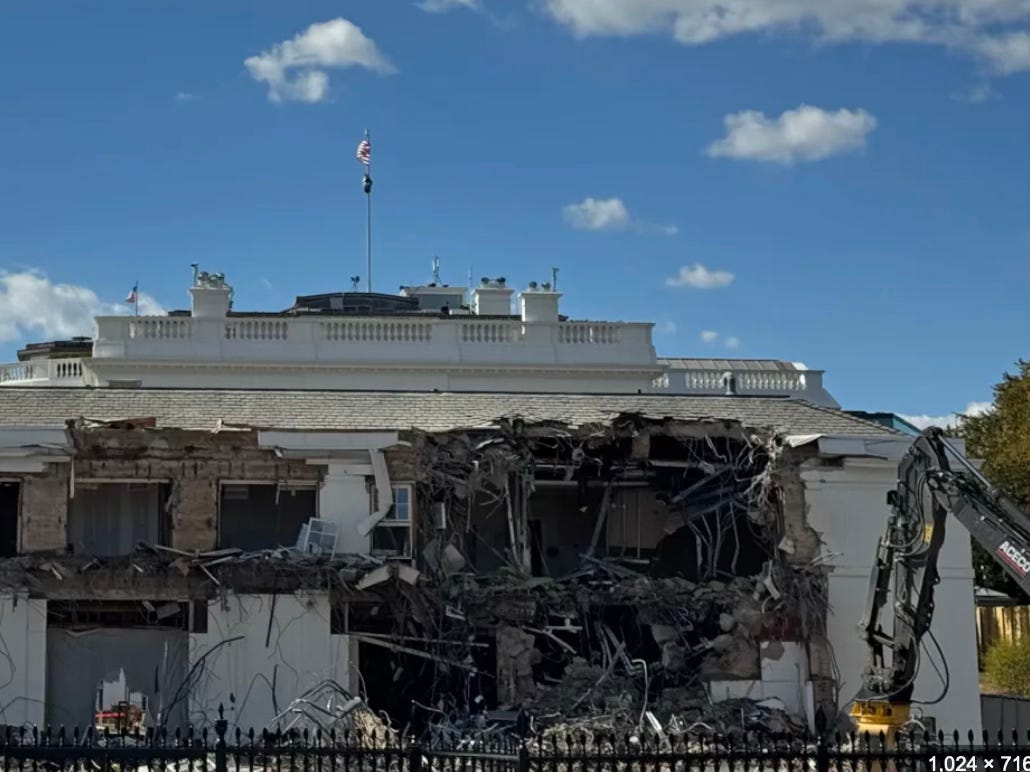
It began with a cloud of dust, a plume of pulverized history rising over the manicured lawns of the White House. Then came the sickening crunch of steel-toothed machines tearing into the elegant façade of the East Wing, a symbol of civic continuity and the nation’s gentler aspirations. The images that flickered across our screens this October were not of construction, but of a brutal, almost gleeful, demolition. Workers in hard hats moved through the rubble like scavengers picking through the bones of a fallen civilization. Satellite imagery captured the transformation in stark, unforgiving detail: where once stood a graceful wing of neoclassical architecture, there was now only a gaping wound in the side of the White House complex (CNN, 2025).
Presidential historian Douglas Brinkley captured the visceral horror of the moment when he told reporters that watching the demolition felt “painful, almost like slashing a Rembrandt painting. Or defacing a Michelangelo sculpture” (The Guardian, 2025). This is not hyperbole. It is an accurate description of what we are witnessing: the vandalism of a masterpiece, the deliberate destruction of a priceless artifact because it did not match the gilded décor of Mar-a-Lago, because it did not reflect the personal brand of the man who now claims ownership of the American state.
The East Wing was not just a building. It was a repository of memory, a physical embodiment of more than a century of American history. First constructed in 1902 during the presidency of Theodore Roosevelt, it was expanded in 1942 by Franklin Delano Roosevelt to provide additional working space during the Second World War and to conceal the construction of the Presidential Emergency Operations Center, an underground bunker that would protect the president and his staff in the event of an attack (PBS, 2025). Over the decades, it became the home of the First Lady’s office, the place where presidential spouses from Rosalynn Carter onward worked to advance their own initiatives and to represent the softer, more humane face of American power. It was where tourists entered for White House tours, where children gathered for Easter Egg Rolls, where the nation came together to celebrate and to mourn.
All of that is gone now, reduced to rubble and carted away in red and grey scrap trucks to an unknown destination (CBS, 2025). The White House Historical Association has assured us that a “comprehensive digital scanning project” was completed before the demolition, that the historical artifacts have been “preserved and stored” (PBS, 2025). But a digital scan is not a building. A photograph is not a place. What has been lost cannot be recovered, and what is being built in its place is something altogether different, something darker and more ominous.
‘My House’: When a President Acts Like an Owner
The language used to defend the demolition is as revealing as the act itself. White House Press Secretary Karoline Leavitt dismissed the widespread outrage as “fake,” arguing that “nearly every single president who has lived in this beautiful White House behind me has made modernizations and renovations of their own” (Politico, 2025). She praised Trump as someone who is “good at building things,” as if the issue were one of competence rather than propriety, as if the problem were that Americans simply do not understand the necessity of progress.
This framing deliberately misses the point. While it is true that past presidents have made changes to the White House, they have done so with a sense of reverence for its history and a clear understanding of their role as temporary stewards of a public trust. Thomas Jefferson added the east and west colonnades. Andrew Jackson built the North Portico. Theodore Roosevelt added the West Wing to provide dedicated space for the president and his staff (The Guardian, 2025). These were additions, expansions, improvements made in the spirit of enhancing the functionality of the building while respecting its historical integrity.
The most radical renovation in White House history was undertaken by Harry Truman, who ordered a complete gutting of the interior between 1948 and 1952 after engineers determined that the mansion was structurally unsound and in danger of collapse (The Guardian, 2025). This was a controversial decision at the time, but it was also a necessary one, an act of preservation rather than destruction. Truman did not tear down the White House to build a monument to himself; he saved it so that future presidents could continue to inhabit it.
Trump’s project, by contrast, is an act of conquest. His initial promise in July that the new ballroom “won’t interfere with the current building” and would be “near it but not touching it” and would “pay total respect to the existing building, which I’m the biggest fan of” was a calculated deception (Politico, 2025). The complete razing of the East Wing, a structure that has stood for over a century, reveals a contempt for the past and a desire to impose his own aesthetic, his own brand, onto the very heart of the American state. This is not the behaviour of a custodian; it is the behaviour of an owner, of someone who believes that the White House belongs to him personally and that he can do with it as he pleases.
The psychological shift from custodian to king is profound and deeply troubling. It signals a fundamental misunderstanding of the nature of democratic power, which is always temporary and always conditional. The president is not the owner of the White House; he is its tenant, occupying it on behalf of the American people for a limited term. When a president begins to act as if the White House is his personal property, when he begins to remake it in his own image without regard for its history or its meaning, he is no longer acting as a president. He is acting as a monarch.
The Ballroom of Eternal Rule
The new 90,000-square-foot ballroom, designed to accommodate up to 999 guests, is not merely an expansion of the White House’s entertainment capacity. It is a transplantation of a private empire into a public space, a physical manifestation of Trump’s belief that there is no meaningful distinction between his personal interests and the interests of the nation. The renderings released by the White House show a striking resemblance to the gilded ballroom at Mar-a-Lago, Trump’s private club in Palm Beach, Florida (The Guardian, 2025). The same opulent chandeliers, the same neoclassical columns, the same overwhelming sense of wealth and power on display. This is a deliberate act of architectural branding, an attempt to remake the White House in the image of his own personal kingdom.

The ballroom will dwarf the main White House building, at nearly double its size (The Guardian, 2025). It will be a monument to excess; a space designed not for the business of governance but for the performance of power. A ballroom, in the context of authoritarian rule, is a space of spectacle, hierarchy, and loyalty displays. It is a stage upon which the leader performs his dominance, surrounded by a court of fawning supplicants who compete for his favour. It is a place where business deals are made, where access is granted or denied, where the machinery of corruption is oiled by champagne and flattery.
The construction of such a space within the White House complex is a clear signal that Trump sees his presidency not as a temporary term of service, but as a permanent reign. The fact that the project is being privately funded by a consortium of “generous Patriots, Great American Companies, and, yours truly” (The Guardian, 2025) further blurs the lines between public and private, transforming the White House from a symbol of the nation into a monument to a single man’s ego. The list of donors reads like a who’s who of corporate America seeking favour: Apple, Amazon, Meta, Microsoft, Google, Lockheed Martin, Palantir, T-Mobile, and Comcast (The Guardian, 2025). These are not philanthropists making a gift to the nation; they are supplicants paying tribute to the king, purchasing access and influence in the most literal way imaginable.
The White House has promised that the ballroom will be completed before the end of Trump’s term in January 2029 (The Guardian, 2025). But this is not a project designed for a single term. You do not invest $300 million in a gilded throne room if you plan to leave office in four years. You do not build a monument to your own glory if you believe that your time in power is temporary. The ballroom is a prophecy of permanence, a physical declaration that Trump has no intention of relinquishing his grip on the presidency, that he sees himself not as the 47th president of the United States, but as the first king of a new American monarchy.
Subscribe to Notes From Plague Island and join our growing community of readers and thinkers.
The Erasure of Civic Symbolism
The East Wing has long been the ‘softer face’ of American governance, the place where the presidency intersected with the daily lives of ordinary Americans. It was the public entrance to the White House, the place where tourists and guests were welcomed for events. It housed the offices of the First Lady and her staff and was the centre of their philanthropic and social initiatives. It was home to the Jacqueline Kennedy Garden, a quiet space of beauty and reflection (The Guardian, 2025). It was, in short, a space of civic engagement, a symbol of the presidency as a shared cultural space rather than a private domain.
Kate Andersen Brower, author of The Residence and First Women, has written extensively about the role of the East Wing in the life of the White House. She notes that Rosalynn Carter was the first presidential spouse to keep an office there, and that before her, many First Ladies worked out of the residence in a sitting room near their bedrooms (PBS, 2025). The move to the East Wing was significant; it represented a professionalisation of the role of the First Lady, a recognition that the president’s spouse had important work to do on behalf of the nation.
Brower argues that the demolition of the East Wing “speaks a lot to how diminished the role of the president’s spouse has become” under Trump (PBS, 2025). “Truly, the power center in the White House is always the Oval Office and the West Wing, and proximity to the Oval Office is so important,” she explains. “If you have the first lady and her staff working out of the Eisenhower Executive Office Building, which I think is what will likely happen, they’re even more removed from the center of power. I mean, the East Wing has been called ‘Siberia’ as a joke inside the White House. If there’s anything farther away than Siberia, that’s it.”
The symbolism is clear: in Trump’s White House, there is no room for the softer, more humane aspects of governance. There is no space for the First Lady’s initiatives, for the philanthropic work, for the public engagement. There is only the ballroom, the space of spectacle and power, where the king holds court and his subjects come to pay tribute.
The erasure of the East Wing is part of a broader pattern of attacking the symbols and institutions of civic life. It is of a piece with Trump’s contempt for the press, his attacks on the judiciary, his attempts to politicise the military and the intelligence agencies. Each of these institutions represents a check on presidential power, a reminder that the president is not a king but a public servant. By demolishing the East Wing and replacing it with a private ballroom, Trump is sending a clear message: the old symbols of civic engagement are obsolete, the old institutions of democratic governance are irrelevant. What matters now is personal loyalty, personal power, personal glory.
The State as a Prop in the Cult of Trump
The destruction of the East Wing is not just an act of personal vanity; it is also a performance for his supporters, a demonstration of his willingness to take a wrecking ball to the institutions they have been taught to despise. The concept of “sado-populism,” as coined by historian Timothy Snyder, helps to explain the appeal of such destructive acts. Sado-populism is a political strategy in which leaders inflict pain on their own followers, and on the nation as a whole, in order to create a sense of shared grievance and to rally support against a common enemy (Snyder, 2018).
In Snyder’s formulation, sado-populism is “how America can be governed without policy and with pain.” It replaces the American Dream with an American nightmare, directing the attention of a fragile middle class toward those who are doing still worse. The logic of sado-populism is that pain is a resource, something that can be harvested and weaponised. Sado-populist leaders like Trump use that pain to create a story, a narrative in which the suffering of the people is not the result of failed policies or systemic problems, but the result of a conspiracy by corrupt elites who have betrayed the nation.
For many of Trump’s supporters, the institutions of government are seen as corrupt and in need of ‘cleansing.’ They believe that the federal bureaucracy is a ‘deep state’ working to undermine the will of the people, that the courts are politicised and illegitimate, that the media is ‘fake news’ spreading lies and propaganda. The destruction of these institutions, whether through defunding, neglect, or, in this case, literal demolition, is not a cause for alarm but a source of delight. It is a sign that their leader is a genuine outsider who is willing to take on the establishment, to ‘drain the swamp,’ to burn it all down if necessary.
The pain and chaos that result from these destructive acts are not seen as a bug, but as a feature, a necessary part of the process of national renewal. When Trump tears down the East Wing, his supporters do not see the loss of a historic building or the erasure of a symbol of civic engagement. They see a man who is willing to challenge the corrupt institutions that have held them back, who is willing to destroy the old order to make way for something new. The fact that what is being built in its place is a monument to personal excess and corruption is irrelevant; what matters is the act of destruction itself, the demonstration of power and will.
This is the essence of sado-populism: the transformation of governance into spectacle, the replacement of policy with performance, the elevation of pain and destruction into political virtues. It is a deeply nihilistic worldview, one that sees the institutions of democracy not as precious inheritances to be preserved but as obstacles to be swept aside. And it is a worldview that is fundamentally incompatible with the survival of the republic.
A Warning from the Rubble
The new ballroom is more than just a building; it is a prophecy of permanence. The scale of the project, the opulence of the design, the private funding from corporate supplicants - all of it points to a leader who has no intention of relinquishing power. You do not invest $300 million in a gold-plated throne room if you ever plan to leave. You do not build a monument to your own glory if you believe that your time in power is temporary.
The rubble of the East Wing is a stark reminder of the fragility of democratic norms. It shows how quickly the symbols of our republic can be dismantled, how easily the institutions of American government can be hollowed out and repurposed for the benefit of a single man. The dust that has settled over the White House lawn is the dust of a dying republic, the physical manifestation of a political order that is crumbling before our eyes.
There is a Virginia couple, Charles and Judith Voorhees, who have filed a lawsuit attempting to halt the ballroom project (PBS, 2025). They are asking a federal judge to issue a temporary restraining order to stop further destruction to the mansion, arguing that the project moved forward “without legally required approvals or reviews.” It is a brave and necessary act, but it is also a desperate one. The fact that private citizens must resort to the courts to protect the White House from its own occupant is a measure of how far the U.S. has fallen.
The National Trust for Historic Preservation has also spoken out, warning that the proposed ballroom threatens to “overwhelm” the White House itself (Politico, 2025). Carol Quillen, the president and CEO of the National Trust, notes that the White House’s current structure is “carefully balanced, with the main house in the center and two smaller wings on either side.” The building, she explains, “respects Georgian and neoclassical principles. It is a National Historic Landmark, a National Park, and a globally recognized symbol of our nation’s ideals.” It is also, she reminds us, “owned by the American people and its design was chosen by the nation’s first president, George Washington” (Politico, 2025).
But these appeals to history, to law, to the very idea of public ownership, fall on deaf ears. Trump has made it clear that he does not see himself as bound by such constraints. He is not a custodian of a public trust; he is the owner of a private estate. And he will do with it as he pleases.
Conclusion: When a President Becomes a King, the People Become Guests (or Serfs)
The demolition of the East Wing is a return to the initial metaphor: the vandalism of a masterpiece. The American state, like a great work of art, is a precious and fragile inheritance. It is the product of centuries of struggle and sacrifice, a complex and beautiful creation that is meant to be held in trust for future generations. To treat it as a personal plaything, to tear it apart and remake it in one’s own image, is an act of profound desecration.
When a president becomes a king, the people are no longer citizens; they are guests in his house, or worse, serfs on his estate. The White House is no longer the “people’s house”; it is the palace of the king. The nation is no longer a republic; it is a brand extension, a gaudy and tasteless reflection of its leader’s ego.
The ballroom of the king is rising from the rubble of the East Wing, and with it, the spectre of an American monarchy. It is a monument to the death of the American state, to the transformation of a democratic republic into an authoritarian regime. The dust has settled, the rubble has been carted away, and in its place, something new and terrible is being born. We are witnessing not a renovation, but a revolution - a counter-revolution, to be precise, a return to the old world of kings and courts and subjects who know their place.
The question now is whether Americans will accept this transformation, whether they will allow the $300 million ballroom to be completed and the prophecy of permanence to be fulfilled. Or whether they will find the courage to resist, to demand that the president is not a king, that the White House belongs to the people, and that the republic, however fragile, however battered, is still worth fighting for. The rubble of the East Wing is a warning. It is up to the people to heed it.
Or support us with a one-off tip → Buy Me a Coffee
References
CBS (2025) ‘Where is debris from the White House East Wing demolition?’ Available at: https://www.cbsnews.com/news/white-house-east-wing-demolition-debris/ [Accessed: 25 October 2025].
CNN (2025) ‘See the East Wing demolition from satellite images.’ Available at: https://www.cnn.com/2025/10/23/us/east-wing-white-house-satellite-photos-invs [Accessed: 25 October 2025].
Cooper, P. (2018) ‘Saddam’s ‘Disney for a despot’: How dictators exploit ruins.’ Available at: https://www.bbc.com/culture/article/20180419-saddam-disney-for-a-despot-how-dictators-exploit-ruins [Accessed: 25 October 2025].
PBS (2025) ‘The East Wing of the White House has been demolished. Here’s a look at its history.’ Available at: https://www.pbs.org/newshour/politics/the-east-wing-of-the-white-house-has-been-demolished-heres-a-look-at-its-history[Accessed: 25 October 2025].
Politico (2025) ‘It’s your house. And he’s destroying it’: Trump demolishes White House East Wing.’ Available at: https://www.politico.com/news/2025/10/22/white-house-demolition-sends-shock-waves-spurs-calls-for-pause-00618230[Accessed: 25 October 2025].
Snyder, T. (2018) Timothy Snyder Speaks, ep. 4: Sadopopulism. Available at: https://www.youtube.com/watch?v=oOjJEkKMX4 [Accessed: 25 October 2025].
The Guardian (2025) ‘What is the White House East Wing and why has it been torn down in Trump’s renovation plans?’Available at: https://www.theguardian.com/us-news/2025/oct/25/what-is-the-white-house-east-wing-and-why-has-it-been-torn-down-in-trumps-renovation-plans [Accessed: 25 October 2025].