The Art of the Fold: Kushner, Witkoff, and the Moscow Capitulation
The Circus Comes to the Kremlin
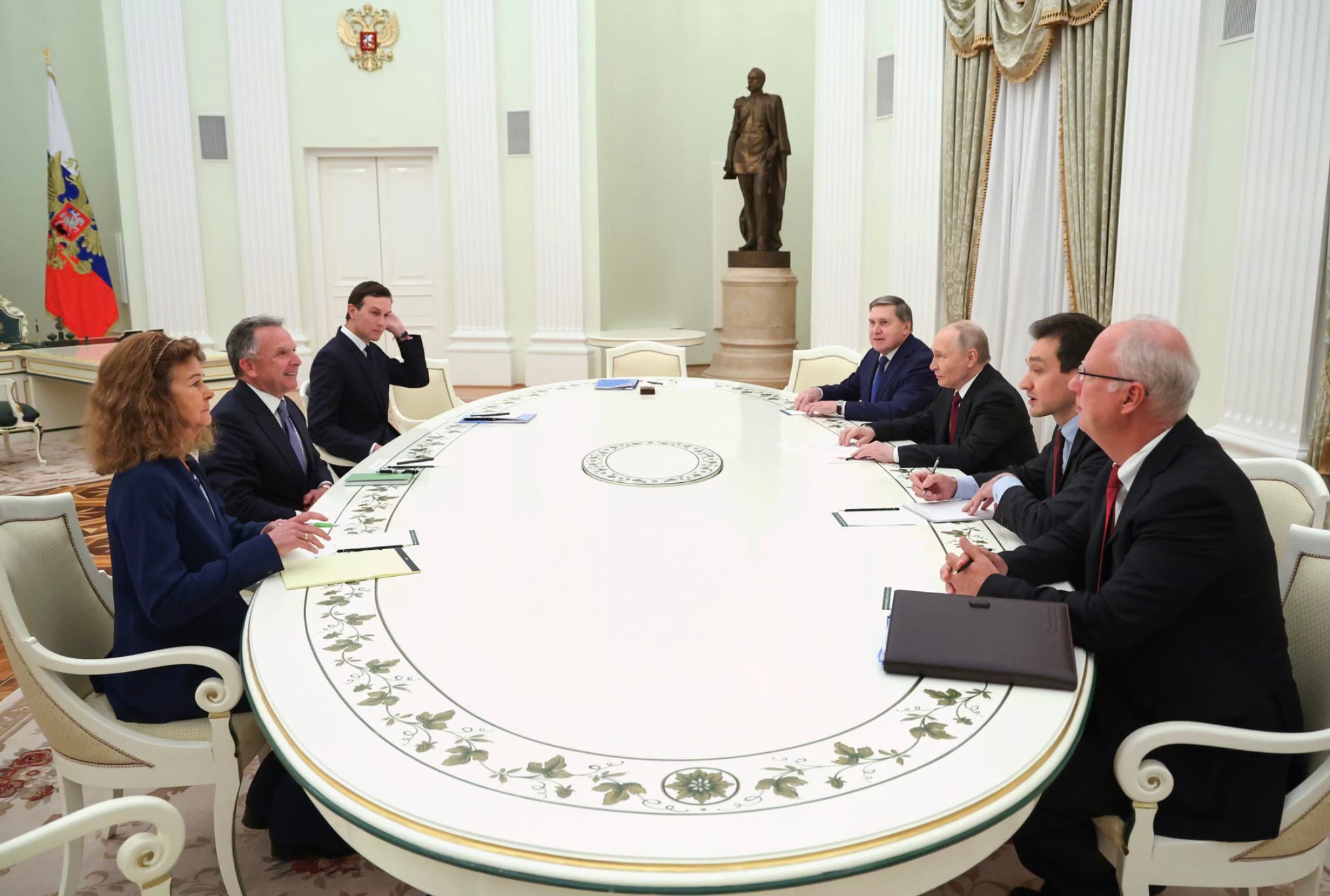
The ghosts of tsars and commissars must have watched with a mixture of bewilderment and grim satisfaction. On December 2, 2025, the hallowed, blood-soaked halls of the Kremlin, rooms that had witnessed the iron wills of Ivan the Terrible, the brutal purges of Stalin, and the cold calculus of the Cold War, played host to a spectacle of uniquely American degradation. Across the polished table from Vladimir Putin, a man forged in the shadows of the KGB and now presiding over the most savage land war in Europe since 1945, sat not seasoned diplomats or steely-eyed strategists, but a princeling of private equity and a New York real estate tycoon. Jared Kushner, the silent son-in-law, and Steve Witkoff, a developer described by stunned observers as “fawning,” had come to Moscow to talk peace (Reuters, 2025).
This was not a negotiation; it was a foreclosure. The very image was a geopolitical grotesque: Putin, the architect of a four-year campaign of terror against a sovereign nation, patiently entertaining two men whose professional expertise lies not in nuclear deterrence or alliance management, but in Manhattan zoning laws and the art of flipping distressed assets (Sky News, 2025b). They were there to close a deal, to liquidate a problem, to apply the crude logic of the boardroom to the brutal reality of the battlefield. The commodity being traded was the sovereignty of Ukraine. The meeting was the final, humiliating proof that American diplomacy, under the second Trump administration, has ceased to be an instrument of statecraft and has become a transactional racket, a family business where national interest is sold to the highest or most convenient bidder (Plague Island, 2025).
The thesis of this gathering was simple and chilling: the “peace” being peddled by these amateur envoys was a hollow capitulation, a Kremlin wish list gift-wrapped in the language of deal-making. It was a proposal designed not to end a war, but to validate the aggression that started it. The presence of Kushner and Witkoff, operating with the informal opacity that has become the hallmark of the Trump dynasty, was a calculated insult to America’s allies and a signal to its adversaries that the post-war liberal order was officially in receivership (BBC, 2025a).
The timeline of this absurdity only sharpens the focus. For nearly four years, Ukraine has bled to defend its right to exist. In the face of this heroic resistance, the United States, under the stewardship of its celebrity-in-chief, has presented a revised 19-point plan: a cosmetically altered version of an already disgraceful 28-point proposal (Axios, 2025). While Ukrainian President Volodymyr Zelenskyy, the face of democratic defiance, was relegated to anxious waiting in Ireland and Florida, the American envoys were given a guided tour of Moscow by Kirill Dmitriev, the head of the Russian Direct Investment Fund and a key figure in the 2016 Trump-Russia interface (Guardian, 2025a).
The Envoys: A Confederacy of Amateurs
To understand the Moscow capitulation, one must first understand the envoys. They were not chosen for their wisdom, their experience, or their patriotism. They were chosen for their loyalty - not to the country, but to the man. They are the embodiment of a government where proximity to power is the only qualification that matters.
Jared Kushner: The Silent Son-in-Law
After a brief, self-imposed exile in the gilded world of private equity, Jared Kushner has returned to the geopolitical stage. His firm, Affinity Partners, flush with billions from Gulf sovereign wealth funds, was supposed to be his focus. Yet, here he is, reprising his role as the shadow Secretary of State, the whisperer in the presidential ear. Kushner operates from a strategic framework he once proudly described as an advantage: having “no context” (Iorfida, 2025). He views history, alliances, and diplomatic precedent as inconvenient clutter that gets in the way of a deal.
This is dangerous, wilful negligence. To approach a man like Putin, a master of historical grievance and strategic patience, with a blank slate is to hand him the chalk. Kushner’s diplomacy is a toxic cocktail of arrogance and ignorance. The deep, glaring conflict of interest - negotiating on behalf of the United States while his personal fortune is inextricably linked to the whims of foreign autocrats - is not a bug in the system; it is the system itself. A 2024 Senate Finance Committee investigation into Kushner’s firm highlighted its questionable deals with foreign governments and fee structures that seemed to benefit Kushner far more than his investors (Senate Committee on Finance, 2024). He was not in Moscow to save Ukrainian lives or defend American interests. He was there to close a deal, any deal, that would allow his father-in-law to declare a victory and move on to the next news cycle.
Steve Witkoff: The “Gollum” of Diplomacy
If Kushner represents the silent, entitled face of this new diplomacy, Steve Witkoff is its grotesque, grasping id. A New York real estate developer and long-time friend of Donald Trump, Witkoff’s presence in the Kremlin is perhaps the most baffling and insulting aspect of the entire affair (The Atlantic, 2025). His performance was so shockingly obsequious that it drew a scathing comparison from The Independent’s Julian Borger, who noted he was seen “fawning like Gollum” before the master of the Kremlin (Borger, 2025). But the truth is far more damning than mere obsequiousness. Bloomberg’s investigation revealed intercepted phone calls in which Witkoff was coaching the Kremlin on how to get Trump on side, advising Russian officials on the best approach to manipulate the American president (Guardian, 2025c). This an operative actively coordinating with Russia, feeding the Kremlin intelligence on Trump’s psychology and preferences. Witkoff was not representing American interests in Moscow. He was representing Russian interests in the White House.
Witkoff’s diplomatic toolkit is, to put it mildly, empty. It has been reported that in previous engagements, he took no notes, a cardinal sin in any negotiation, let alone one with a hostile power. He relied entirely on Kremlin-provided translators, effectively ceding control of the historical record to the adversary. A calculated surrender of American interests. When you hand your adversary the pen that writes the official record, you have already lost the negotiation. It is the diplomatic equivalent of handing over your bank account password and hoping for the best, except worse, because you are doing it on behalf of a nation, not yourself.
Witkoff’s worldview is shaped by the concrete canyons of Manhattan, where every asset has a price and every conflict can be resolved by adjusting the terms of the sale (Sky News, 2025b). He sees the Donbas, a region soaked in the blood of thousands of Ukrainian patriots, not as the sovereign territory of a democratic ally, but as a ‘distressed asset’ on a balance sheet, a problem to be liquidated rather than a tragedy to be prevented. The problem of the war, in this mindset, is not the moral outrage of unprovoked aggression, but the untidiness of an unresolved liability. The solution, therefore, is to liquidate it, to sell it off to settle the debt and clean up the books. In Witkoff’s transactional universe, the lives of Ukrainians are just line items in a spreadsheet, to be written off as losses in a failed investment.
The Exclusion of Professionals
The most telling detail of the Moscow circus was not who was in the room, but who was not. The halls of the Kremlin were conspicuously empty of career diplomats, of the men and women who have dedicated their lives to the art of American statecraft. The State Department, the National Security Council, the entire apparatus of professional foreign policy, was marginalised, sidelined in favour of the family and the friends.
Even the official Secretary of State, Marco Rubio, was reduced to a background player, dispatched to Florida to manage the fallout and provide a veneer of officialdom while the real business was being conducted by the amateurs in Moscow (Guardian, 2025a). This is the Trump method in its purest form: the hollowing out of expertise, the elevation of personal loyalty over professional competence, and the transformation of the state into an extension of the family will. The message to the world was clear: the United States government is no longer a reliable institution, but the personal fiefdom of one man and his chosen courtiers.
The “Plan”: A Blueprint for Surrender, Written in Russian
The so-called “peace plan” that Kushner and Witkoff carried to Moscow was not a serious proposal for resolving a conflict; it was a blueprint for surrender. But the truth is even more damning. The initial 28-point plan, which shocked observers with its pro-Moscow bias, was not a US-authored document at all. It was, as senior US senators revealed after speaking with Secretary of State Marco Rubio, a “wish list from the Russians” (Sky News, 2025a). Republican Senator Mike Rounds was even more blunt, stating, “It looked more like it was written in Russian to begin with” (Sky News, 2025a).
This revelation reframes the entire episode from one of gross incompetence to one of active complicity. The Trump administration was not negotiating a peace; it was laundering a Russian ultimatum. The subsequent reduction of the plan from 28 to 19 points was not a sign of tough negotiation by the US side, but a desperate cosmetic exercise. It was an attempt to sand down the sharpest edges of a Russian-authored document, to make it marginally more palatable and to obscure its true origins. The goal was to create the illusion of a US-led initiative, a face-saving measure to hide the fact that the American envoys were acting as little more than delivery boys for the Kremlin.
The 19-Point Indignity
Viewed through this lens, the 19-point plan is not a compromise, but a slightly redacted version of a surrender document. Its core tenets remain a wholesale adoption of Moscow’s primary war aims (CSIS, 2025):
Territorial Concessions: The plan offers de facto recognition of Russian control over Crimea, which it illegally annexed in 2014, and the regions of Donetsk and Luhansk in the Donbas.
NATO Neutrality: The plan demands that Ukraine permanently renounce its ambition to join the NATO alliance. This has been a central, obsessive goal of Vladimir Putin for decades.
Demilitarisation: In perhaps its most absurd and insulting provision, the plan stipulates that Ukraine must drastically reduce the size of its military. It demands that a nation bordering a proven aggressor must unilaterally disarm.
It is the codification of the principle that might makes right. It is a message to the world that the United States will no longer stand for the ideals of sovereignty and self-determination, but will instead broker their sale to the highest bidder. The financial incentives woven into the deal, including proposals to use Russia’s frozen assets as a signing bonus for the Trump administration, reveal the nakedly transactional nature of the entire enterprise (Foreign Policy, 2025; Daily Beast, 2025).
Subscribe to Notes From Plague Island and join our growing community of readers and thinkers.
The European Reaction: “Alone with these guys”
The reaction from America’s European allies was a predictable mixture of panic, fury, and despair. The plan was drafted in a vacuum, with no meaningful consultation with the very nations that bear the primary security and financial burdens of the war. Europe, which has absorbed millions of Ukrainian refugees and provided tens of billions in aid, was treated not as a partner, but as a vassal, expected to rubber-stamp a deal cooked up in Mar-a-Lago and Moscow (BBC, 2025a).
A confidential conference call among European leaders, reported by Der Spiegel, captured the sense of utter abandonment. “We must not leave Ukraine and Volodymyr alone with these guys,” one senior official pleaded (Spiegel, 2025). The “guys” in question were not the Russians, but the Americans. The sentiment reveals a terrifying new reality: for the first time since the Second World War, the United States is no longer seen as the guarantor of European security, but as a primary threat to it.
Putin, ever the opportunist, masterfully exploited this division. He used the meeting with Kushner and Witkoff to drive a deeper wedge between Washington and Brussels. He issued a thinly veiled threat, boasting that “’Russia ready for war if Europe starts it “ (Guardian, 2025d). The message was clear: with America in retreat, Europe stands alone. The transatlantic alliance, the bedrock of global stability for eighty years, is fracturing under the weight of Trumpism.
The Meeting: Five Hours of Nothing
The five-hour meeting in the Kremlin was a masterclass in autocratic stagecraft (Reuters, 2025). It produced no breakthroughs, no agreements, and no progress. But it did produce a powerful propaganda victory for Vladimir Putin. The very fact that the American delegation agreed to sit for five hours while achieving nothing is itself a form of capitulation, a public acknowledgment that they had come to Moscow not as equals, but as supplicants.
Inside the Room
Official readouts were sparse and laden with the empty jargon of diplomacy. Kremlin aide Yuri Ushakov described the talks as “constructive” and “useful” (Turan, 2025), which in the lexicon of international relations translates to: ‘We lectured them, and they listened.’ The power dynamic was brutally clear. On one side sat Putin, the seasoned autocrat, a man who has spent a quarter of a century playing the long game of geopolitics, who understands that patience is a weapon and that the appearance of strength is itself a form of strength. On the other sat two real estate developers, men accustomed to the instant gratification of a signed contract, men for whom a handshake and a press release constitute a victory.
Julian Borger noted Putin’s preternatural ability to “scent weakness” (Borger, 2025). And he would have found it in abundance. Kushner and Witkoff arrived in Moscow with a Russian wish list, hoping that Putin would be satisfied with a slightly edited version of his own ultimatum. Putin, a man who has spent decades studying the art of negotiation through the lens of power, would have recognised this immediately. The five hours were a masterclass in humiliation. Putin would have spent the time explaining, with the patience of a teacher addressing a particularly slow student, why the American proposal did not go far enough. He would have probed for more concessions, demanded more humiliations, testing the limits of their desperation to close a deal. And Witkoff and Kushner, sitting across from him with no notes, no professional diplomats, no institutional backing, would have had nothing to offer but apologies and further capitulations. The five hours were a performance of power designed not just for the world, but for history; a demonstration that the United States, under Trump, was no longer a serious power.
The Outcome: The Brick Wall
Despite the fawning and concessions, the talks ultimately hit a “brick wall” (RFE/RL, 2025). Putin, smelling blood in the water, rejected key parts of the American plan. He did not do so because it was too harsh on Russia, but because he correctly calculated that he could get more. Why settle for a partial victory today when a total victory is on the horizon? The American delegation had shown their hand; they had revealed their weakness, their desperate hunger for a deal, any deal.
Kushner and Witkoff left Moscow with empty hands. They had achieved nothing. But they had given Putin a priceless gift: the image of two American envoys, hats in hand, in the heart of the Kremlin, begging for a deal. They had granted him the legitimacy of a global statesman while he continues to wage a war of annihilation. They had humiliated their own country on the world stage, and they had received nothing in return. Worse, they had demonstrated to every autocrat, every aggressor, every would-be conqueror in the world that the United States was no longer willing to defend its interests or its allies. The message was clear: if you are ruthless enough, if you are patient enough, the Americans will eventually come to you, not to punish you, but to ask you what you are willing to accept.
The Ghost of Zelenskyy
The most poignant image of this entire sordid affair is the split screen. On one side, the opulent grandeur of the Kremlin, where the fate of a nation is being discussed by men who see it as a line item on a spreadsheet. On the other, the frantic, desperate shuttle diplomacy of Volodymyr Zelenskyy. The president of a nation fighting for its very existence was reduced to a spectator, forced to “await signals” from a meeting where his country’s chief adversary was being courted by his country’s most powerful ally (Guardian, 2025a).
It is a degradation of the highest order. It is a public shaming of a man who has become a global symbol of courage and defiance. It is the final, bitter fruit of a foreign policy that prioritises the comfort of the aggressor over the survival of the victim.
Conclusion: The Geopolitical Pawn Shop
The Moscow talks of December 2, 2025, will be remembered as a moment of profound and irreversible shame. It was the day the United States formally abdicated its role as the leader of the free world and became a geopolitical pawn shop, a place where the sacred heirlooms of the liberal international order - sovereignty, democracy, human rights - are appraised and sold off for parts (Moscow Times, 2025).
In their desperate, amateurish pursuit of a ‘deal,’ Kushner and Witkoff have made a genuine peace all but impossible. They have sent an unambiguous signal to Putin and to every other autocrat and aggressor in the world: Your brutality works. Your violence will be rewarded.
This is the ultimate paradox of the Trumpian approach to foreign policy. The self-proclaimed master of the “Art of the Deal” has revealed himself to be a master of the “Art of the Fold.” The American delegation did not go to Moscow to negotiate. They went to appraise the property before handing over the keys.
But beneath this spectacle lies a more troubling question, one that really puzzles us: What explains Trump’s peculiar deference to Putin? Is it ideological kinship, a recognition that they are cut from the same cloth, both transactional operators who view the world through the lens of power, dominance, and personal enrichment rather than democratic principles or national interest? Or is it something darker, more sinister? Does Putin hold leverage over Trump, financial entanglement, compromising material, or other forms of coercion, that constrains his choices and forces his capitulation? The pattern is unmistakable: Trump’s combative stance toward traditional allies, his eagerness to abandon long-standing commitments, his willingness to hand over victories to autocrats without extracting concessions. It is the behaviour of a man either ideologically aligned with authoritarianism or bound by forces beyond public view. Either way, the implications are equally catastrophic. Whether Trump shrinks before Putin out of shared conviction or hidden compulsion, the result is the same: the death of American leadership and the triumph of the strongman’s worldview.
Or support us with a one-off tip → Buy Me a Coffee
References
Atlantic Council (2025) ‘Ukraine peace plan must not include amnesty for Russian war crimes’, Atlantic Council. Available at: https://www.atlanticcouncil.org/blogs/ukrainealert/ukraine-peace-plan-must-not-include-amnesty-for-russian-war-crimes/ [Accessed: 4 December 2025].
Axios (2025) ‘Trump’s full 28-point Ukraine-Russia peace plan’, Axios. Available at: https://www.axios.com/2025/11/20/trump-ukraine-peace-plan-28-points-russia [Accessed: 20 November 2025]
Borger, J. (2025) ‘Putin doesn’t want peace – and Trump’s baffling error has made it easy for him’, The Independent, 4 December. Available at: https://www.independent.co.uk/news/world/europe/trump-putin-peace-talks-ukraine-russia-war-b2877797.html [Accessed: 5 December 2025].
BBC (2025a) ‘How Trump blew up the world order - and left Europe to pick up the pieces’, BBC News. Available at: https://www.bbc.com/news/articles/c2er9j83x0zo [Accessed: 25 March 2025].
BBC (2025b) ‘US to sell F-35 jets to Saudi Arabia, Trump says ahead of MBS visit’, BBC News. Available at: https://www.bbc.com/news/articles/c7512rkvg7ro [Accessed: 18 November 2025].
Brookings Institution (2025) ‘What is the status of Russia’s frozen sovereign assets?’, Brookings. Available at: https://www.brookings.edu/articles/what-is-the-status-of-russias-frozen-sovereign-assets/ [Accessed: 5 December 2025].
Cleary, O. (2025) ‘Putin and Trump Envoy Witkoff to Meet Today for High-Stakes Peace Talks’, Time, 1 December. Available at: https://time.com/7337963/putin-witkoff-russia-ukraine-peace-talks-trump-key-issues/ [Accessed: 5 December 2025].
Council on Foreign Relations (2025) ‘How to Use Russia’s Frozen Assets’, CFR. Available at: https://www.cfr.org/article/how-use-russias-frozen-assets [Accessed: 21 November 2025].
CSIS (2025) ‘Unfinished Plan: Peace in Ukraine Provision by Provision’, Center for Strategic and International Studies. Available at: https://www.csis.org/analysis/unfinished-plan-peace-ukraine-provision-provision [Accessed: 4 December 2025].
Daily Beast (2025) ‘Trump’s $2 Trillion Plan to Cash in on Ukraine Peace Leaks’, Daily Beast. Available at: https://www.thedailybeast.com/trumps-2-trillion-plan-to-cash-in-on-ukraine-peace-leaks/ [Accessed: 2 December 2025].
European Council (2025) ‘Impact of sanctions on the Russian economy’, European Council. Available at: https://www.consilium.europa.eu/en/infographics/impact-sanctions-russian-economy/ [Accessed: 5 December 2025].
Foreign Policy (2025) ‘U.S.-Russia Plan Gives Trump a $300 Billion Signing Bonus’, Foreign Policy. Available at: https://foreignpolicy.com/2025/11/24/trump-putin-russia-ukraine-peace-plan-frozen-assets-central-bank-reserves/[Accessed: 24 November 2025].
Guardian (2025a) ‘US special envoy Steve Witkoff to meet Ukraine national security officials’, The Guardian. Available at: https://www.theguardian.com/world/2025/dec/04/trump-ukraine-peace-envoys-prepare-meet-kyiv-official [Accessed: 4 December 2025].
Guardian (2025b) ‘Trump’s belligerence is pushing Xi, Putin and Kim together’, The Guardian. Available at: https://www.theguardian.com/commentisfree/2025/sep/03/donald-trump-xi-jinping-vladimir-putin-us-world-order[Accessed: 3 September 2025].
Guardian (2025c) ‘Who leaked Witkoff’s call advising Kremlin on how to get Trump on side?’, The Guardian, 26 November. Available at: https://www.theguardian.com/us-news/2025/nov/26/who-leaked-steve-witkoff-call-kremlin-trump-analysis [Accessed: 5 December 2025].
Guardian (2025d) ‘Russia ready for war if Europe starts it, Putin says, as US peace talks end without progress’, The Guardian, 2 December. Available at: https://www.theguardian.com/world/2025/dec/02/witkoff-in-moscow-for-talks-as-putin-claims-to-have-taken-key-ukrainian-city [Accessed: 5 December 2025]
Iorfida, C. (2025) ‘Kushner goes to Moscow: Trump’s son-in-law re-emerges as White House dealmaker’, CBC News, 26 November. Available at: https://www.cbc.ca/news/world/us-trump-white-house-russia-kushner-9.6992959 [Accessed: 5 December 2025].
Moscow Times (2025) ‘Trump’s Ukraine Peace Push Was Always a Naked Cash Grab’, Moscow Times. Available at: https://www.themoscowtimes.com/2025/12/04/trumps-ukraine-peace-push-was-always-a-naked-cash-grab-2-a91345[Accessed: 4 December 2025].
New York Times (2025) ‘Trump’s Vision: One World, Three Powers?’, New York Times. Available at: https://www.nytimes.com/2025/05/26/us/politics/trump-russia-china.html [Accessed: 26 May 2025].
Plague Island (2025) ‘Trump’s Spectacle Diplomacy: MBS, Al-Sharaa, and the Death of Values’, Plague Island. Available at: https://www.plagueisland.com/p/trumps-spectacle-diplomacy-mbs-al [Accessed: 4 December 2025].
Reuters (2025) ‘Putin meets Witkoff and Kushner for over four hours to discuss Ukraine peace’, Reuters. Available at: https://www.reuters.com/world/china/witkoff-kushner-meet-putin-moscow-discuss-an-end-ukraine-war-2025-12-02/[Accessed: 2 December 2025].
RFE/RL (2025) ‘Ukraine Peace Efforts Further Stalled After US-Kremlin Talks Make Little Headway’, Radio Free Europe/Radio Liberty, 3 December. Available at: https://www.rferl.org/a/33612090.html [Accessed: 5 December 2025].
Sauer, P. (2025) ‘US envoy Steve Witkoff to meet Ukraine national security chief in Miami’, The Guardian, 4 December. Available at: https://www.theguardian.com/world/2025/dec/04/trump-ukraine-peace-envoys-prepare-meet-kyiv-official[Accessed: 5 December 2025].
Senate Committee on Finance (2024) ‘Wyden Investigation of Kushner Firm Continues: New Letter Outlines Affinity Partners Fee Structure, Lack of Return to Investors, Questionable Deals with Foreign Governments’, United States Senate Committee on Finance. Available at: https://www.finance.senate.gov/chairmans-news/wyden-investigation-of-kushner-firm-continues-new-letter-outlines-affinity-partners-fee-structure-lack-of-return-to-investors-questionable-deals-with-foreign-governments [Accessed: 15 July 2024].
Sky News (2025a) ‘Who actually wrote US-Russian peace plan for Ukraine?’, Sky News. Available at: https://news.sky.com/story/who-actually-wrote-us-russian-peace-plan-for-ukraine-13474427 [Accessed: 24 November 2025].
Sky News (2025b) ‘Steve Witkoff: Who is the property mogul seeking a Ukraine peace?’, Sky News. Available at: https://news.sky.com/story/steve-witkoff-who-is-the-real-estate-mogul-tasked-with-brokering-peace-in-ukraine-13326927[Accessed: 26 November 2025].
Spiegel International (2025) ‘Confidential Conference on Ukraine Peace: “We Must Not Leave Ukraine and Volodymyr Alone with These Guys”’, Der Spiegel, 4 December. Available at: https://www.spiegel.de/international/europe/confidential-conference-on-ukraine-peace-we-must-not-leave-ukraine-and-volodymyr-alone-with-these-guys-a-a7b269ed-b6c2-4739-8e83-81552e097c14 [Accessed: 5 December 2025].
The Atlantic (2025) ‘Trump’s Real Secretary of State’, The Atlantic. Available at: https://www.theatlantic.com/politics/archive/2025/05/steve-witkoff-putin-russia-ukraine-diplomat/682805/ [Accessed: 14 May 2025].
Treasury (2025) ‘Treasury Announces Agreement to Establish United States-Ukraine Reconstruction Investment Fund’, U.S. Department of the Treasury. Available at: https://home.treasury.gov/news/press-releases/sb0126 [Accessed: 30 April 2025].
Turan, R. (2025) ‘Witkoff, Kushner hold about 5 hours of talks in Moscow with Putin on revised Ukraine peace plan’, Anadolu Agency, 2 December. Available at: https://www.aa.com.tr/en/americas/witkoff-kushner-hold-about-5-hours-of-talks-in-moscow-with-putin-on-revised-ukraine-peace-plan/3760412 [Accessed: 5 December 2025].
Washington Post (2025) ‘U.S. delegation meets with Putin in latest bid to end Ukraine war’, The Washington Post, 3 December. Available at: https://www.washingtonpost.com/world/2025/12/02/russia-putin-witkoff-kushner-ukraine-talks-moscow/ [Accessed: 5 December 2025].