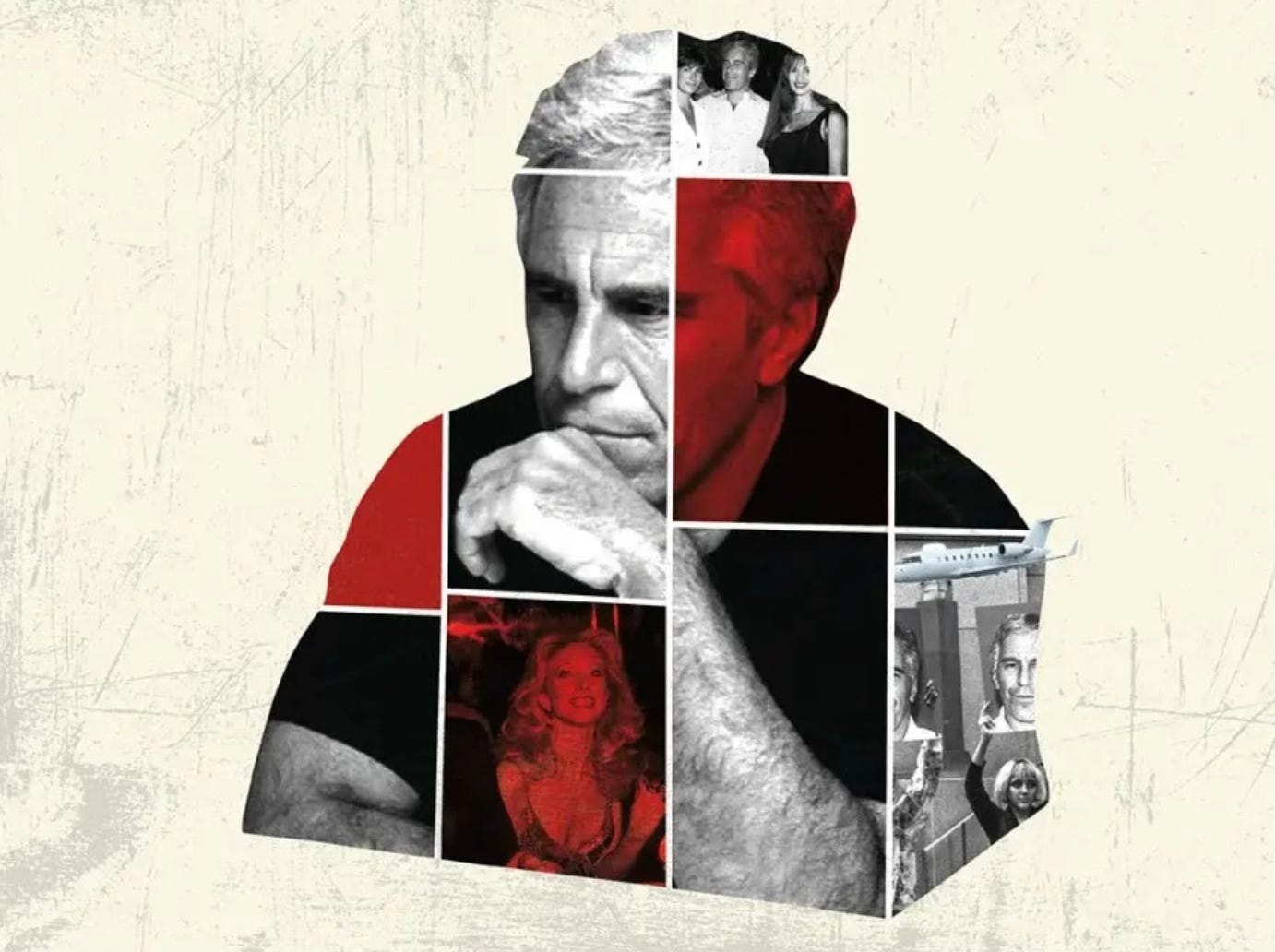
The Architecture of Distraction: From Epstein’s Cell to the Bombing of Tehran - How One Death Set the World on Fire

The Cell: A Man Dies in Manhattan, and the Cameras Miss it
On the morning of August 10, 2019, Jeffrey Epstein was found dead in his cell at the Metropolitan Correctional Center in lower Manhattan. He was sixty-six years old. The official story was clean, almost elegant in its simplicity: a disgraced financier, facing the rest of his life in prison, has committed suicide. But whether that ending was chosen by him, or forhim, was a question upon which the official story didn’t linger. The guards had been asleep; the cameras had malfunctioned. It was a seemingly explicable official conclusion.
Almost no one believed it. Not because the American public had become a nation of conspiracy theorists, but because for the first time in a long time, the conspiracy was visible. The cameras outside his cell had malfunctioned in a way that produced a specific, inexplicable gap in the footage. The missing seconds corresponded exactly to the window in which his life ended (Reuters, 2019). The two guards assigned to check on Epstein every thirty minutes had, by their own later admission, been asleep and falsifying their logs (Department of Justice, 2019). The most high-profile prisoner in the United States of America, a man who had allegedly compromised some of the most powerful people on earth, had been left entirely alone.
In a report released in June 2023, the Department of Justice’s own Inspector General found that the Bureau of Prisons had failed Epstein through a cascade of institutional dysfunction: chronic staffing shortages, a culture of negligence, and a series of decisions that, taken together, created the conditions for his death (OIG, 2023). The report was careful, bureaucratic, and deliberately inconclusive. It said nothing about who might have wanted Epstein dead, or why. It was the sound of a system protecting itself.
But the files remained. Millions of pages of documents, flight logs, FBI interview summaries, and email correspondence sat in the vaults of the Justice Department. They were the accumulated evidence of a network so vast and so powerful that its exposure threatened not just individuals but the entire architecture of elite power in the Western world. And for years, the people who held those files did everything they could to keep them buried.
Here is the thing that the official story never wanted you to sit with too long: Jeffrey Epstein was not in that cell just because of what he had done. He was there because of what he knew others had done. He was the ledger; the proof… and as long as he was alive, the ledger could be opened.
The Network: The Blackmail Machine at the Heart of Western Power
To understand the world that Jeffrey Epstein inhabited, you have to understand something about the nature of power in the late twentieth century: it had become untethered from accountability. The old structures of democratic oversight — the press, the courts, the legislature — had been systematically gouged through the accumulated weight of a thousand small decisions made by people who believed that the rules were for other people.
Epstein was the product and prefect expression of this world. He was a man of no particular genius or talent who had somehow accumulated extraordinary wealth and extraordinary access. He moved between Palm Beach, Manhattan, the Virgin Islands, and Paris, hosting a rotating cast of the world’s most powerful men at his properties, connecting them to each other, making himself indispensable. He was, in the language of intelligence agencies, a “facilitator.”
Donald Trump had been part of this world for decades. In 2002, he told New York magazine that Epstein was “a terrific guy” who liked women “on the younger side” (New York Magazine, 2002). They attended parties together at Mar-a-Lago. They shared the same social universe of Palm Beach money and Manhattan excess. When Epstein was first arrested in Florida in 2008, it happened on Trump’s watch. The man who handled the prosecution was Alexander Acosta, who would later become Trump’s Secretary of Labour. Acosta gave Epstein a non-prosecution agreement of tremendous leniency: thirteen months in a county jail, with work release, for crimes that federal investigators had documented in a fifty-three-page indictment. A deal so extraordinary that it was later ruled illegal by a federal judge (Miami Herald, 2019). The survivors were not consulted. They were not even told the deal had been made.
Then came the Biden years. The files sat in the vaults of the Justice Department, and no one came for them. The survivors waited. They gave interviews. They filed legal motions. They begged. The administration that had promised to restore decency and accountability to the American government looked at those files and quietly decided the cost of opening them was too high. No one cared enough about the survivors to bring the powerful to account. The files were too dangerous; names inside them were too important. So, the silence continued, bipartisan and absolute.
Subscribe to Notes From Plague Island and join our growing community of readers and thinkers.
What made the files so dangerous was names of American politicians and billionaires and the architecture of the operation itself. Documents revealed Epstein’s deep and troubling connections to Israeli intelligence. An FBI memo from the bureau’s Los Angeles field office, produced in October 2020 and released in the 2026 document dump, reported that one of its sources had come to believe Epstein “was a co-opted Mossad agent” who had been “trained as a spy” (Al Jazeera, 2026). His email correspondence showed extensive contact with Yoni Koren, a senior aide to former Israeli Prime Minister Ehud Barak and a figure connected to Israeli military intelligence, who made regular stays at Epstein’s New York residence. Barak himself appeared repeatedly throughout the files, his relationship with Epstein spanning fifteen years (Al Jazeera, 2026).
This was more than a story of a paedophile and his clients. This was the story of a blackmail operation at the heart of Western power, with tentacles reaching into the intelligence services of at least two nations. The people who had visited Epstein’s properties, flown on his planes, and attended his dinners; they were not only morally compromised, but potentially compromised in ways that could be weaponised. Someone, somewhere, had been collecting the evidence.
In this reading, Epstein was not a criminal who had been brought to justice, but a liability who had been contained. The question of who contained him, and why, and whether the containment was permanent, was one that the system had no interest in answering.
The Fever Dream: QAnon Was Wrong About Everything Except the Thing That Mattered
While the files sat in the vaults, something strange was happening to the American psyche. A nation that had lost faith in its institutions began to construct its own explanations for the rot it could feel but could not see.
In 2017, an anonymous poster known as “Q” began leaving cryptic messages on internet message boards. The core claim of what became the QAnon movement was both bonkers and terrifyingly simple: that the world was controlled by a secret cabal of Satan-worshipping elites who operated a global child sex-trafficking ring, and that Donald Trump was engaged in a secret war to destroy them (Ohio Capital Journal, 2025).
It was an utter fever dream, a conspiracy theory that absorbed every other conspiracy theory, mutating and expanding until it became a quasi-religion for millions of people who felt abandoned by the modern world. It led to violence, to the storming of a pizzeria in Washington D.C., and eventually to the halls of Congress.
But the profound, uncomfortable irony of QAnon was that its central, animating premise — that a network of untouchable elites was operating a shadow ring of exploitation — was not entirely wrong. It was a distorted, funhouse-mirror reflection of an actual reality. The Epstein network did exist. Powerful men were exploiting the vulnerable with total impunity. The conspiracy theorists were right to believe they were being lied to; they were just wrong about the details.
The ultimate irony was the figure they chose as their saviour. The QAnon faithful believed that Donald Trump was the hero who would expose the elite paedophile ring. They did not know, or chose not to see, that Trump was himself a creature of that very same world, a man who had partied with Epstein, who had flown on his planes, and who, when the time came, would do everything in his power to keep the truth buried.
There is a school of thought — taken seriously by philosophers and physicists, not just the unhinged corners of the internet — that we may be living inside a simulation. That reality as we experience it is a constructed thing, a programme running on some vast and indifferent machine. It is usually discussed in the abstract, as a thought experiment, a provocation.
But then you look at this story: a paedophile financier with ties to intelligence services on two continents dies in a federal prison cell in a gap in the surveillance footage, while the guards sleep. His files are buried through three presidencies. The man who gave him his sweetheart deal becomes a Cabinet secretary. The man who called him a “terrific guy” becomes the President. The Attorney General says the files are on her desk. The President says the files don’t exist. The First Lady holds a press conference to say she is not a victim. And then the bombs fall on Tehran.
You can see why people start to wonder. Not because the simulation theory is true, but because reality has arranged itself with such a perfect, almost literary sense of irony that the alternative — that all of this is simply what human power looks like when it is left unchecked — is somehow even harder to accept.
The Contradiction: The Hoax That Was Sitting on the Desk
Fast forward to early 2026. Donald Trump had returned to the White House, and the world had changed in ways that were difficult to fully comprehend. The economy was stuttering as tariffs were biting. But the greatest threat to Trump was not economic. It was historical.
In November 2025, under enormous public pressure, Trump had signed the Epstein Files Transparency Act. It was a populist gesture, a way of presenting himself as the man who would finally expose the “deep state.” But what followed was a masterclass in obfuscation.
The files have not been fully released. What we know is already devastating — the hundreds of mentions of Trump, the emails detailing the mechanics of a social network built on mutual complicity, the names of billionaires and princes who operated in plain sight (BBC, 2026; New York Times, 2026). But you can only guess at what is being held back. The truth is being kept in the shadows, exactly where the powerful need it to be.
The contradictions from the White House were incredible, a dizzying spectacle of denial. Trump stood on the White House lawn and claimed the files “were made up by Comey. They were made up by Obama. They were made up by Biden” (Al Jazeera, 2025). He repeatedly dismissed the demands for transparency as a “Democrat hoax” (C-SPAN, 2025).
Yet, at the exact same time, his own Attorney General, Pam Bondi, was telling Fox News that the Epstein client list was “sitting on my desk right now” (Fox News, 2025).
You cannot have a hoax sitting on your desk. You cannot have a fabricated document that you simultaneously refuse to release. But this is the world of Donald Trump, where contradictions do not cancel each other out. They simply pile up, one on top of the other, until the sheer weight of them becomes the point. The confusion is the strategy.
The political firestorm was total. The Epstein scandal, which had smouldered for years, had become a conflagration that threatened to consume the presidency.
Trump needed a way out. And here is what you have to understand about Donald Trump: when he needs a way out, he does not look for a door. He looks for a wall to knock down. He does not de-escalate or negotiate. He does not accept the consequences of his actions and manage them carefully. He reaches for the largest, loudest, most consuming thing available to him and he sets it on fire. He always has. The only question, in the early weeks of 2026, was what he would choose to burn next.
The Decision: The order given at altitude, on the way to a rally
Donald Trump was not an ideologue. He was not driven by a coherent political philosophy or a vision of the world. He was the final, bloated form of American capitalism — a man driven by a single, overwhelming imperative: survival. Everything he did, every institution he defied, and norm he shattered, was ultimately in service of the project of Donald Trump.
In the weeks before the decision to strike Iran, the walls were closing in. The Epstein files were dominating the news cycle. His approval ratings were in freefall. The tariffs he had imposed were choking the economy. And there was Benjamin Netanyahu.
The two men needed each other in ways that were almost too convenient to be accidental. Netanyahu was fighting for his political life, facing corruption charges at home, internationally isolated over Gaza, his government held together by the narrowest of parliamentary margins. He had been lobbying Trump for a decisive strike against Iran for months. He had made it clear that Israel was prepared to act with or without American involvement, but that he wanted Trump’s blessing, planes, and bombs (Washington Post, 2026). Trump — drowning in Epstein and the accumulated wreckage of his own decisions — looked at Netanyahu’s war and saw something he had been searching for: an exit from a burning building.
The New York Times reported that Trump, briefed on Netanyahu’s determination to act, had concluded that he had “no choice but to join a strike that Israel would launch” (New York Times, 2026). But the timing was not an accident of geopolitics. The decision to strike came on February 27, 2026, less than a week after the most damaging Epstein revelations had been published, and just as the pressure on Pam Bondi was reaching its breaking point.
Trump gave the order to launch Operation Epic Fury while aboard Air Force One, somewhere over the American heartland, flying to a rally in Texas. Think about that for a moment. The order that would send warplanes screaming towards Tehran, kill the Supreme Leader of Iran, and set the Middle East on fire — that order was given at altitude, in a pressurised cabin, by a man on his way to a campaign rally. There was no Oval Office address or solemn briefing of Congressional leaders. No moment of national gravity.
When Air Force One landed, Trump walked out onto the stage in Texas, bathed in the adulation of the crowd, and danced to “Y.M.C.A.” (New York Post, 2026). Rather than the behaviour of a man wrestling with the moral weight of sending his nation to war, this was the behaviour of a man who had just solved a problem.
The Spectacle: The Easter Bunny and the End of Civilisation
The strikes were called Operation Epic Fury. They were, by any measure, an act of extraordinary violence. American and Israeli warplanes struck Iranian military bases, missile storage facilities, naval assets, and government buildings. The Supreme Leader, Ali Khamenei, was killed.
But the reality of war is never found in the names of operations or the lists of targets. It is found in fire and ash. The strikes caused both military and civilian casualties on a scale that was, in the early days of the war, impossible to fully assess (House of Commons Library, 2026). Neighbourhoods were reduced to rubble; families torn apart. The sky over Tehran burned with the terrible light of American munitions.

The Trump administration offered a series of justifications that shifted and contradicted each other. They said Iran had posed an imminent threat to US bases and was on the verge of acquiring nuclear weapons. They also said it was a pre-emptive war of self-defence but the intelligence did not support the rhetoric. Senator Mark Warner of the Senate Intelligence Committee, who had been briefed by Secretary of State Marco Rubio before the war began, said publicly that there was “no evidence that Iran was going to launch a pre-emptive strike against the US” (Wikipedia, 2026). A Defence Intelligence Agency assessment had determined that Iran would not be capable of building ballistic missiles until 2035 (Wikipedia, 2026).
None of this mattered. The war had begun, and the logic of war — the rallying of the nation, demonisation of the enemy, and suppression of dissent — had taken over. The Epstein files were not forgotten, but they were buried under an avalanche of breaking news from the Persian Gulf.
Critics were not silent. Representative Thomas Massie and former Representative Marjorie Taylor Greene both argued publicly that Trump had started the war as a distraction from the Epstein scandal (Wikipedia, 2026). A CBS News poll found that a majority of Americans believed the conflict was not going well and that the war had been launched, at least in part, for domestic political reasons (CBS News, 2026). The Concordia Monitor published a letter that asked, simply: “Is it because he wants to be a ‘war president’? Or is it because he wants to distract us?” (Concordia Monitor, 2026).
But in the immediate term, the strategy worked. The 24-hour news cycle, which had been dominated by the graphic details of the Epstein files, pivoted entirely to the war. Analysts noted that public interest in the scandal had “plummeted” following the launch of the strikes (Al Jazeera, 2026).
And then came the image that was sign America had truly lost its way. On Easter Monday, April 6, 2026, Donald Trump stood on the South Lawn of the White House for the annual Easter Egg Roll. Children played on the grass, families gathered in the spring sunshine. Beside the President, as is tradition, stood a person in a giant Easter Bunny costume. Trump turned to the assembled press and began to talk about the war: he boasted about the bombing campaign, discussed military operations, and threatened to rain destruction on a nation of ninety million people — all while standing next to a six-foot rabbit, surrounded by children hunting for eggs.
If you had written this scene in a novel, no editor would have let you keep it. It would have been cut for being too heavy-handed, absurd, and obviously symbolic. But it was real. The President of the United States, threatening to end a civilisation, flanked by the Easter Bunny. It was perhaps the clearest marker (or sign from whatever gods still watch over this experiment) that America has truly, irreversibly lost its way.
And standing beside him, smiling for the cameras, was Melania. Three days later she would take to the podium and declare that she was not Epstein’s victim. But on that Easter Monday, she stood on the deck of the ship and said nothing.
What did she see, standing there? Did she see the absurdity? Did she see the cracks? Did she watch her husband threaten to drown a civilisation while a man in a rabbit costume waved at children and wonder: is this how it ends? Did she see, in that moment, what the rest of us were only beginning to understand — that Donald Trump would use any moment, any stage, any person, any war, any bunny, to survive? And did she decide, right there on the South Lawn, that when the ship finally went down, she would not be standing next to him?
Regarding the Easter Bunny moment: earlier in this story, we asked whether we might be living in a simulation, whether reality had become so perfectly, absurdly scripted that it could not possibly be real. The Easter Bunny is the answer because any competent simulation would have removed it. Any half-decent programme constructing a plausible reality would have flagged this scene as a glitch, a moment so grotesque that it breaks the audience’s immersion in the world being built for them. No algorithm would have allowed the President to threaten genocide next to a man in a rabbit suit. The fact that it happened — that it was real, broadcast, and no one stopped it — is the proof that this is not a simulation. This is just what America has become.
The Architecture: How Power Protects Itself When the Truth Gets Too Close
How does a man who:
1. ran a blackmail operation for two decades
2. allegedly compromised some of the most powerful people on earth
3. was arrested, charged, and imprisoned in the most high-security federal system in the world
end up dead in his cell with no witnesses, footage, or answers? The answer is not complicated; it is just very dark. It tells you something about the nature of power the powerful would very much prefer you did not understand.
To understand how power functions in the modern era, you have to look past the rhetoric and the press conferences. Instead, you have to look at what the people who run the world actually do when they are threatened. Over the past half-century, they have retreated from the complexity of reality into a series of simplified, self-serving narratives. They no longer try to solve the real problems of the world — inequality, environmental destruction, democratic decay — because those problems are too hard and the solutions too threatening to their own power. Instead, they manage perception. They construct stories, create spectacles, and when the stories fail, they create wars.
The Epstein network was the dark, hidden engine of this system. It was built on the management of power through the accumulation of compromising information. The men who visited Epstein’s properties were not only indulging their appetites, but entering into a system of mutual complicity that bound them together and made them, in a very real sense, untouchable. The network was not a conspiracy in the traditional sense. It was something more banal and terrifying: a shared understanding among the powerful that certain truths would never be spoken.
The war in Iran was the violent, fiery expression of that same system trying to protect itself. When the accumulated weight of those truths threatened to break through the surface, the response was not accountability or transparency, but war. A real war, with real bombs, dropping on real people in a real city. The deaths in Tehran were the price of keeping a network of elite corruption hidden from public view.
This is the world America has built. A world in which the death of a man in a Manhattan prison cell — a man who knew too much, who had gathered too much, who had become too dangerous — can set in motion a chain of events that ends with bombs falling on a city on the other side of the world. A world in which the most powerful man on earth can order a war not because of any strategic necessity, but because he needs to change the subject.
The bombs that fell on Tehran were simultaneously destroying buildings and the truth. And if the war was a distraction — people died in Tehran, Iranian families were torn apart, American soldiers came home in flag-draped coffins, if a nuclear deal that was within reach in Geneva was destroyed, and the entire architecture of Middle Eastern stability was set on fire — and all of that was done, even in part, to stop you reading a set of documents, then you have to ask yourself: what on earth is in those documents?
The scale of what was done to hide the truth is itself a measure of the truth being hidden. A man who will start a war to change the subject is a man who cannot afford for you to read what is in those files. He will let people die in Tehran and in the Persian Gulf rather than face a Congressional subpoena because he knows those files would utterly destroy him.
We don’t know what is in the unreleased documents, but we do know this: Donald Trump has shown us, with extraordinary clarity, exactly how far he will go to keep them hidden. And the lengths he will go to, the price he is willing to make others pay, is the most terrifying thing of all. He will do anything, burn anything, destroy anything, for you not to find out. Whatever is in those files is worse than you can imagine.
The Reckoning: The Dam Will Break (It Always Does)
The spectacle of war is a temporary magic. It does not, in the end, make the underlying rot go away. The Guardianreported in March 2026 that advocates for the survivors were insisting that “24/7 coverage of US attacks will not last forever — and the spotlight will return to Epstein and his crimes” (Guardian, 2026). They were right. The files and allegations were still there. The network was still there, waiting to be fully mapped and understood.
The war itself was already unravelling. By early April, Trump had publicly stated that he did not “care” about Iran’s stock of highly enriched uranium because it was underground — directly contradicting the central justification he had offered for launching the conflict in the first place. The nuclear deal that had been within reach in Geneva, just days before the bombs fell, had been destroyed. Iran’s enriched uranium stockpile was now assessed as a greater proliferation risk than it had been before the war began.
On April 2, Trump fired Pam Bondi. The official line was that she was “transitioning” to the private sector, but the reality was clear: her handling of the Epstein files, and her impending subpoena to testify before Congress about them, had made her a liability (CNN, 2026; Al Jazeera, 2026). The woman who had said the files were on her desk was removed from the desk.
On April 7, a fragile two-week ceasefire was agreed with Iran (Guardian, 2026). The guns fell silent. The news cycle, for the first time in weeks, had a gap in it. And into that gap, on April 9, stepped Melania Trump.
The First Lady took to the podium at the White House for a rare, extraordinary address. “I am not Epstein’s victim,” she declared, denying any knowledge of his crimes and insisting he had not introduced her to her husband (Hindustan Times, 2026). “Epstein was not alone,” she said, before calling on Congress to give the survivors a public hearing. Reporters were baffled. The Guardian noted that no one could explain why she had chosen this moment to speak, or whether the President had even known she was going to do it (Guardian, 2026).
The temptation is to read this as another calculated distraction: the First Lady deployed to fill the silence left by the ceasefire, to keep the news cycle spinning so that the Epstein files could not resurface. But that feels too neat, too conspiratorial, even for this story.
The more unsettling possibility is simpler. Melania Trump has lived in that world. She has been in those rooms. She has met those people. She almost certainly knows things about those files that the public does not. And she knows, perhaps better than anyone in that White House, that the reckoning is coming. Not today. Not next week. But eventually. The files are too vast, the names too numerous, the survivors too determined. The pressure will build until something gives. And when it does, Melania Trump needed to have already placed herself on the right side of it. Her speech was not a distraction, but a lifeboat.
Every crisis exists to bury the one before it. The Epstein files were released in a flood designed to overwhelm. When the flood was not enough, the war buried the files. When the war began to unravel, Bondi was fired to silence the one person who had admitted the files were real. When the ceasefire opened a gap in the news cycle, Melania’s speech filled it. It is distractions all the way down. Each spectacle exists to obscure the spectacle that came before. This is architecture. It is what power looks like when it has abandoned any pretence of governing and exists solely to perpetuate itself.
All of this leads to a question that no one in Washington will ask out loud, but that hangs over everything like smoke: what do Russia and Israel have over Donald Trump? The Epstein files revealed a network with deep ties to Israeli intelligence. The FBI’s own documents described Epstein as a co-opted Mossad agent. His operation was, at its core, a blackmail machine designed to gather compromising material on the most powerful men in the Western world. Was Epstein their man all along? Was the network not just a criminal enterprise but an intelligence operation, and were the people it compromised not just morally exposed but strategically owned?
Then there is Moscow: the stories about the hotel room, the dossier, and the allegations that have followed Trump since before he first took office. We were told they were unverified and to move on. But the pattern of Trump’s behaviour towards Vladimir Putin has never been explained by any rational strategic calculation. The refusal to enforce sanctions; the private meetings with no American witnesses; the abandonment of Ukraine; the absence of any meaningful ceasefire, any accountability, any consequence for Russia’s invasion of a sovereign nation. None of it makes sense unless you accept the possibility that the stories were true all along.
Is Epstein the reason there is no ceasefire in Ukraine? Is he the reason there is no Russian accountability? Is the kompromat from Moscow, from the island, from the Manhattan townhouse; the reason that families mourn their dead in Tehran and Beirut? Is the foreign policy of the most powerful nation on earth being dictated not by its national interest, but by what foreign intelligence services know about the man in the Oval Office? These are the questions that the evidence demands, and the fact that no one in a position of power will ask them is, perhaps, the most damning answer of all.
The man in the Manhattan prison cell is dead and the files remain hidden. The bombs have fallen, the ceasefire is fragile and the First Lady has spoken. The world is left to reckon with what it has become: a place where truth is the most dangerous thing of all, and where the people who hold power will destroy whatever they must to keep it in the shadows.
But the truth will come. It always does. Veritas temporis filia, meaning truth is the daughter of time. You can bury it under wars and firings and press conferences and ceasefire agreements. You can distract and deny and contradict yourself until the contradictions become meaningless noise. But eventually the distractions run out and every spectacle fades. When that happens, what is left is the thing they were trying to hide all along.
Power is shaking. You can see it in their desperation and absurdity, and in the fact that the best they can offer the world is one distraction after another, each more grotesque than the last. Rather than strength, that is the behaviour of people who know that the ground beneath them is giving way.
For a conspiracy, Q could not have written it any better.
Or support us with a one-off tip → Buy Me a Coffee
References
Al Jazeera (2025) ‘How Donald Trump shifted on releasing the Jeffrey Epstein files,’ 18 November. Available at: https://www.aljazeera.com/news/2025/11/18/how-donald-trump-shifted-on-releasing-the-jeffrey-epstein-files [Accessed: 10 April 2026].
Al Jazeera (2026) ‘Analyst says interest in Epstein files plummeted after war on Iran launched,’ 4 March. Available at:https://www.aljazeera.com/news/2026/3/4/analyst-says-interest-in-epstein-files-plummeted-after-war-on-iran-launched[Accessed: 10 April 2026].
Al Jazeera (2026) ‘Why did Trump fire Pam Bondi from Justice Department, who is Todd Blanche?,’ 3 April. Available at: https://www.aljazeera.com/news/2026/4/3/why-did-trump-fire-pam-bondi-from-justice-department-who-is-todd-blanche [Accessed: 10 April 2026].
Al Jazeera (2026) ‘What were Jeffrey Epstein’s links to Israel?,’ 9 February. Available at: https://www.aljazeera.com/news/2026/2/9/what-were-jeffrey-epsteins-links-to-israel [Accessed: 10 April 2026].
BBC (2026) ‘Takeaways from the millions of newly released Epstein files,’ 2 February. Available at: https://www.bbc.com/news/articles/cevnmxyy4wjo [Accessed: 10 April 2026].
CBS News (2026) ‘Iran war, rising gas prices fuel economic concerns; most say conflict not going well,’ 22 March. Available at: https://www.cbsnews.com/news/iran-war-epstein-poll-trump-approval/ [Accessed: 10 April 2026].
CNN (2026) ‘How Pam Bondi lost her job,’ 4 April. Available at: https://www.cnn.com/2026/04/04/politics/how-pam-bondi-lost-her-job [Accessed: 10 April 2026].
C-SPAN (2025) ‘President Trump Calls Epstein File Release Efforts a “Hoax”,’ 3 September. Available at: https://www.c-span.org/clip/white-house-event/president-trump-calls-epstein-file-release-efforts-a-hoax/5170986 [Accessed: 10 April 2026].
Concordia Monitor (2026) ‘Letter: War as distraction,’ 21 March. Available at: https://www.concordmonitor.com/2026/03/21/letter-war-as-distraction/ [Accessed: 10 April 2026].
Department of Justice (2019) ‘Correctional Officers Charged With Falsifying Records,’ 19 November. Available at: https://www.justice.gov/usao-sdny/pr/correctional-officers-charged-falsifying-records-august-9th-and-10th-metropolitan[Accessed: 10 April 2026].
Department of Justice (2026) ‘Department of Justice Publishes 3.5 Million Responsive Pages in Compliance with the Epstein Files Transparency Act,’ 30 January. Available at: https://www.justice.gov/opa/pr/department-justice-publishes-35-million-responsive-pages-compliance-epstein-files [Accessed: 10 April 2026].
Fox News (2025) ‘Bondi says Epstein client list ‘sitting on my desk right now’,’ 21 February. Available at: https://www.foxnews.com/politics/bondi-says-epstein-client-list-sitting-my-desk-right-now-reviewing-jfk-mlk-files[Accessed: 10 April 2026].
Guardian (2026) ‘Epstein outrage unlikely to subside despite Trump’s Iran war,’ 16 March. Available at: https://www.theguardian.com/us-news/2026/mar/16/epstein-files-trump-iran-war [Accessed: 10 April 2026].
Hindustan Times (2026) ‘Read Melania Trump’s full speech about Jeffrey Epstein ties - top quotes and revelations,’ 10 April. Available at: https://www.hindustantimes.com/world-news/us-news/read-melania-trumps-full-speech-about-jeffrey-epstein-ties-top-quotes-and-revelations-101775763099086.html [Accessed: 10 April 2026].
House of Commons Library (2026) ‘US/Israel-Iran conflict 2026,’ Research Briefing CBP-10521. Available at: https://commonslibrary.parliament.uk/research-briefings/cbp-10521/ [Accessed: 10 April 2026].
Miami Herald (2019) ‘How a future Trump Cabinet member gave a serial sex abuser the deal of a lifetime,’ 28 November. Available at: https://www.miamiherald.com/news/local/article220097825.html [Accessed: 10 April 2026].
New York Magazine (2002) ‘Jeffrey Epstein: International Moneyman of Mystery.’ Available at: https://nymag.com/nymetro/news/people/n_7912/ [Accessed: 10 April 2026].
New York Post (2026) ‘Trump ordered Iran war, then ordered ‘hamburgers for all’ at Whataburger,’ 2 March. Available at: https://nypost.com/2026/03/02/us-news/trump-ordered-iran-war-then-ordered-hamburgers-for-all-at-wataburger/[Accessed: 10 April 2026].
New York Times (2026) ‘How Trump Decided to Go to War,’ 2 March. Available at: https://www.nytimes.com/2026/03/02/us/politics/trump-war-iran-israel.html [Accessed: 10 April 2026].
New York Times (2026) ‘New Epstein Files Name Elon Musk, Bill Gates and Other Prominent Figures,’ 31 January. Available at: https://www.nytimes.com/2026/01/31/us/epstein-trump-gates-musk-tisch-andrew.html [Accessed: 10 April 2026].
Ohio Capital Journal (2025) ‘How QAnon entered mainstream politics – and why the silence on Epstein files matters,’ 23 July. Available at: https://ohiocapitaljournal.com/2025/07/23/how-qanon-entered-mainstream-politics-and-why-the-silence-on-epstein-files-matters/ [Accessed: 10 April 2026].
NPR (2026) ‘DOJ removed, withheld Epstein files related to accusations against Trump and Maxwell,’ 24 February. Available at: https://www.npr.org/2026/02/24/nx-s1-5723968/epstein-files-trump-accusation-maxwell [Accessed: 10 April 2026].
Office of the Inspector General (2023) ‘Investigation and Review of the Federal Bureau of Prisons’ Custody, Care, and Supervision of Jeffrey Epstein at the Metropolitan Correctional Center,’ June. Available at: https://oig.justice.gov/reports/investigation-and-review-federal-bureau-prisons-custody-care-and-supervision-jeffrey[Accessed: 10 April 2026].
PBS NewsHour (2026) ‘DOJ releases Epstein files containing sexual assault allegations against Trump,’ 6 March. Available at: https://www.pbs.org/newshour/show/doj-releases-epstein-files-containing-sexual-assault-allegations-against-trump [Accessed: 10 April 2026].
Reuters (2019) ‘FBI studies two broken cameras outside cell where Epstein died,’ 29 August. Available at: https://www.reuters.com/article/world/fbi-studies-two-broken-cameras-outside-cell-where-epstein-died-source-idUSKCN1VI2M3/ [Accessed: 10 April 2026].
Washington Post (2026) ‘Push from Saudis, Israel helped move Trump to attack Iran,’ 28 February. Available at: https://www.washingtonpost.com/national-security/2026/02/28/trump-iran-war-israel-saudi-arabia/ [Accessed: 10 April 2026].
Wikipedia (2026) ‘Rationale for the 2026 Iran war.’ Available at: https://en.wikipedia.org/wiki/Rationale_for_the_2026_Iran_war [Accessed: 10 April 2026].