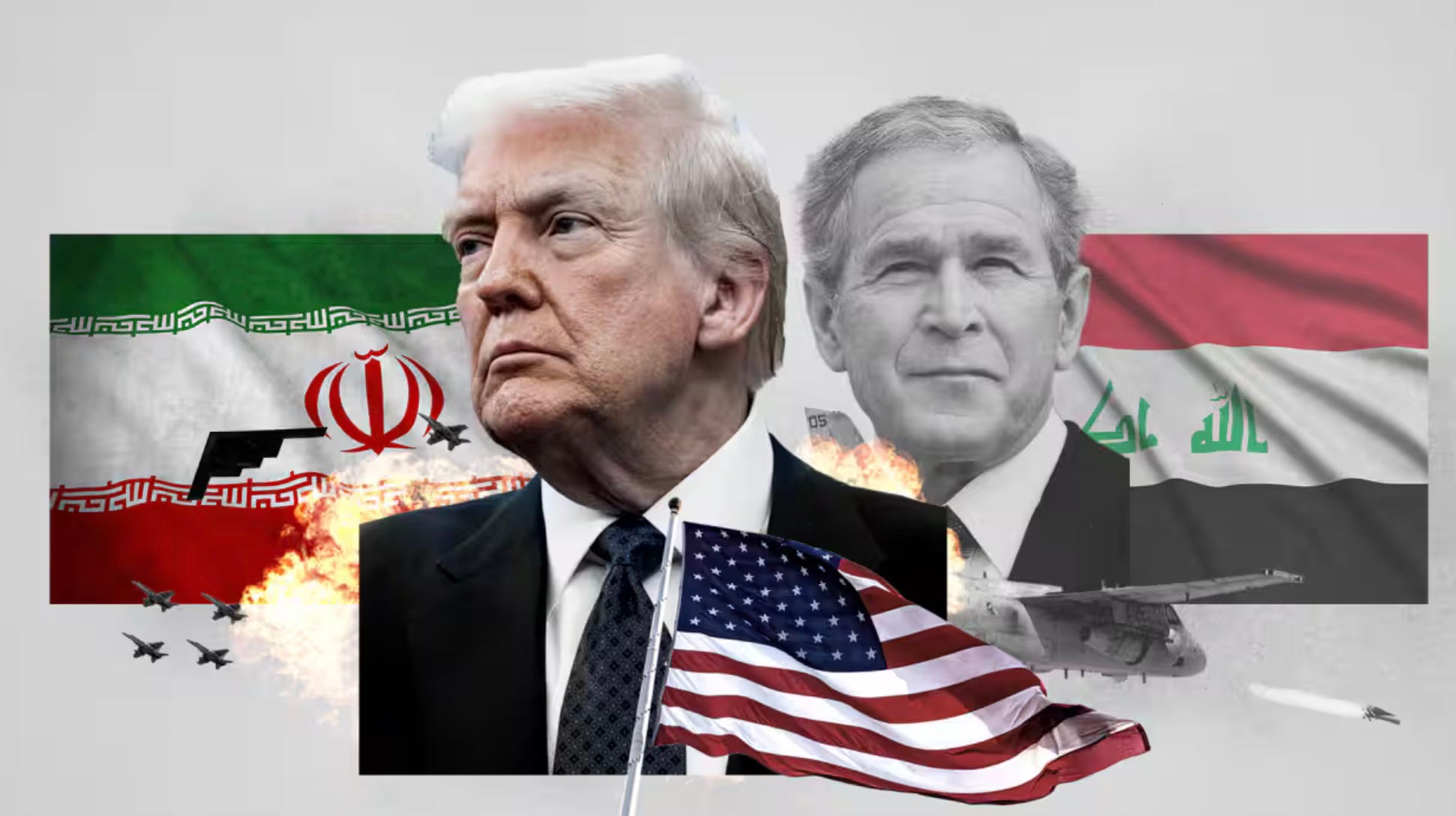
Preventing Peace: America and Israel’s War on Iran
There is a particular exhaustion that comes with invoking international law in 2026. You can feel it before words are even spoken; the slight deflation, the sense that everyone already knows how this goes. The United Nations Charter prohibits the use of force against the territorial integrity of a sovereign state. The UN Security Council did not authorise these strikes. No Article 51 self-defence argument survives contact with the facts: Iran did not attack the United States or Israel. But none of these facts matters and they’ve not mattered for some time. The rules-based international order - that phrase, so beloved of foreign ministers and think-tank reports - was always a set of rules that the powerful followed when it suited them and discarded when it did not. What is new is that the discarding is no longer even disguised. There is no Colin Powell moment, no performance of evidence, no attempt to dress the aggression in the language of legality. There is the assertion, and then there are the bombs. When you do not need the law, you do not need the lie to be convincing. You just need it to be loud.
The aggressor always needs a story, which always comes before the violence. First the fiction is constructed, then the bombs are dropped to make the fiction feel true, and then the destruction itself becomes the proof that the fiction was necessary. This is how it works and how it has always worked.
The lie this time is that diplomacy was tried and failed, that Iran was given every chance to come to the table and refused, and that the United States was left with no choice but to act. As explosions rocked Tehran and Isfahan, the American president announced that the United States had begun “major combat operations” in Iran (The Guardian, 2026). His Israeli counterpart called it a “preventative” strike (The Guardian, 2026).
Consider the word. Preventative. They had started a war, they explained, to prevent a war. They were bombing a country to save its people. They called it “Operation Epic Fury.” Within hours, the supreme leader of Iran, Ayatollah Ali Khamenei, was dead, along with his daughter, son-in-law, and granddaughter, and the head of the Revolutionary Guards. Trump announced the killing on Truth Social: “Khamenei, one of the most evil people in history, is dead” (Roth and Burke, 2026). Iranian media reported 201 people killed and 747 injured in the opening salvo, including more than 100 children at a school (Roth and Burke, 2026). So, this is what prevention looks like. But the negotiations had not failed; Iran had not walked away. At the moment the bombs began to fall, a deal was on the table (Wintour, 2026), and the American president chose to set fire to it. The language does the work that evidence cannot. It constructs a version of events in which violence was the last resort, when in reality it was the first preference. The story comes first. The bombs follow. And by the time the smoke clears, the story is all that remains.
We must be precise about the nature of this logic. It is one of a superpower that has always needed the world to conform to its will, and that has always been willing to lie to make it so. The invasion of Iraq. The torture chambers of Abu Ghraib. The slow, deliberate dismantling of the idea that governments owe their citizens the truth. The manufacture of pretexts to justify force is the oldest habit of American power. What Rumsfeld and Cheney pursued through doctrine, legal memos, and carefully constructed performances of evidence, Trump pursues through instinct. The neoconservative project required justification; Trump has stripped it of the need. He is not a departure from that tradition; he is its completion. Donald Trump is its most accomplished American practitioner. His entire political career has been a sustained assault on the principle that facts exist independent of his will. The bombing of Iran is the violent culmination of a worldview that has always been at the heart of his power: the aggressor’s demand that the world accept his right to use force, and that any part of it which refuses - a city, a people, a fact - will be bombed into submission.
The Ghost of Baghdad
To understand the logic of this “preventative” war, we must look back to another moment of American unreality: the 2003 invasion of Iraq. The script is the same. The actors are only slightly changed. In January 2003, President George W. Bush stood before the United States Congress to warn of a “grave danger” from a dictator armed with weapons of mass destruction (Bush, 2003). Twenty-three years later, in the same chamber, President Trump used his State of the Union address to paint a strikingly similar narrative: a rogue regime, a looming nuclear threat, and a ticking clock (Al Jazeera, 2026).
In 2003, Secretary of State Colin Powell, a man whose credibility was the administration’s most valuable diplomatic asset, stood before the United Nations and presented what he was assured was irrefutable intelligence. There were satellite photographs, elaborate charts, and intercepted communications. It was a performance, a carefully constructed theatre of evidence designed to give the veneer of legitimacy to a pre-ordained decision. Powell would later call the speech a “great intelligence failure” and describe it as a “blot” on his record (PBS Frontline, 2016). The war it helped justify killed hundreds of thousands of people (Iraq Body Count, 2023), destabilised an entire region, and generated the conditions for the rise of the Islamic State. The lie had consequences that are still being counted.
We know now that it was all a lie. There were no weapons of mass destruction. The intelligence was faulty, manipulated, and cherry-picked to fit the desired narrative. And twenty-three years later, the ghost of that lie haunts the skies over Iran. Once again, an American president speaks of a looming threat. In his State of the Union address just days before the attack, Trump claimed that Iran was “working on missiles that will soon reach” the United States (Trump, 2026). He spoke of a nuclear program being rebuilt, of a regime that posed an existential threat to America and its allies. But just as in 2003, the intelligence community does not support the president’s narrative.
Reuters reported that Trump’s claim about Iranian missiles was not backed by US intelligence reports, and appeared to be exaggerated, according to three sources familiar with those reports (Landay, Pamuk and Slattery, 2026). The Defense Intelligence Agency had assessed as recently as 2025 that Iran would not have a militarily viable intercontinental ballistic missile until 2035 at the earliest. The New York Times confirmed that three American officials with access to current intelligence said that Trump had exaggerated the immediacy of the threat (Mazzetti et al., 2026). The Wall Street Journal reported that Iran faces significant technological challenges to develop an ICBM capable of striking the American homeland, a conclusion supported by independent experts including former UN nuclear inspector David Albright (Wall Street Journal, 2026). Even Trump’s own Secretary of State, Marco Rubio, offered a far more cautious formulation, saying only that Iran was “on a pathway to one day” being able to develop such weapons - a statement that is the precise opposite of the imminent threat the president described.
The lie is not even well-constructed this time. It is lazy, arrogant, and confident in the knowledge that the truth no longer matters. In 2003, the Bush administration at least went through the motions of building an evidentiary case, however fraudulent. In 2026, the Trump administration does not bother. The president makes a claim that his own intelligence agencies contradict, and the bombs fall anyway. This is what a decade of manufactured justification produces: a government so accustomed to operating in its own constructed universe that it no longer feels the need to reconcile its assertions with the facts. The doctrine of preventative war - the right to attack a country not for what it has done, but for what it might do - is, in its purest form, the doctrine of the aggressor’s reality. It is the claim that one nation reserves the right to determine which other nations may arm themselves, which may defend themselves, and which must simply accept the violence that is done to them. It is the logic of a world in which force is governed not by law, but by ownership.
The Neoconservative Without the Disguise
Trump was never the outsider he claimed to be. Strip away the rhetoric, the rallies, the performative chaos, and what you are left with is something far more familiar: a neoconservative fantasy.
Because what figures like Donald Rumsfeld and Dick Cheney pursued through doctrine and justification, Donald Trump has pursued through instinct. The end result converges: a presidency unrestrained by international norms, impatient with alliances, and dismissive of the legal architecture that once governed American power abroad. Where the Bush-era project wrapped itself in the language of pre-emption and security, Trump dispensed with the script entirely. No need for careful legal framing or coalition-building. No need to even pretend that international law matters. Power, in his framing, is its own justification.
This is what makes him so useful, and so quietly aligned, with the neoconservative worldview. He normalises what they had to argue for. The erosion of international law, once controversial, becomes ambient. Drone strikes, targeted assassinations, treaty withdrawals - these are no longer debated as exceptional acts but absorbed into the background noise of governance.
Subscribe to Notes From Plague Island and join our growing community of readers and thinkers.
Trump reveals something uncomfortable: that the post-Cold War “rules-based order” was always more fragile than advertised. Not because Trump broke it, but because he exposed how easily it could be ignored. The newspapers are full of mourning for this order. But we should be honest about what we are mourning. Did the rules-based international order ever truly exist? Not for the powerful. The rules applied to the weak, they always did. The United States invaded Iraq without a Security Council resolution. It ran secret torture programmes in black sites across the globe. It overthrew elected governments in Iran, Chile, Guatemala, and beyond. It maintained the largest nuclear arsenal on earth while threatening other nations for attempting to acquire a fraction of that capability. The rules-based order was not a system of equal constraint, but a story the powerful told about themselves to make their dominance appear principled rather than merely convenient. What Trump ended was not the order, but its veneer. He removed the requirement that the powerful at least perform compliance with the rules they wrote for everyone else. Rather than the disease, he is the diagnosis. Rumsfeld and Cheney would have recognised the opportunity immediately. A leader willing to act first, justify later - or not at all. A public desensitised to legal breaches. Institutions too slow, too cautious, or too compromised to respond effectively. It is, in many ways, the logical endpoint of a trajectory they helped set in motion.
Consider the distance between Colin Powell at the United Nations Security Council in 2003 - the satellite photographs, the intercepted communications, the vials, the global audience, the performance of legitimacy - and Donald Trump announcing the killing of Iran’s supreme leader on Truth Social in 2026. The theatre of justification has been dismantled. The fiction no longer needs a stage. It no longer needs an institution, a formal audience, or even the pretence of evidence. It needs only a post. Powell required the world’s most important diplomatic forum to make his case. Trump required a phone.
The Death of Diplomacy
The fiction of the “preventative” strike is unsupported by intelligence and contradicted by something far more damning: the existence of a deal. In the days before the bombs fell, Badr Albusaidi, the foreign minister of Oman, who had been mediating between Washington and Tehran, made an emergency dash to the American capital. He knew what was coming. He went on CBS and did something extraordinary for a diplomat: he revealed the terms of the agreement that was taking shape. Iran had agreed to zero stockpiles of highly enriched uranium, down-blend its existing stockpile inside Iran, and permit full verification access for the International Atomic Energy Agency. It had even opened the door to American weapons inspectors on Iranian soil. A final agreement on principles, Albusaidi said, could be signed that week. The details of verification might take another three months. A peace agreement was within reach (Wintour, 2026).
A peace agreement was within reach. And the American president chose war.
Albusaidi was not permitted to see Trump. He was allowed only to meet the vice-president, JD Vance, to make his case. The mediator was kept from the decision-maker and shown to a side room while the bombs were loaded. This was the deliberate murder of diplomacy. The talks were a stage prop, a performance of reasonableness designed to make the eventual violence seem like a last resort. Trump’s own special envoy, Steve Witkoff, revealed the truth of the administration’s posture when he said that the president was “surprised Iran had not yet capitulated” (Wintour, 2026). The language of unconditional surrender, applied to a country that was, at that very moment, offering historic concessions at the negotiating table.

But even capitulation would not have been enough. Consider what was actually being demanded. Iran was expected to surrender its nuclear programme, dismantle its missile defences, and abandon its regional allies - in other words, to strip itself of every meaningful capacity for self-defence. And in return for this total disarmament, what guarantee was offered? None. Israel, the state that has bombed Iran twice in the space of a year (Wintour, 2026), would retain its undeclared nuclear arsenal, its air force, and its demonstrated willingness to strike whenever it chooses. The deal on offer was the assertion of a monopoly: we decide who is allowed to possess the means of violence, and who is not. Iran must disarm. Israel keeps its nuclear arsenal. America keeps its carrier groups in the Arabian Sea. The right to use force is not distributed equally; it belongs to those who already hold it, and the role of diplomacy is to make the dispossession look consensual. This was the demand that Iran accept its place at the bottom of a hierarchy enforced by bombs.
Behind the language of prevention lies the real objective: regime change. Trump no longer bothers to disguise it. “This is the single greatest chance for the Iranian people to take back their Country,” he wrote on Truth Social (Roth and Burke, 2026). Netanyahu, in his evening address, called on Iranians to “flood the streets and finish the job” (Roth and Burke, 2026). The implication is not subtle, and neither is it really an implication. It is an instruction, issued by the men who just killed a country’s leadership, to the survivors: do what we want, or we will keep bombing. But we should be clear about what regime change means in the vocabulary of American power. It does not mean and never has meant liberation. It did not mean liberation in Iraq, where the toppling of Saddam Hussein produced a decade of sectarian carnage, hundreds of thousands dead (Iraq Body Count, 2023), and the rise of the Islamic State. It did not mean liberation in Libya, where the removal of Gaddafi left a failed state and open-air slave markets (CNN, 2017).
No, regime change in the American lexicon means the installation of a government that is compliant — one that serves the strategic and economic interests of Washington and Tel Aviv, regardless of what it does to its own people. In 1953, the CIA orchestrated a coup that overthrew Mohammad Mossadegh, the democratically elected prime minister who had dared to nationalise Iranian oil, and installed the Shah - a compliant autocrat who ruled with the help of SAVAK, one of the most feared secret police forces in the Middle East. The Iranians have already lived through America’s version of freedom. It came with torture chambers and a monarch who answered to Washington. The call to “take back their Country” is not an invitation to self-determination. The role of leader has already been written; the only question is which compliant face will fill it. The Iranian civilians whose suffering Trump invokes as justification are the collateral of this project. They always have been.
This was not the first time. In June 2025, Israel, with the United States later joining, launched a ten-day attack on Iran just three days before the two sides were due to meet for a sixth round of nuclear talks. So, the pattern is a strategy: attack during negotiations, destroy the possibility of a deal, then claim that diplomacy failed and that force was the only option. As one Iranian Telegram channel put it: “Once again the US attacked while Iran was pursuing diplomacy. Once again diplomacy does not work with the terrorist state of the US” (Wintour, 2026). The aggressor poisons the well so thoroughly that peace becomes impossible, and then points to the poisoned well as proof that there was never any water.
What is perhaps most extraordinary is that Trump himself, prior to the attacks, made next to no attempt to articulate or justify his actions to the American people, to Congress, or to his allies (Wintour, 2026). There was no address to the nation. There was no presentation of evidence. There was no vote. The most consequential act of American foreign policy in a generation was launched in silence, as though the consent of the governed were an irrelevance, a formality from a bygone era that no longer applied.
And then, after the bombs fell, the word “negotiate” was deployed one final time. In a rare joint statement, the leaders of France, Germany, and the United Kingdom urged Iran to “seek a negotiated solution” (Ferguson, 2026). They condemned Iran’s retaliatory strikes. They did not condemn the American and Israeli strikes that provoked them. The country that was bombed while offering a deal was told to come back to the table. The countries that did the bombing were not asked to explain themselves. This is what the word “negotiate” means in the vocabulary of the monopoly: accept what has been done to you. The aggressor strikes, and the victim is told to be reasonable. The house is burned down, and the arsonist’s allies ask the homeowner to discuss fire safety.
The Humanitarian Mask
The 2026 version of this doctrine contains a deeper, more cynical inversion than anything that came before it. The American president now cloaks his aggression in the language of humanitarianism. The lie begins not with a threat, but with a claim of compassion. Trump has claimed that the Iranian regime killed 32,000 protesters, a figure significantly higher than any independent estimate, and one that Iran’s foreign ministry dismissed as “big lies” (CBS News, 2026). The inflation of the figure is the same technique deployed in every authoritarian project: exaggerate the evil of the enemy to the point where any response seems proportionate.
This rhetorical sleight of hand obscures a real and terrible truth. The government in Tehran is a brutal theocracy. In September 2022, a twenty-two-year-old Kurdish woman named Mahsa Amini died in the custody of Iran’s “morality police” after being arrested for allegedly wearing her hijab improperly. Her death ignited a nationwide uprising, the “Woman, Life, Freedom” movement, which spread to every corner of the country and represented the most serious challenge to the Islamic Republic since its founding. The regime’s response was savage. We see it in the hundreds of protesters shot in the streets; the tens of thousands arrested; the UN estimate that the number of civilians killed in the crackdown may exceed 20,000 (Iran International, 2026); the 1,000 people executed in 2025 alone. A deliberate campaign of terror designed to extinguish any remaining ember of resistance (Amnesty International, 2025).
This suffering is real. The evil of the regime is real. The women who risked their lives in the streets of Tehran and Mashhad and Zahedan were fighting for freedoms that the rest of the world takes for granted. They deserve our solidarity, our support, and our witness. What they do not deserve is to be used as a justification for bombing the cities they live in. More than 100 children were killed in a single school in the opening hours of this war (Roth and Burke, 2026). Netanyahu told the survivors to “flood the streets.” This is the humanitarian mask, and it is the most dishonest thing about this war. To claim you are saving a people while killing their children is a form of moral derangement so profound it requires a new vocabulary to describe. It is the logic of an abuser who beats his victim and calls it love. The Iranian civilians, already trapped by a murderous regime, now find themselves “saved” by a foreign power that kills them from the sky. They are a prop in a drama of American power, their real lives and deaths an inconvenient detail in a story about American righteousness. And in the final act of this cruelty, the moment the bombs began to fall, Iran’s mobile phone services were cut, and its airspace was closed (The Guardian, 2026). The information vacuum was created before the dust had settled. The people whose liberation was being announced were silenced. They were made invisible.
The Alliance of Moral Nullification
This moral inversion is made possible by the company America now keeps. The partner in this “preventative” war is a state against which the International Court of Justice has found a plausible case of genocide, sufficient to order provisional measures (International Court of Justice, 2024). As Israeli jets strike Iran, its armies are systematically erasing the people of Gaza. For more than two years, the world has watched a relentless campaign of destruction. As of February 2026, the death toll in Gaza has surpassed 75,000 people, with a Lancet study estimating the true figure, accounting for indirect deaths from disease and starvation, to be far higher (The Guardian, 2026; Al Jazeera, 2026). This is a war against a society. If you bomb a hospital, like Al-Shifa and Al-Quds, then you are not fighting soldiers. If you destroy a university, then you are not fighting soldiers. If you target journalists and aid workers, then you are not fighting soldiers. If you create a famine - a medieval tactic of siege warfare deployed in the 21st century - then you are not fighting soldiers. If your defence minister calls an entire people “human animals” (Gallant, 2023), he gives permission for any atrocity to follow.
The same military that has done all of this is now presented as a credible partner in a mission to secure peace and protect civilians. The genocide in Gaza and the “humanitarian” war in Iran are presented as part of the same coherent moral project, because in the reality that Trump and his allies have constructed, they are. In that reality, the lives of Palestinians do not count. The suffering of Iranian civilians will not count either, once the bombs begin to fall in earnest. What counts is the will of the aggressor, and the willingness of the world to accept his version of events.
To stand with a state committing genocide and claim to be acting on humanitarian grounds is to declare that morality itself is meaningless. It is to enter a realm of pure power, where the only principle is that those who hold the monopoly of violence may do as they wish, and those who do not must suffer what they must. The United States, by joining Israel in this act, has not only become a co-aggressor in a new war but has also made itself an accomplice in an existing one. It has laundered the unreality of the Gaza genocide through the unreality of the Iran strike. The two lies reinforce each other, creating a fortress that is impervious to fact, to reason, and to human decency. This is the alliance of moral nullification.
The Terminal Velocity of the Lie
The machinery of justification is not new. It has been growing within the body of Western democracy for a generation, fed by the lies of the Iraq war, the torture that was rebranded as “enhanced interrogation,” the surveillance that was rebranded as “security,” and the slow, steady erosion of the principle that governments are accountable to facts. What Trump has done, across two terms in office, is accelerate the logic of lies to terminal velocity. He has taken the tools that were always present in the arsenal of power - the manufactured threat, the humanitarian pretext, the information vacuum, the dehumanisation of the enemy - and deployed them with a shamelessness and a consistency that has normalised them. The result is a dishonest government that has made honesty structurally irrelevant.
This is the most dangerous thing about the lie that protects the monopoly. It does not need to convince; only to exhaust. When the president can assert, without evidence, that Iran is building missiles that can hit America, and when that assertion is sufficient to launch a war, then the entire framework of democratic accountability - the hearings, the intelligence assessments, the congressional debates, the independent journalism - has been rendered decorative. It exists, but it no longer functions. Congress did not debate this war. The intelligence agencies were overruled. The allies were informed, not consulted. The form of democracy remains. The substance has been evacuated. The institutions stand, but they are hollow - a stage set for the performance of a power that no longer answers to them.
And there is a second function to this war, one that is older than any doctrine of pre-emption. War demands unity. War demands that a nation put its differences aside and rally behind its leader. The moment the first bomb falls, every other conversation stops. The tariffs that are hollowing out the American middle class. The Epstein files that implicate the powerful. The dismantling of federal agencies by unelected technicians. The questions about who is really governing and in whose interest. All of it vanishes behind the flag. “Support the troops” becomes “stop asking questions.” The war does not merely distract from the damage Trump is doing at home; it makes the damage unmentionable. To raise it is to be unpatriotic. To question the president during wartime is to give comfort to the enemy. This is the oldest trick in the authoritarian playbook: when the walls are closing in, start a war, and watch the domestic opposition fold itself into silence. The bombs falling on Tehran are also falling on every inconvenient truth in Washington.
And the world is learning the lesson. The doctrine of preventative war, once unleashed, teaches every nation on earth the same thing: the only true security lies in obtaining the very weapons that invite a “preventative” strike. It tells North Korea that its nuclear arsenal was the right decision. It tells every state that has so far refrained from pursuing nuclear weapons that it has been naive. If the only thing that deters a superpower is the threat of mutual annihilation, then every nation that wishes to survive must seek that threat. But there is a third consequence, and it is the one that history teaches most brutally. When you destabilise a country, you do not control what comes next. You never have. The invasion of Iraq did not produce democracy. It produced a power vacuum that gave birth to the Islamic State, which tore through Syria, triggered the largest refugee crisis since the Second World War, destabilised European politics, and fuelled the rise of the far right across the continent. The collapse of Libya did not produce freedom. It produced a failed state, open-air slave markets, and a Mediterranean crossing that became a mass grave for thousands of people whose names we will never know. Syria’s civil war scattered millions of refugees across the Middle East and Europe and handed Russia a permanent military foothold in the region. Every one of these catastrophes was an unintended consequence of a war launched on a lie. And now the same people, using the same methods, are doing it to Iran — a country of 88 million people, far larger and more complex than Iraq or Libya, with ethnic minorities that span multiple borders, sitting on one of the most critical oil chokepoints on earth. If Iran fragments, the consequences will make Iraq look like a rehearsal. The refugee flows, the sectarian violence, the power vacuums, the regional wars; none of it will be contained or controlled. And none of it will be the problem of the men who gave the order to bomb.
This is the world that Trump and Netanyahu are building with their bombs. Not a safer world. A more armed one. A more paranoid one. A more broken one. A world where the United Nations Charter is treated a quaint suggestion, and where the right to use force belongs permanently to those who already hold it. The international order is not merely being bent here. It is being broken.
The Ending They Did Not Write
None of this is for the people of Iran. The destruction of Iran’s military capacity serves one purpose above all others: the removal of the last meaningful deterrent to Israel’s expansion. With Iran broken, there is no force in the region capable of challenging what Israel is building — the annexation of the West Bank, the permanent occupation of Gaza, the seizure of territory in southern Lebanon, the military presence in Syria that grows with each passing month. The Middle East is being remade in the image of Israel, and America is holding the door open. The word for this, in Israel’s own political vocabulary, is Greater Israel. For Trump, the motivation is closer to home. A wartime president does not face scrutiny over tariffs that are gutting the middle class, or the dismantling of federal agencies. A wartime president does not answer questions about Jeffrey Epstein, or face the fact that his own name appears in those files. A wartime president sets the conditions under which midterm elections become a question of patriotism rather than policy — if they happen at all. The people of Iran are not the point. They are the price.
We can see the plot. We can recite the script. We have watched it performed in Iraq, in Libya, in Syria. The powerful state identifies a threat. The threat is inflated or invented. The bombs fall. The regime collapses. The victors announce a new dawn. And then the ending arrives - the one that was not in the script, the one that no one planned for, the one that makes the authors of the war wish they had never started it.
The people who orchestrated the 1953 coup against Mohammad Mossadegh thought they had won. They had removed a democratic leader who had dared to nationalise Iranian oil, and they had installed a compliant monarch who would do as he was told. The Shah ruled for 26 years. He ruled with American weapons, American money, and American approval. And then, in 1979, the Iranian people rose up and swept him away, and in his place came the Islamic Republic - the very regime that America and Israel are now bombing. The men who overthrew Mossadegh did not intend to create the Islamic Revolution. But they did. Actions have reactions. Maybe not today, not tomorrow, not next week… but they come. And when they come, they are never what the aggressor expected.
The invasion of Iraq was supposed to produce a democratic ally in the heart of the Middle East. It produced ISIS. The destruction of Libya was supposed to end a dictatorship. It instead produced a failed state and a migration crisis that reshaped European politics for a generation. Every act of imperial hubris carries within it the seed of its own unravelling. None of it was planned; none of it was the problem of the men who gave the order.
Somewhere in Tehran tonight, the phones are dead and the sky is on fire. The people there cannot tell us what is happening to them. That silence is the point. The aggressor needs the silence, because the silence is where the lie lives.
But no one in Washington or Tel Aviv can predict what comes next. That is the lesson America has never learned and never will. America spent twenty years in Afghanistan. Two trillion dollars. Hundreds of thousands of lives. And the Taliban walked back in within weeks of the last American soldier leaving, as if the twenty years had never happened. America is not a nation-builder. It is a nation-remover. It is good at the destruction and catastrophically unprepared for the shadows the destruction casts. Those shadows are where ISIS was born. They are where the migration crisis was born. They are where the next thing - the thing no one has named yet - is being born right now, in the rubble of Tehran and Isfahan, in the grief of families who had nothing to do with any of this. America will not see it coming. It never does. When it arrives, the question will be the same one it always is, asked in the same tone of genuine bewilderment: why do they hate us?
Or support us with a one-off tip → Buy Me a Coffee
References
Al Jazeera (2026) Gaza death toll exceeds 75,000 as independent data verify loss, 18 February. Available at: https://www.aljazeera.com/features/2026/2/18/gaza-death-toll-exceeds-75000-as-independent-data-verify-loss [Accessed: 26 February 2026].
Al Jazeera (2026) How Trump’s 2026 Iran ‘war’ script echoes and twists the 2003 Iraq playbook, 26 February. Available at: https://www.aljazeera.com/news/2026/2/26/how-trumps-2026-iran-war-script-echoes-and-twists-the-2003-iraq-playbook [Accessed: 27 February 2026].
Amnesty International (2025) Iran: Over 1,000 people executed as authorities step up horrifying assault on right to life, 26 September. Available at: https://www.amnesty.org/en/latest/news/2025/09/iran-over-1000-people-executed-as-authorities-step-up-horrifying-assault-on-right-to-life/ [Accessed: 26 February 2026].
Bush, G.W. (2003) State of the Union Address to Congress, 28 January. Transcript available at: https://georgewbush-whitehouse.archives.gov/news/releases/2003/01/20030128-19.html [Accessed: 26 February 2026].
CBS News (2026) Iran reacts to Trump’s 2026 State of the Union, accusing him of ‘big lies’, 25 February. Available at: https://www.cbsnews.com/news/iran-reaction-trump-2026-state-of-the-union-claims-big-lies-nuclear-program/ [Accessed: 27 February 2026].
CNN (2017) People for sale: Where lives are auctioned for $400, 14 November. Available at: https://edition.cnn.com/2017/11/14/africa/libya-migrant-auctions/index.html [Accessed: 26 February 2026].
Conway, K. (2017). Interview on Meet the Press, NBC News, 22 January. Available at: https://www.nbcnews.com/storyline/meet-the-press-70-years/wh-spokesman-gave-alternative-facts-inauguration-crowd-n710466 [Accessed: 26 February 2026].
Ferguson, D. (2026) France, Germany and UK urge Iran to ‘negotiate solution’ after attack. The Guardian, 28 February. Available at: https://www.theguardian.com/world/2026/feb/28/uk-france-germany-urge-iran-negotiate-solution-us-israel-attack-europe [Accessed: 28 February 2026].
Gallant, Y. (2023) Statement as Israeli Defense Minister, 9 October 2023. Reported by The Times of Israel. Available at: https://www.timesofisrael.com/liveblog_entry/defense-minister-announces-complete-siege-of-gaza-no-electricity-food-or-fuel/ [Accessed: 27 February 2026].
International Court of Justice (2024) Application of the Convention on the Prevention and Punishment of the Crime of Genocide in the Gaza Strip (South Africa v. Israel), Order of 26 January 2024. Available at: https://www.icj-cij.org/case/192 [Accessed: 26 February 2026].
Iraq Body Count (2023) Documented civilian deaths from violence. Available at:
https://www.iraqbodycount.org/
[Accessed: 27 February 2026].
Iran International (2026) Iran protest crackdown toll may top 20,000, UN rapporteur says, 22 January. Available at: https://www.iranintl.com/en/202601223433 [Accessed: 26 February 2026].
Kessler, G., Rizzo, S. and Kelly, M. (2021) Trump’s false or misleading claims total 30,573 over 4 years. The Washington Post, 24 January. Available at: https://www.washingtonpost.com/politics/2021/01/24/trumps-false-or-misleading-claims-total-30573-over-four-years/ [Accessed: 27 February 2026].
Landay, J., Pamuk, H. and Slattery, G. (2026) Trump Iranian missile claim unsupported by U.S. intelligence, say sources. Reuters, 27 February. Available at: https://www.reuters.com/business/aerospace-defense/trump-iranian-missile-claim-unsupported-by-us-intelligence-say-sources-2026-02-27/ [Accessed: 28 February 2026].
Mazzetti, M., Wong, E., Sanger, D.E. and Barnes, J.E. (2026) Fact-check: In Trump’s Case for an Attack on Iran, False or Exaggerated Claims. The New York Times, 26 February. Available at: https://www.nytimes.com/2026/02/26/us/politics/trump-iran-claims-nuclear-weapons.html [Accessed: 27 February 2026].
Roth, A. and Burke, J. (2026) Iran state media confirms killing of Ayatollah Ali Khamenei following US-Israeli missile strikes. The Guardian, 1 March. Available at: https://www.theguardian.com/us-news/2026/feb/28/khamenei-likely-killed-us-israel-iran-strikes [Accessed: 1 March 2026].
PBS Frontline (2016) Colin Powell: U.N. Speech “Was a Great Intelligence Failure”, 17 May. Available at: https://www.pbs.org/wgbh/frontline/article/colin-powell-u-n-speech-was-a-great-intelligence-failure/ [Accessed: 26 February 2026].
The Guardian (2026) Gaza death toll for first 16 months of war far higher than reported, 19 February. Available at: https://www.theguardian.com/world/2026/feb/19/gaza-death-toll-higher-than-reported-lancet-study [Accessed: 27 February 2026].
The Guardian (2026) Trump says US has begun ‘major combat operations’ in Iran after Israel launches strikes — live, 28 February. Available at: https://www.theguardian.com/world/live/2026/feb/28/israel-attacks-iran-as-blasts-heard-in-tehran-live-updates [Accessed: 28 February 2026].
Trump, D. (2026) State of the Union Address to Congress, 25 February. Transcript available at: https://apnews.com/article/trump-state-of-the-union-2026-transcript [Accessed: 28 February 2026].
Wall Street Journal (2026) Iran Is Far from Building ICBMs, Experts Say, Despite Trump’s Warning of a Looming Threat, 27 February. Available at: https://www.wsj.com/world/middle-east/iran-is-far-from-building-icbms-experts-say-despite-trumps-warning-of-a-looming-threat-b079bf72 [Accessed: 28 February 2026].
Wintour, P. (2026) Yet another mid-talks attack jeopardises chances of Iran taking Trump seriously. The Guardian, 28 February. Available at: https://www.theguardian.com/world/2026/feb/28/yet-another-mid-talks-attack-jeopardises-chances-of-iran-taking-trump-seriously [Accessed: 28 February 2026].