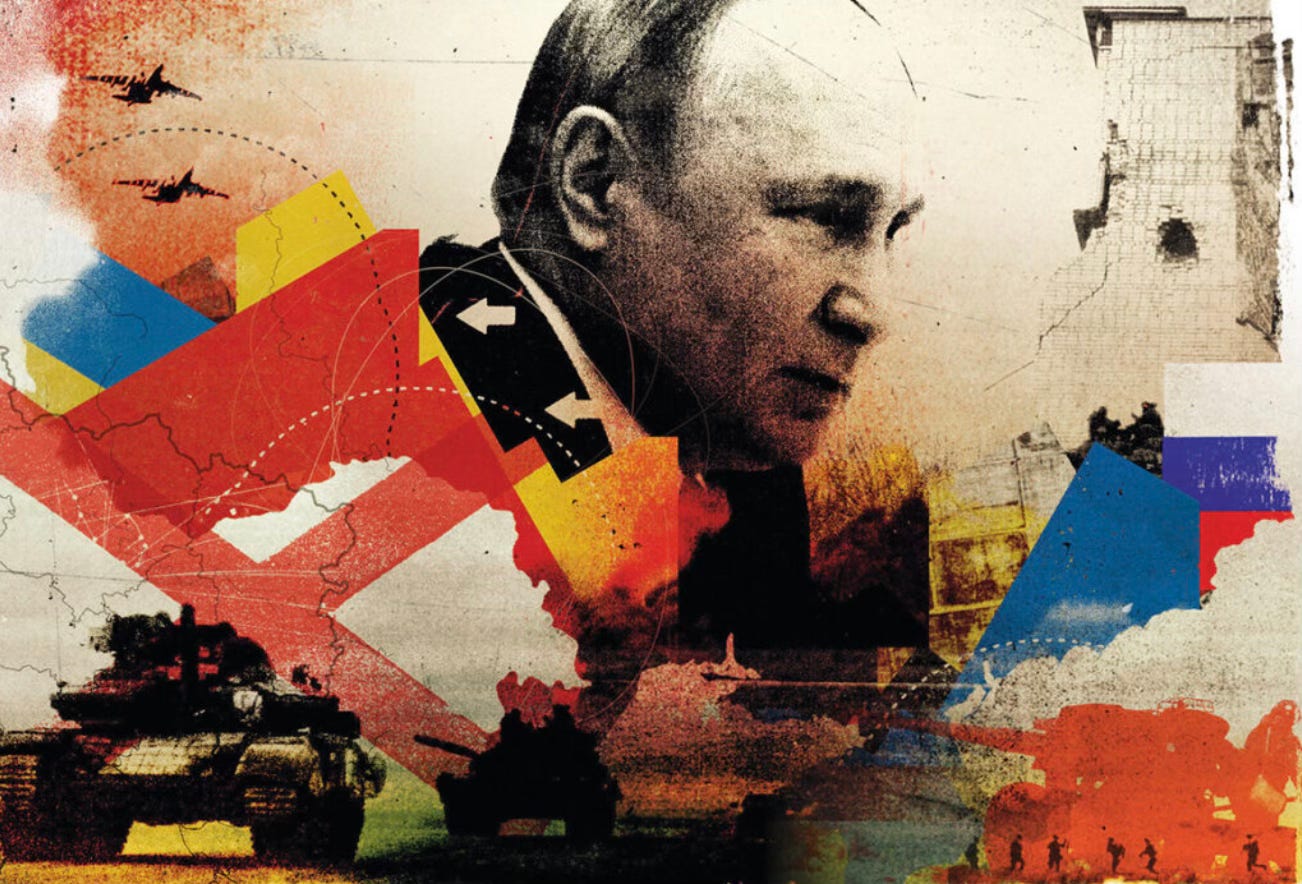
On the Blueprint for Annihilation: Deconstructing Putin’s Historical Fiction

To begin a war of destruction, you must first destroy the truth.
We have previously examined the devastating consequences of Russia’s war on reality. We have seen the ruined cities, the stolen children, the shattered lives, and the geopolitical tremors that followed the full-scale invasion of Ukraine (Plague Island, 2026). We have documented the atrocities that inevitably occur when a state decides that a neighbouring nation does not exist. But to understand the true nature of this authoritarian threat, we must examine how that foundational lie was meticulously constructed. We must look at the blueprint to understand the architecture of the fiction that made the slaughter possible.
On July 12, 2021, exactly seven months before Russian tanks rolled toward Kyiv, Vladimir Putin published a 5,000-word essay. It was titled On the Historical Unity of Russians and Ukrainians (Putin, 2021). Even the title is a weapon. The word “On” does all the heavy lifting before the reader begins. It is the language of the academic treatise — “On Liberty,” “On the Origin of Species” — a framing device that presupposes the existence of its subject. Putin does not title his essay The Case for Historical Unity or Why Russians and Ukrainians Are One People, which would at least acknowledge that an argument needs to be made. He titles it On the Historical Unity… as if the unity is already an established, settled fact, and he is merely offering reflections upon it. The conclusion is smuggled into the premise before the first sentence has been read.
At the time, the essay was dismissed by many Western observers as the rambling of an isolated autocrat with too much time on his hands during a global pandemic. It was treated as a bizarre historical excursion, a piece of amateur scholarship from a former KGB operative playing historian-in-chief. Western diplomats read it, shrugged, and filed it away as domestic political posturing. They assumed it was rhetoric designed for internal consumption, a nostalgic lament for a lost empire rather than a practical guide for future action.
This was a catastrophic failure of imagination. In retrospect, the essay was a glaring, neon-lit declaration of war. What made the failure all the more inexcusable was the context in which the essay appeared. Putin published it in July 2021, in the immediate aftermath of a massive Russian military build-up on Ukraine’s borders that spring — the largest concentration of Russian forces since 2014 — which had only recently been stood down (Dickinson, 2021). The tanks had temporarily retreated but the ideology that would send them back had just been committed to paper.
It was a weaponised narrative; a piece of imperial propaganda designed to erase a sovereign nation from the map. Crucially, it was not meant for academic debate. Just four days after its publication, Russian Defense Minister Sergei Shoigu personally ordered the essay to be added to the compulsory curriculum of the military-patriotic directorate (The Moscow Times, 2021). It was distributed to the Russian military, given to soldiers to tell them why they must kill their neighbours. When a dictator publishes an essay claiming a neighbouring country does not exist and immediately makes it mandatory reading for his armed forces, we must believe him. The destruction of truth always precedes the destruction of people. You cannot mobilise an army to annihilate a brother nation; you must first convince the army that the nation is a phantom, a mistake, a disease.
Putin’s essay is a calculated denial of Ukrainian agency and a cynical distortion of the past, engineered specifically to lay the ideological groundwork for mass slaughter and territorial theft. To read it is to step into a hall of mirrors where facts are inverted, where victims are aggressors, and where empire is disguised as brotherhood. It is a masterclass in the authoritarian use of history, where the past is something to be conquered and occupied, just like physical territory.
The Hijacking of Kievan Rus’ and the “One People” Myth
The core of Putin’s argument is a fabrication: that Russians, Ukrainians, and Belarusians are “one people” descending from Ancient Rus’, bound by language and Orthodox faith, and that any division between them is a tragedy orchestrated by external enemies (Putin, 2021). This is the myth of the “one people.” It sounds, to the untrained ear, like a statement of affection. It is, in fact, a denial of the right to exist. If Ukrainians are simply confused Russians, then Ukraine is not a nation. If Ukraine is not a nation, it has no right to sovereignty. If it has no right to sovereignty, its borders can be erased by force, and its people can be “liberated” from their own identity.
To sustain this myth, Putin must hijack history. He begins with Kievan Rus’, the medieval federation of principalities centred around present-day Kyiv. In Putin’s telling, this was a unified Russian ethno-state, the joint ancestral homeland that makes Kyiv the “mother of Russian cities” (Putin, 2021). He projects the modern concept of the Russian nation backward by a thousand years, claiming a continuous, unbroken lineage from the baptism of Volodymyr the Great in 988 to the modern Russian Federation.
This is a profound distortion. Kievan Rus’ was an increasingly fragmented federation of principalities, not a unified state, and certainly not a “Russian” one in any modern sense (Düben, 2020). It was a multi-ethnic, polyglot trading empire founded by Scandinavian Vikings (the Varangians) who ruled over various Slavic, Finnic, and Baltic tribes. Volodymyr the Great ruled from Kyiv centuries before Moscow was even a clearing in the forest. Moscow claiming ownership over Kyiv’s history is the equivalent of modern Romania claiming ownership of Italy because both trace their lineage to the Roman Empire, or Britain claiming the right to invade Denmark because of shared Anglo-Saxon heritage. It is a retroactive nationalism that makes a mockery of historical reality.
But Putin’s historical fiction requires more than just claiming the medieval past. It requires erasing the centuries that followed. Following the Mongol conquests in the 13th century, the political and cultural trajectories of the Eastern Slavs diverged sharply. The south-western territories of Rus’ — encompassing most of present-day Ukraine — were conquered by Poland and Lithuania in the early 14th century. For roughly four hundred years, these lands were under Polish-Lithuanian rule (Düben, 2020).
During these four centuries, the Orthodox East Slavic population of these lands developed an identity entirely distinct from that of the East Slavs remaining under Mongol and later Muscovite rule. A distinct Ukrainian language had already begun to emerge in the dying days of Kievan Rus’, contradicting Putin’s factually incorrect claim that linguistic differences appeared only around the 16th century (Düben, 2020). Following the incorporation of present-day Ukraine into Poland-Lithuania, the Ukrainian language evolved in relative isolation from the Russian language, absorbing different influences and developing its own distinct vocabulary and grammar.
Crucially, the lands of modern Ukraine were exposed to the intellectual currents of Europe — the Renaissance, the Reformation, and the Counter-Reformation — while Muscovy remained largely isolated. Ukrainian cities enjoyed Magdeburg rights, a form of European urban self-government that fostered a civic culture entirely alien to the autocratic traditions developing in Moscow. At the same time, religious divisions developed within Eastern Orthodoxy. From the mid-15th to the late 17th centuries, the Orthodox Churches in Moscow and Kyiv developed as separate entities (Düben, 2020). The Kyivan clergy, heavily influenced by the intellectual currents of the Polish-Lithuanian Commonwealth, developed a distinct theological and cultural tradition. When the concept of “Great Russia and Little Russia” was first articulated, it was a product of 17th-century Kyivan clergy seeking the protection of the Orthodox Tsar, but their vision was one of distinctiveness and equality between two peoples. Moscow absorbed the language and discarded the equality. It has been doing so ever since (Plokhy, 2017).
Ukraine has a history, a language, and a culture. It has an identity forged over centuries of distinct historical experience. It is not a subset of Russia; it is a parallel development, a different path taken by people who lived at the crossroads of empires.
Putin cannot accept this. To accept it would be to acknowledge that Ukrainians are a separate people with the right to determine their own destiny. Therefore, he must invent a conspiracy. In his essay, Putin treats genuine Ukrainian national identity as an artificial concoction. He claims it is a “disorder of the mind” invented by Poles and Austrians to weaken Russia (Düben, 2020; Plokhy, 2017). He argues that the very word “Ukraine” simply meant “periphery” or “borderland,” and that “Ukrainian” originally referred only to frontier guards (Putin, 2021).
This is deeply insulting. It is the language of the coloniser. It strips forty million people of their history and tells them that their identity is nothing more than a foreign plot. It is a narrative that systematically ignores all manifestations of the historic growth of a distinct Ukrainian nationhood, reproducing a myth of a 1000-year continuity of the Russian nation that has been popular in Russian nationalist circles since the 19th century (Düben, 2023).
The irony, of course, is that the Russian Empire itself recognised the distinctiveness of the Ukrainian identity — and viewed it as a mortal threat. When the Russian Empire eventually absorbed most of modern-day Ukraine in the late 18th century, its imperial authorities systematically persecuted expressions of Ukrainian culture. Catherine the Great dismantled the Cossack Hetmanate, erasing the last vestiges of Ukrainian autonomy. Later Tsars made continuous attempts to suppress the Ukrainian language. In 1863, the Russian Minister of the Interior issued the Valuev Circular, which banned the publication of religious and educational books in Ukrainian, declaring that a separate Ukrainian language “never existed, does not exist, and shall not exist.” This was followed by the Ems Ukaz of 1876, which banned the printing and importation of all books in Ukrainian, as well as the staging of plays and lectures in the language (Plokhy, 2017).
Subscribe to Notes From Plague Island and join our growing community of readers and thinkers.
Putin acknowledges these decrees in his essay, but he dismisses them as defensive responses to the Polish national movement and the intrigues of foreign powers (Putin, 2021). He cannot admit the obvious truth: that the Russian Empire treated the Ukrainian language as a matter of state security because it recognised the reality of a separate Ukrainian identity. You do not need to ban a language that does not exist. You do not need to suppress a culture that is identical to your own. The very ferocity of Russian imperial repression is the greatest proof of Ukrainian distinctiveness.
The Hypocrisy of “Stolen” Lands and the Bolshevik Blame Game
The myth of the “one people” is the foundation of the war. It is the lie that makes the killing possible. But it is only the first part of Putin’s historical fiction. To justify the dismemberment of the Ukrainian state, he must also invent a grievance about its borders. He must blame the Bolsheviks.
In the Kremlin’s telling, modern Ukraine is an accident of history, a mistake made by communists. Putin’s essay devotes significant space to a bizarre and hypocritical grievance: that the Bolsheviks “robbed” Russia by drawing arbitrary borders and giving away “primordially Russian territories” to the Ukrainian Soviet Socialist Republic (Putin, 2021).
He calls the right of Soviet republics to secede “Lenin’s most dangerous time bomb” (Putin, 2021). He claims that the south-eastern regions of Ukraine — the Donbas, the Black Sea coast — were handed over with no consideration for the ethnic make-up of the population. He concludes that “modern Ukraine is entirely the product of the Soviet era” (Putin, 2021).

The idea that the borders were drawn arbitrarily is a lie. The eastern borders of Ukraine were formally drawn in 1919-1924 as the boundaries of the Ukrainian SSR. The first Soviet census in 1926, conducted shortly after these borders were finalised, clearly showed Ukrainian majorities in these south-eastern territories (Düben, 2020). The claim that these were “primordially Russian territories” is preposterous. There was no substantial Russian presence in the “historical South of Russia” prior to the 19th century. During the Polish-Lithuanian era, these territories were known as the “Wild Fields,” a sparsely populated no-man’s-land inhabited primarily by nomadic Turkic peoples and later by Ukrainian Cossacks. When settlement began in earnest in the 19th century, the ethnic make-up was highly diverse, including Ukrainians, Russians, Greeks, Bulgarians, and Germans. The cities at the centre of the current conflict, Luhansk and Donetsk, were not founded by Russian imperialists. They were founded in 1795 and 1869 by British industrialists Charles Gascoigne and John Hughes, respectively (Düben, 2020).
The preponderance of Russian speakers in certain parts of eastern and southern Ukraine today is not proof of primordial Russianness. It is the legacy of Russian imperial rule, deliberate colonisation, and the cruel consequences of Stalinist ethnic cleansing (Düben, 2023). It is the result of the Holodomor — the man-made famine of 1932-33 engineered by Joseph Stalin that killed between three and five million Ukrainians (Düben, 2020). The Holodomor was a targeted genocide designed to break the back of the Ukrainian peasantry, which Stalin viewed as the core of the Ukrainian national movement. Following the famine, the Soviet state engaged in the “Executed Renaissance,” systematically murdering a generation of Ukrainian writers, artists, and intellectuals. After the Ukrainian population of these regions was decimated by starvation and purges, the Soviet state repopulated the empty villages and industrial cities with ethnic Russians.
To use the demographic results of imperial violence and genocide as a justification for further imperial violence is the logic of a monster. It is the equivalent of a murderer claiming ownership of a house because he killed the previous occupants and moved his own family in. Putin’s narrative demands that we ignore the graves beneath the soil and focus only on the language spoken by those who were brought in to replace the dead.
This demographic engineering laid the groundwork for the pseudo-legal arguments that followed. Putin’s argument is intended to be legally useful. He echoes the twisted, mafia-style logic of his former political mentor, Anatoly Sobchak, the former mayor of St. Petersburg. Putin argues that when a republic leaves the Soviet Union, it must “take what [it] brought with [it]” and that all other territorial acquisitions are “subject to discussion” (Putin, 2021).
There is one fact that exposes the entirety of Putin’s border grievance as bad faith, and it is this: Russia signed it away. In December 1994, Russia was a co-signatory to the Budapest Memorandum, a formal international commitment in which Russia, the United States, and the United Kingdom explicitly guaranteed Ukraine’s sovereignty and territorial integrity in exchange for Ukraine surrendering the world’s third-largest nuclear arsenal — over 1,900 strategic warheads inherited from the Soviet Union (Plokhy, 2017). Ukraine gave up nuclear weapons on the basis of a solemn promise from Moscow that its borders would be respected. Putin’s Russia then annexed Crimea in 2014 and launched a full-scale invasion in 2022. The man who complains about the injustice of Soviet-era borders is the same man who signed a guarantee to respect those borders and then tore it up. The grievance is a pretext.
This is a transparent justification for violent expansionism, and the intellectual scaffolding for the annexation of Crimea and the invasion of the Donbas. It establishes a principle that borders are not fixed by international law, treaties, or the democratic will of the people who live within them but are subject to the historical grievances of the stronger power. It is a formula for endless war. If borders can be redrawn based on the perceived historical injustices of the 1920s, then no border in Europe is safe. If the map of Europe is to be redrawn according to the imperial high-water marks of the past, then the entire continent will drown in blood. The borders of Finland, Poland, Estonia, Latvia, Lithuania, Moldova, and Georgia — all nations that once fell under the shadow of the Russian Empire — are suddenly open to question (Dickinson, 2025). Putin himself made this chillingly clear when he remarked, “Wherever a Russian soldier sets foot is ours” (Dickinson, 2025).
The “Anti-Russia Project” and the Erasure of Agency
If Ukraine is not a real nation, and its borders are not real borders, how does Putin justify the undeniable reality of Ukrainian resistance? How does he interpret the millions of people who took to the streets in 2004 and 2014 to demand a European future? How does he articulate the army that fought the Russian invasion to a standstill? How does he explain a population that endures freezing winters and relentless bombardment rather than submit to Moscow’s rule?
He explains it by erasing Ukrainian agency entirely. He invents the “anti-Russia project.”
In the final sections of his essay, Putin descends into paranoid conspiracy. He asserts that Ukrainian sovereignty is a weapon forged by the West to destroy Russia. He claims that the 2014 Maidan revolution was a Western-backed coup utilising neo-Nazis, and that the Ukrainian government is a puppet regime forced to assimilate its own people (Putin, 2021). He frames the entire existence of an independent, democratic Ukraine as an act of aggression against Russia.
This strips forty million Ukrainians of their agency. Putin cannot fathom that a people would willingly choose democracy and the rule of law over subjugation by Moscow. He rules a population cowed into silence, a garrison state where dissent is criminalised and civil society has been crushed. He assumes all populations are directed from above. He cannot explain Ukrainian defiance, so he invents a phantom Western conspiracy to make it disappear.
The reality of the Maidan revolution was entirely different. It was not a Western plot; it was a desperate, organic uprising against a corrupt, Russian-backed autocrat, Viktor Yanukovych, who broke his promise to sign an association agreement with the European Union in favour of a Russian customs union. When Yanukovych’s security forces opened fire on unarmed protesters in the dead of winter, the movement transformed from a protest about a trade agreement into a revolution for human dignity. The people who stood behind makeshift barricades of ice and burning tires on the Maidan were fighting for the right to live in a country where the police do not shoot you for demanding a better future. They were asserting their existence as a sovereign people capable of determining their own political destiny.
To obscure this reality, Putin weaponises the legacy of the Second World War, transforming the complex tragedy of the Eastern Front into a crude binary of Soviet heroes and Ukrainian fascists. He relies heavily on the “Banderite” myth, a creation of Soviet propaganda from the 1940s that branded all Ukrainian independence fighters as Nazi collaborators (Zygar, 2024). This narrative is simplistic, historically illiterate, and demonstrably false. While some factions of the Ukrainian nationalist movement did temporarily collaborate with the Nazis in the naive and desperate hope of securing independence from Stalin’s terror, the reality was far more complex. Stepan Bandera himself, the ultimate boogeyman of Russian state media, was imprisoned by the Nazis in the Sachsenhausen concentration camp for refusing to rescind his declaration of Ukrainian independence, and his brothers were murdered in Auschwitz (Zygar, 2024). Furthermore, millions of Ukrainians fought and died in the Red Army to defeat Nazism, a colossal sacrifice that Putin conveniently ignores when he paints the entire modern nation with the brush of fascism.
There is also a grotesque irony at the heart of this accusation that must not go unnamed. Putin calls Ukraine a Nazi state. But consider the regime making the accusation: a state built on ethnic mythology and the cult of a sacred homeland; territorial expansion justified by blood-and-soil nationalism; the glorification of a strong leader above the law; the violent suppression of all internal dissent, and the elimination of political opponents. Putin’s Russia embodies the thing it claims to be fighting. The fascist calls his enemy fascist. It is the oldest trick in the authoritarian playbook, and it works precisely because the accusation is so outrageous that reasonable people struggle to believe anyone would make it in bad faith.
But Putin’s understanding of history was shaped not by archives, but by Soviet spy fiction. His worldview is heavily influenced by the novels of Yulian Semyonov, which popularised these simplistic myths of heroic Soviet agents battling treacherous Ukrainian fascists for a KGB audience in the 1970s and 80s (Zygar, 2024). Putin has taken the pulp fiction of his youth and elevated it to state ideology. Having elevated that doctrine to the level of state truth, the next step was logical and ruthless: ensure that no competing version of the past could survive.
He has moved methodically to guarantee exactly that. No alternative version of history can survive within Russia’s borders. The criminalisation of historical dissent is a legal reality. In December 2021, Russia’s Supreme Court ordered the dissolution of Memorial International, the country’s oldest and most respected human rights organisation, which had spent three decades documenting the crimes of the Soviet state and maintaining a database of victims of Stalinist repression. The court’s justification was that Memorial had violated rules on labelling itself a “foreign agent” — but the subtext was unmistakable: an organisation dedicated to the truthful documentation of Soviet history had no place in Putin’s Russia (Düben, 2023). When the state destroys the institution that keeps the records, it is the deliberate erasure of memory.
The institutionalisation of the lie extends to the next generation. In 2023, Putin mandated that all Russian high school students study history using a single, state-approved textbook written by Vladimir Medinsky, his former minister of culture and personal ghostwriter (Zygar, 2024). Medinsky is not a historian. He is a propagandist. His textbook presents the war in Ukraine as a necessary and heroic act of self-defence against Western aggression, erases Ukrainian identity entirely, and frames the entire arc of Russian history as a story of innocent victimhood and righteous resistance. Millions of Russian children are now being educated in Putin’s historical fiction as though it were fact. The blueprint is being handed to the next generation as a birthright.
The reality is that the idea of Ukrainian independence was put on the political agenda in the 20th century and has refused to leave. There were five separate attempts to declare independence in that century alone, culminating in the successful, democratic vote of 1991, where over 90% of Ukrainians — including majorities in every single region, including the Donbas and Crimea — voted for independence (Plokhy, 2017). Ukrainians have fought, bled, and died for their statehood. They are not a project. They are a people. They are a nation that has chosen its own path, and that path leads away from the authoritarian darkness of Moscow.
Conclusion: The Dictator Trapped in the Past
When we read Putin’s essay today, we are reading the obituary he wrote for the nation he intended to conquer. It is a document that reveals a revanchist dictator trapped in a mythical past, willing to burn down the present to satisfy his imperial delusions. It is important to understand that this is not a narrative handed to Putin by advisers or manufactured by a propaganda department. He wrote the essay himself, in the first person, and has spoken obsessively about Ukrainian history in interviews and speeches for years. He has been making versions of this argument since at least 2008, when he reportedly told George W. Bush at a NATO summit that Ukraine was “not even a country” (Plokhy, 2017). This is his own conviction, obsession, and historical fiction. He has built a closed loop of shared delusion, and he is feeding his own citizens into the meat grinder to make it real. He believes his own lies, and that makes him infinitely more dangerous than a cynic because a cynic can be bought, while a fanatic must be defeated.
The implications of this historical fiction extend far beyond the borders of Ukraine. Putin’s historical revisionism is not geographically limited. He sees himself as a “gatherer of historic Russian lands” (Düben, 2023). If the myth of the “one people” and the grievance of “arbitrary borders” can be used to justify the destruction of Ukraine, they can be used against others. He has already explicitly denied the historical statehood of Kazakhstan, stating in August 2014 that Kazakhs had never had a state before the collapse of the Soviet Union (Düben, 2023). In his address to the Russian nation on February 21, 2022 — three days before the full-scale invasion — he declared that “the collapse of the historical Russia known as the USSR” was on the conscience of those who had dismantled it (Putin, 2022). The Soviet Union, in Putin’s mind, was not a communist state. It was Russia. The Baltic states, Moldova, Georgia — any nation that once fell under the shadow of the Russian Empire or the Soviet Union is vulnerable to this weaponised history. His vision poses an existential threat to the entire post-Soviet space and the international rules-based order (Dickinson, 2021).
The war on reality is a military strategy. Putin’s essay demonstrates that before you can annex territory, you must first annex history and before you can kill a people, you must first declare that they do not exist. The rewriting of the past is the prerequisite for the destruction of the present.
The West must understand that there is no negotiating with a man who operates within this framework. You cannot find a diplomatic compromise with a historical fiction, or split the difference between existence and non-existence. When a leader believes that a neighbouring country is a Western invention occupying stolen land, any “peace deal” that leaves him in power and in possession of conquered territory is capitulation. It is the ratification of his lie; the acceptance of the principle that history can be rewritten with artillery, and that reality is whatever the man with the most tanks says it is.
We cannot compromise with a lie of this magnitude. We can only defeat it. The defence of Ukraine is not just the defence of a territory, but the defence of truth itself. It is the assertion that history matters, that facts exist, and that the identity of a people cannot be erased by the decree of a dictator.
In July 2021, Vladimir Putin published a blueprint for annihilation, and the world looked away. We treated a declaration of war as a historical curiosity. We must never make that mistake again. The essay remains online, a digital monument to the arrogance of empire, but the nation it sought to erase is still fighting. The blueprint failed because Ukrainians refused to die for someone else’s lie.
Reality is not open to debate because it is built on observable facts and shared histories. History teaches us, with terrible consistency, that when men like Putin are permitted to deny what is real, atrocity follows. It followed in Ukraine. It will follow elsewhere, unless we find the will to stop it.
Or support us with a one-off tip → Buy Me a Coffee.
References
Dickinson, P. (2021) ‘Putin’s new Ukraine essay reveals imperial ambitions’, Atlantic Council, 15 July. Available at: https://www.atlanticcouncil.org/blogs/ukrainealert/putins-new-ukraine-essay-reflects-imperial-ambitions/ [Accessed: 28 March 2026].
Dickinson, P. (2025) ‘Reclaiming Russia’s ‘historical lands’: How far do Putin’s imperial ambitions extend?’, Atlantic Council, 23 December. Available at: https://www.atlanticcouncil.org/blogs/ukrainealert/reclaiming-russias-historical-lands-how-far-do-putins-imperial-ambitions-extend/ (Accessed: 28 March 2026).
Düben, B.A. (2020) ‘“There is no Ukraine”: Fact-Checking the Kremlin’s Version of Ukrainian History’, LSE International History Blog, 1 July. Available at: https://blogs.lse.ac.uk/lseih/2020/07/01/there-is-no-ukraine-fact-checking-the-kremlins-version-of-ukrainian-history/ [Accessed: 28 March 2026].
Düben, B.A. (2023) ‘Revising History and ‘Gathering the Russian Lands’: Vladimir Putin and Ukrainian Nationhood’, LSE Public Policy Review, 3(1), p. 4. Available at: https://ppr.lse.ac.uk/articles/10.31389/lseppr.86 [Accessed: 28 March 2026].
Plague Island (2026) ‘The War on Reality: Four Years of Ukraine’, Notes From Plague Island, 26 February. Available at: https://www.plagueisland.com/p/the-war-on-reality-four-years-of [Accessed: 28 March 2026].
Plokhy, S. (2017) Lost Kingdom: The Quest for Empire and the Making of the Russian Nation. New York: Basic Books. (Interviewed by Harvard Ukrainian Research Institute, 2021).
Putin, V. (2021) ‘Article by Vladimir Putin “On the Historical Unity of Russians and Ukrainians”’, President of Russia, 12 July. Available at: http://en.kremlin.ru/events/president/news/66181 [Accessed: 28 March 2026].
Putin, V. (2022) ‘Address by the President of the Russian Federation’, President of Russia, 21 February. Available at: http://en.kremlin.ru/events/president/news/67828 [Accessed: 29 March 2026].
The Moscow Times (2021) ‘Russian Military to Make Putin’s Ukraine Opus Compulsory – RBC’, The Moscow Times, 16 July. Available at: https://www.themoscowtimes.com/2021/07/16/russian-military-to-make-putins-ukraine-opus-compulsory-rbc-a74538 [Accessed: 28 March 2026].
Zygar, M. (2024) ‘Putin’s Myths About Ukraine, Debunked’, TIME, 10 February. Available at: https://time.com/6693504/vladimir-putin-history-myths-russia-ukraine-debunked/ [Accessed: 28 March 2026].