

Since December 2024 we have documented the genocide in Gaza and the political, legal and rhetorical machinery Britain and the West built to protect it. Every piece is collected, in the order it was written, at Palestine: The Evidence.
On the March 30, 2026, the Israeli Knesset passed a law that stripped away the final, thin veneer of judicial neutrality in the occupied territories. The legislation mandates execution by hanging within ninety days for Palestinians convicted of “terror” offences in military courts. There is no provision for clemency. There is no avenue for pardon. The law grants civil and criminal immunity to state officials carrying out the sentence. As the votes were tallied — 62 in favour, 48 against — the atmosphere in the legislative chamber was one of triumphant vengeance. MK Limor Son Har-Melech, who initiated the bill and whose husband was killed in a 2003 attack, stood before a cheering plenum. On the verge of tears, she shouted, “Am Yisrael Chai!” — “the people of Israel live” (+972 Magazine, 2026). Beside her, the National Security Minister, Itamar Ben-Gvir, stood wearing a pin shaped like a hangman’s noose on his lapel. He did not attempt to hide the brutality of the moment behind the sterile language of statecraft. He embraced it. “From today,” he declared, “every terrorist will know, and the whole world will know, that whoever takes a life, the State of Israel will take their life” (Al Jazeera, 2026).
It is an arresting statement, not for its severity, but for its profound and deliberate hypocrisy. Ben-Gvir’s proclamation forces us to confront a fundamental question, one that lies at the very heart of modern state power: what is terrorism, anyway?
We are taught to believe that terrorism is an objective reality; it is defined by the nature of the act — the deliberate targeting of civilians, the instillation of fear within a population, the use of violence to achieve a political objective. But the reality of the modern world, and specifically the reality of the occupied West Bank, demonstrates that terrorism is no longer defined by the blood on the ground or the terror inflicted upon the innocent. It is defined entirely by who holds the pen, and by who possesses the monopoly on state violence. The rule is simple, brutal, and universally applied by those in power: what we do is never called terrorism; only what other people do.
The new death penalty law is the ultimate codification of this principle. It lays bare a central, inescapable hypocrisy. If a Palestinian commits an act of violence, they are labelled a terrorist, dragged before a military tribunal, and sent to the gallows. If an Israeli settler burns a Palestinian village to the ground, shoots civilians in the street, and violently seizes a family home, they face no equivalent sanction. They are neither tried in military courts nor sent to the gallows. In the vast majority of cases, they are not tried at all. Instead, they are protected by the military, subsidised by the state, and permitted to keep the land they have stolen. The question of terrorism, then, is not about the act itself, but about who is permitted to commit it.
The Original Miscalculation
To understand how a state arrives at the point where its ministers wear nooses in the legislature, we must understand the foundational logic of the project itself. The death penalty law, the military courts, the settler pogroms — none of these are aberrations or sudden departures from democratic norms. They are the inevitable, escalating consequences of a project built on a single, catastrophic miscalculation: the assumption that the indigenous population would simply leave.
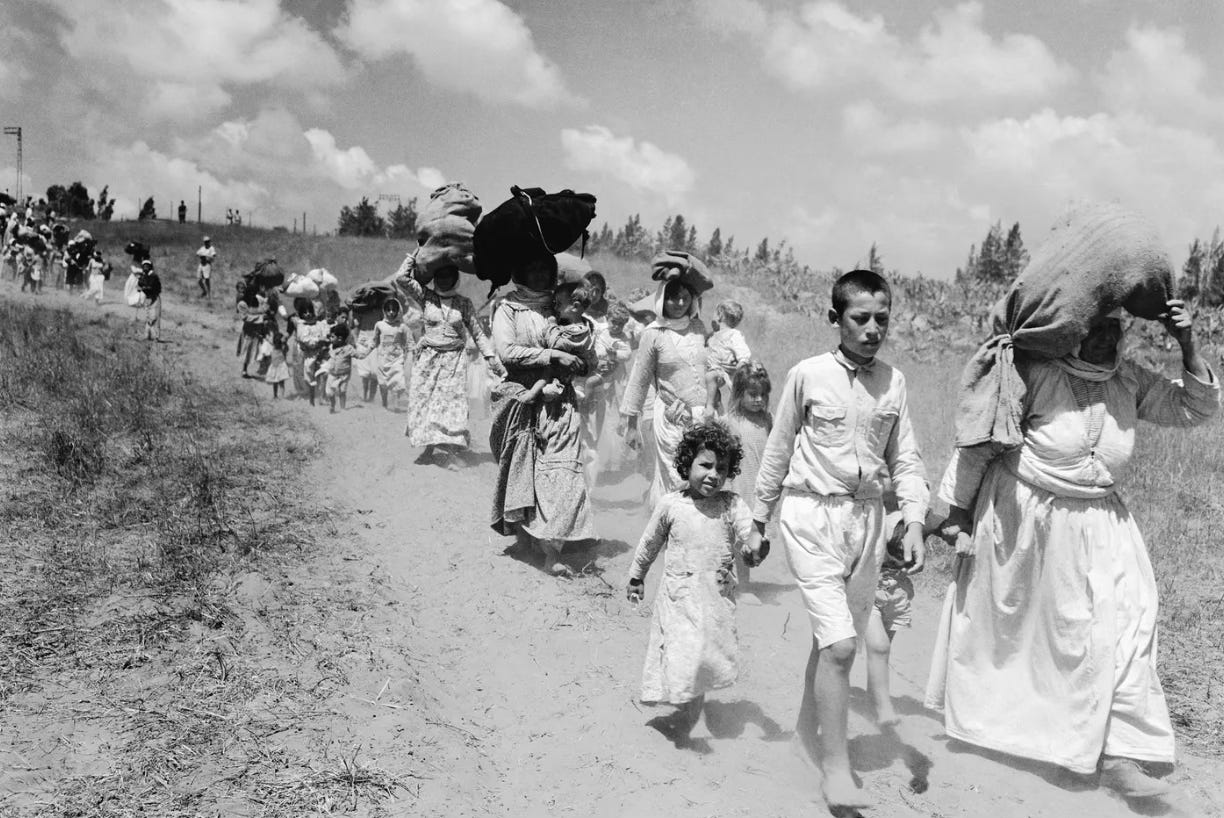
The Zionist project, from its inception, required the demographic transformation of the land. The establishment of the state in 1948 was achieved through the Nakba: the mass expulsion and flight of over 700,000 Palestinians, and the destruction of more than 500 of their villages. The expectation, both then and in the aftermath of the 1967 occupation of the West Bank and Gaza, was that military dominance, economic strangulation, and the steady encroachment of settlements would eventually force the remaining Palestinians to abandon their homes. They were expected to vanish into the surrounding Arab states, leaving the land clear for the taking. But they did not leave. They stayed, rebuilt, and resisted.
When a state’s foundational project requires the removal of a population that refuses to be removed, the state does not abandon the project. It escalates the violence required to sustain it. The history of the occupation is the history of that escalation. When administrative dispossession failed to clear the land, the state turned to military occupation. When military occupation met resistance, the state built a two-tiered legal system to criminalise that resistance. When the two-tiered system was not enough to break the population’s will, the state armed the settlers and granted them impunity to terrorise the villages directly.
This trajectory is a constitutional requirement. In 2018, the Knesset passed the Nation-State Law, formally codifying what had always been the operative reality: that Israel is an ethno-state. The law explicitly declared that the right to exercise national self-determination within the state is “unique to the Jewish people” (Knesset, 2018). It downgraded the status of the Arabic language and established the development of Jewish settlement as a “national value” that the state must encourage and promote. By elevating Jewish supremacy to the level of a Basic Law, the state legally mandated the permanent subjugation of its non-Jewish subjects. The ethno-state cannot, by definition, can only offer domination.
The death penalty law is simply the latest chapter in this unbroken narrative. It is the juridical expression of a state that has run out of administrative methods to make a population disappear and has decided instead to build the gallows; ethnic cleansing codified into law.
The Mechanics of the Double Standard
The March 2026 law does not operate in a vacuum; it is the capstone of a two-tiered legal reality that has governed the occupied territories for decades. This is a system designed to manufacture impunity for one demographic while guaranteeing the harshest possible punishment for another. The law itself is weaponised, transformed from a shield for the vulnerable into a sword for the powerful.
Subscribe to Notes From Plague Island and join our growing community of readers and thinkers..
The law explicitly targets Palestinians tried in military courts in the occupied West Bank. These courts are administrative instruments of the occupation, presided over by military officers whose primary allegiance is to the security apparatus, not to abstract notions of justice. According to human rights organisations, these military tribunals boast a conviction rate of between 96 and 99 percent for Palestinians (Amnesty International, 2026). Convictions are routinely secured based on confessions extracted under severe duress, including physical and psychological torture. Children are prosecuted in these same military courts, often dragged from their beds in the middle of the night, interrogated without a lawyer or parent present, and forced to sign confessions in Hebrew, a language they often do not understand. The system is a machine designed to process human beings into convicts with ruthless efficiency. Now, that machine has been equipped with gallows. The speed of the execution is designed to prevent any meaningful international campaign or prolonged legal appeal. It is designed to kill quickly and quietly, under the cover of law.
Conversely, Jewish Israelis living in the exact same geographic territory — the illegal settlements of the West Bank — are subject to Israeli civil law. They are tried in civilian courts, with all the robust legal protections, rights of appeal, and evidentiary standards that a modern democracy affords its citizens. They are explicitly excluded from the reach of the new death penalty law. As Amichai Cohen, a legal scholar at the Israel Democracy Institute, stated: “Jews will not be indicted under this law” (Human Rights Watch, 2026).
It is necessary to state, with profound discomfort, exactly what kind of legal architecture this is. If one searches the historical record for capital laws that explicitly designate one racial or ethnic group as subject to the death penalty while exempting another by name, the precedents are few and horrifying. Jim Crow lynching was extrajudicial; the state tolerated it, but it was not written into the penal code. Apartheid South Africa’s death penalty was catastrophically discriminatory in application, but it was nominally race-neutral in its text. To find a legal system where the racial exclusion from capital punishment is explicitly codified in the statute itself — where the law formally dictates that one ethnicity hangs and the other does not — one must look to the Nuremberg Laws of Nazi Germany. That is the historical company this legislation keeps.
The depravity of this law goes deeper than its racial exclusivity. It is not only that the state is executing Palestinians while exempting Israelis; it is that the state is executing Palestinians for exercising a right that international law explicitly guarantees them. Under United Nations General Assembly Resolution 37/43, and affirmed repeatedly since, peoples under colonial and foreign occupation have a recognised legal right to struggle for self-determination by all available means, including armed resistance. The International Committee of the Red Cross has confirmed that armed resistance to occupation is lawful under international humanitarian law, provided it is directed at military targets. The very acts the Israeli state is labelling “terrorism” and punishing with the gallows are, in many cases, acts that the international community has affirmed as the lawful exercise of the right to self-determination. Meanwhile, the settler violence, which meets every academic and legal definition of terrorism, carries no sanction whatsoever.
This is the system in practice. The Association for Civil Rights in Israel (ACRI) immediately filed a petition with the Supreme Court, correctly identifying the legislation as “discriminatory by design” (Adalah, 2026). Human Rights Watch noted that the law “entrenches discrimination and a two-tiered system of justice, both hallmarks of apartheid” (Human Rights Watch, 2026). Amnesty International’s Erika Guevara-Rosas was unsparing in her assessment: “Israel is brazenly granting itself carte blanche to execute Palestinians while stripping away the most basic fair-trial safeguards” (Amnesty International, 2026). The Palestinian Authority described the law as “a war crime against the Palestinian people,” arguing that it breaches the Fourth Geneva Convention’s protections for civilians under occupation (Al Jazeera, 2026). The state has legally codified that the exact same act of violence is a capital offence for one ethnicity and a matter for the civilian penal code — if it is prosecuted at all — for another.
But the double standard is embedded in the very language the state uses to describe violence. Israel’s 2016 Counter-Terrorism Law provides a broad and sweeping definition of a terrorist act, encompassing any offence that creates fear or terror in the public. By any objective academic or policy standard, the actions of extremist Israeli settlers in the West Bank meet this definition perfectly. They deliberately destroy Palestinian property, deface mosques, slaughter livestock, and murder civilians. They do this with the express, stated goal of instilling terror in the Palestinian population to force them off their land and secure permanent Jewish sovereignty over the territory. As the Atlantic Council noted in a 2026 analysis, “Extremist Israeli settler violence readily meets both the academic and policy definitions of terrorism: the deliberate creation of fear through violence or the threat of violence in pursuit of a political objective” (Waldo, 2026).
Yet, the Israeli state categorically refuses to apply the “terrorist” label to these violent settlers. The IDF and the Shin Bet internally classify severe incidents of settler violence as “nationalistic crime” or even acknowledge them as terrorism in their own data collection. However, they refuse to designate the perpetrators themselves as terrorists. The justification offered for this refusal is a supposed “lack of organisational coherence” compared to Palestinian groups (Waldo, 2026).
This distinction is entirely arbitrary and intellectually bankrupt. The IDF’s own materials regarding Palestinian violence show no hesitation whatsoever in applying the terrorist label to lone-wolf attackers who have no formal affiliation with any armed group. When a Palestinian acts alone, they are a terrorist. When hundreds of armed settlers coordinate a massive assault on a village, burning homes and shooting residents, they are dismissed by military leadership as “anarchists” or “extremists.” The IDF Chief of Staff, Eyal Zamir, used precisely this language, “anarchists,” to describe the perpetrators of the violence, even as his own institution’s data classified their acts as terrorism (Waldo, 2026). The word “anarchist” is carefully chosen. It implies chaos, disorder, a problem of governance. It does not imply a political project or intent.
This is the sanitisation of state-sanctioned violence. By refusing to label settler violence as terrorism, the state ensures that the perpetrators are never subjected to the draconian counter-terrorism measures deployed against Palestinians. They do not face administrative detention without trial. Their family homes are not demolished by military bulldozers. They are not subjected to collective punishment. And, under the new law, they will never face the hangman. The legal system exists to define terror in a way that protects the state’s vanguard and criminalises its enemies.
The man who championed this death penalty law — Ben-Gvir himself — is the same minister who oversees the police force that has systematically refused to prosecute settlers for decades. He is both the architect of the gallows and the guardian of the impunity. This is a coherent political project, working exactly as intended. The state has created a legal fiction where the violence of the occupier is a policing issue, while the violence of the occupied is an existential threat requiring the ultimate sanction.
The Settler Pogroms: State-Sanctioned Terror and Dispossession
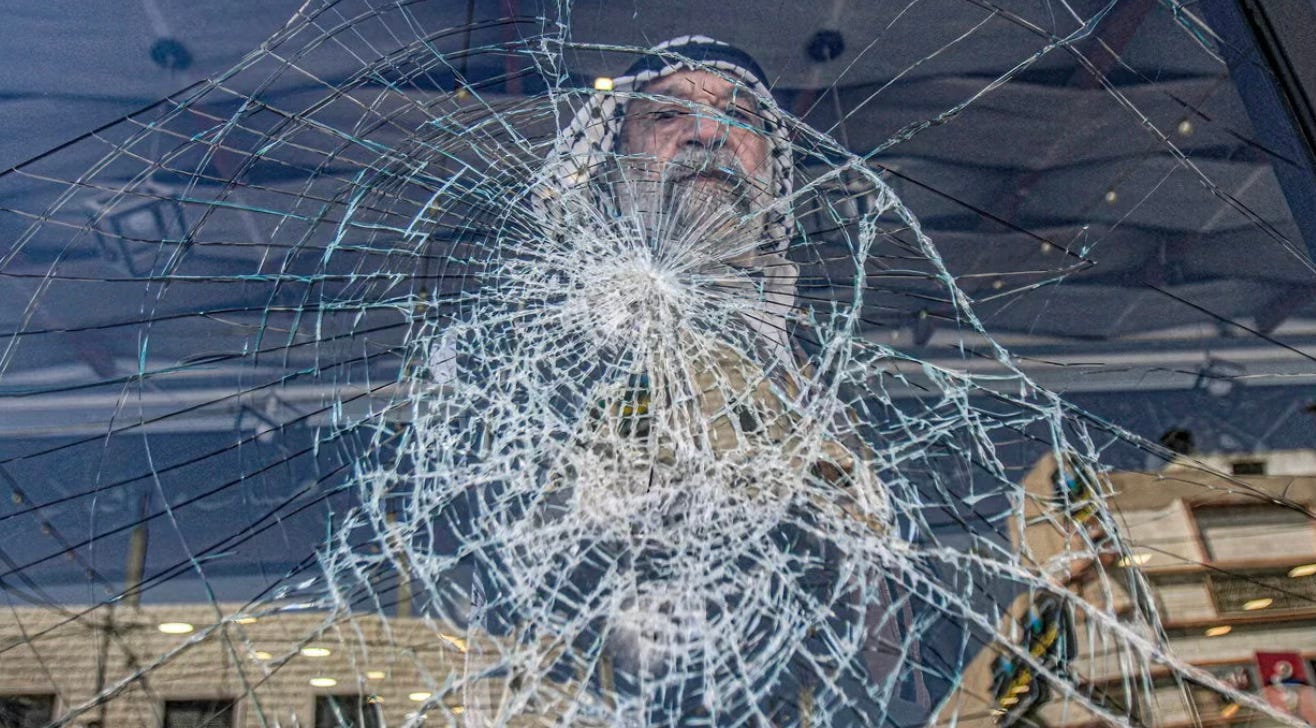
On the evening of March 21, 2026, during the Eid al-Fitr holiday, extremist Israeli settlers launched a massive, coordinated assault across the occupied territory. According to reports, the settlers carried out a “widespread pogrom that lasted over six hours, struck more than 14 villages, attacked dozens of Palestinians, and no one stopped them” (Time, 2026). They set homes and vehicles ablaze. They smashed windows and beat residents, sending several to the hospital with severe head wounds and gunshot injuries. The Palestinian Red Crescent reported at least three people hospitalised, including a 45-year-old man shot in the foot and a woman suffering from smoke inhalation. The IDF, which was present in the area, did not intervene for hours. When it eventually acted, it detained five Israeli civilians and confiscated some weapons. Five. In a six-hour pogrom across fourteen villages involving hundreds of armed people.
This was a calculated campaign of terror, designed to inflict maximum psychological and physical damage on a civilian population. Ayman Odeh, the leader of the Hadash-Ta’al party, described it as a “night of fire” (Time, 2026). Yair Golan, leader of the Democrats party, was even more explicit, stating: “Jewish terrorism is spreading, exploiting the war, with the backing of extremist ministers and dangerous encouragement from the prime minister and the defence minister” (Time, 2026). Even former Prime Minister Naftali Bennett felt compelled to condemn the violence, stating, “We did not establish a Jewish state so that violent gangs would operate within it” (Time, 2026). Former Prime Minister Ehud Olmert went further still, calling on the International Criminal Court to issue arrest warrants for the perpetrators (Daily Sabah, 2026). Former senior security officials — military chiefs, intelligence heads, police commissioners — warned publicly that the attacks amounted to “Jewish terrorism” (Daily Sabah, 2026). Two former justice ministers accused the government of allowing “active and horrific ethnic cleansing” (Daily Sabah, 2026).
When former prime ministers and former justice ministers of Israel are using the words “ethnic cleansing” and calling for ICC arrest warrants, we are in the realm of documented atrocity. Yet the state responds not with prosecution, but with a death penalty law aimed at the victims of that atrocity.
The March 2026 pogrom was merely the latest escalation in a long, unbroken continuum of state-sanctioned violence. It echoes the horrific events of February 2023 in Huwara, where hundreds of settlers rampaged through the town, burning homes and businesses while the Israeli military stood by and watched. The IDF’s own top general in the West Bank at the time, Major General Yehuda Fuchs, called the Huwara riot a “pogrom” (Times of Israel, 2023). He used the word deliberately: a pogrom is not a riot, but an organised, state-tolerated massacre of an ethnic minority. The general knew what he was witnessing, yet the perpetrators of the Huwara pogrom walked free. No charges. No trial. No consequences. The state absorbed the violence, digested it, and allowed the perpetrators to return to their settlements as heroes.
A 2026 analysis revealed that since the start of the decade, at least 1,100 Palestinian civilians have been killed in the West Bank by Israeli soldiers and settlers. In that entire period, not a single indictment has been filed against an Israeli for the killing of a Palestinian civilian. The last time a civilian settler was prosecuted for such a killing was in 2018 (Daily Sabah, 2026). The last prosecution involving the security forces was in 2019. Since then, the killing has continued, and the silence of the justice system has been absolute.
Data collected over two decades by the Israeli human rights organisation Yesh Din confirms that this is a structural feature of the occupation, not a temporary aberration. Between 2005 and 2024, 94 percent of police investigations into ideological crimes committed by Israelis against Palestinians were closed without an indictment. Only 3 percent of investigations ever resulted in a conviction (Yesh Din, 2025). The system is so thoroughly broken that an estimated 60 to 66 percent of Palestinian victims do not even bother to file police complaints, knowing that doing so will yield no justice and will likely invite further retaliation or the revocation of their work permits (Yesh Din, 2025). The victims have learned, through bitter experience, that the police are not their protectors. The police exist to manage the occupation, not to enforce the law.
As Ziv Stahl, the executive director of Yesh Din, observed: “The Israeli law-enforcement systems, both civil and military, function less as mechanisms for justice and more as shields for perpetrators” (Daily Sabah, 2026). Michael Sfard, a prominent Israeli human rights lawyer, was equally direct, noting that “the system is programmed to manufacture impunity, not accountability” (Daily Sabah, 2026). These are the words of Israeli legal professionals who have spent decades working within the system and watching it fail, deliberately and repeatedly, to protect Palestinian lives.
The scale of the violence has accelerated dramatically in recent years, emboldened by a government that openly shares the settlers’ maximalist goals. According to IDF and Shin Bet data, extremist settlers perpetrated 867 attacks against Palestinians and Israeli security forces in the West Bank in 2025 alone, a 27 percent increase from 2024. Severe incidents of nationalistic crime — the IDF’s own euphemism for what it privately acknowledges as terrorism — increased by more than 50 percent from 2024 levels, more than doubling since 2023 (Waldo, 2026). More than 1,000 Palestinians have been killed by Israeli troops and settlers in the West Bank since October 2023 (Time, 2026). These are the IDF’s own numbers, documenting a campaign of terror that the state refuses to prosecute.
We must understand that this violence is not random, senseless, or the work of a few “bad apples.” It is a highly effective, calculated strategy of dispossession. The objective of settler terrorism is theft. It is the violent vanguard of the state’s expansionist project. The settlers terrorise, burn, kill, and then they take over the homes and the land. They use forged property deeds, archaic Ottoman land laws, and the brute force of the military to seize Palestinian property. More than 750,000 Israeli settlers now live in illegal settlements across the West Bank (Al Jazeera, 2025). Their presence is illegal under international law. The settlements violate the Fourth Geneva Convention and have been repeatedly condemned by UN Security Council resolutions. They exist because the state built them, funds them, arms them, and protects them.
The results of this strategy are devastating and measurable. It is crucial to understand that the erasure of the West Bank did not begin on October 7th. The architecture of dispossession was already fully operational, the villages were already being burned, and the land was already being stolen. But the war in Gaza provided something invaluable to the settler project: absolute narrative cover. As the world watched a genocide unfold on their screens, the global narrative narrowed so completely that the West Bank disappeared from view. The international community began treating Gaza as a separate, isolated conflict, rather than one front in the same continuous colonial struggle. The media’s cameras and the diplomatic bandwidth were entirely consumed by the destruction of the strip, providing the perfect smokescreen for the acceleration of the settler project. A report from the UN High Commissioner for Human Rights found that between November 2024 and October 2025, 36,000 Palestinians were forcibly displaced in the West Bank (Time, 2026). In the first few months of 2026 alone, nearly 700 Palestinians in nine communities were driven from their homes due to escalating settler attacks (Time, 2026). The UN Human Rights Council has explicitly condemned this as an “accelerating campaign of ethnic cleansing and annexation” (Time, 2026). The Office of the UN High Commissioner for Human Rights stated in March 2026 that “Israel has accelerated unlawful settlement expansion and annexation of large parts of the occupied West Bank” (OHCHR, 2026). The UNRWA Commissioner General described the reality on the ground in stark terms: “large groups of settlers storm Palestinian communities, brutalise residents and torch buildings” (Time, 2026).
This is the reality against which the new death penalty law must be judged. The state has constructed a legal apparatus that guarantees the execution of Palestinians who resist the occupation, while simultaneously providing absolute, mathematically verifiable impunity to the Israeli settlers who serve as the shock troops of that same occupation. The settlers are doing the work of the state: clearing the land, expanding the borders, and terrorising the indigenous population into submission. Why would the state hang its own foot soldiers?
The Architecture of Apartheid
We do not need to rely solely on historical parallels to understand what this legal architecture represents. International law provides a precise, contemporary vocabulary for a system that subjects two different racial or ethnic groups living in the same territory to entirely different legal regimes, with the express purpose of maintaining the domination of one over the other. That word is apartheid.
For decades, the term was treated as a rhetorical provocation, a political slur rather than a legal reality. But the passage of the death penalty law, and the two-tiered justice system it crowns, strips away any remaining ambiguity. The intent to maintain domination is explicitly stated in government policy, such as the 2018 Nation-State Law. The context of systematic oppression is codified in the very architecture of the occupation: the dual legal system where Palestinians face military courts with a 99 percent conviction rate while their settler neighbours enjoy civil rights. And the inhumane acts committed to maintain this regime are visible in the daily violence of the occupation: the demolition of Palestinian homes, the state-backed settler pogroms, and now, the construction of the gallows.
Major international human rights organisations have already reached this conclusion. In 2021, Human Rights Watch issued a landmark report detailing how Israeli authorities were committing the crimes against humanity of apartheid and persecution, noting that the severity of repression in the occupied territory, including draconian military rule for Palestinians alongside rights-respecting civil law for Jewish Israelis, amounts to the systematic oppression required for apartheid (Human Rights Watch, 2021). In 2022, Amnesty International followed suit, publishing a comprehensive analysis demonstrating that Israel imposes a “cruel system of domination and crime against humanity” (Amnesty International, 2022).
But the most definitive legal judgment came in July 2024, when the International Court of Justice (ICJ) — the highest court in the world — issued a historic advisory opinion. The Court found multiple and serious international law violations by Israel in the Occupied Palestinian Territory, and, for the first time, explicitly found Israel responsible for apartheid and racial segregation (Human Rights Watch, 2024). The ICJ declared the occupation itself illegal and placed responsibility on all states to end these violations.
Yet, the response of the Israeli state to the highest court in the world was not to dismantle the system of apartheid, but to fortify it. The March 2026 death penalty law is the ultimate expression of this defiance. It takes the two-tiered legal system that the ICJ condemned as apartheid and arms it with the ultimate sanction. When a state legally mandates that a Palestinian can be hanged for an act of violence, while an Israeli settler who commits the exact same act is protected by the police and tried in a civilian court (if they are tried at all) we are no longer debating the definition of apartheid. We are watching it execute its subjects.
Conclusion: The Verdict
When a state legally codifies that the exact same act of violence is a capital offence for one ethnicity and a protected, unpunished right for another, it ceases to be a justice system. It becomes an administrative tool for ethnic cleansing. The law is no longer a mechanism for resolving disputes or maintaining order; it is a weapon wielded by the powerful against the powerless. It is the architecture of apartheid, rendered in the starkest possible terms.
The death penalty law passed by the Knesset is not about deterrence. Decades of empirical evidence from around the globe have proven that capital punishment does not deter violent crime. No serious criminologist or penologist argues otherwise. The law is about establishing absolute, irreversible dominance. It is the final, brutal codification of a reality where the state decides who is human enough to deserve a trial, and who is merely an obstacle to be removed. It is a declaration that Palestinian life holds no value, while Israeli violence is inherently justified by the project it serves.
We should not be surprised by this law because it is the inevitable next step for a state built on ethnic cleansing, from the Nakba to the present day. A state that sustains itself through the continuous dispossession of an indigenous population will always, eventually, require the gallows to maintain its grip. This final step was taken with the tacit approval of the international community. The genocide in Gaza was green lit by the world. It was met with muted condemnation by Western leaders who invoke international law only when it suits them, and who continued to arm the state even as the atrocities were broadcast live. The United States, Germany, and the United Kingdom continued to supply weapons and components throughout the Gaza offensive, finding legal carve-outs to keep arming the state while Gaza burned (SIPRI, 2025; Campaign Against Arms Trade, 2025). The world demonstrated, through its silence and its shipments of artillery, that there was no red line. If killing children in their beds did not cross a line, why would the world care about the execution of those the state has already defined as “terrorists”? The label does the work. Once you are called a terrorist, the world has already decided you do not count. The death penalty law is the direct result of that complicity. It is the juridical extension of the exact same eliminationist project. It is genocide by other means. When a state learns that it can commit genocide without consequence, it does not moderate its behaviour.
If international law does not matter — if the ICJ’s rulings are dismissed, UN resolutions are treated as irrelevant, the legal right to armed resistance is punished with execution while the state’s own violence is protected by statute — then we must ask the question again: what is terrorism? It has become a political weapon; the word the coloniser uses to describe the resistance of the colonised, while reserving the language of justice for its own atrocities. The powerful state never commits terrorism. It conducts “counter-terrorism.” It conducts “security operations.” It “mows the lawn.” That is the universal alibi of state violence throughout modern history. The Nazis called their massacres of resistance fighters “anti-partisan operations” and “security measures.” The British in Kenya, the French in Algeria, the apartheid regime in South Africa — every powerful state that has committed mass atrocities against a subject population has done so under the banner of counter-terrorism and the protection of order. We write that list with extreme discomfort; Israel is the latest state to dress its lawlessness in the language of justice.
Ben-Gvir told the world that whoever takes a life, the state will take their life in return. He said this while wearing a noose; as the settlers who burn Palestinian villages and shoot Palestinian civilians continue to walk free, protected by the very legal system he oversees. He said this knowing, with absolute certainty, that the noose he was celebrating would never be placed around a settler’s neck. He said it because he knows that in the architecture of hypocrisy, the law does not apply to the architects.
But history offers a final, inescapable verdict on states built this way. The British Raj fell. French Algeria fell. Apartheid South Africa fell. The most brutal regimes in history do not last forever; they end, and they often end abruptly, eaten from the inside out by their own moral rot. A state that requires a two-tiered justice system, a permanent military occupation, the construction of the gallows, and the prosecution of a genocide to maintain its existence is projecting the profound, terminal weakness of a project that cannot survive the light of day. The noose is a desperate measure, and desperate measures are the hallmark of a regime that knows it’s time is running out.
Against this machinery of erasure stands something the state cannot legislate out of existence: the profound, unbreakable steadfastness of the Palestinian people. The gallows are built on the assumption that fear will eventually triumph over belonging, that the indigenous population will finally break and leave. But they have not left. They remain. Through decades of dispossession, through military courts and settler pogroms, through the destruction of their homes and the bombardment of their cities, they have maintained their sumud — their steadfast perseverance. They are the active, enduring agents of their own survival.
The architects of the Zionist project understood this from the very beginning, even if their modern successors pretend otherwise. Writing in 1923, Ze’ev Jabotinsky, the ideological father of the Israeli right, laid out the brutal, inescapable truth of the colonial endeavour with a clarity that today’s politicians lack. He did not deal in the sanitised language of counter-terrorism. He understood exactly what he was building, and exactly who he was building it against:
“Every indigenous people will resist alien settlers as long as they see any hope of ridding themselves of the danger of foreign settlement. That is what the Arabs in Palestine are doing, and what they will persist in doing as long as there remains a solitary spark of hope that they will be able to prevent the transformation of ‘Palestine’ into the ‘Land of Israel’.” (Jabotinsky, 1923)
Resist they did. And still are: from the river to the sea.
Or support us with a one-off tip → Buy Me a Coffee.
References
+972 Magazine (2026) ‘They already shoot us for no reason. Now they have a death penalty’. Available at: https://www.972mag.com/israel-death-penalty-law-palestinian-prisoners/ [Accessed: 31 March 2026].
Adalah (2026) Adalah petitions Supreme Court against discriminatory death penalty law. Available at: https://www.adalah.org/en/content/view/11561 [Accessed: 31 March 2026].
Al Jazeera (2025) By the 50th anniversary of Land Day, Palestinians lose most of their land. Available at: https://www.aljazeera.com/features/2026/3/30/by-the-50th-anniversary-of-land-day-palestinians-lose-most-of-their-land[Accessed: 31 March 2026].
Al Jazeera (2026) Israel passes discriminatory death penalty bill targeting Palestinians. Available at: https://www.aljazeera.com/news/2026/3/30/israel-passes-discriminatory-death-penalty-bill-targeting-palestinians[Accessed: 31 March 2026].
Al Jazeera (2026) Israeli soldiers accused of ‘torturing’ toddler in Gaza. Available at: https://www.aljazeera.com/video/newsfeed/2026/3/24/israeli-soldiers-accused-of-torturing-toddler-in-gaza [Accessed: 29 March 2026].
Amnesty International (2022) Israel’s apartheid against Palestinians: Cruel system of domination and crime against humanity. Available at: https://www.amnesty.org/en/documents/mde15/5141/2022/en/ [Accessed: 31 March 2026].
Amnesty International (2026) Israel/OPT: Newly adopted death penalty law must be repealed. Available at: https://www.amnesty.org/en/latest/news/2026/03/israel-opt-newly-adopted-death-penalty-law-must-be-repealed/[Accessed: 31 March 2026].
Campaign Against Arms Trade (2025) New figures reveal massive increase in UK arms exports to Israel as government defends F-35 exemption in court. Available at: https://caat.org.uk/news/new-figures-reveal-massive-increase-in-uk-arms-exports-to-israel-as-government-defends-f-35-exemption-in-court/ [Accessed: 1 April 2026].
Daily Sabah (2026) Israelis have near-total impunity in W. Bank Palestinian killings: report. Available at: https://www.dailysabah.com/world/mid-east/israelis-have-near-total-impunity-in-w-bank-palestinian-killings-report[Accessed: 31 March 2026].
Jabotinsky, Z. (1923) The Iron Wall (We and the Arabs). Available at: https://www.marxists.org/history/etol/document/mideast/ironwall/ironwall.htm [Accessed: 31 March 2026].
Human Rights Watch (2021) A Threshold Crossed: Israeli Authorities and the Crimes of Apartheid and Persecution. Available at: https://www.hrw.org/report/2021/04/27/threshold-crossed/israeli-authorities-and-crimes-apartheid-and-persecution [Accessed: 31 March 2026].
Human Rights Watch (2024) World Court Finds Israel Responsible for Apartheid. Available at: https://www.hrw.org/news/2024/07/19/world-court-finds-israel-responsible-apartheid [Accessed: 31 March 2026].
Human Rights Watch (2026) Israel: Discriminatory Death Penalty Bill Passes. Available at: https://www.hrw.org/news/2026/03/31/israel-discriminatory-death-penalty-bill-passes [Accessed: 31 March 2026].
Knesset (2018) Basic Law: Israel - The Nation State of the Jewish People. Available at: https://main.knesset.gov.il/EN/activity/documents/BasicLawsPDF/BasicLawNationState.pdf [Accessed: 31 March 2026].
OHCHR (2026) Israel’s settlement expansion drives mass displacement in West Bank: UN report. Available at: https://www.ohchr.org/en/press-releases/2026/03/israels-settlement-expansion-drives-mass-displacement-west-bank-un-report [Accessed: 31 March 2026].
Schneid, R. (2026) Israeli Settlers Carry Out Wave of Attacks on Palestinian Villages in West Bank, Time. Available at: https://time.com/article/2026/03/22/settler-attacks-west-bank/ [Accessed: 31 March 2026].
SIPRI (2025) How top arms exporters have responded to the war in Gaza: 2025 update. Available at: https://www.sipri.org/commentary/topical-backgrounder/2025/how-top-arms-exporters-have-responded-war-gaza-2025-update [Accessed: 31 March 2026].
Times of Israel (2023) Settler extremists are sowing terror, Huwara riot was a ‘pogrom,’ top general says. Available at: https://www.timesofisrael.com/settler-extremists-sowing-terror-huwara-riot-was-a-pogrom-top-general-says/ [Accessed: 31 March 2026].
Waldo, C. (2026) Israeli settler terrorism demands a tougher US response, Atlantic Council. Available at: https://www.atlanticcouncil.org/dispatches/israeli-settler-terrorism-demands-a-tougher-us-response/ [Accessed: 31 March 2026].
Yesh Din (2025) Data Sheet: Law Enforcement on Israeli Civilians in the West Bank (Settler Violence) 2005–2024. Available at: https://www.yesh-din.org/en/data-sheet-law-enforcement-on-israeli-civilians-in-the-west-bank-settler-violence-2005-2024/ [Accessed: 31 March 2026].