Donald Trump, Rob Reiner, and the End of Presidential Guardrails

Violent death has traditionally imposed a limit on political language. This is not necessarily because politicians are moral exemplars, but because democratic systems rely on shared symbolic restraints: moments when power pauses, lowers its voice, and acknowledges something larger than itself. Even in eras of bitter division, death has tended to mark a boundary between politics and humanity, rhetoric and reality.
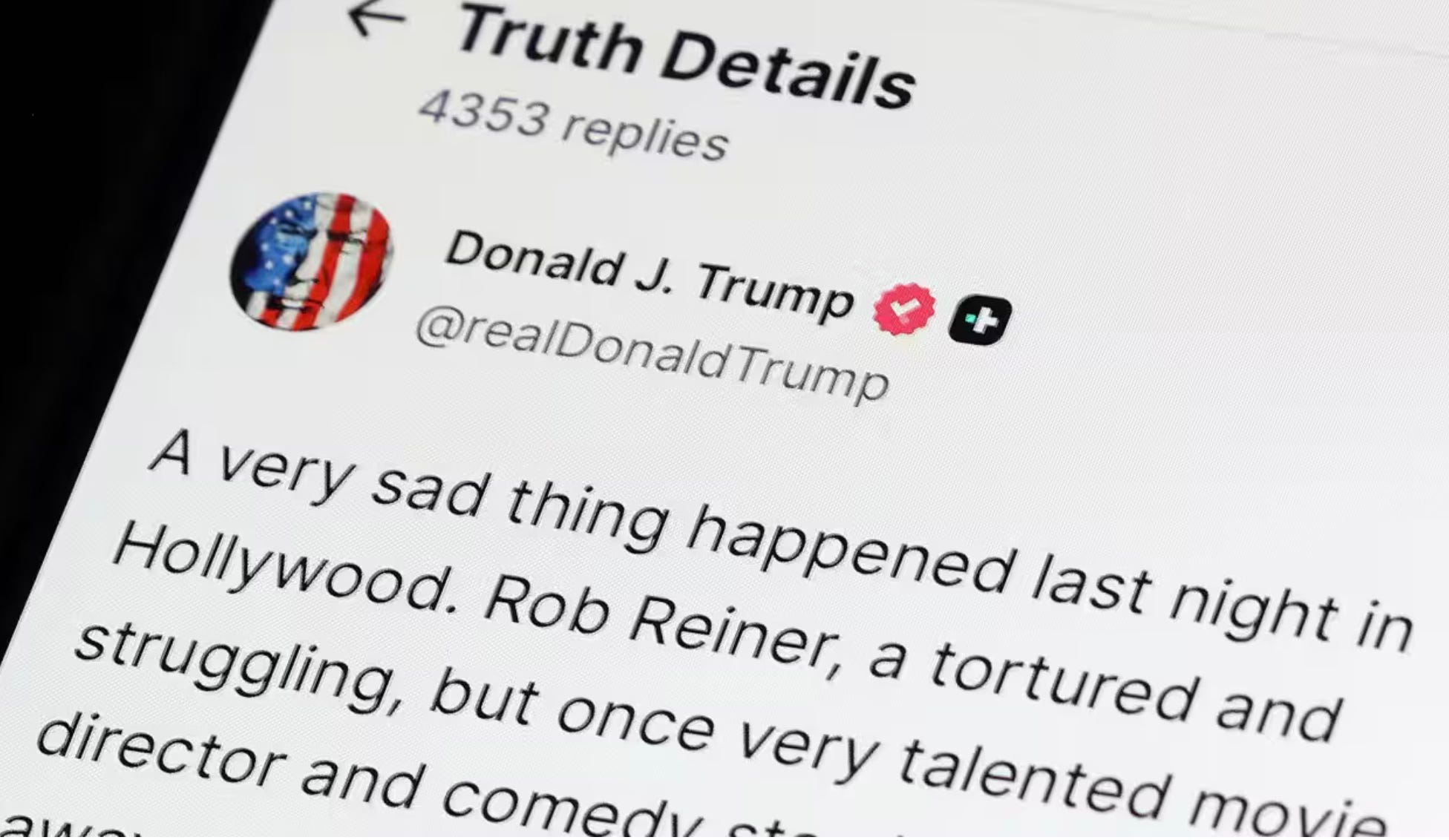
That boundary did not hold when Donald Trump responded publicly to the murder of the film director, Rob Reiner.
Rather than expressing restraint or withholding comment while facts emerged, Trump issued a post that falsely framed Reiner’s death, mocked him as a political enemy, pathologised dissent through the familiar invocation of “Trump Derangement Syndrome,” and centred the event around Trump’s own imagined vindication. It was more than intemperate; it was an assertion of narrative authority at a moment when authority ought to have receded.
This essay is not concerned with outrage. Nor is it interested in diagnosing Donald Trump. It does not speculate on his mental or physical health because those questions (however tempting) are ultimately unknowable to the public and, in any case, miss the more serious point. The danger revealed in Trump’s response to Reiner’s murder lies not in Trump’s inner life, but in the political environment that now treats such behaviour as acceptable, ignorable, or even normal.
What matters is not that Trump wrote something offensive. He has done so countless times. What matters is how he did it, when he did it, and what did not happen afterward.
Trump did not simply insult a critic. He spoke in the register of finality, adopting the tone of obituary and judgement, as though he possessed the authority to announce death, explain it, and assign it moral meaning. In doing so, he treated death not as a human tragedy but as narrative proof: evidence of his own righteousness and his opponent’s supposed moral failure. This is a significant escalation. It is one thing to mock the living, but quite another to fold death itself into a political performance.
Equally revealing was the response — or lack of one. There was no institutional rupture. No sustained political condemnation. No emergency language from party leaders. No moment where the norms of the office reasserted themselves. Instead, the post was absorbed into the ambient noise of Trump’s presidency, treated as yet another provocation in an already saturated news cycle. The system did not recoil. It’s too adjusted to do that.
This is the core problem this essay seeks to address. Donald Trump’s reaction to Rob Reiner’s murder is not most alarming because it was cruel, or false, or self-centred, though it was all of those. It is alarming because it demonstrates how thoroughly the moral restraints of the presidency have eroded, and how little capacity remains within American institutions to enforce them.
We will argue that focusing on Trump’s temperament, psychology, or possible decline is a form of misdirection. It personalises what is fundamentally a structural failure. Trump’s behaviour does not occur in a vacuum. It is enabled by a political culture that has recalibrated its expectations downward, by elites who manage rather than confront, and by a media ecosystem conditioned to treat even the most extreme transgressions as familiar.
When death no longer imposes restraint on power, something fundamental has shifted. The question is not whether this is shocking. The question is what it reveals about a system that no longer recognises shock as a reason to act.
The Post as Political Artefact
Donald Trump’s response to the murder of Rob Reiner warrants close attention not because it is shocking, as shock has long since lost its disciplinary power in American politics, but because it reveals how presidential speech now operates when unmoored from restraint. This was not a spontaneous outburst delivered verbally under pressure. It was a written statement, posted deliberately, in full awareness of its audience and reach.
The first and most striking feature of Trump’s post is its adoption of the language of finality. Although framed as commentary, it borrows the tone and posture of an obituary: declarative, conclusive, morally summative. This particular death is not approached as an event still unfolding, nor as a tragedy requiring care or silence, but as a resolved narrative, one that Trump feels entitled to complete. This matters. The rhetorical authority to declare death, explain it, and attach meaning to it has historically been treated with caution by political leaders precisely because it carries symbolic weight. Trump deploys that authority casually, as if it were merely another instrument of political combat.
This posture goes beyond insult. Trump presents Reiner’s death as evidence that his critics are not merely wrong but disordered, not opponents, but moral failures. The familiar phrase “Trump Derangement Syndrome” appears once again, serving a crucial function. It pre-emptively disqualifies any objection by redefining dissent as pathology. In this formulation, disagreement does not arise from reason or conscience, but from illness. Trump is not accountable to critics because critics are, by definition, unwell.
This rhetorical move has been widely documented across Trump’s political career. Scholars and journalists alike have noted his repeated tendency to pathologise opposition rather than engage with it, collapsing political disagreement into personal deficiency (McCoy, 2018; Stanley, 2018). What distinguishes this instance is the context in which the move is made. It is deployed not in response to criticism, but in the aftermath of a violent death. Death becomes not a reason for humility, but an opportunity to reinforce hierarchy: Trump as the arbiter of sanity, legitimacy, and moral worth.
Equally significant is the role of falsehood in the post. Trump’s framing of Reiner’s death is indifferent to accuracy. The facts of the case were still emerging at the time Trump posted, and reputable outlets were careful to stress the provisional nature of the investigation (BBC News, 2025; CNN, 2025). Trump shows no such caution. He speaks with certainty, as though factual verification were subordinate to his rhetoric. This is consistent with a long-established pattern in Trump’s communication style, in which assertion itself functions as a demonstration of power. Truth is not something to be discovered; it is something to be declared.
Political theorists have described this as a hallmark of authoritarian rhetoric: language that does not seek persuasion or verification, but dominance (Stanley, 2018). The point is that the speaker has the authority to make it. In this sense, Trump’s post operates less as commentary than as command. It signals to supporters that reality remains pliable, and to opponents that facts offer no protection.
The cruelty of the post is therefore not incidental. It is not a lapse or a loss of control. It is structured, purposeful, and recognisable. Trump does not mourn. He judges. He does not hesitate. He declares. He does not acknowledge uncertainty. He replaces it with certainty of his own making. The absence of empathy is the message. Empathy would suggest limits. Cruelty signals that there are none.
Taken together, these elements — finality without authority, falsehood without hesitation, cruelty without disguise — mark an important escalation. Trump is using death as a stage on which to reassert his central role in the political universe. The murdered man becomes a prop; the act of killing becomes narrative material; the presidency becomes a platform for moral domination.
This is why the post cannot be dismissed as ‘just another Trump rant.’ It represents a further erosion of the symbolic restraints that once governed presidential speech. When a president treats violent death as an opportunity for self-vindication and mockery, something more than decorum has been lost. A boundary has been crossed and, crucially, it is crossed without consequence.
Self-Reference as Compulsion: When External Reality Collapses
One of the most revealing aspects of Donald Trump’s response to Rob Reiner’s murder is its gravitational pull. Everything bends toward Trump. The victim does not exist as an independent human being. The event does not exist as an event. Even death itself is stripped of autonomy and absorbed into Trump’s personal narrative of grievance, vindication, and persecution.
This pattern is not new. Trump has long exhibited an inability, or unwillingness, to acknowledge events that do not ultimately reaffirm his centrality. Natural disasters, mass shootings, court rulings, international crises: all are treated less as realities in their own right than as occasions to restate Trump’s own significance. Scholars of populist leadership have described this as a defining feature of personalised authoritarianism, in which the leader ceases to operate within reality and instead positions reality as something that happens to him (Moffitt, 2016; McCoy, Rahman and Somer, 2018).
What distinguishes this moment is the extremity of the absorption. Violent death is among the most resistant facts of political life. It traditionally demands acknowledgement of something beyond the self: loss, contingency, human fragility. Trump’s post refuses that demand. Reiner’s murder is not permitted to interrupt Trump’s narrative. Instead, it is repurposed to confirm it.
The mechanism is simple but powerful. Trump frames the death as the logical endpoint of opposition to him. Reiner does not die because violence occurs in society, or because individuals act with malice, or because tragedy is sometimes senseless. He dies, in Trump’s telling, because he stood on the wrong side of Trump himself. The implication is unmistakable: opposition to Trump is self-destructive. Reality punishes those who resist.
This is where self-reference shifts from narcissism into something more politically dangerous. Narcissism still presupposes an external world against which the self is measured. What Trump displays here is closer to what political psychologists describe as monomaniacal cognition: a closed system in which all meaning is generated internally, and external events exist only insofar as they can be assimilated (Post, 2015). Within such a system, contradiction is erased, and facts are overwritten.
Trump’s repeated invocation of “Trump Derangement Syndrome” is central to this process. The phrase performs an act of cognitive foreclosure. If opposition is defined as illness, then opposition cannot carry information. It cannot correct error. It cannot impose limits. The leader becomes epistemically sovereign: the sole healthy mind in a diseased landscape. This rhetorical move has appeared consistently in Trump’s responses to criticism, legal accountability, electoral defeat, and now death itself (Stanley, 2018).
Importantly, this is a governing style. When leadership becomes fully self-referential, it undermines the basic democratic premise that power is accountable to a shared reality. Democratic institutions rely on the assumption that leaders will, at minimum, recognise events that do not centre them: court rulings they lose, elections they fail to win, tragedies that demand collective mourning rather than individual vindication. Trump’s response to Reiner’s murder demonstrates how thoroughly that assumption has broken down.

When a president cannot acknowledge events except as extensions of his own story, the scope for responsible governance narrows dramatically. Policy becomes secondary to performance. Institutions become props. Human suffering becomes material. The leader is no longer constrained by circumstance because circumstance itself has been rhetorically conquered.
This is why Trump’s response cannot be dismissed as tasteless or inappropriate in isolation. It reveals a deeper transformation in how power is exercised and justified. The presidency, in this model, is a stage on which a single figure performs inevitability. Everything that happens — victory, loss, violence, death — must ultimately testify to him.
In such a system, there is no external brake. No moment of silence that forces reflection. No tragedy large enough to impose humility. Death merely becomes another line in the story. It is a collapse of the relationship between power and reality itself.
Subscribe to Notes From Plague Island and join our growing community of readers and thinkers.
Cruelty as Currency: Why This Resonates
Donald Trump’s response to Rob Reiner’s murder must also be understood as a successful political act. The post did not emerge in a vacuum, nor did it risk alienating Trump’s core audience. On the contrary, it functioned precisely as intended: as a signal of strength, dominance, and loyalty to a political identity built around transgression.
Trump’s political appeal has long been rooted in his willingness to violate norms that others respect. For supporters, this norm-breaking is not a bug but a feature. Political scientists studying populist movements have repeatedly shown that supporters interpret elite outrage as confirmation that their leader is authentic and dangerous to the right people (Moffitt, 2016; Hochschild, 2016). Cruelty, in this framework, becomes proof of sincerity.
In Trumpism, empathy is coded as weakness and restraint as hypocrisy. The refusal to mourn publicly is therefore not read as inhumanity, but as honesty. Trump does not pretend to care. He does not perform what supporters see as false rituals of elite civility. Instead, he speaks plainly, brutally, and without apology. This posture reassures followers that he is not bound by the moral expectations that constrain other politicians, expectations they increasingly distrust.
The concept of sadistic populism helps clarify this dynamic. Rather than offering policy solutions or material improvement, such movements promise emotional satisfaction: the humiliation of enemies, the inversion of moral hierarchies, and the pleasure of seeing those deemed superior brought low (Snyder, 2018; Wodak, 2021). Trump’s post delivers precisely this. Reiner is not treated as a victim of violence, but as an enemy finally silenced. His death is framed a form of cosmic justice.
This emotional economy depends on constant escalation. Once basic norm-breaking becomes familiar, stronger transgressions are required to generate the same affective reward. Trump’s long history of inflammatory speech: mocking the disabled, praising violence, encouraging crowd aggression, has gradually shifted the baseline of what is considered acceptable (Stanley, 2018). Against that backdrop, responding cruelly to death is not a shocking departure; it is the next logical step.
Social media architecture reinforces this logic. Platforms reward engagement, outrage, and extremity. Trump’s direct-to-supporter communication bypasses traditional mediating institutions and allows him to speak in a register calibrated for virality rather than responsibility. Research into online political communication shows that messages framed around conflict and moral domination travel further and faster than those framed around empathy or complexity (Benkler, Faris and Roberts, 2018). Trump’s post fits this pattern perfectly.
Importantly, the cruelty is directional. Trump does not mock random victims; he mocks enemies. This distinction allows supporters to maintain a sense of moral coherence. Violence is not condemned or celebrated universally, but selectively justified based on identity. The dead are sorted into categories: worthy of mourning or deserving of contempt. Trump positions himself as the arbiter of that distinction.
This is why efforts to shame Trump for such behaviour consistently fail. Shame requires shared moral reference points. Trumpism explicitly rejects those points. Instead, it constructs an alternative moral universe in which loyalty overrides compassion and domination replaces solidarity. Within that universe, Trump’s response to Reiner’s murder is affirming.
The deeper danger is that this incentive structure reshapes leadership itself. When cruelty is rewarded, leaders learn to escalate it. When restraint produces no benefit, it disappears. Trump’s behaviour is therefore not merely reflective of his base; it actively trains it. Each unpunished transgression widens the range of what can be said next.
In this sense, Trump’s post is not an aberration but a data point. It shows how political systems decay not only through coercion, but through appetite. When enough people find pleasure in the collapse of restraint, restraint ceases to function as a political force at all.
The question is no longer whether this rhetoric is offensive. It is whether a democratic culture can survive when cruelty becomes a form of currency, and death, becomes just another asset to be spent.
The Health Question Reframed: Behaviour, Disinhibition, and Institutional Indifference
The question of Donald Trump’s mental and physical health inevitably arises in moments like this. Yet it is also a question that resists resolution. Trump releases limited medical information, and his physicians have historically offered glowing assessments rather than transparent evaluations. The public does not have access to the data required for diagnosis, and pretending otherwise would be irresponsible.
We therefore cannot make any medical claim. We cannot assert that Trump has dementia, cognitive decline, or any specific condition. To do so would be speculative and unsound. But refusing diagnosis does not require intellectual silence. What can be examined, legitimately and rigorously, is behaviour.
Trump’s public conduct is extensively documented and observable. Over time, that record reveals a pattern that has intensified rather than moderated: escalating disinhibition, compulsive repetition, fixation on perceived enemies, and a diminishing capacity, or willingness, to filter speech in accordance with context. These traits are visible across years of rallies, interviews, social media posts, and official statements (Stanley, 2018; McCoy, Rahman and Somer, 2018).
Disinhibition, in political terms, does not mean impulsivity alone. It refers to the erosion of internal and external constraints on behaviour. Leaders normally adjust their language depending on circumstance: death demands restraint; crisis demands care; uncertainty demands caution. Trump’s response to Rob Reiner’s murder demonstrates the opposite tendency. The more grave the context, the less restraint he applies. Violence does not narrow his rhetorical range.
This matters because political systems are built on layered guardrails: advisers, party structures, media scrutiny, institutional norms. When those guardrails function, individual excess is corrected, redirected, or contained. The critical question, therefore, is not whether Trump exhibits troubling behaviour, but why that behaviour triggers so little response.
In earlier eras, visible disinhibition at the presidential level would have provoked intervention. Party leaders would have distanced themselves. Media coverage would have escalated, and questions about fitness for office would have been framed as necessary. None of this occurs now in any sustained way.
Instead, Trump’s conduct is normalised. His posts are reported and rapidly absorbed into the news cycle. The abnormal becomes routine, and routine becomes invisible.
Political scientists have warned that democratic systems often fail not through dramatic rupture, but through incremental accommodation. When elites conclude that confronting a leader is futile or costly, they shift from enforcement to management. Norms are no longer defended; they are worked around (Levitsky and Ziblatt, 2018). Trump’s presidency exemplifies this process.
This institutional indifference has consequences. It removes incentives for restraint. If there is no cost to escalating cruelty, escalation becomes rational. If death does not impose limits, nothing will. Trump’s response to Reiner’s murder thus becomes not only a reflection of his disposition, but a diagnostic moment for the system itself.
Focusing on Trump’s possible decline personalises what is fundamentally a collective failure. It invites the comforting belief that the problem will resolve itself through biology rather than confrontation. But even if Trump were perfectly healthy, the structural issue would remain. The presidency has been reshaped to tolerate conduct that once would have been disqualifying. This reframing is essential. The danger is not that Trump might be unwell, but that the American political system has demonstrated that it no longer expects presidents to meet minimal standards of restraint, empathy, or accountability.
When institutions grow indifferent to visible disinhibition at the centre of power, they send a clear signal: the office no longer corrects the individual; the individual defines the office. That inversion marks a critical stage in democratic decay.
From Exception to Template: The Future This Enables
Donald Trump is often described as an aberration produced by a unique convergence of celebrity culture, partisan polarisation, and media dysfunction. This framing is comforting. It suggests that once Trump exits the stage, politics will snap back into familiar shape. But history suggests the opposite. Once norms are broken without consequence, they rarely reassemble themselves. They become optional, and optional norms, in practice, are already gone.
Trump’s response to Rob Reiner’s murder is therefore best understood as a proof of concept. It demonstrates how far presidential conduct can deviate from restraint without triggering meaningful resistance. Future leaders, whether more disciplined or more dangerous, will take note.
Political scientists have long warned that democratic backsliding accelerates once informal norms collapse. Formal rules may remain intact, but they are no longer animated by shared expectations of behaviour. Leaders learn from precedent: what their predecessors were allowed to do, and what they were punished for doing (Levitsky and Ziblatt, 2018). Trump’s presidency has dramatically expanded the catalogue of permissible excess.
The most significant legacy of Trumpism may therefore be instructional rather than ideological. Trump shows that a president can mock death, distort reality, centre himself in tragedy, and face no institutional reckoning. That lesson does not belong to Trump alone. It is available to anyone who follows.

Crucially, Trump is not even the most sophisticated figure who could exploit this terrain. His impulsiveness, lack of discipline, and erratic communication often blunt the full force of his power. A successor with greater strategic patience, someone willing to combine Trump’s norm-breaking with bureaucratic competence, would inherit a presidency already stripped of many restraints. The path would be clearer because Trump walked it first.
There is also a cultural consequence. As presidential behaviour changes, public expectation changes with it. Citizens recalibrate their sense of what leadership looks like. Younger voters encounter a political world in which cruelty is ordinary, empathy suspect, and restraint derided as weakness. Over time, this reshapes political imagination. What once seemed grotesque comes to feel familiar.
Media ecosystems amplify this effect. The constant churn of provocation encourages short memory and shallow response. Each incident is quickly superseded by the next. In this environment, precedent accumulates quietly. The bar does not collapse in one dramatic fall; it is lowered incrementally, until it disappears from view.
Conclusion: The Lowering of the Bar
Rob Reiner’s murder did not require presidential commentary. What it required, at most, was restraint. The fact that Donald Trump chose instead to respond with mockery, false certainty, and self-reference matters less, at this stage, than the fact that such a response now sits comfortably within the expected repertoire of presidential behaviour. The episode did not disrupt political life; it slotted neatly into it.
This is why focusing too narrowly on Trump’s temperament, psychology, or possible decline misses the point. Such explanations personalise what is fundamentally a structural collapse. Trump is not an isolated pathology afflicting an otherwise healthy system. He is the product and beneficiary of a political culture that has steadily lowered its expectations of leadership and hollowed out its own guardrails.
Those guardrails were legal, cultural and institutional: shared assumptions about what power should not do, even when it could. They relied on enforcement not only through rules, but through response, through the willingness of parties, media, and civic institutions to draw lines and insist that they mattered. That willingness has eroded. In its place sits a politics of performance, in which excess is absorbed, contextualised, and normalised rather than confronted.
Trump’s response to Reiner’s murder illustrates how complete that shift has become. There was no rupture, no sustained resistance, no moment of recalibration. The behaviour was processed as familiar. That familiarity is the most consequential fact of all. When conduct of this kind is anticipated rather than contested, leadership itself is redefined. The presidency ceases to act as a stabilising force and becomes an instrument of personal performance, liberated from restraint by the absence of consequence.
This does not result in constant crisis. It produces something quieter and more damaging: a political culture in which degradation is routine and accountability intermittent. When restraint is no longer expected, it disappears. When standards are no longer enforced, they lose their force. Over time, citizens adapt to the lowered bar, and institutions adapt to their own inaction.
What this moment exposes, then, is not simply the character of one man, but the condition of the system that surrounds him. Trump governs in alignment with what American political life has learned to tolerate. The presidency has been reshaped accordingly, and society has adjusted its expectations to match.
That is the indictment. Not that a president behaved badly, but that political life no longer insists he behave otherwise.
References
BBC News (2025) ‘Homicide detectives investigate death connected to Hollywood director Rob Reiner.’ Available at: https://www.bbc.co.uk/news/articles/ce8qnzd680ro [Accessed: 16 December 2025].
Benkler, Y., Faris, R. and Roberts, H. (2018) Network Propaganda: Manipulation, Disinformation, and Radicalization in American Politics. Oxford: Oxford University Press.
CNN (2025) ‘Homicide detectives investigating at address connected with Hollywood director Rob Reiner.’ Available at: https://edition.cnn.com/entertainment/live-news/homicide-detectives-investigating-at-address-connected-with-hollywood-director-rob-reiner [Accessed: 16 December 2025].
Hochschild, A.R. (2016) Strangers in Their Own Land: Anger and Mourning on the American Right. New York: The New Press.
Levitsky, S. and Ziblatt, D. (2018) How Democracies Die. New York: Crown.
McCoy, J. (2018) ‘The populist path to autocracy’, Journal of Democracy, 29(3), pp. 61–75.
McCoy, J., Rahman, T. and Somer, M. (2018) ‘Polarization and the global crisis of democracy’, American Behavioral Scientist, 62(1), pp. 16–42.
Moffitt, B. (2016) The Global Rise of Populism: Performance, Political Style, and Representation. Stanford: Stanford University Press.
Post, J.M. (2015) Narcissism and Politics: Dreams of Glory. Cambridge: Cambridge University Press.
Snyder, T. (2018) The Road to Unfreedom: Russia, Europe, America. New York: Tim Duggan Books.
Wodak, R. (2021) The Politics of Fear: What Right-Wing Populist Discourses Mean. London: Sage.
Stanley, J. (2018) How Fascism Works: The Politics of Us and Them. New York: Random House.