Cold War Aesthetics, Imperial Decay: Trump and the Performance of Executive Power
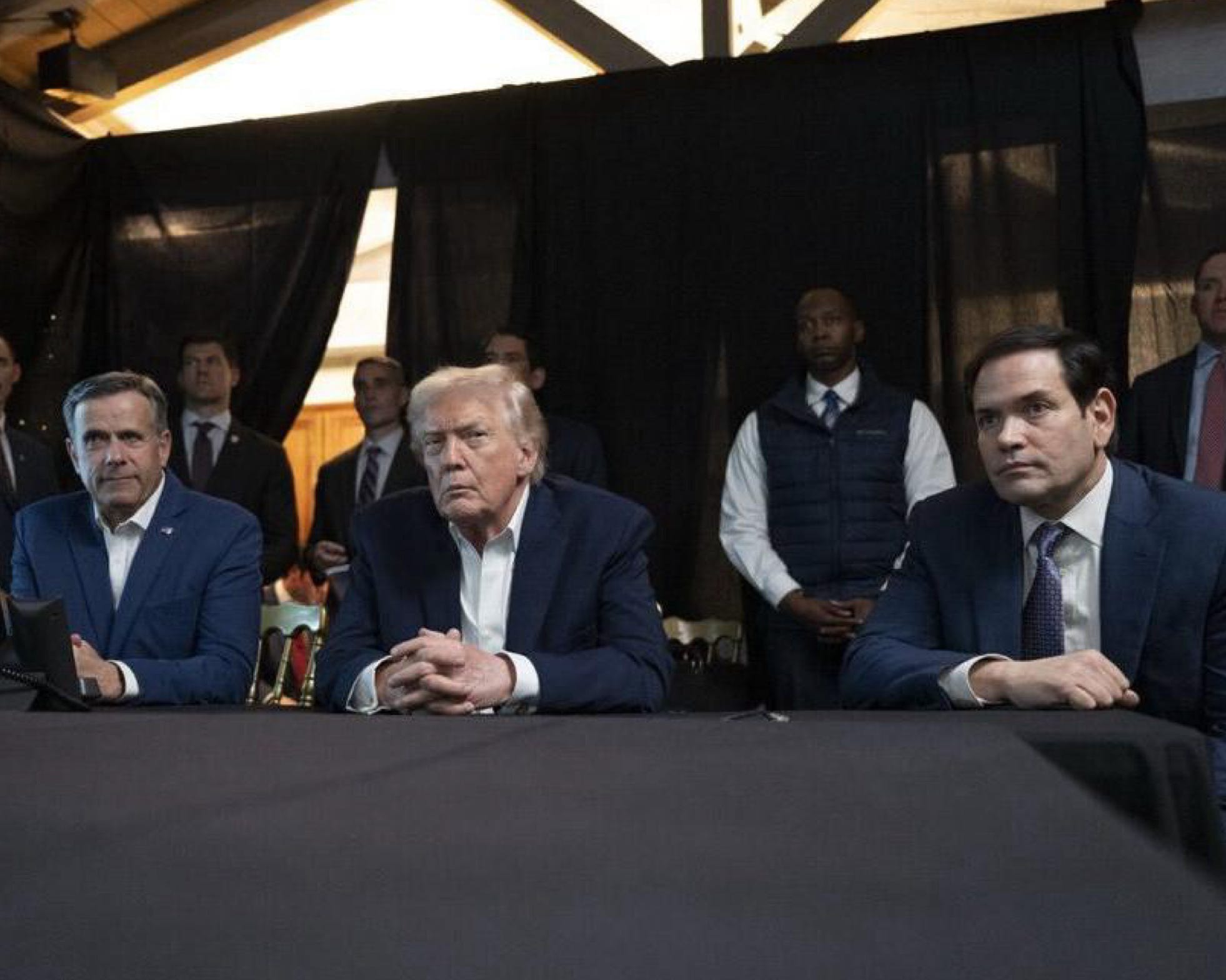
On the morning of a highly consequential news cycle, a photograph was published alongside reporting on the Venezuela crisis. This image was placed front and centre as a visual anchor in mainstream media for its story about an administration in crisis and a president on the defensive. But, the image was far from a neutral capture of public business; it was a constructed tableau, what the administration and its allies likely hoped the public would absorb as evidence of ‘control,’ ‘gravity,’ and ‘unity.’
Look closely, though. This image is performance rather than documentation. Everything in it, from the place chosen, to the staging of bodies, to the visual emptiness, is doing ideological work. What we are shown is not governance in action but the appearance of inevitability.
To understand what this photograph intends you to believe, and how it does that, it must be read against the visual tradition it imitates.
Cold War Executive Imagery: Power as Process
During the Cold War, executive photography served a specific ideological function. Images from the Kennedy administration during the Cuban Missile Crisis, particularly those of the Executive Committee of the National Security Council (ExComm), are dense with visual cues of democratic process. Men lean forward. Papers are spread across tables. Bodies turn toward one another. The room itself matters: identifiable, institutional, civic.
Those photographs reassured the public that unimaginable power was being exercised collectively, cautiously, and procedurally. Authority was not personalised but distributed. Even the president appeared as first among equals, burdened by uncertainty rather than elevated above it (WBUR, 2017).
The same is true, albeit more cynically, of Nixon-era National Security Council imagery. Photographs of Nixon and Kissinger present a colder, more hierarchical world, but still one rooted in bureaucratic machinery. Documents, telephones, briefing materials dominate the frame. Kissinger is frequently shown mid-speech or mid-gesture, embodying expertise and argument. Power appears calculating, but still recognisably institutional (Nixon Foundation, 2017).
In both cases, legitimacy is visually anchored in process.
Subscribe to Notes From Plague Island and join our growing community of readers and thinkers.
The Trump Image: The Stage Replaces the Room
The Trump image visually imitates legitimacy, but it falls short and tells a different kind of story. The black curtain behind the figures erases all sense of institutional space. This is not a Situation Room, an Oval Office, or a recognisable civic interior. It is a stage. The absence of architecture is ideological: democracy depends on visible spaces of governance. Here, place dissolves into abstraction.
All that remains is the body of the leader. Trump sits centrally, fully illuminated, framed symmetrically by senior figures. The lighting is ruthless in its hierarchy: he is legible, the others progressively less so. Security personnel recede into shadows, present but indistinct. Visibility is authority; obscurity is force. This is deliberate staging. It tells the viewer exactly where power resides, and where it does not.
The table dominates the image, forming a hard horizontal barrier between the viewer and the figures seated behind it. In Cold War imagery, tables were sites of labour: cluttered, functional, and alive with competing claims. Here, the table is empty. There are no papers or maps. No telephones; no trace of deliberation.
Th function here is defensive. Power is sealed off from scrutiny rather than being open to view. The emptiness is as intentional as the bodies themselves: decisions are not being made here because they have already been made.
This image presents authority as finality.
Trump’s Expression: Severity Without Doubt
Trump’s facial expression is the emotional centre of the image. It is carefully chosen. The mouth is set, the eyes heavy, the jaw tense. This is not the theatrical aggression of the rally stage, but a performance of executive gravity.
Art-historically, this draws from Cold War portraits of presidential burden, the leader as the man who must decide. But where Kennedy’s expressions conveyed anxiety and moral weight, Trump’s conveys inevitability. There is no visible doubt, no sign of contingency.
The hands tell a different story. Clasped tightly, fingers interlocked, they suggest containment rather than calm; tension held in check. The image strains to project control, but the body betrays compression. Authority here is asserted, not inhabited.
The figures flanking Trump act as legitimising supports rather than collaborators. They lean subtly inward, reinforcing his centrality. Their expressions are attentive but mute. They do not argue. They do not interrupt. They do not think visibly.
This marks a decisive break from Cold War imagery, where disagreement, particularly expert disagreement, was part of the visual script. The Cuban Missile Crisis photographs are compelling precisely because they show uncertainty made visible. Nixon/Kissinger images show calculation, strategy, tension between civilian and military priorities.
In the Trump image, cognition has been replaced by loyalty. Expertise is just implied, not shown. Dissent is completely absent.
Behind the seated figures stand security personnel, upright, hands clasped, half-obscured by darkness. Their presence signals threat without naming it. Danger is everywhere and nowhere, an amorphous justification for authority. This is classic authoritarian visual language. Fear is ambient. The viewer is not invited to understand the threat, only to accept that it exists and that command must therefore be centralised.
Cold War Form, Authoritarian Content
What makes this image so revealing is not that it mimics Cold War executive aesthetics, but that it does so without the Cold War ethic of restraint.
The imagery of the mid-twentieth century was haunted by catastrophe. Nuclear annihilation loomed. Photographs of power carried an implicit moral weight: decisions mattered because consequences were real and irreversible.
The Trump image carries none of that ethical burden. It performs decisiveness without consequence, authority without accountability, command without explanation. The ethical anxiety that once underpinned executive imagery has been stripped away, leaving only posture.
And this photograph is not an outlier. It is emblematic of Trump’s broader visual culture, which consistently substitutes affect for structure. Power is communicated through facial expression, spatial dominance, and controlled visibility rather than through institutions or procedures.
Democracy relies on seeing how decisions are made. Trump’s imagery refuses that visibility. It closes ranks. It seals spaces. It presents authority as self-justifying and complete. The message is simple and chilling: the decision has been made; your role is to witness, not to question.
Conclusion
This image wants to look inevitable. It wants to feel like the calm centre of a dangerous world. But inevitability is not legitimacy, and severity is not wisdom. By appropriating the visual language of Cold War executive power while hollowing out its democratic content, the Trump administration reveals something more corrosive than authoritarian affect: a stage of political decay in which power no longer feels obliged to explain itself, justify itself, or even acknowledge the public as a participant.
Late–Cold War empires learned, often too late, that when authority becomes spectacle and deliberation is reduced to posture, collapse follows not from external threat but from internal exhaustion. What is being staged here is not leadership under constraint, but authority without audience, a system still wearing the costume of command long after the habits that once sustained it have eroded. In that sense, the photograph is more than propaganda. It is a warning image: a portrait of imperial power at the moment it mistakes performance for permanence.
Or support us with a one-off tip → Buy Me a Coffee
References
The Guardian (2026) ‘ ‘Extremely Dangerous Precedent’ set by Trump’s attack on Venezuela, six countries warn - live,’ 4 January. Available at: https://apple.news/AlVZKoww9SUaN7AJ0nSWN2A [Accessed: 4 January 2026].
Nixon Foundation (2017) ‘How Nixon and Kissinger Dealt with North Korea,’ 23 August. Available at: https://blog.nixonfoundation.org/2017/08/nixon-kissinger-dealt-north-korea/ [Accessed: 4 January 2026].
WBUR (2017) ‘Remembering JFK: The Cuban Missile Crisis,’ 23 May. Available at: https://www.wbur.org/radioboston/2017/05/23/cuban-missile-crisis [Accessed: 4 January 2026].


