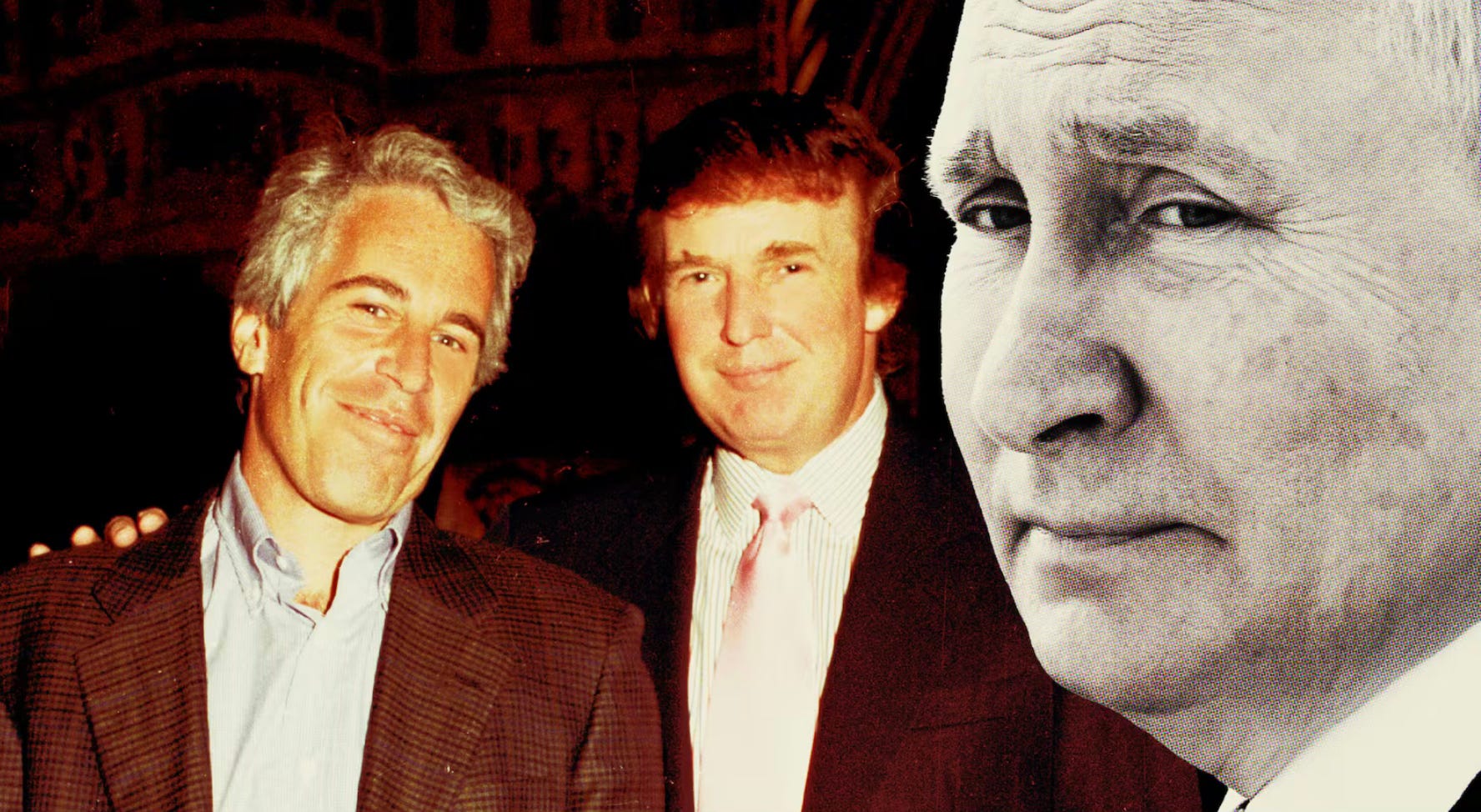
An Empire of Malign Influence: The Russian Rot at the Core of the Epstein Enterprise

The story of Jeffrey Epstein is one we think we know: a tale of a predator who used immense wealth and power to prey on the vulnerable. But to see Epstein merely as a lone monster is to miss the true, systemic nature of his operations. The recently released trove of documents from the US Department of Justice adds more names to his list of associates and exposes the superstructure of his entire enterprise. It reveals a sprawling, transnational network of crime, influence, and corruption that points directly to the heart of the Kremlin.
Before proceeding, one thing must be stated plainly: Epstein did not need Russia to be a monster. He was already one. His crimes — the trafficking, the abuse, the systematic destruction of young lives — were the product of his own insatiable, perverted appetites and the catastrophic failure of every institution that should have stopped him. What the Russia connection reveals is something distinct and, in its own way, even more disturbing: it shows how the concentrated, unaccountable power of the global elite creates the conditions in which authoritarian states can operate freely, because the corruption is already there, waiting to be exploited. Epstein’s story is not primarily a story about Russia, but about what power does to people, and what people do with power when no one is watching. Russia simply recognised him for what he was; a man who had built, through sheer force of greed and depravity, the most valuable intelligence asset in the world, and used him accordingly.
The evidence paints an undeniable picture of a symbiotic and deeply embedded relationship between Epstein and the Russian state. The documents show a man who was not just a sex trafficker, but a willing and indispensable asset at the nexus of Western elite corruption and Russian malign influence operations. He was a super-connector, a facilitator, and a pioneer in the weaponisation of money, sex, and blackmail. This was a geopolitical enterprise; Epstein’s network functioned as a perfectly engineered intelligence operation, a private-sector kompromat factory that served the strategic objectives of Vladimir Putin’s Russia. This is the story of the rot at the core of the Epstein enterprise — a rot that was always human, always venal, and always greedy for more. It is a story that demands to be told in full, because the forces it describes are not historical curiosities but active, ongoing threats to the security and integrity of every Western democracy.
Courting the Kremlin: The Overt Pursuit of Power
The sheer audacity of Jeffrey Epstein’s ambition is laid bare in his relentless and overt pursuit of the Russian state. This was the brazen campaign of a man who believed he belonged in the room with tyrants, a man convinced he had something of value to offer the Kremlin. His communications reveal a deliberate, multi-year strategy to embed himself within Russia’s power structures, moving far beyond casual networking into the realm of geopolitical manoeuvring.
The ultimate prize for Epstein was Vladimir Putin himself. The documents reveal multiple, persistent attempts to secure a private, multi-hour meeting with the Russian dictator (Zadorozhnyy, 2026). He leveraged high-level intermediaries, most notably the former Norwegian Prime Minister and then-Secretary General of the Council of Europe, Thorbjørn Jagland, as his personal couriers to the Kremlin. In a stunning June 2018 email, Epstein instructed Jagland to make a direct suggestion to Putin: “I think you might suggest to putin, that lavrov, can get insight on talking to me” (Khurshudyan, Ullah, and Culpepper, 2026). The implication was clear: Epstein believed he held a unique key to understanding the West, a key he was eager to hand over to Russia’s foreign minister.
His confidence stemmed from his established relationship with another key Russian figure: the late UN Ambassador Vitaly Churkin. Epstein boasted to Jagland that “vitaly churkin used (to) but he died. ?!” (Khurshudyan, Ullah, and Culpepper, 2026). He claimed that Churkin, with whom he met regularly in New York, “understood trump after [our] conversations,” positioning himself as the essential interpreter of American power for Moscow. In a classic intelligence tradecraft move to build rapport and obligation, Epstein had also offered to help Churkin’s son, Maxim, secure a job at a New York wealth management firm, stressing confidentiality at every step. “Any Maxim help is confidential,” Epstein wrote. “He’s a great son” (Zadorozhnyy, 2026). The correspondence also included social invitations, with Epstein inviting Churkin for coffee and to his home, noting in one message that former Israeli Prime Minister Ehud Barak would be visiting the following day and that Churkin was always welcome. When Churkin died suddenly in 2017, Epstein lost a direct conduit to the Kremlin’s diplomatic machine, one he was desperate to replace. Churkin’s death, officially from a heart attack, was one of at least six high-profile Russian diplomats to die suddenly and unexpectedly in the nine months between November 2016 and August 2017 (Cohen and Pagliery, 2017). The US State Department took the unusual step of instructing New York’s medical examiner not to release the full autopsy report, fuelling further suspicion (BBC News, 2017).

The role of Ehud Barak as a bridge between Epstein and the Russian elite deserves particular attention. In May 2013, Epstein wrote to Barak that Jagland was going to see Putin in Sochi and asked if Epstein could meet the Russian president “to explain how russia can structure deals to encourage western investment” (Khurshudyan, Ullah, and Culpepper, 2026). Epstein instructed Jagland to tell Putin that “you and I are close, and that I advise Gates.” After attending SPIEF in 2015, Barak reported back to Epstein that he had met Lavrov, the head of Russia’s central bank Elvira Nabiullina, and other senior Russian banking officials, writing: “Thx for (setting) the whole thing together” (Khurshudyan, Ullah, and Culpepper, 2026). The picture that emerges is of Epstein as a kind of geopolitical concierge, arranging meetings, making introductions, and positioning himself as the indispensable middleman between Western power and the Kremlin.
Perhaps the most damning connection is Epstein’s close relationship with Sergey Belyakov, a graduate of Russia’s FSB Academy — the primary training ground for its intelligence officers (Power, 2026). Epstein referred to Belyakov as “my very good friend” in a 2015 email to billionaire Peter Thiel, offering to introduce the two men (Khurshudyan, Ullah, and Culpepper, 2026). While serving as head of the St. Petersburg International Economic Forum (SPIEF), Putin’s glitzy alternative to Davos, Belyakov acted as far more than a mere conference organiser. As former CIA officer Alex Finley has noted, events like SPIEF “are never really just about investment... (they are) about gaining leverage over important people” (Ingber and Finley, 2026). In a chilling 2015 exchange, Epstein sought Belyakov’s help in dealing with a Russian model who was allegedly blackmailing powerful American businessmen. “I need a favor,” Epstein wrote, describing an extortion attempt at the Four Seasons Hotel in New York (Power, 2026). Belyakov, the FSB Academy graduate, responded not with the advice of a civilian bureaucrat, but with the cold efficiency of an intelligence officer. He provided Epstein with a detailed, roughly 100-word intelligence-style profile of the woman, noting her operational patterns, her “sex and escort” business, her lack of state “patronage,” and coolly suggesting that denying her access to the United States would be a “real threat” to her business (Power, 2026; Dossier Center, 2026). The relationship was deeply reciprocal. In return, Epstein acted as a key recruiter for SPIEF, exploiting his own network to bring high-profile Westerners into Russia’s orbit. After Belyakov arranged introductions with Thiel and billionaire Thomas Pritzker, the Russian official reported back to Epstein that the meetings had been “very helpful” and that he was “surprised that they had a lot of information about Russian economy” (Power, 2026). Belyakov also drafted a recommendation letter for Epstein’s Russian assistant, Svetlana Pozhidaeva, for a US visa, further intertwining their personal and professional networks (Dossier Center, 2026). Crucially, Belyakov now works alongside Kirill Dmitriev, a figure on Russia’s negotiating team dealing with Trump envoys Keith Kellogg and Steve Witkoff — a detail that underscores the continuing relevance of this network (Ingber and Finley, 2026).
The Financial Web: Oligarchs, Sanctioned Banks, and Dirty Money
If Epstein’s diplomatic overtures reveal his ambition, his financial dealings expose the architecture of his operation. His Russian connections were built on a shared ecosystem of dirty money, sanctions evasion, and the weaponisation of finance that is the hallmark of Putin’s kleptocracy. An uncorroborated but explosive claim contained within an FBI FD-1023 intelligence report from 2020 alleged that Epstein served as a “wealth manager” for Vladimir Putin himself, helping the dictator and other autocrats hide their illicit fortunes offshore (Cooper, 2026; Zadorozhnyy, 2026). While the claim remains unproven, Epstein’s documented actions show that he swam in these murky waters and helped build the plumbing for a parallel, criminalised financial system.
His choice of financial institutions is telling. As former CIA officer Alex Finley notes, Epstein was comfortable using sanctioned Russian banks like Alfa-Bank and Sberbank, institutions known to be intimately “connected back to Putin and his main oligarchs” and which have been “used in the past to get money out of Russia in order to use for Russian intelligence operations in the West” (Ingber and Finley, 2026). This was a deliberate choice to operate within the Kremlin’s financial shadow-world, a decision that provided both access and a degree of deniability that state-to-state channels could not offer.
The web extends directly to Russia’s most powerful oligarchs. The documents show correspondence and repeated attempts by Epstein to arrange meetings with Oleg Deripaska, a man the US Treasury has identified as a key figure in laundering money on behalf of Putin (Zadorozhnyy, 2026). These connections were facilitated by figures like the British politician Peter Mandelson, who acted as an intermediary, discussing Deripaska’s property and business interests with Epstein. In one 2010 exchange, Mandelson even offered to help Epstein secure a Russian visa at short notice, a trip that emails suggest was for the purpose of meeting young women in Moscow (Fenwick and Tavriger, 2026). The trip was ultimately cancelled because of delays in obtaining the necessary visas, but the exchange reveals the seamless integration of political access, financial manoeuvring, and sexual procurement that defined Epstein’s world. On the very same day Epstein asked Mandelson for visa help, he was emailing a woman in Russia who replied that she “really want(ed) to have someone very nice soon” for him and that she had “around 10 friends” she was “working on now” (Fenwick and Tavriger, 2026). The casual, transactional language of sexual procurement, running in parallel with the diplomatic language of visa applications and oligarch meetings, tells us everything we need to know about the nature of this operation.
Beyond simply moving money, Epstein was actively pitching ideas to the Kremlin for a new kind of financial warfare. He proposed that Russia could “leapfrog” the West by creating a “sophisticated Russian version of Bitcoin” and a new cryptocurrency he called “BRIC,” while also suggesting a new bank that could lend out “nine times its reserves” (Zadorozhnyy, 2026). These were blueprints for a parallel financial system designed to operate outside of Western oversight and undermine the global economic order. “(Putin) is in a unique position to do something grand, like Sputnik did for the space race,” Epstein wrote to Jagland in 2013, adding that the conversation was “confidential” and that he would need “a minimum of two to three hours” with the Russian president to explain his vision (Zadorozhnyy, 2026). He was offering the Kremlin the tools to fight a new kind of war, with him as a key architect. The scale of Russia’s presence in the files is itself huge: the latest batch of documents mentions Russia 5,876 times and Putin 1,055 times, a statistical testament to the depth of his obsession and entanglement (Zadorozhnyy, 2026).
The Intelligence Nexus: Kompromat, Access Agents, and ‘Useful Idiocy’
To understand the Epstein-Russia connection, one must look beyond the traditional, Cold War model of a spy. Epstein was likely never a trench-coated figure exchanging dead drops in a foggy park. His value to Russia was something far more modern, and far more insidious. Analysing his operations through the lens of intelligence tradecraft reveals a man who functioned as a perfect, if perhaps informal, intelligence asset, a man who built a deniable, privatised intelligence service fuelled by greed and depravity.
As intelligence expert Robert Dover has argued, Epstein fits the profile of an “access agent” to a tee (Dover, 2026). The value of an access agent lies not in the secrets they personally possess, but in the unparalleled social and professional access they provide to those who do. With his private jets, his sprawling mansions, and his carefully curated aura of scientific and financial genius, Epstein created the ultimate platform for access. He was, as one former US Attorney was allegedly told, a man who “belonged to intelligence” and should be left alone (Skeptic Magazine, 2025). This operational model has a dark precedent in his own circle: Ghislaine Maxwell’s father, the notorious tycoon Robert Maxwell, was himself widely suspected of being a lifelong agent for multiple intelligence services, including the Mossad and the KGB.
At the heart of this model was Epstein’s most potent weapon: kompromat. His industrial-scale sex trafficking operation was an expression of his own depravity, and a ready-made blackmail enterprise; a kompromat marketplace that aligned perfectly with the preferred methods of Russian intelligence services (Sipher, 2026). The goal of kompromat is not just extortion, but control. It creates a system, as former CIA officer John Sipher describes it, where “everyone is complicit, and everyone is vulnerable.” The files hint at this dark practice, with one 2013 email containing the shocking allegation that Epstein helped Bill Gates “get drugs in order to deal with the consequences of sex with Russian girls” (Zadorozhnyy, 2026). Every powerful figure lured onto his island, every politician who boarded his jet, every businessman who attended his parties, became a potential target, a node in a web of compromise that could be leveraged for influence and control.
Subscribe to Notes From Plague Island and join our growing community of readers and thinkers..
The same 2017 FBI informant report that alleged Epstein was Putin’s wealth manager also claimed he employed a “personal hacker” (Radauskas, 2026). While the name is redacted, the details point to Vincenzo Iozzo, an Italian cybersecurity expert who would later become a senior director at CrowdStrike. The informant alleged that this hacker developed zero-day exploits for iOS and BlackBerry, established the Saudi government’s cyber surveillance program, and even sold an exploit to the militant group Hezbollah. Epstein’s own emails confirm his interest in the field, with a 2009 message noting, “I think we should find great hackers at the Black Hat convention” (Radauskas, 2026). This adds a terrifying technological layer to the kompromat operation, suggesting a capacity for digital surveillance to complement the physical surveillance of his homes and island.
Was Epstein a witting collaborator, or a “useful idiot,” in the blunt terminology of Russian intelligence? The distinction, while important, may be strategically irrelevant. As Sipher argues, the Russian intelligence model is far more elastic than its Western counterparts. The Kremlin has long been comfortable drawing value from a broad ecosystem of “propagandists, witting collaborators, sympathizers, hackers, students, oligarchs, and other loosely connected helpers” (Sipher, 2026). Formal recruitment is not required when an individual’s own incentives and behaviours so perfectly advance Moscow’s dirty objectives. Epstein, driven by his own insatiable appetites for money, power, and sexual predation, created a machine that was perfectly suited to Russia’s strategic goals of sowing discord, gaining leverage, and rotting the Western elite from within. He may not have been a spy in the classic sense, but he may have caused as much damage as any highly placed mole. He was a willing vendor in the marketplace of corruption, and the Kremlin was his most eager customer. Whether he was on the payroll or simply pursuing his own monstrous agenda, the outcome for Russia was the same: the systematic corruption of the institutions, individuals, and alliances that underpin the entire Western security architecture.
What Moscow Gets: The Strategic Logic of the Epstein Connection
To fully grasp the significance of the Epstein-Russia nexus, one must ask the question that Western intelligence agencies have been conspicuously reluctant to answer in public: what, precisely, did Russia gain from this relationship? The answer is not one thing, but five — five distinct and compounding strategic benefits that, taken together, represent one of the most cost-effective intelligence operations of the modern era.
The first and most obvious benefit is kompromat on the Western elite. Russian intelligence doctrine, rooted in KGB tradecraft and refined by the FSB, treats the cultivation of compromising material on foreign officials, politicians, and businessmen as a primary strategic asset. Epstein’s operation was, functionally, a kompromat factory at industrial scale. Every powerful figure who visited his properties — politicians, financiers, royals, academics — was photographed, recorded, and documented. Russia did not need to run Epstein as a formal agent to benefit from this; it simply needed access to the product, or the knowledge that the product existed and could be activated at a moment of Moscow’s choosing. The threat of exposure is often more valuable than exposure itself.
The second benefit is leverage over the American presidency. The Trump dimension is the apex of the Epstein-Russia story. If Russia possessed any form of leverage over Donald Trump via the Epstein network, it would represent the single most significant intelligence penetration of the American executive branch in history. The documented overlap between Trump’s social world, Epstein’s operation, and the Kremlin’s ambitions is the central fact of the entire affair, and its implications for American foreign policy — from NATO to Ukraine — are impossible to overstate.
The third benefit is the disruption of Western institutional trust. Even if no specific kompromat was ever directly deployed, the mere existence of the Epstein network and its eventual, explosive exposure, serves Russian strategic interests by corroding public faith in Western democratic institutions, the judiciary, the intelligence services, and the political class. The chaos, the scandal, the endless revelations of elite complicity: this is precisely the kind of societal fracture that Russian active measures doctrine is designed to engineer. The Epstein files are, in this sense, a Russian intelligence win regardless of whether Moscow ever pulled a single string.
The fourth benefit is financial intelligence and sanctions evasion. The FBI’s claim that Epstein managed Putin’s wealth points to a more prosaic but equally important return: the use of Epstein’s financial network to move money outside the reach of Western sanctions and regulatory oversight. This is consistent with the well-documented use of Western-connected intermediaries by Russian oligarchs, and it explains why Epstein’s comfort with sanctioned Russian banks was a core operational feature.
The fifth, and perhaps most underappreciated, benefit is access to cutting-edge science and technology. Epstein’s cultivation of scientists at MIT, Harvard, and the Santa Fe Institute gave him extraordinary proximity to emerging research in artificial intelligence, genetics, and quantum computing. Russian intelligence has a long-documented and voracious appetite for Western scientific and technological intelligence. Epstein was, in effect, a one-stop shop: a man who could deliver the secrets of the boardroom, the bedroom, and the laboratory, all under one roof; all deniable, and all for the price of a few introductions and a seat on a private jet.
The Human Pipeline: Trafficking from the East
The most visceral horror of the Epstein enterprise will always be the human cost. His network was built on the bodies of young women and girls, and the newly released files confirm a deliberate focus on victims from Russia and Eastern Europe. This was a targeted human trafficking pipeline that turned the vulnerable into a currency of international influence and a tool for blackmail. The geography of his predation maps onto the geography of post-Soviet instability and organised crime, creating a system of exploitation that was both industrial in scale and disturbingly personal in its cruelty.
The mechanics of this pipeline are laid bare in the documents. Investigators have identified Warsaw, Poland, as a key transit hub, a gateway through which Epstein sourced victims from across the former Eastern Bloc (Day, 2026). Hundreds of flights in and out of Warsaw’s Chopin Airport are documented, with passenger names often redacted — a sombre indicator that they were victims. Epstein’s executive assistant, Lesley Groff, managed the logistics with chilling efficiency. “FYI, I changed [name redacted] ticket this morning to depart Poland on 27th and go to the island on the 28th,” reads one 2014 email (Day, 2026). Another email from 2019 details a young woman flying from Kyiv to Paris via Warsaw, noting, “She should have her passport stamped there” (Day, 2026). The overlap between these trafficking routes and Russian organised crime is well-documented, and as former CIA officer Alex Finley has pointed out, these networks have long served as a tool for Russian intelligence operations in the West (Ingber and Finley, 2026). The scale of this operation has prompted Poland’s Prime Minister, Donald Tusk, to launch a formal investigation into the “satanic circle,” looking for any evidence that Polish women or girls were trafficked and whether Russian intelligence was involved (Reuters, 2026a; CBS News, 2026). Latvia and Lithuania have followed suit, opening their own criminal probes into human trafficking (Reuters, 2026b).
Epstein’s inner circle was itself populated with key figures from this world. It is crucial to distinguish between witting associates and victims, but the line was often deliberately blurred. One of his publicists was Maria Drokova, a Russian national now known as Masha Bucher. Before becoming a Silicon Valley venture capitalist with Epstein’s help, Drokova was a prominent activist in ‘Nashi,’ a pro-Kremlin youth movement often described as the “Putin Youth” (Martin, 2026). She gained notoriety in Russia after being filmed giving Vladimir Putin a kiss at a youth forum, the subject of the 2012 documentary Putin’s Kiss. Another Russian national, Svetlana Pozhidaeva, a graduate of the elite Moscow State Institute of International Relations (MGIMO), was also a key assistant, with Epstein’s own lawyer filing the trademark paperwork for her “Women’s Empowerment” project, which shared an address with the Epstein Foundation (Dossier Center, 2026). These were trusted insiders, women who moved seamlessly between the worlds of Kremlin-backed politics, Russian high society, and Epstein’s criminal enterprise. Pozhidaeva was even photographed leaving Epstein’s Manhattan mansion in December 2010, at a time when Prince Andrew was staying there (Dossier Center, 2026). The interweaving of these worlds — Russian state-connected individuals, British royalty, and an American sex trafficker — is the architecture of an influence operation.
The most baffling and disturbing thread in this human pipeline leads to a Belarusian dentist named Karyna Shuliak, Epstein’s last romantic partner. She was, as Le Monde has reported, simultaneously his lover, his manager, and his dependent (Jego, 2026). Their relationship began in 2009, when Shuliak was a 20-year-old dental student in Minsk and Epstein was 36 years her senior. He invited her to the United States, all expenses paid, promising help with her studies and visa support. She arrived in New York in August 2009, just after he had served his first prison sentence for procuring minors for prostitution, and she remained loyal to him until his death a decade later. His very last phone call from his jail cell was to her. Just two days before he died, Epstein signed a new will making Shuliak the primary beneficiary of his vast fortune, set to inherit approximately $100 million in cash and property, including a 33-carat diamond, his Manhattan townhouse, his Paris apartment, his private islands, and his New Mexico ranch (New York Times, 2026; Belsat, 2026; Jego, 2026). Epstein had also engineered her admission to Columbia University’s dental school, with a professor on the admissions committee later removed after it emerged he had solicited funds from Epstein. The geopolitical dimension of this relationship cannot be ignored. Belarus, under Alexander Lukashenko, effectively a client state of Vladimir Putin’s Russia, a country that has served as a staging ground for Russian military operations and a conduit for Kremlin influence. That the man at the centre of a Russian intelligence-adjacent network chose a Belarusian woman as his most trusted intimate — the last person he spoke to, the sole heir to his empire — is a detail that demands far more scrutiny than it has so far received.
The scrutiny only deepens when the full picture emerges. Shuliak was one of only nine employees at Epstein’s Southern Trust Company, the opaque financial vehicle at the heart of his empire (Yeryoma, 2026). Over a decade, Epstein wired at least $80,000 directly to her parents in Minsk, with her father purchasing an apartment in Drazdy, a Minsk suburb known for housing Belarusian officials and celebrities, shortly after receiving the funds (Yeryoma, 2026). Her parents made multiple personal visits to Epstein in the United States, including one less than a month before his 2019 arrest.
To maintain her US immigration status, Shuliak entered into a sham same-sex marriage with an Epstein associate, a US citizen, a scheme documented in the newly released files (Bloomberg, 2026). Shuliak is mentioned an extraordinary 40,000 times in the Epstein files, with Belarus and Minsk appearing approximately 1,500 and 1,000 times respectively — a statistical footprint that dwarfs almost every other individual or location in the documents (Yeryoma, 2026). Most damning of all: Epstein obtained a Belarusian visa, yet there is no official record of him ever crossing Belarus’s border through any official checkpoint.
According to Uldzimir Zhyhar of Belpol, the group of exiled Belarusian law enforcement officials who hold government records up to 2021, “the only way Epstein could have arrived in Belarus without producing a record of it in the passenger traffic system is by flying to Russia and travelling to Belarus from there by car or train” (Yeryoma, 2026). In a country where a wealthy American cannot obtain a visa or move large sums of money without the regime’s knowledge, the implications of that statement are impossible to ignore. The Epstein files also reference the name of exiled Russian opposition politician Ilya Ponomarev, who was described by Epstein associate Boris Nikolic as a potential future president of Russia who needed support during the 2011-2012 Bolotnaya protests. “I am afraid (of) what will happen to (Ponomarev),” the associate wrote. “The stakes are huge. He might replace Putin and become the president by himself” (Zadorozhnyy, 2026). Ponomarev himself has denied ever knowing Epstein. The episode illustrates the sheer breadth of Epstein’s Russian ambitions: he was courting the Kremlin, and hedging his bets across the entire spectrum of Russian power, from the ruling elite to the opposition.
The Trump-Russia-Epstein Triangle
The most explosive and nationally significant dimension of the Epstein-Russia saga is its intersection with American politics at the highest level: the presidency of Donald Trump. This is a tale of one very tightly woven rope. Trump’s well-documented, decades-long friendship with Epstein and his equally long and desperate pursuit of Russian money and influence are two sides of the same grubby, corrupt coin. Together, they created the perfect storm of personal depravity and geopolitical ambition that left the American presidency critically exposed to the Kremlin.
Trump’s relationship with Epstein was deep, lasting, and built on a shared predatory worldview. They were neighbours in Palm Beach, fixtures at the same parties, and, according to one former Trump casino executive, Epstein was Trump’s “best friend” for a time (Klee and Ramirez, 2025). They flew on each other’s private jets. Epstein was a guest at Trump’s 1993 wedding. In a now-infamous 2002 interview, Trump called Epstein a “terrific guy,” adding, “It is even said that he likes beautiful women as much as I do, and many of them are on the younger side” (Klee and Ramirez, 2025). This was intended as a boast. The two men were, as former CIA officer John Sipher has argued, “birds of a feather,” two predators who had spent decades building their power in the same moral sewer, each one a mirror of the other’s appetites and vulnerabilities (Sipher, 2026).
This shared ecosystem was fundamentally Russian in character. For the same thirty years that he was friends with Epstein, Trump was also desperately trying to do business in Russia. He made repeated, failed attempts to build a Trump Tower in Moscow, a project that became an obsession (Corn and Isikoff, 2018). His 2013 Miss Universe pageant in Moscow was a business development trip, a vehicle to finally secure the deal he craved. He was, by his own admission, desperate to meet Vladimir Putin, tweeting, “will he become my new best friend?” (Corn and Isikoff, 2018). This decades-long courtship of the Kremlin, and his reliance on lenders like Deutsche Bank — a bank fined hundreds of millions for laundering Russian money — demonstrates a clear and consistent pattern: Trump has always been drawn to the orbit of Russian power and its associated dirty money.
Epstein was the natural bridge between these two worlds. His network of Russian oligarchs, state-connected officials, and intelligence-linked figures was precisely the milieu Trump sought to penetrate. When Epstein offered the Kremlin “insight on talking to” President Trump, he was not bluffing; he was marketing a relationship he had cultivated for decades (Khurshudyan, Ullah, and Culpepper, 2026). He understood Trump’s transactional, ego-driven nature because it was his own. His assessment that Trump “must be seen to get something” was the core of their shared worldview (Zadorozhnyy, 2026).
The continued presence of Epstein’s network within Trump’s inner circle, even after his 2008 conviction, underscores this point. In 2019, Epstein was still texting with former Trump adviser Steve Bannon. His Commerce Secretary, Howard Lutnick, was coordinating Caribbean yacht visits with Epstein in 2012. His pick for the Federal Reserve, Kevin Warsh, was on a party list for St. Barth’s (Rogin, 2026). These were part of an integrated social and professional world where Epstein remained a key node. The presence of Russian ultranationalist ideologue Alexander Dugin in the same web of communications as Steve Bannon is a symptom of this convergence (Zadorozhnyy, 2026).
The ultimate, terrifying conclusion is that Epstein’s Russian-linked kompromat operation was a live intelligence threat that had a direct line into the Oval Office. The cesspool of corruption that Epstein cultivated, with its deep Russian connections, was the perfect environment to ensnare a man with Trump’s unique combination of moral flexibility and desperate ambition. Answering the question of what leverage this network gave the Kremlin over a sitting US President is no longer the domain of conspiracy theorists, but a matter of urgent national security. The failure to fully investigate and comprehend the Trump-Russia-Epstein triangle represents a catastrophic intelligence failure for the West, one whose consequences we are still living with today.
Conclusion: The Rot at the Core
The Epstein-Russia connection is a story of systemic corruption and state-sponsored criminality. It reveals a world where the lines between intelligence, organised crime, high finance, and political power have dissolved into a toxic sludge. Jeffrey Epstein was a depraved individual, a symptom and a vector of a rot that has infested the core of Western institutions; a rot that the Kremlin was all too willing to cultivate and exploit for its own strategic ends. The international community is slowly waking up to the scale of the damage, with formal investigations now underway in Poland, Latvia, Lithuania, and Norway (Reuters, 2026a; Reuters, 2026b; Khurshudyan, Ullah, and Culpepper, 2026). Estonia’s Foreign Affairs Committee chairman, Marko Mihkelson, has stated it is “increasingly likely that Epstein consciously or unconsciously served the interests of Russian intelligence” (Ingber and Finley, 2026).
He built an empire of malign influence, a deniable, privatised intelligence service fuelled by greed and degredation. He offered access, he laundered money, he traded in human misery, and he created a global marketplace for blackmail. The result was the ensnaring of the global elite in a web of compromise and corruption whose full dimensions we are only now beginning to understand.
But it is worth pausing, at the end of this catalogue of horrors, to resist the temptation of a single, clean narrative. Epstein was not a Russian creation. He was a Western one. He was the product of a culture that worships wealth without scrutiny, that grants access without accountability, and that protects the powerful from the consequences that destroy the powerless. The billionaires who flew on his jet, the scientists who took his money, the politicians who attended his parties — they were not victims of Russian manipulation. They were participants in a system of elite impunity that has nothing to do with Moscow and everything to do with the moral bankruptcy of unchecked power. Russia did not build the rot. It simply moved in.
The full extent of the damage may never be known. The names that have been released are likely only a fraction of those who passed through Epstein’s web. But the outline of the operation is now clear. While Europe opens investigations and demands accountability, the United States under the Trump administration has shown little appetite for pursuing the Russian dimension of the Epstein case. The contrast is stark and deeply troubling. It is a structure of blackmail and corruption, spun from the darkest threads of human nature, with Vladimir Putin’s Moscow sitting at its centre, patiently waiting to pull the strings. The question is no longer whether the web existed. The question is whether we have the courage to tear it down — and whether the people with the power to do so are already too deeply caught inside it.
Or support us with a one-off tip → Buy Me a Coffee.
References
BBC News (2017) ‘Vitaly Churkin: US will not release cause of Russian’s death’, BBC News, 10 March. Available at: https://www.bbc.com/news/world-europe-39237748 [Accessed: 22 February 2026].
Belsat (2026) ‘Belarusian heiress: How Karyna Shulyak became Jeffrey Epstein’s main beneficiary’, Belsat, 19 February. [Accessed: 20 February 2026].
Bloomberg (2026) ‘Epstein’s Girlfriend Married a Woman, Showing How He Gamed Visas’, Bloomberg, 14 February. Available at: https://www.bloomberg.com/news/features/2026-02-14/epstein-files-sham-marriages-student-visas-used-to-keep-women-in-us [Accessed: 22 February 2026].
CBS News (2026) ‘Polish PM Donald Tusk announces probe to see if Epstein’s “satanic circle” trafficked Polish women, girls’, CBS News, 4 February. Available at: https://www.cbsnews.com/news/epstein-poland-donald-tusk-investigation-satanic-circle-trafficked-polish-women-girls/ [Accessed: 20 February 2026].
Cohen, M. and Pagliery, J. (2017) ‘Nine months, nine prominent Russians dead’, CNN, 24 August. Available at: https://www.cnn.com/2017/03/24/europe/dead-russians [Accessed: 22 February 2026].
Cooper, S. (2026) ‘New Epstein Files Include FBI Report on Alleged Intelligence Connections to Israel, Russia, China, UAE’, The Bureau News, 30 January. Available at:
[Accessed: 20 February 2026].
Corn, D. and Isikoff, M. (2018) ‘What Happened in Moscow: The Inside Story of How Trump’s Obsession with Putin Began’, Mother Jones, 8 March. Available at: https://www.motherjones.com/politics/2018/03/russian-connection-what-happened-moscow-inside-story-trump-obsession-putin-david-corn-michael-isikoff/ [Accessed: 22 February 2026].
Day, M. (2026) ‘Hunting ground: Warsaw’s and Eastern Europe’s role in Epstein trafficking machine’, TVP World, 6 February. Available at: https://tvpworld.com/91452414/how-warsaw-played-a-key-role-in-the-epstein-trafficking-machine[Accessed: 21 February 2026].
Dossier Center (2026) ‘Jeffrey Epstein’s Russian Connection’, Dossier Center, 12 February. Available at: https://dossier.center/jeffreyepsteinrusconnect-en/ [Accessed: 21 February 2026].
Dover, R. (2026) ‘A whiff of espionage around the Epstein files points to how intelligence and influence interact’, The Conversation, 10 February. Available at: https://theconversation.com/a-whiff-of-espionage-around-the-epstein-files-points-to-how-intelligence-and-influence-interact-275344 [Accessed: 20 February 2026].
Fenwick, J. and Tavriger, L. (2026) ‘Mandelson offered to help Epstein get Russian visa, documents suggest’, BBC News, 4 February. Available at: https://www.bbc.com/news/articles/c0r4knee4gno [Accessed: 22 February 2026].
Ingber, S. and Finley, A. (2026 ) ‘Jeffrey Epstein and Russian intelligence’, HUMINT, 9 February. Available at:
[Accessed: 21 February 2026].
Jego, M. (2026) ‘Karyna Shuliak was Jeffrey Epstein’s last partner and main heiress. She won’t benefit from his will’, Le Monde, 22 February. Available at: https://www.lemonde.fr/en/international/article/2026/02/22/karyna-shuliak-was-jeffrey-epstein-s-last-partner-and-main-heiress-she-won-t-benefit-from-his-will_6750738_4.html [Accessed: 22 February 2026].
Khurshudyan, I., Ullah, Z. and Culpepper, T. (2026) ‘Epstein tried to cozy up to Russian officials, repeatedly sought a meeting with Putin’, CNN, 8 February. Available at: https://www.cnn.com/2026/02/08/politics/epstein-putin-russian-officials-connections [Accessed: 20 February 2026].
Klee, M. and Ramirez, N.M. (2025) ‘Trump and Epstein: Complete Timeline of Their Friendship’’, Rolling Stone, 12 November. Available at: https://www.rollingstone.com/politics/politics-features/donald-trump-jeffrey-epstein-timeline-1235464225/ [Accessed: 22 February 2026].
Martin, I. (2026) ‘How Jeffrey Epstein Helped His Publicist Become a Big-Time Venture Capitalist’, Forbes, 4 February. Available at: https://www.forbes.com/sites/iainmartin/2026/02/04/how-jeffrey-epstein-helped-his-publicist-become-a-big-time-venture-capitalist/ [Accessed: 22 February 2026].
New York Times (2026) ‘Jeffrey Epstein’s Trust Reveals Beneficiaries of His Fortune’, The New York Times, 3 February. Available at: https://www.nytimes.com/2026/02/03/business/jeffrey-epstein-trust-inherit-karyna-shuliak.html [Accessed: 21 February 2026].
Power, J. (2026) ‘Epstein sought help of ex-Russian official linked to FSB, files show’, Al Jazeera, 12 February. Available at: https://www.aljazeera.com/economy/2026/2/12/epstein-sought-help-of-ex-russian-official-linked-to-fsb-files-show[Accessed: 22 February 2026].
Radauskas, G. (2026) ‘Epstein allegedly had a “personal hacker,” was into cyberwar and malware’, Cybernews, 2 February. Available at: https://cybernews.com/security/jeffrey-epstein-personal-hacker-doj/ [Accessed: 20 February 2026].
Rogin, A. (2026) ‘Epstein files reveal close ties to Trump’s influential inner circle’, PBS News, 3 February. Available at: https://www.pbs.org/newshour/politics/epstein-files-reveal-close-ties-to-trumps-influential-inner-circle [Accessed: 22 February 2026].
Reuters (2026a) ‘Poland to probe possible links between Epstein and Russia, PM Tusk says’, Reuters, 3 February. Available at: https://www.reuters.com/world/poland-probe-possible-links-between-epstein-russia-pm-tusk-says-2026-02-03/ [Accessed: 20 February 2026].
Reuters (2026b) ‘Latvia launches human trafficking investigation after Epstein file release’, Reuters, 5 February. Available at: https://www.reuters.com/business/media-telecom/latvia-launches-human-trafficking-investigation-after-epstein-file-release-2026-02-05/ [Accessed: 21 February 2026].
Sipher, J. (2026) ‘Birds of a Feather: Epstein, Trump, and Russian Intelligence’, Tomorrow’s Affairs, 16 February. Available at: https://tomorrowsaffairs.com/birds-of-a-feather-epstein-trump-and-russian-intelligence [Accessed: 22 February 2026].
Skeptic Magazine (2025) ‘Did Jeffrey Epstein “Belong to Intelligence”?’, Skeptic Magazine, 2 October. Available at: https://www.skeptic.com/article/did-jeffrey-epstein-belong-to-intelligence/ [Accessed: 20 February 2026].
Thom, F. (2025) ‘The Cesspool and Chaos: The Russian Connection in the Epstein Affair’, Desk Russie, 30 July. Available at: https://desk-russie.info/2025/07/30/the-cesspool-and-chaos-the-russian-connection-in-the-epstein-affair.html[Accessed: 21 February 2026].
Yeryoma, M. (2026) ‘The Belarusian woman at the center of Epstein’s final days’, The Kyiv Independent / Yahoo News, 10 February. Available at: https://www.yahoo.com/news/articles/belarusian-woman-center-epstein-final-181218949.html[Accessed: 22 February 2026].
Zadorozhnyy, T. (2026) ‘Epstein’s Russia connections, explained’, Yahoo News / The Kyiv Independent, 5 February. Available at: https://www.yahoo.com/news/articles/epsteins-russia-connections-explained-195658924.html [Accessed: 22 February 2026].