America's Shadow War: Part Two
The Moment of Rupture: Venezuela and the End of the Rules-Based Order
here is part one - America’s Shadow War: Part One
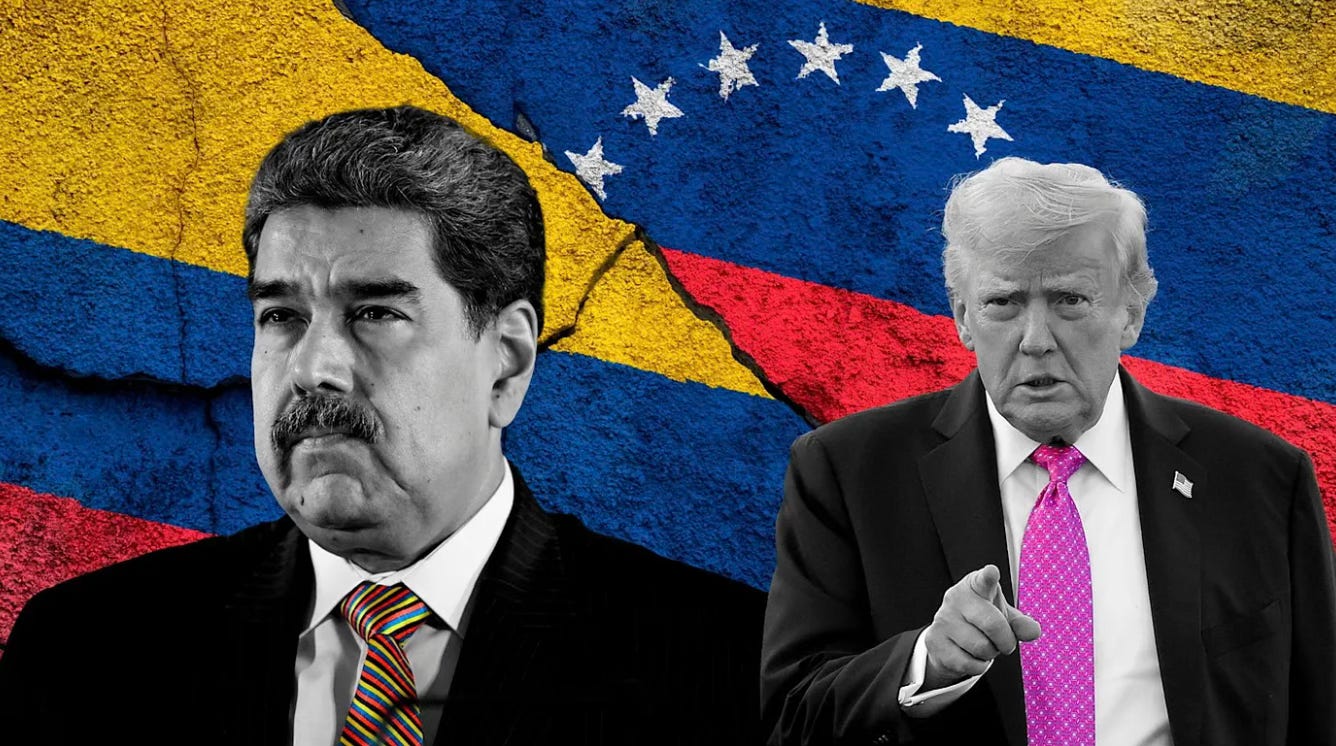
It began in darkness. Before dawn on January 3, 2026, the sky over Caracas was torn open by a series of explosions (Reuters, 2026a). At least seven of them ripped through the pre-dawn quiet (CNN, 2026a). Low-flying aircraft were heard, their engines a low growl in the night. Infrastructure near military bases and airports were hit; fire lit up the horizon. This was not a drill. This was an attack.
Before the smoke cleared, before the full extent of the damage was known, and before the first bodies were counted, the President of the United States announced his victory. He didn’t do so from the Oval Office, flanked by generals and secretaries of state. He did’t address the American nation in a sombre tone, explaining the gravity of the situation. He didn’t offer a legal justification or a declaration of war. He called it from Truth Social.
“Brilliant operation,” he called it. He claimed to have captured Venezuelan President Nicolás Maduro and his wife. He congratulated himself. He performed his victory for the world to see, and posted an image of Maduro in custody, in handcuffs and sensory-deprivation goggles; a spectacle of humiliation (The Guardian, 2026a). There was no formal statement or press conference, and there is no accountability. There is only the assertion, blasted out into the digital ether: we have won (CBS News, 2026).
This is the moment we must understand. This is a revelation of how power operates when it escapes the constraints of law. What we are witnessing is a threshold being crossed. A president of the United States has ordered military strikes on another nation without legal justification, congressional authorisation… without even the pretence of a credible threat. He has acted as though power itself is sufficient justification. He has shown the world what happens when a leader decides that international law is an inconvenience, not a binding obligation.
This is not new in the history of American imperialism because America has invaded Guatemala, the Dominican Republic, Grenada, Panama, and countless others with little to no legal pretext. But what is new is the brazenness, the openness, and the speed. Trump does not hide behind institutional process. He does not construct a legal argument, however false. He does not seek congressional authorisation or UN approval. He simply acts. He announces his victory via Truths. He offers no justification because he does not believe he needs one. He has eliminated the performance, the pretence, the institutional theatre that once surrounded American military action. What remains is pure power, unadorned and unapologetic. This is the threshold: not the violation of international law itself, but the abandonment of even the performance of legality. The mask has been removed, and the world can now see what was always underneath.
In a press conference, Trump declares his intention: “We’re going to run the country until such time as we can do a safe, proper and judicious transition.” He threatens a “second and much larger attack” if needed (The Guardian, 2026a). This represents a moment of rupture. The rules-based international order, fragile as it always was, is now openly abandoned. And with it, the protection that smaller democracies thought they had.
What Happened: The Reconstruction of Force
To understand what happened, we must first reconstruct the events with precision and allow the facts speak for themselves. We must also pay careful attention to what the absence of certain information reveals.
At approximately 2:00 a.m. on January 3, 2026, at least seven explosions were reported in and around Caracas, the capital of Venezuela (ABC News, 2026). The blasts targeted infrastructure in the states of Miranda, La Guaira, and Aragua, with a focus on military bases and airports (CNN, 2026b). The coordinated nature of the strikes indicated a sophisticated military operation. The immediate result was chaos, confusion, and fear (Reuters, 2026b).
What followed was a social media post from Donald Trump rather than a formal declaration from the White House or the Pentagon. He claimed the operation was a success and that Nicolás Maduro and his wife had been captured (The New York Times, 2026). He offered no evidence to support these claims. There was no formal U.S. government release detailing the targets, the number of casualties, or the legal rationale for the strikes. This absence is significant. A president who acts with legal authority typically explains that authority. A president who acts without it simply announces the result and dares anyone to question him.
The Venezuelan government’s response was swift. It rejected Trump’s claims about Maduro’s capture, declared a state of emergency, and called on its citizens to mobilise against what it termed “military aggression” (Reuters, 2026c). It is crucial to note that while Maduro’s government is authoritarian and undemocratic, this does not grant another nation the right to attack it militarily; the existence of a bad government does not justify foreign military intervention.
The world reacted with alarm. Iran and Russia condemned the strikes (CNBC, 2026). European nations expressed grave concern about the violation of international law. Calls were made for an emergency session of the UN Security Council. The world recognised what had happened: a powerful nation had attacked a weaker one without legal justification (Al Jazeera, 2026a).
What is absent from this reconstruction is as important as what is present. There is no legal argument, and no presentation of an imminent threat. There is no UN mandate, no congressional authorisation and no formal declaration of war. There is only force, and the assertion that force is justified because the president says so.
The Escalation: How We Arrived at This Moment
This moment was prepared for and was the logical conclusion of a months-long campaign of escalation. This reveals the pattern of how authoritarian power operates: it does not leap to force immediately. It prepares the ground, normalises aggression, and escalates by degrees until what was once unthinkable becomes inevitable. Understanding this pattern is crucial. It shows us that what happened in Venezuela was not impulsive and was the product of a deliberate strategy of pressure, rhetoric, and militarisation.
In December 2025, the Trump administration expanded its pressure campaign on Venezuela. New sanctions were imposed on oil tankers (Al Jazeera, 2025). Reports emerged of high-seas seizures of Venezuelan assets. Economic strangulation was the goal. The message to Maduro’s government was clear: comply or face escalating consequences. This is the first mechanism of authoritarian power: the use of economic coercion to break resistance. When a government will not bend to economic pressure, the pressure increases, the target population suffers, and the government blames external enemies. The cycle continues.
Then came the rhetorical shift. Trump labelled Maduro’s government a terrorist organisation (Axios, 2025) which is the second mechanism: the use of language to dehumanise and delegitimise. Once a government is labelled as “terrorist,” any action against it can be framed as self-defence. The label does the work of justification; it transforms a political opponent into an enemy of civilization itself. It makes violence seem like necessity.
Next, Trump framed Venezuela as a nexus of narcotics threats to the United States (Politico, 2026). This is the third mechanism: the militarisation of policy through the invocation of threat. Drug trafficking is a real problem, no one denies this. But it is a law enforcement problem, not a military one. By militarising the response, Trump transformed a criminal issue into a security issue. And once something becomes a security issue, military action becomes justified. This echoes the language used to justify interventions throughout American history: the invocation of threat, the militarisation of response, the transformation of political problems into security problems that require military solutions.
What we see across these months is not random aggression but a deliberate pattern. Sanctions increase. Rhetoric hardens. The language of threat intensifies. Military assets are positioned. Each step normalises the next. Each step makes the final step of military action seem inevitable, even necessary. This is how authoritarianism advances. Not through a single dramatic act, but through a series of escalations that each seem justified by the previous one. By the time force is deployed, the ground has been prepared. Resistance has been softened. The public has been conditioned to expect it, and the international community has been warned.
But here is what we must remember: at each step, choices were made. Trump chose to escalate; Congress chose not to constrain him. The media chose to normalise the escalation. The public chose to accept it. These were not inevitable, they were choices, and if choices led us here then different choices can lead us elsewhere. The moment is not predetermined. It is the product of decisions made by people with power.
This is both a warning and a source of hope.
The Illegality: Why This Violates Everything
Let us be clear: the American strikes on Venezuela are illegal. It is a violation of binding legal obligations and fundamental norms of international law.
The United Nations Charter, the foundational document of the post-World War II international order, prohibits the use of force except in two circumstances: when authorised by the UN Security Council, or in self-defence against an armed attack. Trump’s strikes meet neither criterion. There was neither Security Council authorisation nor credible evidence of an imminent armed attack on the United States. Therefore, the strikes are illegal under international law.
Trump made no attempt to justify the strikes under international law. He simply announced them and claimed success. This absence is revealing because it suggests that Trump does not believe he needs to justify his actions to international law. It instead suggests that he believes power is sufficient justification and that he has abandoned the pretence that American power operates within legal constraints.
But this is more than a legal matter. It is an ethical one. International law exists to prevent the strong from preying on the weak. It exists to establish that might does not make right, and to protect sovereignty and self-determination. When a powerful nation violates international law, it sends a message: the law does not apply to us. It applies only to the weak. This is the logic of imperialism, and how empires justify their actions.
What is most dangerous is the precedent. If the United States can attack Venezuela without legal justification, then Russia can attack Ukraine and China can attack Taiwan. Any powerful nation can attack any weaker one, provided it can claim a sufficient pretext. The rule of law depends on the powerful accepting legal constraints. When they abandon those constraints, the entire system collapses.
Subscribe to Notes From Plague Island and join our growing community of readers and thinkers.
The Consequences: What This Reveals About Power
The immediate consequences of the strikes reveal the erosion of American credibility and the damage to international order. In Latin America, leaders responded with alarm. Gustavo Petro of Colombia called for UN engagement. The region recognised what had happened: the United States had violated the sovereignty of a neighbour. The precedent is clear: no nation in the region is safe from American military action.
Latin America has long experience with American intervention. The history is written in blood: the CIA-backed coup in Chile in 1973, the invasion of Grenada in 1983, the decades of support for authoritarian regimes that served American interests (McSherry, 2002). But the willingness to act without legal justification, the speed and the openness of it is new. It signals a return to the era of gunboat diplomacy, when powerful nations simply took what they wanted, when might made right, when weaker nations had no recourse but submission.
The United States claims to be a defender of international law and democratic norms. But here it is, violating international law and attacking another nation without legal justification. The contradiction is stark with US credibility shattered. This matters profoundly. American power has always rested partly on the belief that it operates within legal and ethical constraints. That belief was always partly fiction — the history of American intervention proves that. But it was a useful fiction because it allowed America to claim moral authority. It allowed America to position itself as a defender of rules and norms. When that fiction is shattered, when a president openly acts without legal justification and faces no consequences, American power becomes brute force. And force without legitimacy is fragile. It depends on fear and the willingness of others to accept domination. When fear fades and nations begin to calculate that they can challenge American power without consequences, the entire structure collapses.
The economic motive is laid bare. Trump states his intention to have American oil companies rebuild Venezuela’s oil infrastructure: “We’re going to have our very large US oil companies, the biggest anywhere in the world, go in, spend billions of dollars, fix the badly broken infrastructure, the oil infrastructure, and start making money for the country” (The Guardian, 2026a). This is about oil and economic imperialism, cloaked in the language of liberation.
Inside Venezuela, the strikes had the paradoxical effect of strengthening Maduro’s regime. The attack united the population against a foreign aggressor. The government could now frame all opposition as treason; all dissent as collaboration with the enemy. The authoritarian control hardens. This is the paradox of military intervention: it often strengthens the regime it seeks to weaken. It gives the regime the enemy it needs to justify repression. It transforms a government that was weakening under sanctions into a government that can claim to be defending the nation against foreign attack. It is an absolute gift to authoritarians.
The Global Precedent: What This Means for Taiwan and Ukraine
The Venezuelan strikes are not an isolated incident. They are a signal to the world about the collapse of the rules-based international order. And they have profound implications for Taiwan and Ukraine, the two places where this precedent matters most.
China watches what has happened in Venezuela. It sees that the United States is willing to use military force without legal justification. It sees that international law is no longer a constraint on American power. It sees that the world’s response is alarm and condemnation, but not intervention. For China, the calculation regarding Taiwan shifts. The question is no longer “Will the United States defend Taiwan under international law?” The question is now “Will the United States defend Taiwan at all?”
Trump has shown that he is willing to act unilaterally and without legal justification. But he has also shown that he acts on whim and impulse, without strategic planning. His actions often strengthen the regime he seeks to weaken, and his foreign policy is driven by domestic politics and the desire for spectacle. This must be terrifying to Taiwan, who cannot rely on a president acting on impulse, who has shown a willingness to abandon legal constraints, and whose actions often produce the opposite of their stated intent.
Moreover, Trump has shown sympathy for authoritarian leaders. He has praised Xi Jinping. He has praised Vladimir Putin. He has shown disdain for democratic allies. For Taiwan, this is a catastrophic signal. The United States is no longer a reliable defender of democracy. It is becoming an unreliable ally in the hands of a president who admires authoritarians. China will calculate: If Trump is willing to attack Venezuela without legal justification, what will stop him from allowing China to move on Taiwan? If Trump admires authoritarian leaders, will he really defend a democratic Taiwan? If Trump’s foreign policy is driven by domestic politics, will defending Taiwan serve his political interests? The answer to each question is uncertain, and uncertainty is what authoritarian powers exploit.
Russia watches what has happened in Venezuela. It sees the same thing China sees: the collapse of the rules-based international order, the willingness of the United States to use force without legal justification, the absence of international consequences. For Russia, the implications are different but equally significant. Russia has already invaded Ukraine and violated international law. Russia has already shown that it is willing to use military force to pursue its objectives. What Russia sees in Venezuela is validation. It sees that the United States, the supposed defender of international law, is willing to abandon that role and that military force is the language of power. It sees that the rules-based international order is dead.
Moreover, Russia sees that Trump is willing to act unilaterally, that Trump has shown disdain for NATO and European allies and shown sympathy for authoritarian leaders. Russia calculates: If Trump is willing to abandon the rules-based order in Venezuela, will he defend Ukraine? The answer, from Trump’s perspective, is almost certainly no. Trump has shown little interest in Ukraine. He has shown disdain for NATO. He has shown a willingness to abandon allies. For Ukraine, the Venezuelan strikes are a catastrophic signal: the United States is no longer a reliable defender. The international order that was supposed to protect Ukraine is collapsing. Russia will calculate: Trump is unlikely to defend Ukraine. NATO is weakening. The international order is collapsing. This is the moment to consolidate gains and push further.
What connects Taiwan and Ukraine is the rules-based international order. which was supposed to protect smaller democracies from larger authoritarian powers. It was supposed to constrain the use of military force and establish that might does not make right. The Venezuelan strikes show that this order is collapsing. The United States, which was supposed to defend this order, is now violating it. The rules-based order is dead, killed not by China or Russia but by the United States itself. This is the crucial point: the order did not collapse because China and Russia were too strong but because the United States abandoned it. Trump has shown that American power is no longer constrained by law and that American foreign policy is driven by whim and domestic politics. He has demonstrated that the United States is no longer a reliable defender of international law or democratic norms.
But the future is not predetermined. Congress and the courts can act. The international community can respond -- the moment is open. For Taiwan and Ukraine, this is a moment of extreme vulnerability, but it is also a moment of choice. They can accept that the international order has collapsed and adapt accordingly or they can fight to restore it. They can accept that the United States is no longer a reliable ally or they can work to change that calculation. The choices made now will determine whether Taiwan remains independent, whether Ukraine remains free, whether the rules-based international order survives. Trump’s strikes on Venezuela have opened this moment. What happens next depends on the choices we all make.
The Pattern Across Continents: Greenland, Iran, and the Logic of Simultaneous Threats
Venezuela is not an isolated incident. On the same morning that the Venezuelan strikes were announced, Trump threatened Iran (Reuters, 2026d). He made clear that military action against Iran is on the table. He has also, for months, been fixated on Greenland (a Danish territory,) speaking openly about acquiring it, about American control, about the possibility of military action (BBC, 2025). These incidents are part of a single pattern. They reveal the logic of Trump’s foreign policy: simultaneous threats across multiple regions, the testing of international response, the normalisation of military aggression as a tool of statecraft.
Greenland is instructive. Trump’s interest in acquiring Greenland is not new -- he has spoken about it before (NPR, 2025). But what is new is the brazenness. Trump speaks openly about it. Framing his intentions an inevitability. This is the logic of authoritarianism: the assertion that, ‘what I want will happen because I have the power to make it happen.’ Greenland is a Danish territory. Denmark is a NATO ally. But Trump’s interest in Greenland reveals his contempt for allies, his willingness to violate the sovereignty of others, his belief that American power should be used to reshape the world according to his whims.
What does Trump want with Greenland? The official rationale is strategic: Greenland is important for Arctic security, for trade routes, for resource access. These are real considerations. But the deeper logic is different. Trump wants Greenland because he can. He wants it because it represents the assertion of American power and because it demonstrates that the United States can take what it wants. The strategic rationale is secondary. The primary logic is the assertion of dominance.
Then there are the threats to Iran. Trump has made clear that military action against Iran is a possibility (NBC News, 2026). He has threatened Iran over its nuclear program, over its regional activities, over its support for various militias. These threats are not new, American presidents have threatened Iran before. But the context of the Venezuelan strikes is new, as is the context of the abandonment of the rules-based order. This new context is the assertion that the United States will use military force when it chooses, without legal justification, without congressional authorisation, without international consent.
What connects Venezuela, Greenland, and Iran is a single logic: the assertion that American power is not constrained by law, by alliance, by international norms, or by the sovereignty of others. Venezuela shows that Trump will use military force. Greenland shows that Trump will violate the sovereignty of allies. Iran shows that Trump will threaten military action against regional powers. Together, they reveal a comprehensive assault on the rules-based international order.
This logic has been articulated openly by American foreign policy intellectuals. Michael Ledeen, a neoconservative strategist who has shaped American foreign policy for decades, stated it with brutal clarity: “Every ten years or so, the United States needs to pick up some small crappy little country and throw it against the wall, just to show the world we mean business” (Ledeen, 2008). This is the logic of American imperialism, stated plainly. Military action is about demonstrating power and showing weaker nations that the United States will use force arbitrarily, without legal justification, without strategic purpose, simply to maintain dominance. Trump makes this explicit, threatening other Venezuelan officials: “All political and military figures in Venezuela must understand: what happened to Maduro will happen to them if they defy US desires” (The Guardian, 2026a). Venezuela is that country. It is the wall. Trump is throwing it, to show the world that American power is unconstrained.
This is a pattern and a strategy — or more precisely, the absence of a coherent strategy combined with a consistent willingness to use force and coercion. Trump is testing the international system. He is seeing what he can get away with. Each time he pushes, he learns that there are no real consequences. Venezuela had no real consequences. So why not threaten Iran? Why not move on Greenland?
This is how authoritarianism spreads. Not through a single dramatic act, but through a series of escalations that test the boundaries of what is acceptable. Each escalation is slightly larger than the last and reveals that the previous boundaries were not real. Each escalation normalises the next. By the time the full scope of the assault becomes clear, it is too late: the order has collapsed, the rules have been abandoned and the powerful have taken what they want.
For the world, this pattern is catastrophic. It means that no nation is safe and the rules-based order is not a constraint on American power, but a fiction that Trump has shattered. It means that other nations must now calculate: if the United States can attack Venezuela, threaten Iran, and move on Greenland without consequences, what can we do? What can we take? What can we threaten?
This is the moment we are in. Will we accept this new world? Will we accept that might makes right, that the powerful take what they want, that the rules-based order is dead? Or will we fight to restore it? Will we constrain Trump? Will we hold him accountable? Will we rebuild the international order? The answer is not predetermined. It depends on the choices we make.
The Incoherence: What This Reveals About Trump’s Vision
It is tempting to see the Venezuelan strikes as part of a grand strategy, but that would be a mistake. What the strikes reveal is a fundamental incoherence at the heart of Trump’s foreign policy. It is a series of improvisations driven by personal whim, domestic politics, and the desire for spectacle. Authoritarianism often masquerades as strength, but it is frequently incoherent and self-defeating. This is the crucial insight: authoritarians are not strategic thinkers. They are performers who act on impulse. They create chaos, and then they claim credit for strength.
Trump claims multiple objectives: combatting drug trafficking, opposing tyranny, promoting democracy. But there is no coherent strategy connecting these objectives: there is no plan for what comes after the strikes, there is no definition of success, there is no exit strategy. There is no vision of a post-strike Venezuela, no plan for reconstruction, no consideration of what happens when the strikes fail to achieve their stated objectives. This is improvisation, the use of military force as a tool for creating spectacle and projecting strength without any clear objective or plan. It is the logic of a man who believes that announcing victory is the same as achieving it.
Trump announces the operation via social media. He does not wait for formal channels or provide documentation. He does not brief Congress or consult with allies. He performs the action for an audience who are primarily domestic: his political base, who will see this as strength and decisiveness. This is the logic of authoritarianism: the use of spectacle to project power, the replacement of actual strategy with the appearance of strength, the prioritisation of performance over substance. Reality is secondary.
When your only tool is a hammer, every problem looks like a nail. Trump’s foreign policy is increasingly militarised, and so diplomatic, economic and political problems become military problems. This is dangerous; military force is blunt. It destroys. It does not build or solve political problems -- it often creates new ones. It destabilises regions and refugees. It hardens authoritarian regimes. And it kills people. But it creates the appearance of action and appearance of strength. For Trump, that is enough.
The strikes serve a domestic political purpose. They project strength and distract from other issues. They create a narrative of a president who acts decisively, who does not wait for permission, who does not ask for approval. But they do not serve any coherent foreign policy objective. This is the subordination of foreign policy to domestic politics. It is the use of military force for domestic political gain. It is deeply dangerous. It means that American foreign policy is no longer driven by strategic considerations but by the domestic political needs of a single man.
And finally, there is the absence of accountability. Trump makes decisions and announces them. There is no debate, deliberation or accountability. Congress is not consulted. The courts are not involved. The public is informed after the fact. He is the sole decision-maker, and his decisions are final.
This is authoritarianism.
This is the concentration of power in a single person, the elimination of checks and balances, the replacement of institutional process with personal whim. This is how democracies die.
Conclusion: The Choice Before America
The Venezuela strikes showed that a president could order a full-scale military invasion of another nation without legal justification, congressional authorisation, or even the pretence of a credible threat. It showed that the institutional constraints that once surrounded American power had been eliminated and that the mask could be removed.
The precedent is now set. The world is watching. And the calculations are being made.
In Beijing, the Chinese leadership is asking: if the United States can do this to Venezuela, what stops us from moving on Taiwan? If American power is not constrained by international law, why should ours be? If the rules-based order has collapsed, why not act on our own interests?
In Moscow, the Russian leadership is asking: if the United States can invade without consequence, what does that mean for our position in Ukraine? If the international community will not stop American military action, will they stop ours? The rules have been abandoned. The game has changed.
This is the moment of rupture, not because America has violated international law — that is old. But because America has revealed that it will do so openly, brazenly, without even the performance of legality. The mask has gone, and what the world sees underneath is pure power, unadorned and unapologetic.
The future is not predetermined but the window for action is closing. Congress and the courts could act. The public could demand accountability, the international community could respond, Taiwan could prepare, Ukraine could strengthen itself, and Europe could unite. But none of this will happen without choice, will, or action.
The choice belongs to America. The moment is now. And everything — everything — depends on what they do with it.
Or support us with a one-off tip → Buy Me a Coffee
References
ABC News (2026) ‘US captures Maduro, carries out ‘large scale strike’ in Venezuela’, 3 January. Available at: https://abcnews.go.com/International/explosions-heard-venezuelas-capital-city-caracas/story?id=128861598 [Accessed 3 January 2026].
Al Jazeera (2025) ‘US imposes more sanctions on tankers transporting Venezuelan oil’, 31 December. Available at: https://www.aljazeera.com/news/2025/12/31/us-imposes-more-sanctions-on-tankers-transporting-venezuelan-oil[Accessed 2 January 2026].
Al Jazeera (2026a) ‘World reacts to US bombing of Venezuela, ‘capture’ of Maduro’, 3 January. Available at: https://www.aljazeera.com/news/2026/1/3/world-reacts-to-reported-us-bombing-of-venezuela [Accessed 3 January 2026].
Al Jazeera (2026b) ‘Trump claims Venezuela’s Maduro ‘captured’ after huge US...’, 3 January. Available at: https://www.aljazeera.com/news/2026/1/3/explosions-heard-over-venezuelan-capital-caracas-amid-us-tensions[Accessed 3 January 2026].
Axios (2025) ‘Trump orders oil tankers blockade in Venezuela, labels Maduro regime a ‘terrorist organization’’, 17 December. Available at: https://www.axios.com/2025/12/17/trump-venezuela-oil-blockade-maduro-regime-terrorist-designation [Accessed 2 January 2026].
BBC (2025) ‘Trump says US needs Greenland after naming special envoy’, 22 December. Available at: https://www.bbc.com/news/articles/ckgmd132ge4o [Accessed 1 January 2026].
CBS News (2026) ‘U.S. launches military strikes on Venezuela, Trump says...’, 3 January. Available at: https://www.cbsnews.com/live-updates/venezuela-us-military-strikes-maduro-trump/ [Accessed 3 January 2026].
CNBC (2026) ‘World leaders react to the U.S. attack on Venezuela’, 3 January. Available at: https://www.cnbc.com/2026/01/03/trump-venezuela-attack-world-leaders-react.html [Accessed 3 January 2026].
CNN (2026a) ‘Multiple explosions rock Venezuelan capital Caracas’, 3 January. Available at: https://www.cnn.com/world/live-news/venezuela-explosions-caracas-intl-hnk-01-03-26 [Accessed 3 January 2026].
CNN (2026b) ‘Multiple explosions reported in Venezuela’s capital Caracas’, 3 January. Available at: https://www.cnn.com/2026/01/03/world/video/caracas-venezuela-explosions-vrtc-digvid [Accessed 3 January 2026].
McSherry, J.P. (2002) ‘Tracking the origins of a state terror network: Operation Condor’, Latin American Perspectives, 29(1), pp.38-60.
McSherry, J.P. (2012) Predatory states: Operation Condor and covert war in Latin America. Rowman & Littlefield Publishers.
NBC News (2026) ‘Trump threatens to intervene if Iran kills peaceful protesters’, 3 January. Available at: https://www.nbcnews.com/world/iran/trump-us-intervene-iran-kills-protesters-economic-unrest-rcna251875 [Accessed 3 January 2026].
NPR (2025) ‘Why does Trump want to buy Greenland?’, 7 January. Available at: https://www.npr.org/2025/01/07/nx-s1-5251168/trump-greenland [Accessed 1 January 2026].
Politico (2026) ‘Maduro says US ‘invented’ accusations of Venezuelan...’, 2 January. Available at: https://www.politico.com/news/2026/01/02/maduro-venezuela-trump-pressure-00709036 [Accessed 2 January 2026].
Reuters (2026a) ‘Trump says Venezuela’s Maduro captured after strikes’, 3 January. Available at: https://www.reuters.com/world/americas/loud-noises-heard-venezuela-capital-southern-area-without-electricity-2026-01-03/ [Accessed 3 January 2026].
Reuters (2026b) ‘Shocked Venezuelans hunker down, unsure of what comes next’, 3 January. Available at: https://www.reuters.com/world/americas/shocked-venezuelans-hunker-down-unsure-what-comes-next-2026-01-03/[Accessed 3 January 2026].
Reuters (2026c) ‘Venezuela says it rejects “military aggression” by US’, 3 January. Available at: https://www.reuters.com/world/americas/venezuela-says-it-rejects-military-aggression-by-us-2026-01-03/ [Accessed 3 January 2026].
Reuters (2026d) ‘Trump threatens Iran over protest crackdown as deadly...’, 2 January. Available at: https://www.reuters.com/world/middle-east/trump-threatens-iran-over-protest-deaths-unrest-flares-2026-01-02/[Accessed 2 January 2026].
The Guardian (2026a) ‘Venezuelan president Maduro captured and flown out of country following ‘large scale’ US attack, Trump says – live’, 3 January. Available at: https://www.theguardian.com/world/live/2026/jan/03/caracas-explosions-venezuela-maduro-latest-news-updates-live [Accessed 3 January 2026].
The New York Times (2026) ‘U.S. Captures Venezuelan Leader, Trump Says’, 3 January. Available at: https://www.nytimes.com/live/2026/01/03/world/trump-united-states-strikes-venezuela [Accessed 3 January 2026].
Ledeen, M. (2008) ‘Russia’s splendid little war’, Foreign Policy, 12 August. Available at: https://foreignpolicy.com/2008/08/12/russias-splendid-little-war/ [Accessed 3 January 2026].


