A Figure Suspended: The Synthetic Reality of Donald Trump
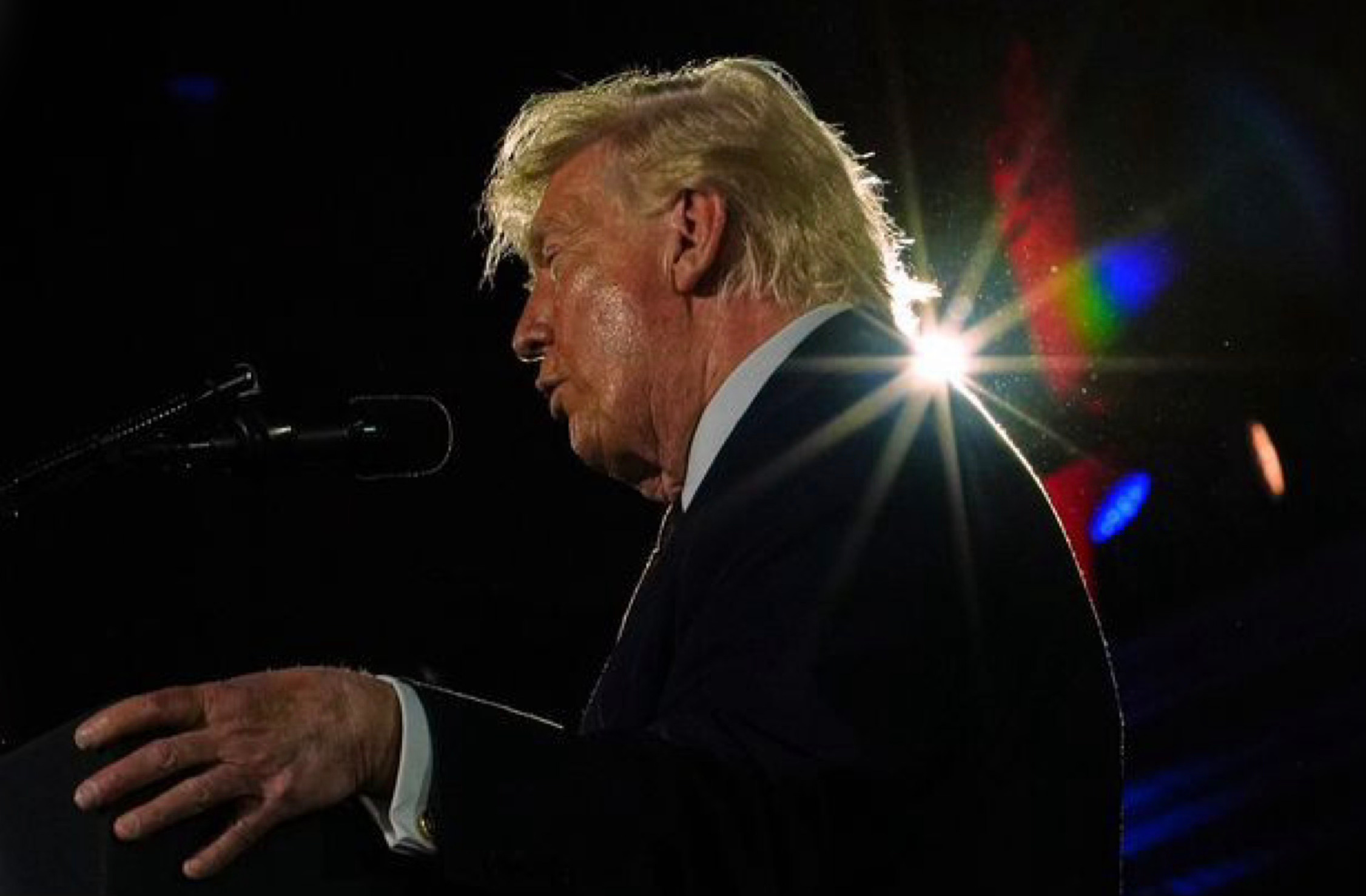
This striking photograph is a profile of Donald Trump, aged 79, standing at a podium at the NRCC annual fundraising event. A microphone extends toward him. Behind his head, a harsh, star-shaped burst of light fractures the frame. A rainbow chromatic aberration — a lens flare — cuts across the deep, surrounding blackness. His hand is caught mid-gesture, slightly awkward, hovering above the wood. His face is partially in shadow, closed off, the skin textured and heavily made-up.
This is not a man illuminated but a figure constructed by light.
The aesthetic is immediately remarkable, and deeply familiar. The light is not natural; it overwhelms rather than reveals. The rainbow flare introduces a visual distortion, rendering the palette synthetic, almost theatrical. It evokes the gritty, neon-lit artificiality of 1970s disco-era New York — the world from which Trump first emerged. He was one of the first patrons of Studio 54, a regular in a venue where, as founder Ian Schrager noted, he “never saw Donald Trump dance... he was a serious guy” (Far Out Magazine, 2026). He stood in the flashing lights, absorbing the energy of the room without participating in its joy. That same cheap, gilded aesthetic of late-stage American excess is captured here. It is the visual equivalent of a dying vision of bloated American capitalism trying to distract itself with strobe lights.
But the longer you look at the image, the more the unease deepens. The subject is partially obscured. The image is fragmented by the flare. The surrounding darkness isolates him entirely from any physical context. He appears not quite real, not fully anchored, suspended somewhere between physical presence and digital projection. This visual distortion mirrors a profound internal dislocation. We are looking at a man descending into his own warped, ersatz reality.
Zoom in on the physicality. The hand gesture is ambiguous, disconnected from any clear communicative intent. The profile is rigid. There is a profound disconnect between the body and its environment: movement without clarity, expression without grounding. It is performance overtaking presence.
This is the inevitable culmination of a life lived entirely within the spectacle. In 1967, the French theorist Guy Debord described a society where “the tangible world is replaced by a selection of images which exist above it, and which simultaneously impose themselves as the tangible par excellence” (Buxton, 2026). Trump is the ultimate product of this media age. He is a man who spent a decade on The Apprentice building a completely fabricated persona. As John D. Miller, the former chief marketing officer for NBC who helped launch the show, admitted: “I want to apologize to America. I helped create a monster... The persona we created for Trump was very much exaggerated for the marketing of the show” (Miller, 2024).
Trump has spent so long living inside this manufactured image that the performance has consumed the man. There is no “real” Trump left behind the podium. He exists only when illuminated by the artificial glare of the cameras. He is not simply in the light; he appears to exist only within a system of projection.
This brings us to the most delicate, and most terrifying, aspect of the photograph. It captures a man who can no longer distinguish the performance from reality. The cognitive decline is more than a medical failing; it is a structural collapse.
The signs of this decline are no longer hidden. Dr. John Gartner, a prominent psychotherapist who taught at Johns Hopkins University Medical School, has stated bluntly: “There is absolutely no doubt Trump has dementia. He is losing his capacity for coherent speech and has difficulty even finishing a sentence” (Gartner, 2025). Gartner points to Trump’s increasing use of phonemic paraphasia — substituting sounds for words he can no longer remember, such as “mishiz” for missiles or “Chrishus” for Christmas.
We saw this cognitive drift on the global stage during his September 2025 address to the United Nations. What was billed as a major foreign policy speech devolved into a “rambling, incoherent homily” where he warned European nations of a “double-tailed monster” and falsely insisted he had “ended seven wars” (Perry, 2025). Dr. Harry Segal of Cornell University noted that Trump’s abrupt decision to stop a town hall and play DJ for 30 minutes was “yet another sign of his accelerating cognitive decline” (Segal, 2024).
The photograph captures this exact state of being. It suggests a growing dislocation, a man increasingly at home in constructed realities, and less anchored in the shared one. He is a man trapped in his own broadcast.
Return to the light in the image. It inverts the usual symbolism. The light here does not clarify; it distorts. It does not reveal truth; it fractures the frame. It is exposure without understanding, illumination without coherence.
We are left with a closing image that is as tragic as it is dangerous. We see not a leader grounded in reality, but a figure isolated in the dark, suspended within a world of his own making — lit from behind, and increasingly difficult to see clearly.
Or support us with a one-off tip → Buy Me a Coffee
References
Buxton, N. (2026) ‘Against the Stage’, Transnational Institute, 3 February. Available at: https://www.tni.org/en/article/against-the-stage [Accessed 26 March 2026].
Far Out Magazine (2026) ‘How Donald Trump became the first person to go to Studio 54’, 24 March. Available at: https://faroutmagazine.co.uk/donald-trump-first-person-studio-54/ [Accessed 26 March 2026].
Gartner, J. (2025) Interviewed by D. Hembree for ‘The Press Has Sanewashed Trump’s Dementia and Mental Illness’, MindSite News, 1 April. Available at: https://mindsitenews.org/2025/04/01/sanewashed-trump-dementia-and-mental-illness/ [Accessed 26 March 2026].
Miller, J. D. (2024) Quoted in ‘Former NBC Marketing Boss Apologizes For Creating The Trump Illusion: I Helped Create A Monster’, TVRev, 17 October. Available at: https://www.tvrev.com/news/former-nbc-marketing-boss-apologizes-for-creating-the-trump-illusion-i-helped-create-a-monster [Accessed 26 March 2026].
Perry, D. (2025) ‘PERRY: Trump’s UN rant was a study in delusion, contempt and disinformation’, Sentinel Colorado, 23 September. Available at: https://sentinelcolorado.com/opinion/perry-trumps-un-rant-was-a-study-in-delusion-contempt-and-disinformation/ [Accessed 26 March 2026].
Segal, H. (2024) Quoted in ‘Trump’s abrupt decision to play DJ, a sign of accelerating cognitive decline says Cornell expert’, Cornell University College of Arts & Sciences, October. Available at: https://as.cornell.edu/news/trumps-abrupt-decision-play-dj-sign-accelerating-cognitive-decline-says-cornell-expert [Accessed 26 March 2026].