
A Farewell to Nothing: The Loveless Landslide and What It Always Meant

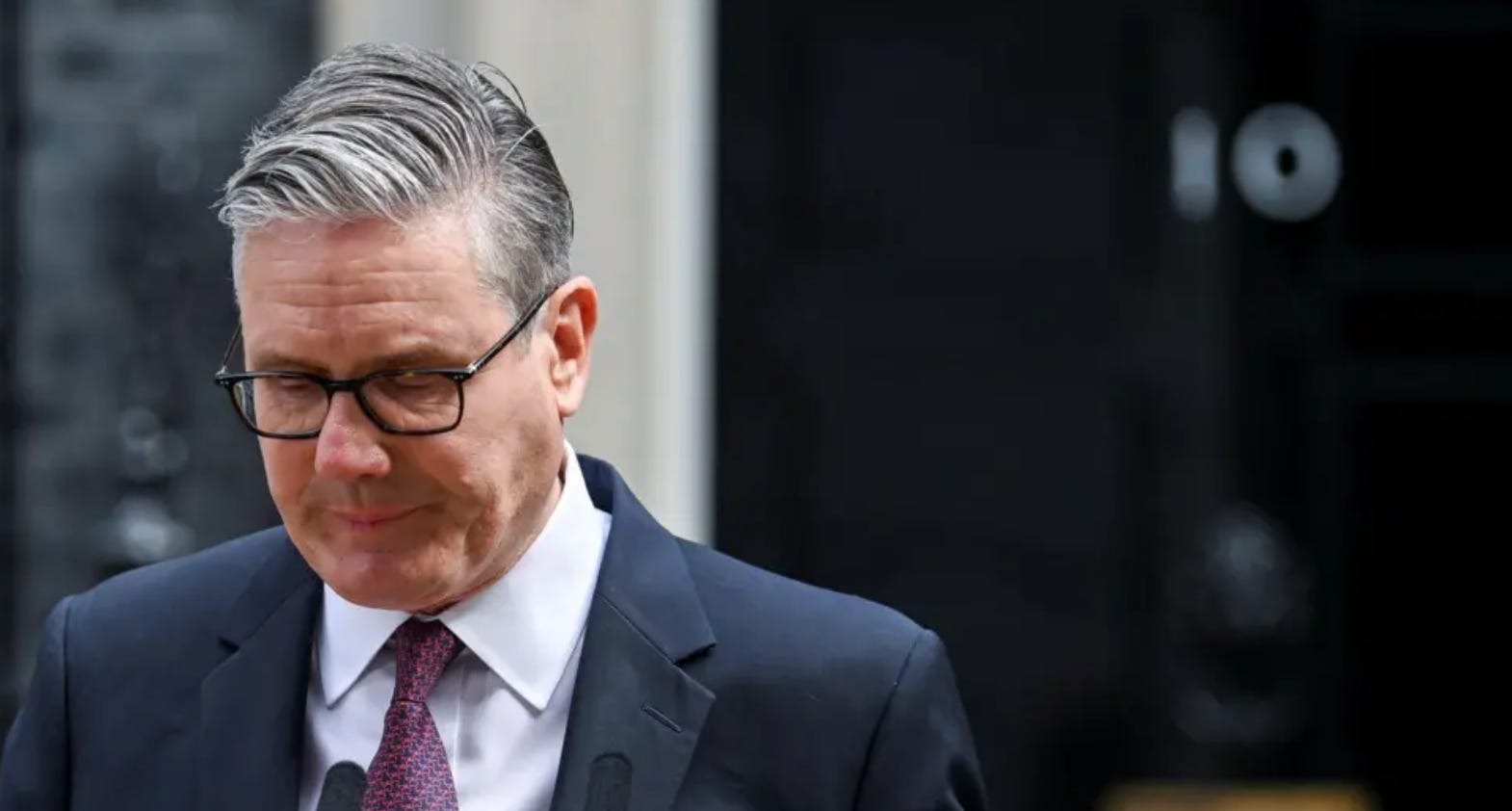
On the morning of 22 June 2026, Keir Starmer stood at a lectern outside Downing Street in the blazing sunshine and announced his resignation (BBC News, 2026a). In the background, the strains of Beethoven’s Ode to Joy could be heard drifting over the gates. It was played not by his team to herald a triumphant exit, but by a protester determined to soundtrack his defeat. Starmer’s voice cracked with emotion as he spoke of his wife and children, the toll of the office, and his belief that he was leaving behind a Britain “far stronger and fairer” than the one he inherited. We do not agree.
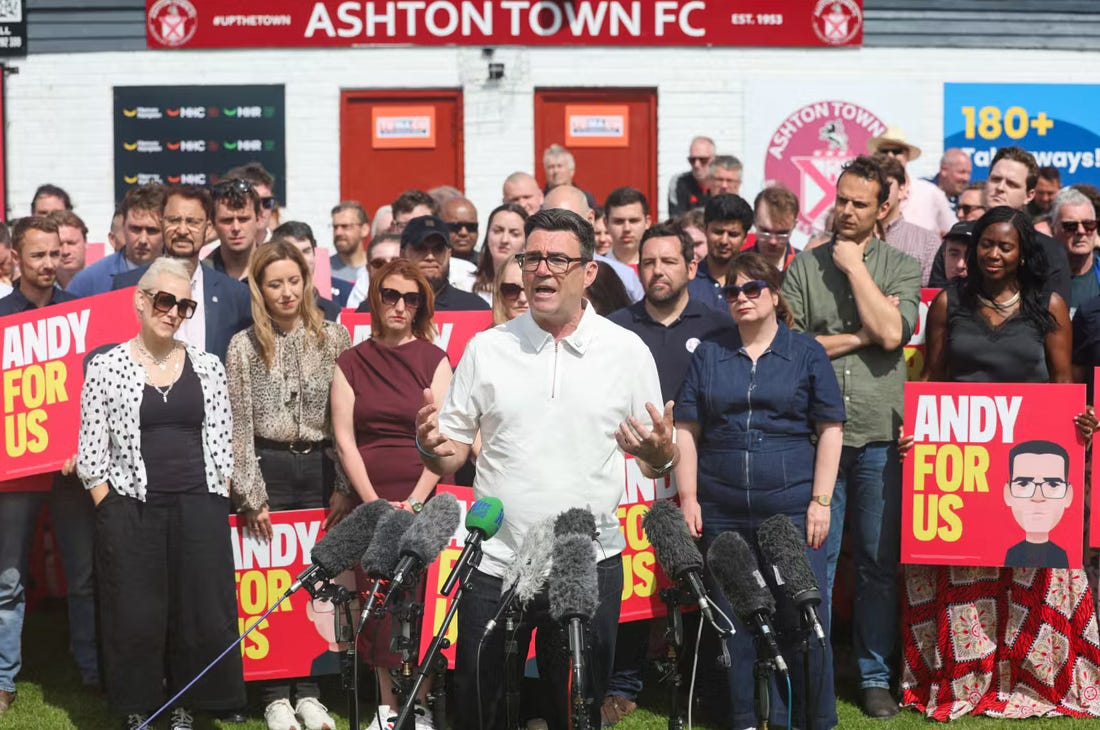
The central irony of Starmer’s departure is not that he was stabbed in the back by a false friend. He is not the victim of the same treachery he inflicted on others. Andy Burnham, whose victory in the Makerfield by-election triggered the final collapse of Starmer’s authority, did not lie to him or scheme against him in the shadows. He stood in an election, won it, and let the numbers speak for themselves (BBC News, 2026b). The parliamentary party did not plot a midnight coup; they withdrew their confidence openly, in broad daylight, because the political calculus demanded it. The difference matters enormously, and it is worth sitting with. Jeremy Corbyn was deceived by a man who pretended to share his vision and signed up to his programme in order to dismantle it from within. Starmer was simply found out. The machinery of power he thought he controlled ran out of road, and when he looked behind him, there was no one left willing to prop it up. That is not a tragedy of betrayal, but of emptiness.
The Usurper and His Pledges
To understand the end of the Starmer project, one must remember how it began. He won the Labour leadership in 2020 by making ten explicit, socialist pledges to a traumatised membership (Campaign for Labour Party Democracy, 2020). He promised to bring rail, mail, energy, and water into public ownership. He promised to abolish universal credit, scrap tuition fees, defend free movement, and increase income tax for the top five per cent. He promised to oppose the two-child benefit cap. He offered the membership exactly what they needed to hear: the promise that they could have Corbynism without Corbyn, that they did not have to abandon their principles to win power. It was a masterclass in political deception, and it worked.
He wore those pledges like a costume, and the moment the leadership was secured, he began systematically stripping them off. It was not a pivot to the centre; it was a purge. Corbyn lost the whip in November 2020, ostensibly over his response to the Equality and Human Rights Commission’s antisemitism report, but the effect was to remove the most prominent symbol of the left from the parliamentary party entirely. Rebecca Long-Bailey was sacked from the shadow cabinet over a reposted article. Hundreds of members were suspended or expelled in a relentless drive to remake the party in Starmer’s own managerial image. The internal party machinery that had once been used to protect the left was repurposed, methodically and without apology, to destroy it.
It is important to be precise about what this was. Starmer actively lied to the people who elected him about his intentions, made specific commitments he had no intention of honouring, and then used the apparatus of the party to silence those who objected. As Grace Blakeley noted, Starmerism was never really about winning elections; it was about destroying the Labour left (Blakeley, 2026). The elections were merely the vehicle.
The contrast with how he was ultimately removed is deliberate and precise. Starmer schemed his way to the top, weaponising the party’s internal mechanics against his ideological opponents, lying to the membership about his intentions. But he was brought down not by a counter-scheme, not by a false friend wielding a knife, but by the simple, democratic withdrawal of confidence. Burnham did not pretend to be his ally. He stood in a by-election and won. The parliamentary party looked at the polling, looked at the May 2026 local election results, looked at each other, and made a collective judgment. The irony is not that Labour behaved as Starmer did. It is that the system he thought he had mastered eventually consumed him anyway, through the most ordinary of political mechanisms. He was not betrayed. He was evicted.
The Man With No Plan and No Conviction
When Labour won its landslide in July 2024, it did so without a governing plan. A staffer, expecting a blitz of major policies after the victory, asked where the plan was and was told there did not appear to be one (Walker, 2026). The historian Anthony Seldon delivered a devastating three-part verdict on Starmer’s premiership: he never worked out what the job of prime minister was, he never knew what he wanted to do, and he did not know who to appoint (Walker, 2026). The political scientist David Runciman pointed out that Labour had two years to prepare for government after Liz Truss destroyed the Conservative brand, and yet they did not prepare (Walker, 2026). “If your reason for being in government is ‘we’re more competent than the other people’,” Runciman observed, “that doesn’t work when the shit hits the fan.”
The Guardian’s Peter Walker, writing on the day of Starmer’s resignation, noted that no modern prime minister had looked so well-suited to the job on paper and been so fundamentally inept in practice (Walker, 2026). The parallel with Boris Johnson is instructive here, and it is emphatically not a parallel in character. Johnson was charismatic, anarchic, and constitutionally incapable of seriousness. Starmer was the opposite on every count: methodical, humourless, and apparently incapable of anything other than seriousness. The parallel is in pattern. There was the same revolving door of aides, the same repeated and fruitless reorganisations of the top team, and the same creeping realisation — dawning too late in both cases — that the problem was not the staff, but the man at the centre. In both cases, the prime minister functioned less as a leader than as a figurehead, with real decisions made elsewhere and the occupant of the office unable to impose coherence on the chaos surrounding them.
This chaos was epitomised by the disastrous appointment of Peter Mandelson as ambassador to Washington. Mandelson had failed his security vetting, yet the Foreign Office overruled its own officials to push the appointment through (The New York Times, 2026). It was, from the beginning, an act of political vanity masquerading as statecraft. Mandelson was a figure from a previous era of Labour politics, a man whose instincts were formed in the 1990s and whose judgment had never been reliably sound. When a trove of Jeffrey Epstein-related documents revealed supportive emails Mandelson had sent to the convicted paedophile, the position became untenable. Mandelson was sacked, and Starmer was forced to stand before Parliament and admit he had made the “wrong judgment” (AP News, 2026). He then attempted to blame Foreign Office officials and fired the top civil servant Olly Robbins in the process. It was a performance that managed to be simultaneously dishonest and incompetent. Morgan McSweeney, the chief of staff who had facilitated the purge of the left from his perch at the Labour Together thinktank, took the fall and resigned. The purge, it turned out, devoured its own architects.
But the defining illustration of Starmer’s lack of conviction was his handling of the two-child benefit cap. Scrapping the cap had been one of his original ten pledges, a commitment made explicitly and in writing to the membership that elected him. Yet in July 2024, he suspended seven of his own MPs for voting to do the very thing he had promised, insisting the country could not afford it (Financial Times, 2024). The seven MPs were treated as rebels, as troublemakers disrupting the smooth operation of the new government. Starmer’s allies briefed against them. The message was clear: fall in line, regardless of what was promised, regardless of what is right.
Eighteen months later, under mounting backbench pressure, with his child poverty taskforce recommending the move and his own political position deteriorating by the week, Rachel Reeves announced the cap would be scrapped (The Independent, 2025). Starmer, entirely without irony, called it his “proudest moment as prime minister” (BBC News, 2025a). The BBC’s political editor Chris Mason noted the obvious: “it has taken him almost 18 months in office to make this announcement and in that year and a half he kicked seven Labour MPs out of his parliamentary party for voting for the very thing he is now so passionately endorsing” (BBC News, 2025a). As Mason also observed, affordability for a government is rarely an absolute; it is a judgment about what is a priority at any given moment. Starmer punished his own MPs for doing the right thing, waited until the political pressure became unbearable, did the politically necessary thing when he had no choice left, and then claimed it as a personal moral crusade. That is the Starmer method in miniature: governing not by conviction, but by crisis management, and then rebranding the crisis as leadership.
Gaza and the Silence That Defines Him
Starmer will undoubtedly be praised by historians for his stance on Ukraine. He will be commended for his commitment to NATO, for the seriousness with which he treated Russian aggression, and for maintaining the cross-party consensus on support for Kyiv. We will not take that from him. But we will hold the other side of the ledger alongside it, and we will not allow the Ukraine record to serve as a shield behind which the Gaza record is quietly buried.
In October 2023, during an interview on LBC, Starmer stated that Israel had “the right” to withhold power and water from the civilian population of Gaza (LBC, 2023). He later attempted to clarify his remarks, claiming he only meant Israel had the right to defend itself, but the damage was permanent and the clarification was unconvincing. The original statement was not a slip of the tongue. It was a window into a set of assumptions that shaped his entire approach to the conflict: that Israeli state violence was categorically different from other forms of state violence, that the rules of international humanitarian law applied selectively, and that Palestinian civilian suffering was a regrettable but essentially secondary concern.
The political consequences were severe. Labour suffered a structural collapse in the Muslim vote at the 2024 general election, losing seats in constituencies it had held for decades, and by early 2026 Labour sources were privately acknowledging that the damage was permanent rather than temporary (The Guardian, 2026a). But the moral consequences are what we are more interested in here. The contrast between Starmer’s eloquence on Ukraine and his equivocations on Gaza is not a paradox; it is a policy. He chose which suffering to name, which international laws to champion, and which to leave unnamed. He chose which civilians deserved his public solidarity and which did not.
When he stood outside Downing Street to announce his resignation, his speech contained no words about Gaza. Not one. By the time his government pushed through the proscription of Palestine Action, 56,500 people had been killed in Gaza, according to the territory’s Hamas-run health ministry (BBC News, 2025b). He said nothing. That silence is the loudest part of his record, and it will not be forgotten.
Subscribe to Notes From Plague Island and join our growing community of readers and thinkers.
The Authoritarian Streak and Protest as Terrorism
In July 2025, the House of Commons voted 385 to 26 to proscribe the direct-action group Palestine Action as a terrorist organisation, bundling them alongside Maniacs Murder Cult, a white supremacist neo-Nazi organisation, and the Russian Imperial Movement, a white supremacist ethno-nationalist organisation (BBC News, 2025b). Under the new law, supporting the group became an offence punishable by up to fourteen years in prison. The Home Secretary who signed the order was Yvette Cooper. The prime minister who backed it was Keir Starmer. The justification offered was that Palestine Action had engaged in criminal damage and trespass at defence facilities. The legal category applied was terrorism.
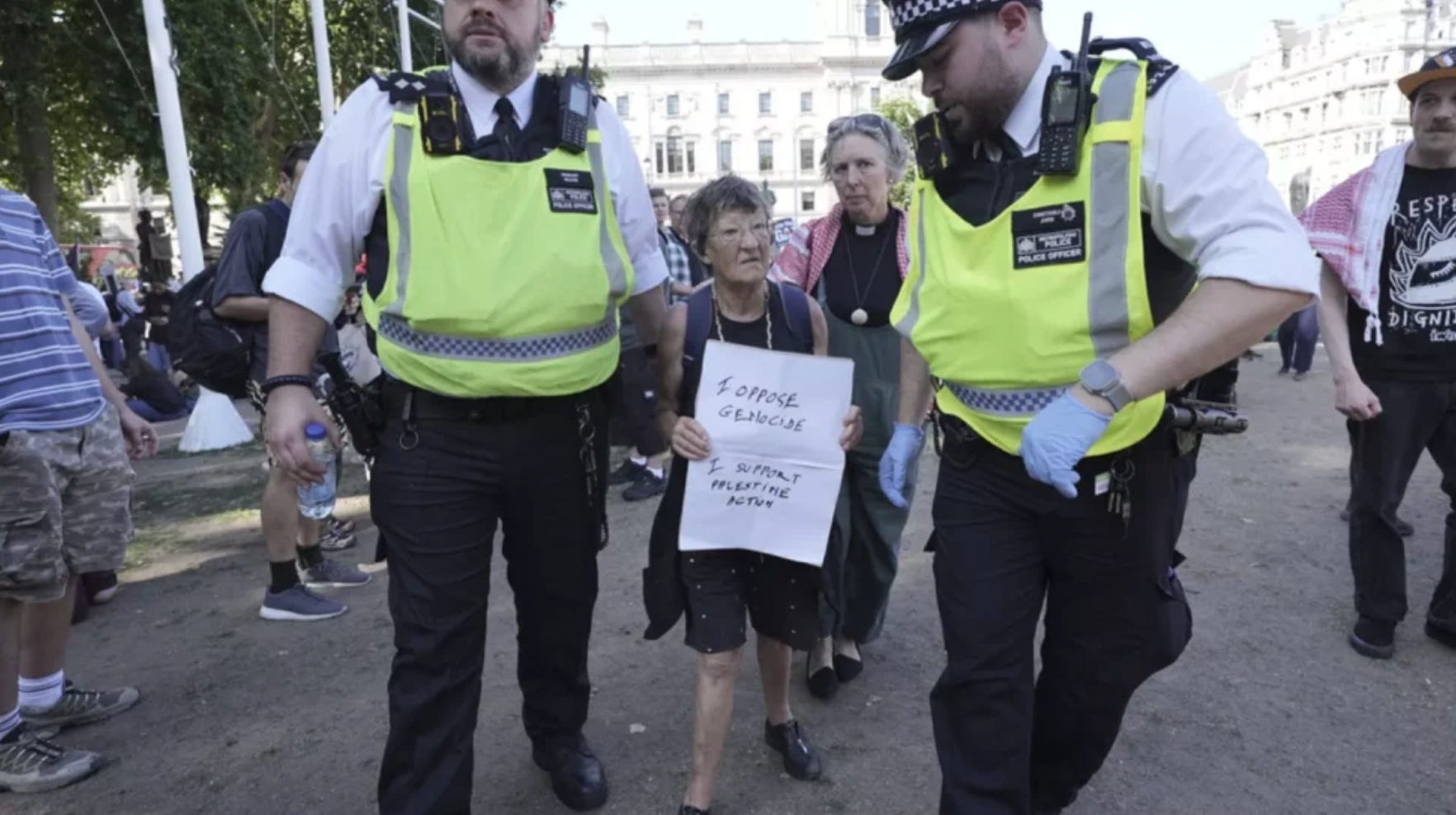
The consequences were immediate and draconian. At a single demonstration in September 2025, police arrested 890 people (Le Monde, 2025). In total, nearly 3,000 people were arrested under terror laws for holding signs or expressing support for the group. Among them were a Catholic priest, Father John McGowan, who told The Guardian that the home secretary should “for goodness sake, not call these people terrorists because they’re not terrorists,” and that “the focus should be on what the government isn’t doing for the Palestinians in Gaza and the West Bank” (The Guardian, 2025). Among them was a former army colonel, Chris Romberg, a veteran of the Falklands War and son of a Holocaust survivor, who told Byline Times that the government’s use of secret evidence and closed court proceedings was “what we would normally expect from an absolute dictatorship,” and asked simply: “Are these really the terrorists that the Government is supposed to be fighting?” (Byline Times, 2025). Among them was a 62-year-old blind man in a wheelchair, arrested and carried away at the Parliament Square protest on 9 August 2025. The images of these people being led away in handcuffs were as absurd as they were plain wrong (The Guardian, 2026b).
The High Court initially ruled the proscription unlawful on two grounds, finding that it violated human rights law and was inconsistent with the Home Secretary’s own policy. The government appealed. On 15 June 2026, just one week before Starmer resigned, the Court of Appeal upheld the ban, ruling the proscription lawful (The Guardian, 2026c). The ban stands. Yasmine Ahmed, the head of Human Rights Watch in the UK, said proscribing Palestine Action was “a grave abuse of state power and a terrifying escalation in this government’s crusade to curtail protest rights,” adding: “We expect this of authoritarian regimes like Russia or China, not a country like the UK that professes to believe in democratic freedoms” (BBC News, 2025b). Amnesty International, in an open letter to MPs before the vote, warned of “a grave misuse of anti-terror law” and expressed concern about the harmful implications for free speech rights more broadly (Amnesty International, 2025). Human Rights Watch, in a comprehensive report published in January 2026, documented the broader pattern of protest repression across the UK (Human Rights Watch, 2026).
This was the continuation of a pattern that began long before Palestine Action was proscribed, a pattern that stretched back to the crackdown on Extinction Rebellion and Just Stop Oil. Environmental activists were handed the longest sentences ever given for non-violent protest in British history — Roger Hallam of Just Stop Oil received five years for his role in planning a motorway blockade, a sentence that appeal courts later acknowledged was “manifestly excessive” and reduced to four years (The Guardian, 2024). Trudi Warner, a retired social worker, was charged with contempt of court simply for holding a sign outside a courtroom informing jurors of their right to acquit. Ninety-two civil society organisations wrote to Yvette Cooper in July 2024 warning against “the steady erosion of the right to protest” (The Guardian, 2024b).
Starmer’s government responded by introducing the Crime and Policing Bill 2025, which proposed further restrictions including a blanket ban on face masks at protests. The man who had built his career on human rights law, served as Director of Public Prosecutions, who had spoken throughout his leadership campaign about the importance of civil liberties, presided over the most sustained assault on the right to peaceful assembly in modern British history. If there is a more complete portrait of political hypocrisy available, we have not seen it.
The Miscalculation That Ended Everything
The tragedy of Keir Starmer is that he never understood the nature of his own victory. His central political bet was that he could govern simply by being perceived as better than the Tories. He assumed the left had nowhere else to go. He assumed the political centre was a stable, permanent foundation rather than a temporary coalition of people with no better option. And he believed, with a confidence that in retrospect looks almost delusional, that the 2024 landslide had wiped out the Conservatives for a decade, clearing the field entirely and leaving him free to govern from the centre without fear of challenge from either flank.
He never grasped what observers called the “loveless landslide” — a massive parliamentary majority built not on enthusiasm for Labour, but on sheer, desperate exhaustion with the Conservative Party. Two-thirds of the electorate did not vote for him. His share of the vote was 33.7 per cent: lower than Tony Blair’s in 1997, lower even than Jeremy Corbyn’s 40 per cent in 2017, and the lowest vote share for any party forming a post-war majority government. The seats came in enormous numbers because the vote was distributed efficiently across constituencies, not because the country had made a positive choice for what Labour was offering. He mistook the absence of viable alternatives for a genuine mandate, and he governed accordingly: without urgency, without vision, and without any apparent awareness that the patience of the electorate is not infinite.
The assumption that the Conservatives were finished for a decade was perhaps the most catastrophic miscalculation of all. It was the assumption that gave him permission to do nothing, to offer nothing, to be nothing beyond a functional contrast to the chaos that preceded him. If the Tories were gone for ten years, then there was no need to inspire anyone, honour the pledges, or take risks. He could simply manage the system and wait for the gratitude to arrive. The gratitude never arrived though, because it was never owed.
When the electorate realised they were being offered nothing but the joyless management of decline, they did not stay home in gratitude. They found other political homes, because other political homes existed. Reform UK surged on the right, hoovering up voters who had been told for years that there was no alternative to the two-party system. The Green Party surged on the left, offering the policies that Starmer had promised and abandoned. In the May 2026 local elections, Labour lost nearly 1,500 council seats — its fifth worst rate of loss for a governing party on record — and its twenty-seven-year hold on Wales, where the First Minister Eluned Morgan lost her own seat (AP News, 2026a; Rallings and Thrasher, 2026). With Starmer’s resignation, the UK had now seen seven prime ministers since 2016. He became the shortest-serving Labour prime minister in history.
The political centre is a waiting room. People sit in it when they have no better option, and they leave the very moment one appears. Starmer never understood this. He believed that if he could just manage the system competently, the public would accept the betrayal of his pledges, the authoritarian crackdowns, the moral vacuity of his foreign policy, and the absence of any coherent governing philosophy. He was wrong on every count. He won a country that didn’t want him, governed a country he didn’t understand, and leaves behind a legacy defined almost entirely by what should have been.
Or support us with a one-off tip → Buy Me a Coffee
References
Amnesty International (2025) ‘Open Letter to Members of the House of Commons and Peers of the House of Lords Regarding Palestine Action,’ 1 July. Available at: https://www.amnesty.org.uk/knowledge-hub/all-resources/open-letter-members-house-commons-and-peers-house-lords-regarding-palestine-action/ [Accessed 22 June 2026].
AP News (2026a) ‘Partial results show losses for Starmer’s Labour in UK polls,’ 8 May. Available at: https://apnews.com/article/britain-elections-labour-starmer-reform-farage-f17a122a0cfcc3595ef01f142517b0b6[Accessed 22 June 2026].
AP News (2026b) ‘Starmer says Foreign Office hid Mandelson’s failed security checks,’ 20 April. Available at: https://apnews.com/article/starmer-mandelson-epstein-parliament-statement-1f434ae174c37ae8a1a0c11204573f83[Accessed 22 June 2026].
BBC News (2025a) ‘Starmer could have scrapped child benefit cap last year — why did he wait?,’ 27 November. Available at: https://www.bbc.com/news/articles/cvgqp71p2nqo [Accessed 22 June 2026].
BBC News (2025b) ‘MPs approve plan to proscribe Palestine Action as terrorist group,’ 2 July. Available at: https://www.bbc.com/news/articles/c2d0j0ljdzko [Accessed 22 June 2026].
BBC News (2026a) ‘Starmer quits as Labour leader and paves way for contest for new prime minister,’ 22 June. Available at: https://www.bbc.com/news/articles/cdxd00lg599o [Accessed 22 June 2026].
BBC News (2026b) ‘Andy Burnham says his Makerfield by-election win could be a turning point,’ 19 June. Available at: https://www.bbc.com/news/articles/cdrpxvz61vko [Accessed 22 June 2026].
Blakeley, G. (2026) ‘Keir Starmer and the Purge That Devoured Its Architects,’ Zeteo, 9 February. Available at:

[Accessed 22 June 2026].
Byline Times (2025) ‘Colonel Turned Campaigner: Ex-Commando Condemns “Dictatorial” Crackdown After Palestine Action Arrest,’ 12 August. Available at: https://bylinetimes.com/2025/08/12/colonel-turned-campaigner-ex-commando-condemns-dictatorial-crackdown-after-palestine-action-arrest/ [Accessed 22 June 2026].
Campaign for Labour Party Democracy (2020) ‘Keir Starmer’s 10 Pledges,’ 12 October. Available at: https://www.clpd.org.uk/resource/keir-starmer-10-pledges/ [Accessed 22 June 2026].
Financial Times (2024) ‘Keir Starmer set to face first rebellion over two-child benefit cap,’ 11 July. Available at: https://www.ft.com/content/two-child-benefit-cap-labour-rebellion [Accessed 22 June 2026].
Human Rights Watch (2026) ‘Silencing the Streets: The Right to Protest Under Attack in the United Kingdom,’ 7 January. Available at: https://www.hrw.org/report/2026/01/08/silencing-the-streets/the-right-to-protest-under-attack-in-the-united-kingdom [Accessed 22 June 2026].
LBC (2023) ‘Israel “has the right” to withhold power and water from Gaza, says Sir Keir Starmer,’ 11 October. Available at: https://www.lbc.co.uk/article/sir-keir-starmer-hamas-terrorism-israel-defend-itself-DWzhBf_2/ [Accessed 22 June 2026].
Le Monde (2025) ‘UK police arrest 890 people at Palestine Action demonstration,’ 7 September. Available at: https://www.lemonde.fr/en/united-kingdom/article/2025/09/07/uk-police-arrest-890-people-at-palestine-action-demonstration_6740000_143.html [Accessed 22 June 2026].
Rallings, C. and Thrasher, M. (2026) ‘How Labour fell to historic defeat,’ Local Government Chronicle, 13 May. Available at: https://www.lgcplus.com/politics/governance-and-structure/rallings-thrasher-how-labour-fell-to-historic-defeat-13-05-2026/ [Accessed 22 June 2026].
The Guardian (2024a) ‘Five Just Stop Oil supporters jailed over protest that blocked M25,’ 18 July. Available at: https://www.theguardian.com/environment/article/2024/jul/18/just-stop-oil-m25-protest-prison-sentences [Accessed 22 June 2026].
The Guardian (2024b) ‘Campaign groups call on Home Office to stop “steady erosion” of protest rights,’ 29 July. Available at: https://www.theguardian.com/law/article/2024/jul/29/campaign-groups-call-on-home-office-to-stop-steady-erosion-of-protest-rights [Accessed 22 June 2026].
The Guardian (2025) ‘”I’m proud to have made this stand”: over-60s arrested at Palestine Action ban protest explain their decision,’ 16 August. Available at: https://www.theguardian.com/world/ng-interactive/2025/aug/16/im-proud-to-have-made-this-stand-over-60s-arrested-at-palestine-action-ban-protest-explain-their-decision [Accessed 22 June 2026].
The Guardian (2026a) ‘Labour anxiety and accusations after big shift in Muslim vote,’ 28 February. Available at: https://www.theguardian.com/politics/2026/feb/28/labour-green-party-muslim-voters-gorton-denton [Accessed 22 June 2026].
The Guardian (2026b) ‘Arrested retirees “vindicated” by ruling against Palestine Action proscription,’ 16 February. Available at: https://www.theguardian.com/uk-news/2026/feb/16/arrested-retirees-vindicated-by-ruling-against-palestine-action-proscription [Accessed 22 June 2026].
The Guardian (2026c) ‘Ban on Palestine Action was lawful, court of appeal rules,’ 15 June. Available at: https://www.theguardian.com/uk-news/2026/jun/15/ban-on-palestine-action-was-lawful-court-of-appeal-rules [Accessed 22 June 2026].
The Independent (2025) ‘Starmer under mounting pressure to lift two-child benefit cap,’ 25 September. Available at: https://www.independent.co.uk/news/uk/politics/starmer-two-child-benefit-cap-labour-b2621455.html [Accessed 22 June 2026].
The New York Times (2026) ‘Mandelson Became Britain’s Ambassador to U.S. Despite Failing Vetting,’ 16 April. Available at: https://www.nytimes.com/2026/04/16/world/europe/peter-mandelson-epstein-starmer-security.html[Accessed 22 June 2026].
Walker, P. (2026) ‘Frozen by the challenges of power: how Starmer turned triumph into tragedy,’ The Guardian, 22 June. Available at: https://www.theguardian.com/politics/ng-interactive/2026/jun/22/frozen-by-the-challenges-of-power-how-starmer-turned-triumph-into-tragedy [Accessed 22 June 2026].
Corbyn wasn't betrayed either, he betrayed the country with his support of brexit. Burnham better undo it
The country needed leadership and, as you point out, KS's renationalisation pledges suggested he would take on the corporate moneybags like a dour but meticulous lawyer committed to socialism and human rights. I think you are far too kind to him. He has managed to make Liz Truss seem like a caring school mistress promoted above her competence. KS is morally contemptible...